English
 Français
 Türkçe
 Español
 Русский

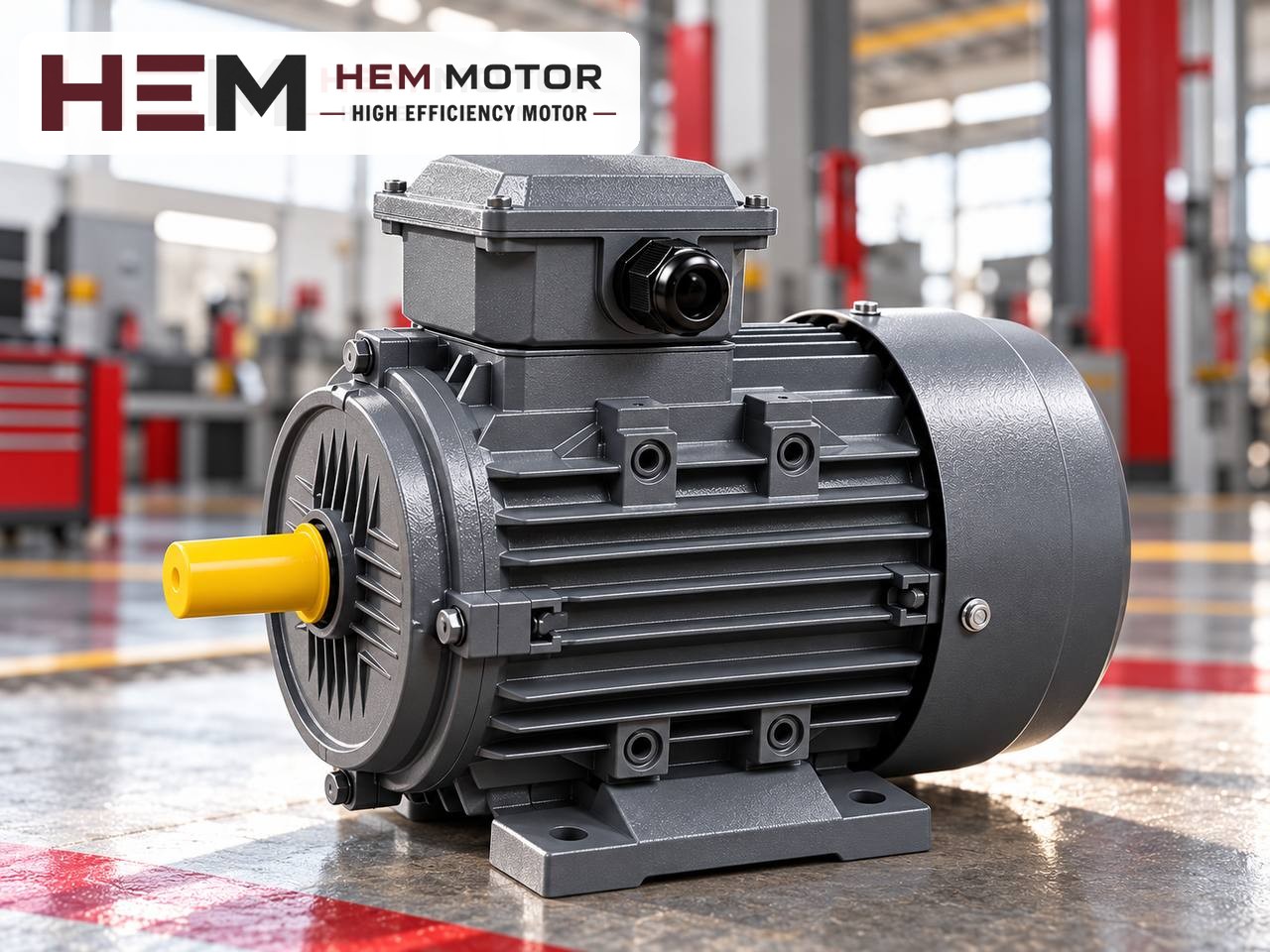

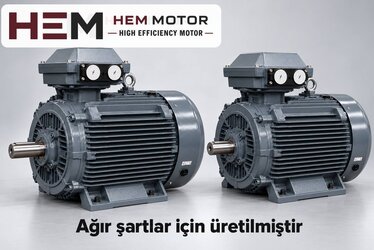
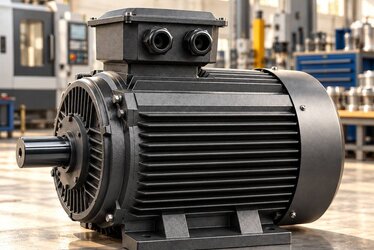
A jaw crusher is the machine that breaks large rock at the first stage in quarries and crushing-screening plants. The moving jaw is pushed towards the fixed jaw by an eccentric shaft; the stone is crushed between the two jaws and drops to the discharge opening below. There are large flywheels at both ends of the eccentric shaft, and one of them usually also serves as the belt pulley. This is the point most often overlooked when replacing the motor: the motor not only does the crushing work but also has to accelerate these heavy flywheels. In this article we explain the load the flywheel places on the motor, the starting conditions, the limits of a standard squirrel-cage motor and the information needed when ordering.
Why is there a flywheel and what does it load onto the motor?
In a jaw crusher the crushing load is not uniform. On every turn of the eccentric shaft the jaw closes once; the load rises at the moment of closing and falls almost to zero while opening. The flywheels smooth this fluctuation: they store energy during opening and transfer it to the stone at the moment of closing. In this way the motor carries a load close to the average, not the peak value of each crushing stroke.
The price is paid at start-up. The inertia of the flywheels is large, and the motor has to bring this mass from standstill to operating speed. The starting time is noticeably longer than for a fan or pump running unloaded. Throughout this time the motor draws a high starting current and the windings heat up. That is why motor selection for a jaw crusher is not made by looking at continuous power alone; starting time and the starting method are part of the same decision.
Starting conditions: empty jaw, full jaw
In normal operation jaw crushers start with an empty jaw; feeding begins after the crusher reaches operating speed. The problem arises after unexpected stops. In a power cut or emergency stop, the crushing chamber can remain full of stone.
- Starting with a full chamber: A standard motor should not be expected to accelerate a jaw jammed with stone together with the flywheels. Most crusher manufacturers require the chamber to be emptied in such a case before starting. This operating rule must be kept when the motor is changed as well.
- Starting method: Star-delta starting lowers the current but also lowers the starting torque; on a machine with heavy flywheels acceleration takes longer and a current surge may be seen at the changeover. The choice between direct-on-line, soft starter or frequency inverter is made on site by an engineer, depending on flywheel inertia, how well the grid or generator withstands the starting current, and the plant layout.
- Protection suited to the starting time: With a long start, the motor protection device must not trip during starting, yet must protect the motor in a real jam. The protection class and setting are selected by the plant electrician according to the measured starting time.
- Sites running on generators: In quarries far from the grid, the starting current can strain the generator's capacity. In that case the starting method is assessed together with the generator power.
Knowing the limits of a standard motor
Some large jaw crushers were originally fitted with a slip-ring (wound-rotor) motor. These motors provide high starting torque at low current by means of resistors connected to the rotor circuit. On such a machine, fitting a standard squirrel-cage motor in place of the slip-ring motor does not count as a like-for-like replacement. Starting torque, starting time and grid impact must be recalculated and, if necessary, planned together with a soft starter or frequency inverter. If you see a second group of values on the old motor's nameplate, such as rotor voltage and rotor current, the motor is most likely a slip-ring type; be sure to state this in the order.
Likewise, two-speed motors, motors with special shafts and brake motors are not the same as a standard motor. If you come across the nameplate of such a motor, assume a special motor is needed, and ask by sending the nameplate and technical information.
Belt drive, pulley and slide rails
On a jaw crusher the motor is usually B3 foot-mounted on slide rails (tensioning rails) and turns the flywheel-pulley with V-belts. Belt tension is adjusted by sliding the motor on the rails.
- Side load: Belt tension places a lateral force on the motor shaft and front bearing. The pulley should be fitted as close to the shaft end as possible; because a small motor pulley increases the side load, you should not go below the pulley diameter specified by the manufacturer.
- Speed and pulley ratio: The eccentric shaft speed of the crusher is the result of the motor speed and the pulley ratio. If the old motor is 6-pole, fitting a 4-pole motor in its place changes the crusher speed; the number of poles is not changed without recalculating the pulley ratio.
- Frame and shaft match: The hole spacing of the slide rails and the motor shaft height must be compared with the new model. If the frame code is different, the rails need adapting. Dimensions are given in the 2D technical drawings and the 2026 catalogue.
Mounting arrangements are offered according to the frame as B3, B5, B14, B34, B35 and vertical V1/V3/V5/V6/V15; the flange size is confirmed with the order. The most common arrangement on crusher drives is B3.