English
 Français
 Türkçe
 Español
 Русский




In an asphalt plant, the mixer motor drives the twin-shaft mixer (pugmill) that makes the hot mix homogeneous within a short time. Two conditions are decisive for this motor: the heat radiating from the mixer body and the hot aggregate, and the load that changes rapidly between empty and full with every batch. Motor selection is therefore not only about power; it also means placing the motor away from the hot zone in a well-ventilated position, getting the gearbox connection right and being prepared for starting with a full mixer.

The drive arrangement of an asphalt mixer
In batch asphalt plants, the mixer consists of two parallel shafts carrying arms and paddles. The two shafts turn in opposite directions; aggregate, filler and bitumen are mixed by this motion. The drive is usually one of two arrangements:
- Single motor and timing gears: One motor drives one shaft through a belt and gearbox; the second shaft turns in the opposite direction via the timing gears between the two shafts.
- Two motors and two gearboxes: Each shaft is driven by its own motor and gearbox; the shafts are still linked to each other by timing gears.
In both arrangements the motor is connected to the mixer not directly but through a gearbox or a belt-gearbox combination. That is why, when replacing the motor, the gearbox input connection and pulley arrangement are as important as power.
In continuous (drum mix) plants mixing takes place inside the drum; if there is no separate mixer motor, the assessment in this article does not apply to the drum drive.
Hot environment: where should the motor be?
The asphalt mix arrives at the mixer at high temperature. The mixer body, bitumen lines and the area around the hot aggregate screen heat up. What matters for the motor is the temperature of its own cooling air: the motor is cooled by the air drawn in by its fan. The hotter this air, the hotter the motor's winding becomes.
- Position: The motor should be positioned so that it does not touch the mixer body and hot lines directly and stays outside enclosed compartments where hot air accumulates. A standard motor is not placed inside the hot zone.
- Ventilation: Exhausting air from enclosed areas on the mixer floor lowers the temperature around the motor.
- Heat conduction: The connection between motor and gearbox and the base can carry heat from the hot body to the motor; adapter parts and base layout are checked with this in mind.
- Sun and rain: Most plants are outdoors. A canopy over the motor that does not block the fan airflow reduces body temperature in summer sun and keeps rain off.
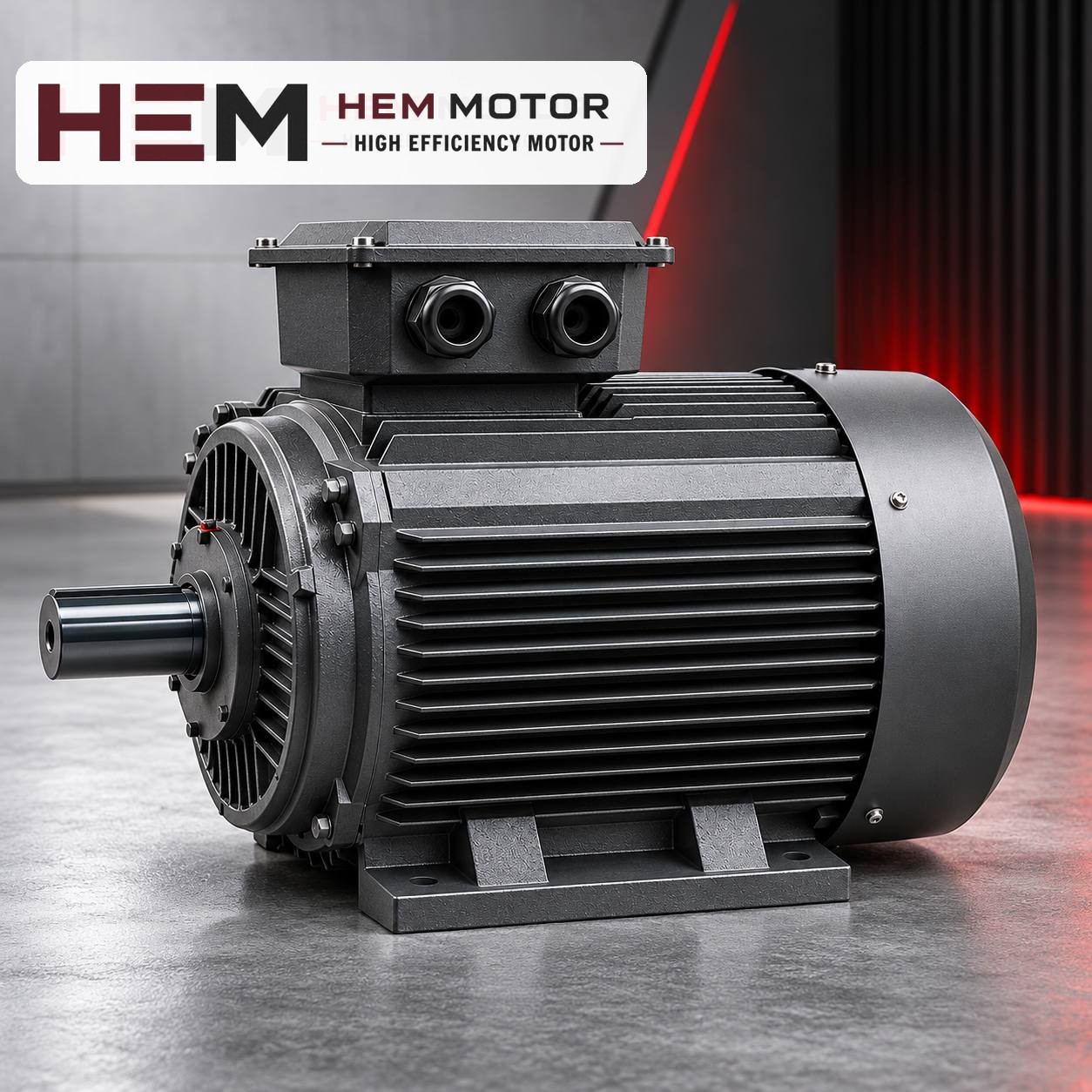
The HEM Motor models on sale have IP55 protection and class F insulation. The ambient temperature where the motor will run should be stated in the order; if it is above standard values, motor selection is assessed accordingly. A duty that involves running directly in hot gas or right next to a hot body needs a special motor; this may fall outside the scope of the standard series in HEM Motor's 2026 catalogue. Consult us with the application details.
Variable load: from batch to batch
In a batch plant the mixer works in a cycle: while it runs empty, aggregate is discharged in, dry mixing is done, bitumen is sprayed, wet mixing is done and the gate opens to discharge the mix. This cycle repeats with every batch. For the motor, the load changes as follows:
- The load is low while running empty.
- The load rises quickly as aggregate is discharged in.
- When bitumen is added the mix becomes heavier and torque fluctuates as its consistency changes.
- The load drops again at discharge.
With this kind of fluctuating load, the winding temperature depends more on the cycle average than on the highest momentary load. Still, peak loads grow if the mix has cooled, the share of coarse aggregate has increased or the batch weight has been raised. Raising batch weight to increase capacity can push the motor and gearbox beyond their design limits; this decision should be made with the plant manufacturer's data.
Reading the load by measuring current
Measuring the mixer motor's current over one batch cycle is the most practical way to understand its real load. If the current often approaches or exceeds the rated current on the nameplate, batch weight, mix temperature and paddle wear should be checked. Worn paddles and arms can increase the load by making mixing harder.
Starting with a full mixer
A power cut or an emergency stop can leave the mixer full. As the mix cools, the bitumen stiffens and the shafts are practically locked. In that case the motor's starting torque works against a resistance far greater than in a normal empty start.
- With star-delta starting, starting torque drops; with a full, cooled mixer the motor may not start.
- A controlled start with a drive manages torque better, but freeing a jammed mix is a job for operations, not for the motor.
- Discharging the mix before it cools, or heating the mixer to soften it, is the safest way to protect the motor and gearbox.
During a full start the motor's thermal protection may trip; overriding the protection and attempting start after start strains the winding and the gearbox. If star-delta starting is used, a motor rated 400/690 V (Δ/Y) is chosen on a 400 V supply. For drive use, note that our three-phase series are suitable for speed control with a frequency inverter; for long periods at low speed with full torque an external fan may be needed, and if the cable between drive and motor is long a dv/dt or sine filter is considered; these conditions are stated with the order.