English
 Français
 Türkçe
 Español
 Русский

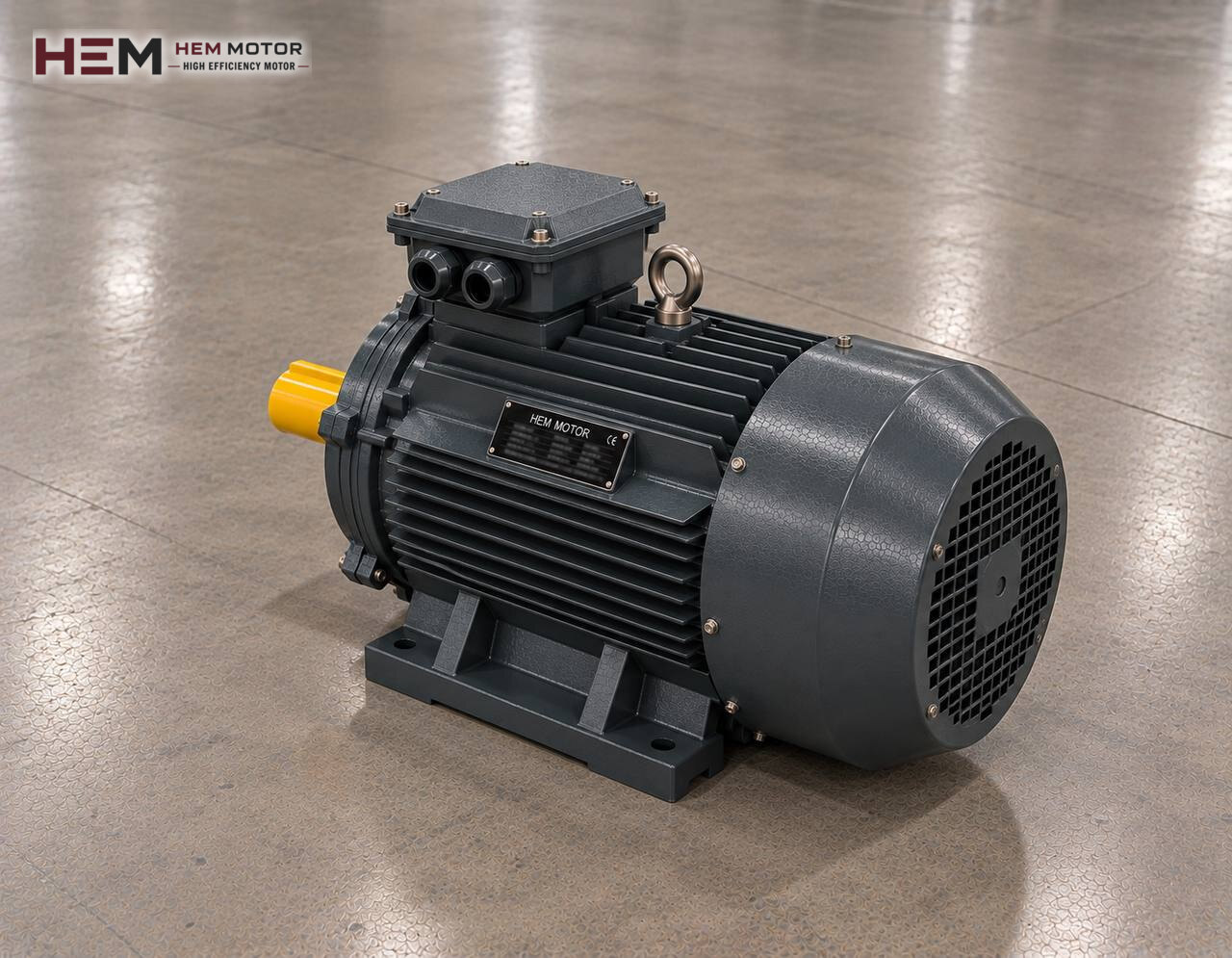
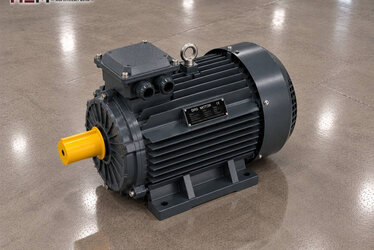
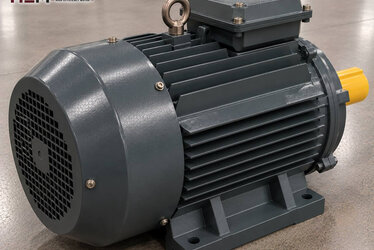
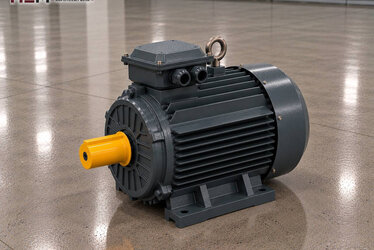
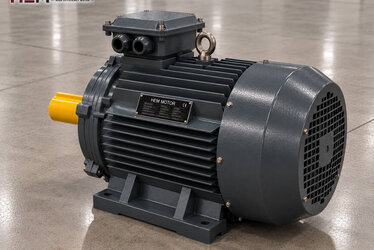
In spinning and weaving halls, cotton dust, short fibre and fluff mixed into the air build up on machines and in ceiling voids; the heart of the system that collects them continuously is an extraction fan. This page covers the three-phase motor that turns this textile-specific fan: the effect of fibre on the fan impeller and the motor, uninterrupted operation across shifts, and the load that changes as the filter fills. The dust collection fan motor page, prepared for wood chips, welding dust or general workshop dust, is a separate application; for all textile machines, see the textile machinery electric motors page.

The Part the Motor Turns in a Fibre Extraction System
In a textile extraction system, the motor's only job is to turn the centrifugal fan impeller. The impeller draws air from the broken-end suction ducts (pneumafil) of ring and open-end spinning machines, from the hoods of cards and draw frames, and from floor inlets in the weaving hall. The air first goes to a fibre separator, usually a rotary drum filter or a bag filter; the fibre is retained there, and the cleaned air returns to the hall or to the air-conditioning plant.
What the motor does not do is also clear. The rotation of the drum filter, the movement of the suction nozzle that cleans the filter surface, pressing and baling the collected fibre and opening and closing dampers are done by separate drives; each has its own small motor or pneumatic arrangement. The fan's airflow, pressure and duct calculation are also the job of the fan or system manufacturer; HEM Motor supplies the standard induction motor that turns this fan.
In most plants the fan sits after the filter, on the clean air side. In this layout the motor stays outside the dirty air flow; however, when the filter is punctured or the bypass is opened, fibre still reaches the fan casing. In systems where the fan is placed before the filter, fibre wrapping on the impeller is seen more often.
Information to Gather When Selecting an Extraction Fan Motor
- Fan type and impeller design (backward-curved, radial), power and speed given by the fan manufacturer.
- Connection: impeller fitted directly on the motor shaft, coupling, or belt and pulley?
- Position of the fan relative to the filter: dirty air side or clean air side?
- Daily operating time and weekend shutdowns.
- Is fan speed adjusted by an inverter, or throttled with a damper?
- The nameplate, frame size and mounting type of the existing motor.
Fan Power and Speed: From the Fan Curve to the Motor Nameplate
The power the extraction fan needs is determined by the airflow the system requires and the pressure created by duct, separator and filter losses. These values are read on the fan manufacturer's curve, at the operating point. When the number of machines in the same hall increases or the duct is extended, the operating point changes; for this reason it would not be correct to give a value such as "this kW is enough for a fibre extraction fan".
In fans, power changes roughly with the cube of speed (an approximation that depends on the system). Changing a pulley to raise the speed of a belt-driven fan loads the motor much more than expected; a speed change should be evaluated together with the fan manufacturer. In direct-coupled fans the impeller speed equals the motor speed; so the fan design tells whether the 2-pole 3,000 rpm or the 4-pole 1,500 rpm class is needed. When buying a spare motor, the most practical source is the power and speed on the nameplate of the running motor.
The condition of the filter also affects the load. As the drum filter or bag clogs, system resistance rises and airflow drops; on backward-curved fans this usually lowers the motor current. When the filter has just been cleaned or a duct branch is left open, airflow and current can rise. The motor power is checked against this maximum airflow condition using the fan manufacturer's data.
| Extraction point | Fibre load and operating pattern | Points to watch on the fan motor |
|---|---|---|
| Ring spinning pneumafil suction | Broken yarn and short fibre; continuous while the machine runs | Uninterrupted operation, airflow adjusted by inverter |
| Card / draw frame hood | Dense fluff and dust; throughout the shift | Fibre wrapping on the impeller, vibration check |
| Weaving hall floor and ceiling suction | Light fluff, large area | Large low-speed impeller, belt tension |
| Central drum filter main fan | Air from all branches; load depends on the filter | Current at maximum airflow, winding temperature monitoring |
The table is general guidance, not a final selection. For each fan, the motor is verified with the fan manufacturer's operating point data and the existing nameplate.
Connecting to the Fan Casing: Frame, Flange and Shaft Checks
On fans with the impeller mounted directly on the shaft, the motor is often foot-mounted (B3) on a base or flanged (B5, B35) to the fan casing; vertical designs such as V1 are used for roof fans with a vertical shaft. In a replacement, the first check is the IEC frame size; then shaft diameter and length, key, flange spigot diameter and pitch circle, and on foot-mounted motors the foot hole spacing are compared with the old motor. The impeller hub must seat fully on the shaft; if the shaft length differs, the impeller's position inside the casing changes and it can rub against the casing.
On the electrical side, mains voltage, star or delta connection and starting method are checked. You can see frame dimensions in the frame size table and mounting options on the mounting arrangements page; flange and shaft dimensions are confirmed when ordering.
Fibre Build-up, Fire Risk and Hall Humidity
The motor of a fibre extraction fan is one of the motors breathing the dustiest air in the hall. Fluff sticking to the fan cover grille and frame fins cuts off the motor's own cooling air. Fluff build-up is not only an overheating problem; cotton fibre is combustible and a layer collecting on a hot surface creates a risk. Regular cleaning around the motor and fan should therefore be planned together with the plant's fire precautions.
In some plants the area may be classified as an explosive dust atmosphere because of dust concentration. If such a classification (ATEX zone) exists, a standard IP55 motor cannot be used in that area; Ex-certified motors are not included in HEM Motor's 2026 catalogue. Classification and protection decisions are the responsibility of the plant and the fan manufacturer.
Our motors are IP55 protected with class F insulation; the ambient range in the catalogue is −15 to +40 degrees, with an altitude limit of 1000 metres. Because spinning halls are humidified, fans standing idle over the weekend can see condensation inside the frame; an anti-condensation heater is an order option.
Continuous Duty, Inverter Airflow Control and Starting
A fibre extraction fan does not stop as long as the spinning machines run; in most plants it turns five or six days a week, three shifts a day. In this S1 continuous duty, the motor's thermal balance and bearing life are decisive. A PTC or PT100 sensor can be added to the order to monitor the winding.
As the number of machines changes, adjusting fan speed with a frequency inverter instead of throttling airflow with a damper is a common method. Our three-phase series are suitable for speed control with an inverter. Because fan load falls with speed, cooling problems at low speed are less common; still, with long cables a dv/dt or sine filter is considered. Details are on the inverter-compatible electric motors page.
Large-diameter impellers have high inertia; starting takes a long time. Our models of 4 kW and above have a winding connection suitable for star-delta starting. If an inverter or soft starter is used, the acceleration time should be set according to the fan's inertia.
Information to Share When Renewing an Extraction Fan Motor
You can send your request for a new motor via WhatsApp. How to take the nameplate photo is explained in the send your motor nameplate article.
- Motor nameplate photo: power, speed, voltage, current and frame code.
- Fan connection: impeller directly on the shaft, or belt-driven?
- Mounting type (B3, B5, B35 or vertical) and shaft and flange dimensions.
- Whether the fan is before or after the filter.
- Whether it runs on an inverter or with star-delta.
- Whether the area is classified as an explosive dust atmosphere.
- Required quantity and need for a spare motor.
Our phone and WhatsApp details are on the contact page.
Motors to Review for Fibre Extraction Fans
All models are on the buy electric motors page. The cast iron frame electric motors category, often preferred for continuously running central extraction fans, can be reviewed; the general framework of centrifugal fan applications is on the centrifugal fan electric motor page. Examples:
- 4 kW 112M-2 cast iron frame (2,905 rpm)
- 7.5 kW 132M-4 cast iron frame (1,460 rpm)
- 11 kW 160M1-2 cast iron frame (2,945 rpm)
These models are examples; their suitability for your fan is verified separately by comparing the fan manufacturer's power and speed data and the mounting dimensions.
Frequently Asked Questions
Is there a difference in terms of the motor between a fibre extraction fan and a general dust collection fan?
In both, the motor's job is to turn the fan impeller; the difference is the environment. In textiles, combustible fibre build-up, humid halls and uninterrupted operation for weeks stand out; cleaning and winding monitoring are therefore more important.
Does fibre wrapping on the fan impeller affect the motor?
Yes. Fibre wrapped on the impeller creates imbalance, and vibration and bearing load increase. Regular cleaning of the impeller and vibration monitoring are recommended.
Can I also buy a motor for the rotary drive of the drum filter?
Drum and suction nozzle drives are usually low-power geared motors. If you send the nameplate details, we check whether our standard series has an equivalent; our smallest three-phase model is 0.25 kW.
Does switching off the extraction fan at night harm the motor?
Stopping alone does no harm; however, condensation can form in a motor cooling down in a humid hall. In plants with frequent stops, an anti-condensation heater can be considered.