English
 Français
 Türkçe
 Español
 Русский

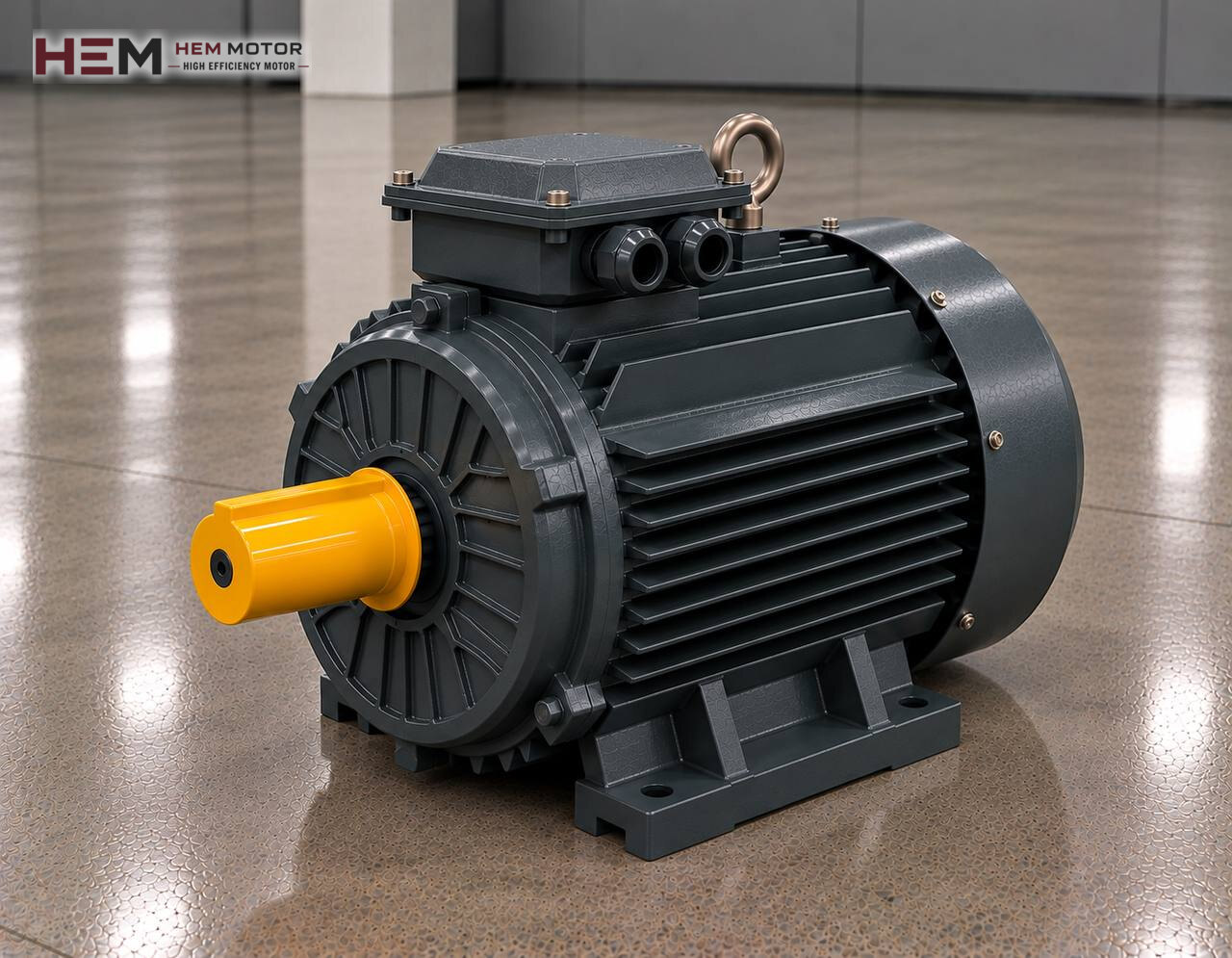
A fabric winding machine takes the fabric coming off the end of the line and builds it into a roll on a tube or cardboard core; some models also measure the length while winding, cut the roll and switch to a new core. This page explains where a standard three-phase induction motor does useful work on such a machine, and where it gives way to a servo or a machine-specific drive. For the other machines in the sector, return to the textile machinery electric motors page.

Which Shaft Does the Motor Turn on a Winding Machine?
Winding machines follow two basic layouts, and the motor's job changes completely between them.
Surface (peripheral) winding: The roll rests on one or two rotating winding drums and turns by friction. The motor only turns this drum, usually through a gearbox or a belt. Because the drum's surface speed is kept equal to the line speed of the fabric, the motor speed does not need to change as the roll grows. This layout is where a standard induction motor works most comfortably.
Centre winding: The core shaft is driven directly. As the roll diameter increases, the shaft must turn more slowly for the same fabric speed, while the torque needed to tension the fabric must rise. If fabric tension does not stay constant, knitted fabric narrows in width, and woven fabric shows wavy edges and telescoping. This is a tension- and speed-synchronised motion; most machines use a servo motor, a vector-controlled special drive, a dancer roller or a closed-loop system with a load cell. We do not offer a standard induction motor as directly compatible with such a shaft; whether a motor can be used for this task is decided by the machine manufacturer according to its own control system.
What the motor does not do is equally clear: measuring fabric tension, edge guiding, counting metres or cutting the roll are tasks of the machine's sensors and control system, not of the motor. The cutting knife and the roll change arms often run on their own small motors or pneumatically.
Data Requested When Asking for a Winding Drive Motor
To select a motor for a winding machine, you first need to know which shaft is involved. After that, the following information settles most of the job:
- Winding layout (surface drum, centre shaft, fabric take-off roller).
- Maximum line speed of the fabric and maximum roll diameter; these are stated in the machine manufacturer's documents.
- Transmission between drum and motor: gearbox, belt and pulley, or chain.
- Whether the motor runs on a frequency inverter or at fixed mains speed.
- The nameplate and frame size of the existing motor.
Working Out Power and Speed for the Winding Drum
In surface winding, the required torque comes from the bearing friction of the winding drum, the tension created while pulling the fabric and the acceleration inertia of the roll. When a heavy roll stops before being removed, and when the new core accelerates again, the motor delivers extra torque for a short time. These values are calculated by the machine designer; since they depend on fabric type, width and roll weight, recommending a single kW value as "suitable for a winding machine" would not be correct.
In practice, the most reliable source is the nameplate of the motor running on the machine. The power and speed on the plate are evaluated together with the gearbox ratio. Because the drum turns slowly, these machines mostly use a 4-pole motor with 1,500 rpm synchronous speed followed by a gearbox; speed is matched to the line by changing it with an inverter. For the gearbox side, the electric motors for gearboxes and foot-mounted helical gearboxes pages give information; motor power, the speed entering the gearbox and the drum's gearbox output speed are separate values and must not be confused.
| Section of the winding machine | Nature of the motion | Standard induction motor |
|---|---|---|
| Surface winding drum | Constant surface speed at line speed, adjusted by inverter | Can be suitable; with gearbox and inverter |
| Fabric take-off / feed roller | Continuous rotation, matched to line speed | Can be suitable; synchronisation requirement to be asked to the machine manufacturer |
| Centre winding shaft | Speed and torque varying with diameter, tension control | Not shown as directly compatible; servo or special drive is used |
| Roll cutting knife, roll change | Short, positioned motion | Machine-specific motor or pneumatics |
The table offers a preliminary distinction, not a final selection. Which shaft runs on which motor depends on the machine's own design.
Comparing Gearbox Flange, Shaft and Foot Dimensions
The winding drum motor is usually connected to a gearbox, so the first item to check is the IEC frame size (for example 90S, 90L, 100L). Next comes the mounting type: B5 or B14 for motors flanged to the gearbox, B34 or B35 when foot and flange are combined, and foot-mounted B3 in a belt layout. Shaft diameter and length, key size, foot hole spacing and flange diameter are compared one by one with the old motor. On the electrical side, voltage, connection type and current are also checked.
Even the same IEC frame size does not mean that every detail matches; flange and shaft dimensions are confirmed when ordering. The frame size table can be used to compare dimensions, and the mounting arrangements page for the available options.
Fibre, Humidity and Heat in the Winding Section
The winding machine usually stands at the very end of the line, at the exit of the stenter or dryer. The fabric is dry, but fluff torn from the edges is drawn into the motor's fan cover. As the cover grille and frame fins clog, cooling weakens; a short cleaning between shifts is therefore important.
Our motors are IP55 protected with class F insulation; the ambient range in the catalogue is −15 to +40 degrees, with an altitude limit of 1000 metres. If the motor is to be mounted very close to the stenter exit where hot air hits it, or if the environment exceeds these limits, this is stated in the order. Machines standing idle over the weekend can see condensation inside the frame; an anti-condensation heater is an order option.
Inverter Speed Matching and Starts at Roll Changes
In surface winding, the motor speed has to be kept in line with the other rollers of the line; this is why the motor mostly runs on a frequency inverter. Our three-phase series are suitable for speed control with an inverter. If the line runs slowly for a long time while the motor turns at full torque, its own fan is insufficient and a separate fan may be needed. If the panel is far from the machine, a dv/dt or sine filter is considered; details are on the inverter-compatible electric motors page.
At every roll change the drum stops and accelerates again. In short-batch work, this means starts repeated several times an hour. A PTC or PT100 sensor can be added to the order to monitor winding temperature. The difference between inverter and servo matters here too: the inverter adjusts the motor speed, but on its own it does not provide the tension and position accuracy of centre winding.
What to Send When Replacing an Old Winding Motor
If you want a new motor in place of the existing one, sending the information below via WhatsApp is enough. A clear photo of the nameplate answers most questions on its own; how to take it is explained in the send your motor nameplate article.
- A legible photo of the motor nameplate (power, speed, voltage, current).
- The shaft the motor turns: surface winding drum or take-off roller?
- How it connects to the gearbox and the mounting type (B3, B5, B14, B34, B35).
- Measurement of shaft diameter, flange diameter or foot hole spacing.
- Whether it runs on an inverter and whether the line speed is adjusted.
- Required quantity and need for a spare motor.
A standard motor should not replace a drive on a shaft for which the machine manufacturer specifies a servo or special motor; if unsure, share the machine information as well. Phone and WhatsApp details are on the contact page.
Motors to Review for a Winding Drum Drive
All shop models are listed on the buy electric motors page, lightweight options in the aluminium frame electric motors category, and those for heavier conditions in the cast iron frame electric motors category. Examples from the 4-pole class common on geared winding drums:
- 1.1 kW 90S-4 aluminium frame (1,445 rpm)
- 1.5 kW 90L-4 aluminium frame (1,445 rpm)
- 2.2 kW 100L1-4 cast iron frame (1,450 rpm)
These models are examples; their suitability for the machine is verified separately against the drum's torque requirement, the gearbox ratio and the mounting dimensions.
Frequently Asked Questions
My fabric winding machine has a servo motor; can I fit an induction motor instead?
A servo motor usually drives a shaft that needs tension or position control. We do not consider a standard induction motor directly compatible with this task; a change can only be evaluated according to the machine manufacturer's control system.
Does the motor speed need to change as the roll grows in surface winding?
Usually not. Since the drum's surface speed stays equal to the fabric speed, the drum speed stays tied to the line speed even as the roll diameter grows. What changes is the increasing inertia of the roll.
Why does the winding motor overheat often?
Common causes are fluff collecting on the fan cover, long running at full torque at low speed and frequent roll changes. A separate fan and a winding sensor can be requested with the order.
Is there a single-phase motor option for a winding machine?
If only 220 V is available in the workshop, our single-phase series ranges from 0.18 to 5.5 kW; however, three-phase motors are more common on lines that need inverter speed matching. Details are on the single-phase electric motor page.
Can the fabric take-off roller and the winding drum share the same motor?
On some machines both are driven from one motor by a chain, on others each has its own motor and inverter. The machine manufacturer decides which layout is used; simply state this in your order.