English
 Français
 Türkçe
 Español
 Русский

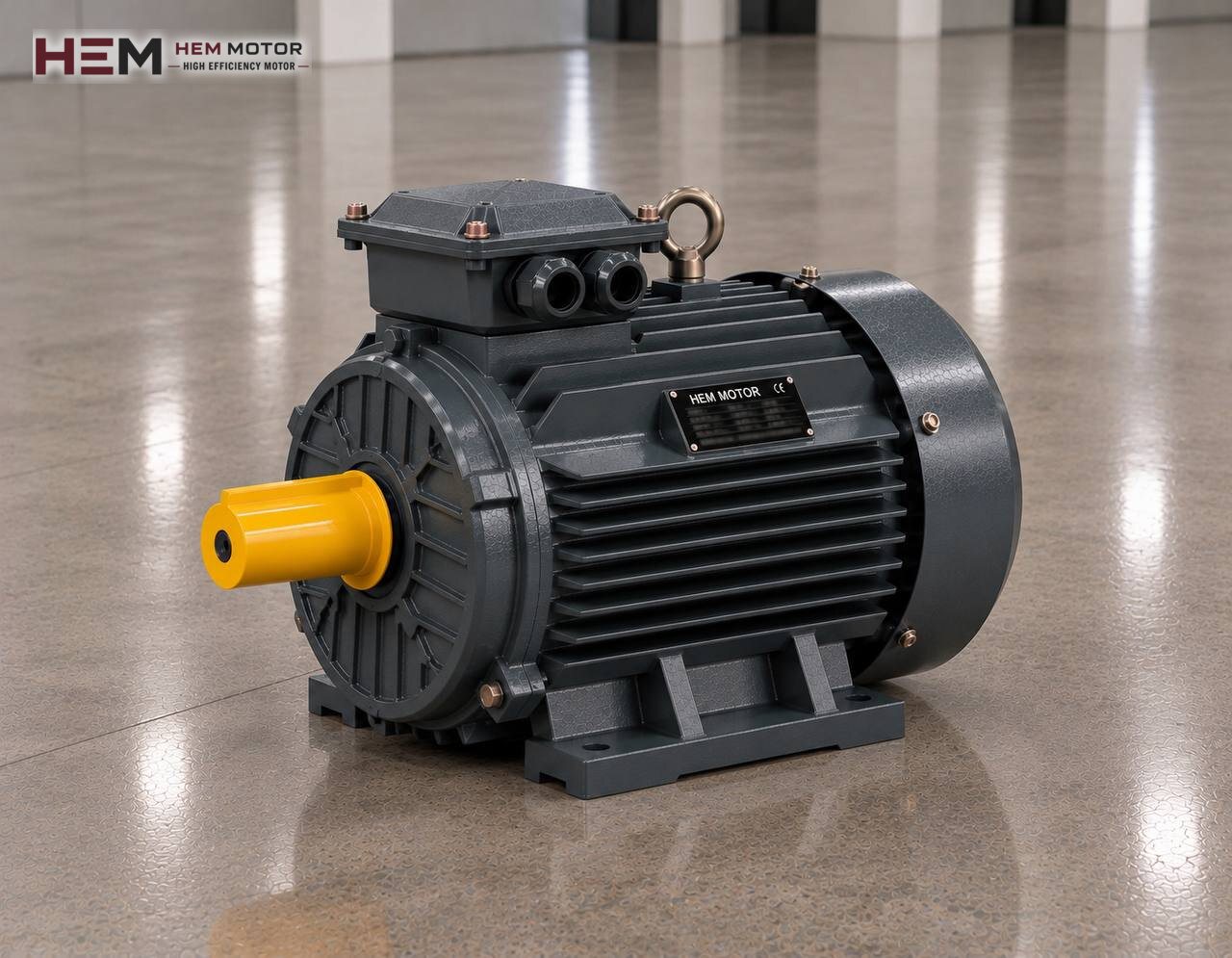
In jet, overflow, package (yarn bobbin) and beam dyeing machines the dye liquor does not stand still in the vessel; a pump drives it continuously through the fabric or the yarn package. Level dyeing depends largely on how well this circulation is organised. This page explains which pump arrangements these machines use as a category and how the three-phase motor that turns those pumps is selected. For the general motor layout of textile machinery, return to the textile machinery electric motors page.

The Pump the Motor Turns in a Dyeing Vessel
The motor's only job is to turn the pump shaft. The pump draws liquor from the bottom of the vessel, sends it through the heat exchanger and delivers it to a different point depending on the machine type:
- Jet machine: Liquor is pumped to the nozzle that carries the fabric rope; it distributes the dye and helps the fabric travel through the tube.
- Overflow machine: Liquor pours onto the fabric from an overflow channel; fabric movement is gentler.
- Package and beam dyeing: Liquor passes through perforated spindles or the beam and penetrates the yarn or fabric layers; here the resistance the pump overcomes depends on package density.
There are also tasks the motor does not perform. Reversing the flow from in-to-out or out-to-in is done with a valve arrangement on most machines. The winch (reel) that moves the fabric, vessel pressurisation, heating, chemical dosing and sampling are separate systems. The pump's mechanical seal is the pump manufacturer's concern.
Information Needed to Order a Pump Motor
To select the right motor, first get to know the pump: its type (centrifugal or axial flow), rated flow and head, operating speed and the motor power recommended by the pump manufacturer. The machine's capacity (number of vessels, load size) and liquor ratio form the background to these values.
In addition, find out how the motor is connected to the pump: a motor sitting on the pump casing by its flange, or a foot-mounted motor coupled on a common baseplate? Whether the pump runs on an inverter and whether the machine reverses the motor to change direction should also be known from the start.
How Flow, Head and Motor Power Relate
The pump decides the power the motor must deliver. The pump manufacturer's curve shows how much shaft power is needed at the required flow and head; the motor is chosen with a rated power above that value. There is no single value such as "this kW suits a dyeing pump"; two machines of the same capacity may be designed with different pumps and speeds.
Pump load in dyeing is not constant. Resistance rises when packages are wound tightly; as the liquor heats up and its viscosity changes, the power drawn by the pump changes too. If the pump speed is raised to increase flow, power grows quickly with speed. So if the existing motor runs constantly near its rated current, the next power step is assessed; the decision must still rest on the pump data.
On the speed side, 2-pole motors (about 3,000 rpm synchronous) are common on centrifugal dyeing pumps; large axial pumps also use 4-pole motors. You can see models by speed group on the 3000 rpm electric motors page.
| Machine type | Resistance seen by the pump | Motor-side attention | Example HEM model |
|---|---|---|---|
| Jet dyeing | Nozzle pressure, fabric transport | Speed set by inverter per recipe | 18.5 kW 160L-2 (2,940 rpm) |
| Overflow dyeing | Lower pressure, high flow | Pump speed, flange and shaft size | 15 kW 160L-4 (1,465 rpm) |
| Package dyeing | High resistance depending on package density | Current monitoring, winding sensor | 22 kW 180M-2 (2,955 rpm) |
| Beam dyeing | Flow through fabric layers | Long continuous running, condensation | Determined by pump data |
The models in the table are for orientation, not a final selection; the decision is made with the pump curve, the existing motor nameplate and the connection dimensions.
Connection to the Pump: Flange, Shaft and Baseplate Check
The first value to look at is the IEC frame size. If the motor mounts on the pump lantern by flange, compare with the old motor whether it is B5 (large flange with through holes) or B14 (small flange with tapped holes), the flange diameter, spigot diameter and number of bolt holes. For foot-mounted motors on a common baseplate, the foot hole spacing and shaft centre height matter; on vertically installed pumps the motor may be a vertical version such as V1.
Shaft diameter, shaft length and key size must match the coupling or pump hub. Electrical values (voltage, connection, current) are added to the same list. The frame size table helps compare dimensions. Even if dimensions match on paper, coupling alignment is checked again during installation.
Dyehouse Conditions: Steam, Leaks and a Hot Pump Casing
In the dyehouse the air is humid and the floor is usually wet. Because the pump casing is filled with liquor above boiling point, the motor flange and shaft pick up heat from the pump. The lantern and coupling gap on the machine side reduce this heat; for the motor itself the catalogue limit is +40 degrees ambient air (lower limit −15) and 1000 metres altitude, and exceeding these limits is stated in the order.
The motor is IP55 protected; this protection is against water jets but is not designed for hot liquor leaking from the seal and dripping onto the motor continuously, or for hosing down. If there is such a risk, a shield or drip deflector is needed on the machine side. When vessels cool down over the weekend, condensation may form inside the motor; an anti-condensation heater and a PTC or PT100 winding sensor can be requested with the order.
Speed Changes per Recipe and the Inverter
On most modern dyeing machines the pump speed changes with each recipe step: low during loading, high during dye uptake, a different value during rinsing. This is done with an inverter. Our three-phase series are suitable for operation with a frequency inverter; details are on the inverter-compatible electric motors page. Since pump load falls at low speed, cooling is usually not a problem; however, if the pump pushes for long periods at low speed through a high-resistance package, a separate fan is assessed. If the panel is in a distant corner of the dyehouse, the need for a dv/dt filter or sine filter is assessed according to cable length.
If the machine changes flow direction by reversing the motor, state it in the order; frequent reversing puts an additional load on the motor and couplings.
Information to Send for a Replacement
- Photo of the existing motor nameplate: power, speed, voltage, current.
- Flow, head and speed from the pump nameplate.
- Machine type: jet, overflow, package or beam dyeing.
- Connection: flanged on the pump lantern (B5/B14) or foot-mounted on a baseplate; horizontal or vertical.
- Whether the pump is fed by an inverter or the mains; whether the motor reverses.
- Risk of liquid dripping onto the motor and ambient temperature.
- Required quantity and number of spares.
Sending this information via WhatsApp is enough; the steps are in the send your motor nameplate article. You can reach us through the contact page.
Product Groups in the Shop for Dyeing Pumps
The main shop list is the buy electric motors page. For the humid, heavy-duty dyehouse, the cast iron frame electric motors category can be reviewed. As examples, the 15 kW 160L-4, 18.5 kW 160L-2 and 22 kW 180M-2 models can be looked at. These are examples; suitability for the machine is confirmed separately with pump data and dimensions. General information on pump drives is on the circulation pump motor page.
Frequently Asked Questions
Why does the jet machine pump motor trip on overcurrent often?
Nozzle setting, a clogged filter or a pump speed raised in the recipe can push the motor above its rated current. Check the filter and inverter setting first, then compare motor power with the pump data.
What happens if I increase motor speed on a package dyeing pump?
Flow increases, but the power drawn by the pump rises much faster than speed. The motor may not cope with this increase; the change should follow the pump manufacturer's data.
Can a foot-mounted motor replace a flanged pump motor?
If the pump lantern carries the motor by its flange, a flanged version is required. Versions with both feet and flange, such as B35, may be a solution on some baseplates; this must be verified by measurement on site.
Does a seal leak affect the motor?
If hot liquor drips continuously onto the motor shaft or frame, it can reach the bearings and winding. The leak should be fixed on the pump side and the motor kept out of the drip path.
Is the dyeing machine's winch motor covered on this page?
No. The winch sets the fabric speed and runs with different drives depending on the machine. This page covers only the motor of the pump that circulates the liquor.