English
 Français
 Türkçe
 Español
 Русский

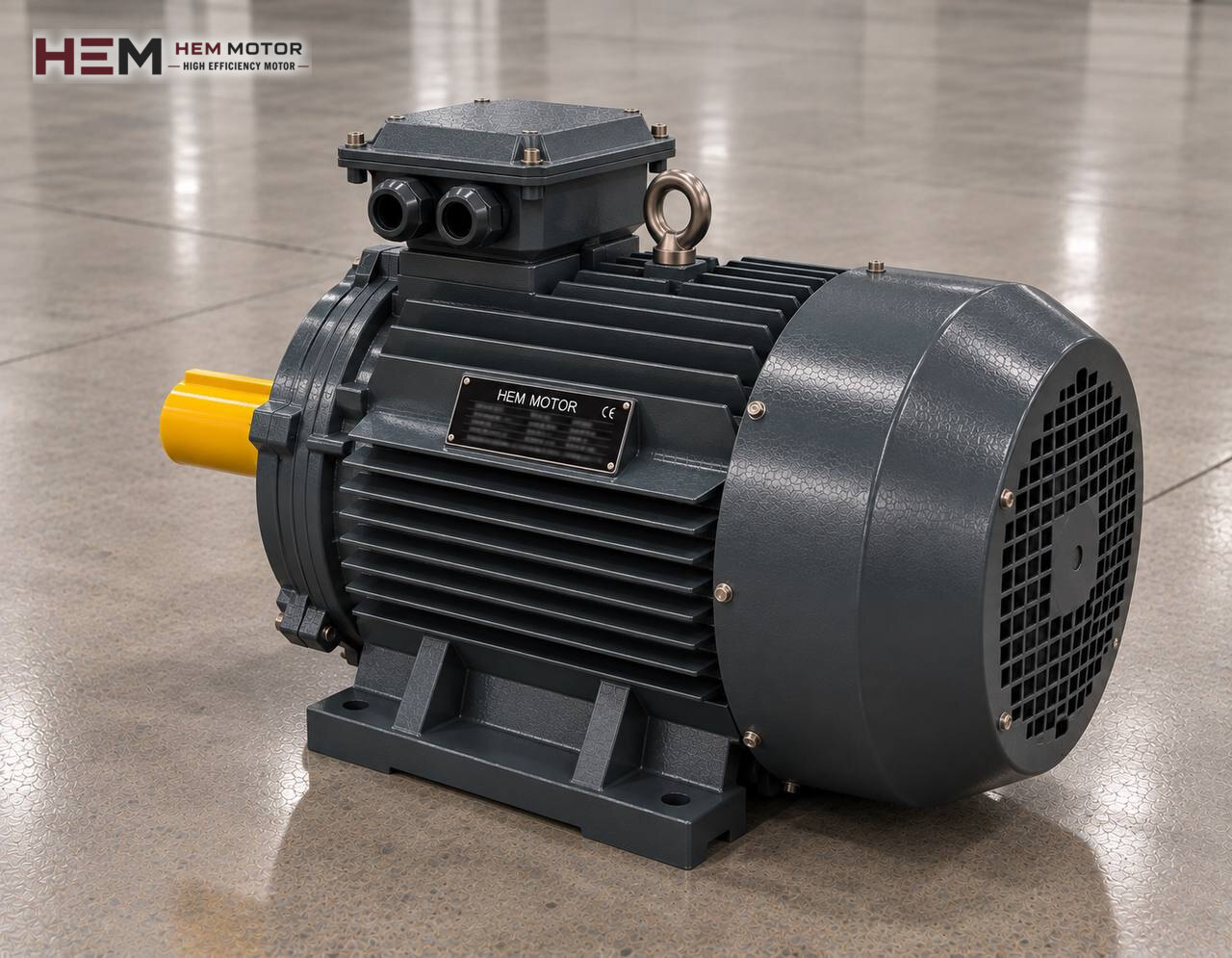
An industrial tumble dryer dries damp textile goods coming out of extraction with hot air inside a rotating drum; it is used in hotel and hospital laundries, in the washing sections of garment plants and in workshops that process rugs and blankets. This page covers the two main drives inside the dryer: the drum motor and the hot-air fan motor. For the general motor needs of the textile sector, see the textile machinery electric motors page.

How a Tumble Dryer Works
Inside the dryer is a horizontal-axis perforated drum. As the drum turns slowly, the lifters on its inner surface carry the laundry up and let it fall; the goods open in the air and hot air can pass around every piece. The air is heated by gas, steam or an electric heater, drawn through the drum by a fan and expelled with the moisture through a lint filter. At the end of drying the heater switches off, the drum keeps turning with cool air for a while and the goods are unloaded without creasing.
On the electrical side this means two different drives: a motor turning the drum at low speed and a fan motor moving the air. In small dryers both can run from a single motor through belts; in medium and large machines they are usually separate.
Drum Motor: Low Speed and Reversing
The drum turns only a few tens of revolutions per minute. The motor is therefore four- or six-pole, and speed is reduced by a belt and pulley arrangement, a gearbox or both. Because the goods inside the drum are lifted and dropped by the lifters, the motor load fluctuates slightly on every turn; on belt-driven systems this fluctuation is easily absorbed.
Many dryers reverse the drum at intervals to prevent sheets and towels from tangling. Reversing means stopping the motor and restarting it in the opposite direction; this can be repeated several times in one drying cycle. In a reversing contactor arrangement the motor should be allowed to stop completely, and sudden reversal should be avoided. On converter-driven machines, reversing is smoother with deceleration and acceleration ramps. Our three-phase motors can be driven by a converter; precautions for long running at low speed and for long cables are discussed during the order. For details see the inverter-compatible electric motors page.
Because the drum carries a heavy mass, the motor needs noticeable torque at start-up; however, owing to the low peripheral speed, acceleration is short. The long-start problem of a spin extractor is generally not seen on a dryer.
Hot-Air Fan: A Continuously Running Load
The fan runs without stopping throughout drying and is the main continuous load on the motor side of the dryer. On most machines a radial impeller is mounted directly on the motor shaft or driven by a belt. The power the fan draws depends on impeller diameter and speed; as speed rises the power requirement increases markedly, roughly in proportion to the cube of speed. When replacing the fan motor, the old motor's pole number must therefore be kept; a faster motor draws excess current, while a slower one moves too little air and drying takes longer.
The fan motor's greatest enemy is lint. If the filter is neglected, lint reaches the fan impeller and from there the motor's cooling fins. A motor covered in lint cannot shed its heat; and since it works near the hot-air duct, it is already in a high ambient temperature. Cleaning the filter every cycle and cleaning the fan cover and fins at regular intervals has a direct effect on motor life. General information on fan drives is on the fan and extractor motors page.
Watch Out for Heat, Lint and Fire Risk
Our motors have class F insulation and are designed for the ambient temperature limit given in the catalogue. If the motor is placed right next to the heater or the hot-air outlet, the surrounding temperature can exceed this limit. In that case the motor should be moved to the cool side, the air duct insulated or a different solution recommended by the machine maker applied; if you have a special temperature requirement, state it in your order.
Besides heating the motor, lint build-up also matters for the machine's fire safety. The dryer's fire extinguishing, high-temperature cut-out and door lock systems are the machine maker's responsibility. What can be done on the motor side is to use a PTC sensor monitoring winding temperature (an order option) and to keep the area around the motor clean. IP55 protection gives an enclosed housing against lint and dust; however, spraying wash water onto it is outside the scope of this rating.
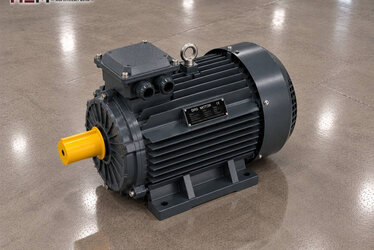
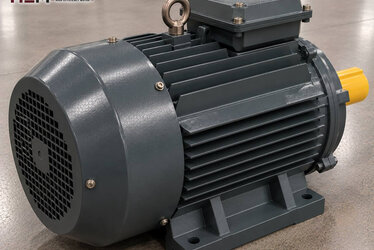
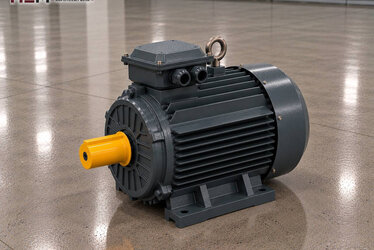
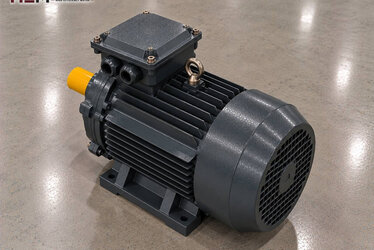
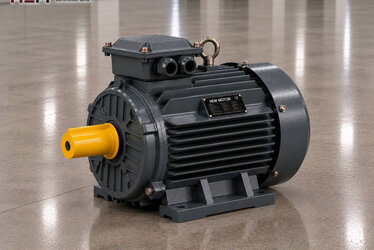
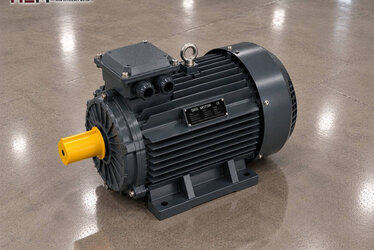
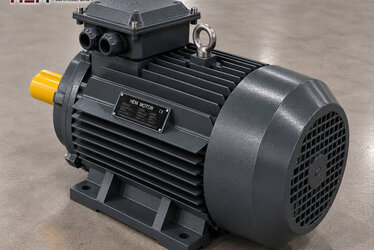
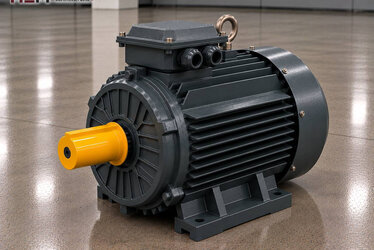
For frame choice, lightweight aluminium-frame motors are common on small and medium dryers; on large drums and heavy belt loads a cast iron frame may be more suitable.
Example HEM Models for Dryers
| Drive | Motor load | Value to check | Example HEM model |
|---|---|---|---|
| Small dryer drum | Slow, reversing | Pulley ratio, reversing | 0.55 kW, 1,400 rpm, 80M1-4 aluminium |
| Large dryer drum | Heavy, geared | Gearbox flange | 1.5 kW, 949 rpm, 100L-6 aluminium |
| Medium hot-air fan | Continuous, hot environment | Fan speed, mounting location | 2.2 kW, 2,895 rpm, 90L-2 aluminium |
| Large hot-air fan | Continuous, lint risk | Pole number, PTC | 4 kW, 1,450 rpm, 112M-4 aluminium |
The models in the table are examples; the final selection is based on the dryer maker's power and speed data, pulley ratio and mounting position. For a replacement, the removed motor's nameplate is the soundest starting point.
For small dryers on a single-phase supply, the single-phase electric motor series in the 0.18–5.5 kW range can be considered.
What to Share With Your Motor Request
For a quotation, send: the machine (dryer capacity, drum or fan drive), power (kW), speed (rpm), mains voltage, mounting type, pulley, coupling or gearbox connection, reversing and converter use, quantity. Depending on the frame, B3, B5, B14, B34, B35 and V1, V3, V5, V6, V15 positions are prepared; flange and shaft dimensions are confirmed together at the order stage.
If you send a nameplate photo of the old motor, an equivalent model is easily found. You can see all models on the buy electric motors page and find prices on the product pages. Write to us on WhatsApp or call for your requests; the numbers are on the contact page.
Frequently Asked Questions
Why does the dryer fan motor keep tripping the thermal relay?
The most common cause is a clogged lint filter or fan cover; the motor cannot shed its heat and overheats. The second cause is the motor being too close to the hot-air outlet. Cleaning and the mounting location should be checked first, then the protection relay setting compared with the rated current on the product page.
Does reversing the drum damage the motor?
If the motor is restarted in the opposite direction after it has fully stopped, it is a normal operation. Damage occurs when the motor is suddenly reversed while still turning; this strains both the winding and the belt. The contactor arrangement should include a waiting time, or a converter ramp should be used.
If I replace the fan motor with a higher-speed model, will drying be faster?
Air volume may increase, but because fan power rises very quickly with speed the motor is overloaded, and the heater and air duct are not designed for that flow. Keeping the old motor's pole number and speed is the right approach.
Is one motor or two better for the drum and fan?
This decision belongs to the machine's design. On small single-motor dryers the belt arrangement does both jobs; on machines with separate motors the fan and drum can be adjusted independently. When replacing, the existing arrangement on the machine should be kept.