English
 Français
 Türkçe
 Español
 Русский

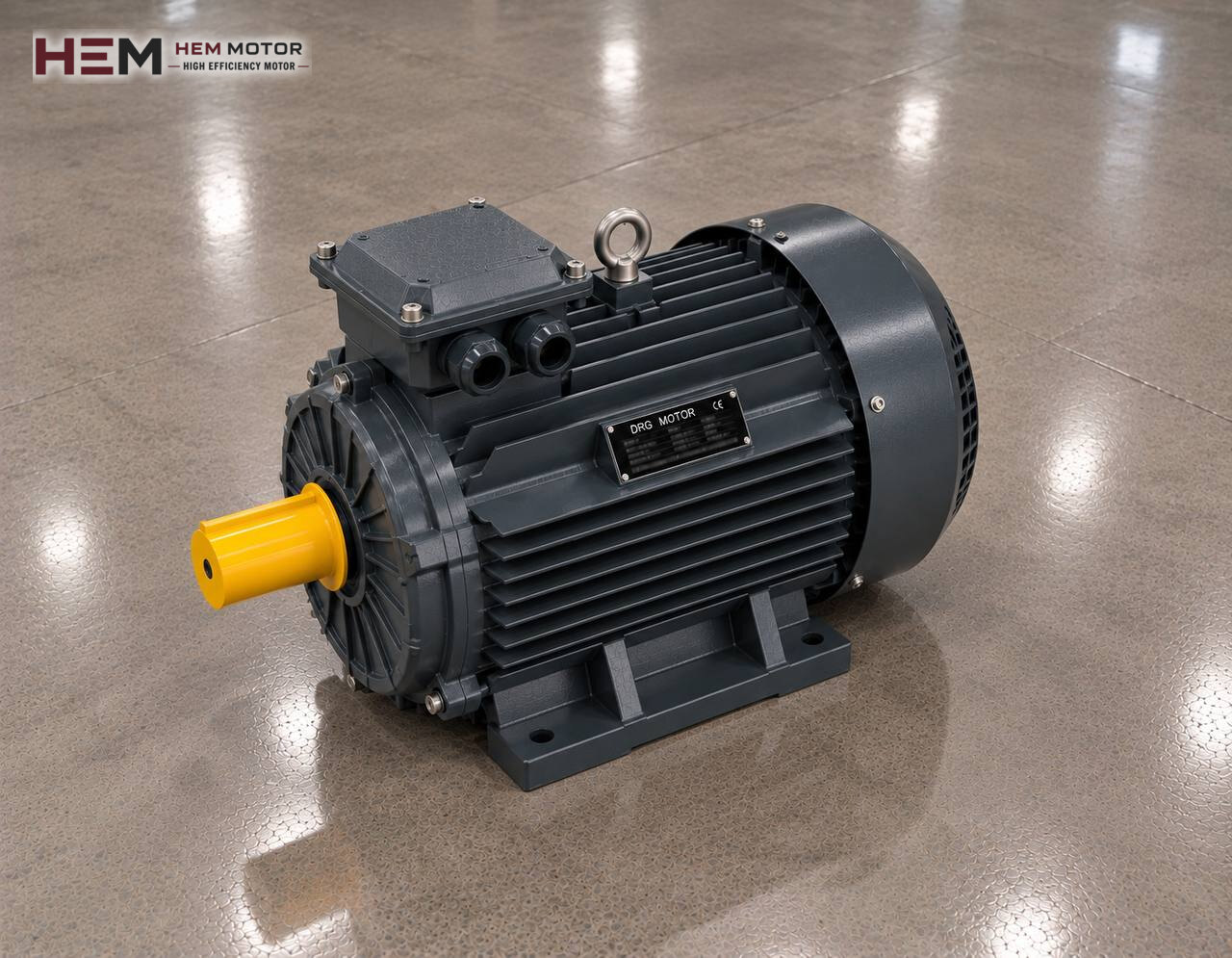
A continuous open-width fabric washing machine passes dyed or printed fabric, spread to full width, through a series of washing compartments arranged one after another. In each compartment the fabric runs in a zigzag over guide rollers, liquor is sprayed onto it, and at the compartment exit it is squeezed before entering the next bath. This page explains which parts a standard three-phase motor turns on such a washing line and how the motor is selected. For the overall picture of the sector the line belongs to, the textile machinery electric motors page is the starting point.

The Duties Shared by Motors on a Washing Line
A continuous washing line has no single large motor; each compartment has its own small drives. Standard asynchronous motors are usually found in these places:
- Compartment drive roller: The roller that moves the fabric through the compartment is turned by a motor via a gearbox.
- Spray and circulation pump: Pumps that take liquor from the compartment and spray it onto the fabric, or create counter-flow between compartments.
- Filter and lint pump: Feed pumps for the filters that separate lint and fibre from the liquor.
- Vibrating or beating wash unit: On some machines an eccentric or beater drive gives the fabric mechanical agitation.
The squeeze roller at the compartment exits is a separate subject and is covered on its own page. Speed matching that holds fabric tension between compartments is the job of the line's drive system. On newer lines this synchronised motion is often done with servo or machine-specific motors; fitting a standard asynchronous motor to these drives may upset speed synchronisation, so it is not considered directly compatible.
Which Information Is Needed for Which Drive?
The first question is which duty the motor to be replaced performs. For the roller drive the gearbox type, input speed and connection flange decide; for a pump, the pump's flow, head and speed. Line width, fabric type (heavy woven or light knit) and the line's speed range describe the load the motor will work under.
The nameplate of your motor shows power, speed and voltage; the foot or flange arrangement on the frame shows the mounting. Note also whether the motor is driven by an inverter and which drive brand is in the panel.
Setting Power and Speed for Roller and Pump Drives
On the drive roller, the machine builder sets motor power from fabric friction, the weight of wet fabric and the resistance of the roller bearings. Motor speed is fed to the gearbox input; the roller turns much more slowly at the gearbox output. These two speeds must not be confused: the motor nameplate shows input speed, the gearbox nameplate shows ratio and output.
For pumps, the pump curve sets the power. As spray nozzles clog or the filter gets dirty, the pump's operating point shifts and the motor load changes. In both cases there is no single value such as "this many kW for a washing machine"; the existing nameplate and machine data are the basis.
4-pole motors (about 1,500 rpm synchronous) are most common at gearbox inputs; spray pumps also use 2-pole motors. For the gearbox side see the electric motors for gearboxes page; for models by speed group see the 1500 rpm electric motors page.
| Drive on the line | Element the motor connects to | Selection data | Example HEM model |
|---|---|---|---|
| Compartment drive roller | Gearbox input | Gearbox flange, input speed, line speed range | 1.5 kW 90L-4 (1,445 rpm) |
| Spray pump | Pump shaft | Flow, head, pump speed | 3 kW 100L-2 (2,895 rpm) |
| Beating wash unit | Eccentric or belt pulley | Oscillating load, belt tension | 4 kW 112M-4 (1,450 rpm) |
| Speed matching between compartments | Synchronised drive system | Servo or machine-specific driven motor may be used | Consult the line builder |
These models were chosen to give an idea; the final selection is made according to machine data, the existing nameplate and connection dimensions.
Comparing Dimensions at the Gearbox and Pump Connection
The first step in a replacement is to confirm the IEC frame size (e.g. 90L, 112M). Motors connected to gearboxes are mostly flanged; the diameter, spigot and bolt holes of the B5 or B14 flange are measured and compared one by one with their counterparts at the gearbox input. Shaft diameter and length and key width must fit the hub at the gearbox input.
On pumps the motor either sits on the pump lantern by its flange or stands foot-mounted (B3) on a common baseplate; the distance between foot holes and the height of the shaft axis above the floor are checked. On the electrical side, voltage, star/delta connection and current are compared. You can check dimensions in the frame size table and see mounting arrangements in the mounting arrangements answer.
Wet Floor, Hot Baths and Chemical Vapour
The area around a washing line is steamy and wet; because the compartments work with hot water, a layer of humid air forms above the line. Frame protection is IP55 and winding insulation is class F. IP55 protects against water jets; however, liquor overflowing from a compartment lid and running onto the motor continuously, or hosing down the line, is not a design condition for this protection. The machine side should ensure that motors sit on side brackets out of the drip path rather than above the compartments.
The catalogue operating range is a lowest air temperature of −15, a highest of +40 degrees and 1000 metres altitude; if the motor area beside the compartments is hotter, write it in the order. On lines that stop over the weekend condensation can appear inside the motor; an anti-condensation heater can be added to the order, and PTC or PT100 can be requested to monitor winding temperature. Vapour from washing chemicals wears the frame paint and terminal box gasket over time; the cover gasket should be checked during maintenance.
Line Speed, Inverter and Frequent Stops
Almost all roller drives are inverter-driven; when line speed changes, every compartment motor receives frequency in the same proportion. The three-phase motors on sale are suitable for speed adjustment with a frequency inverter. If the line carries heavy fabric at very low speed for long periods, the motor's own fan may not be enough; in that case a separate fan is assessed. If cables between panel and motors are long, the need for an output filter (dv/dt or sine) is checked. The subject is explained on the inverter-compatible electric motors page.
At batch changes and fabric seams the line stops and starts often. The roller of a compartment full of wet fabric needs more torque at start; gearbox and motor should be chosen for this repeated load. On lines where speed matching uses feedback from the motor shaft, ask the machine builder whether an encoder connection is needed.
What to Send When Requesting a Spare Motor
- Photo of the motor nameplate (power, speed, voltage, current).
- Motor duty: drive roller, spray pump, filter pump or beating unit.
- If geared, the gearbox nameplate and input flange type.
- Mounting type: B3, B5, B14, B34, B35 or vertical.
- Whether it runs on an inverter and whether there is an encoder.
- Water and steam conditions where the motor is located.
- Number of identical motors on the line and required quantity.
You can send the information via WhatsApp; the steps are described in the send your motor nameplate article. For phone and WhatsApp, see the contact page.
Motors to Review for a Washing Line
All motors in the shop can be reached from the buy electric motors page. For the humid line environment, the cast iron frame electric motors group can be reviewed. As examples, the 1.5 kW 90L-4, 3 kW 100L-2 and 4 kW 112M-4 models can be looked at. These are examples; suitability for the machine is confirmed separately with drive data and dimensions. Gearbox options can be seen in the helical gearboxes category; gearbox selection is made separately from motor selection.
Frequently Asked Questions
The washing compartment roller motor keeps heating up – what could be the reason?
Carrying heavy fabric at low speed for long periods, increased friction in the gearbox and lint stuck on the fan cover are the most common causes. Check inverter frequency, gearbox oil and the cover grille together.
Can the same motor be used in all compartments?
If the compartment roller drives are of the same design, a single model makes spare stock easier. Still, the gearbox flange and shaft size of each compartment should be verified separately.
Can a standard motor be used on a servo-driven washing line?
A standard asynchronous motor is not directly compatible with synchronised motions done by servo. Standard motors can be used on auxiliary drives such as pumps and beating units; for the main motion, consult the machine builder.
The spray pump flow has dropped – has the motor weakened?
Most often the cause is clogged nozzles or a dirty filter. If motor current is normal, the problem is most likely on the hydraulic side; clean the nozzles and filters first.