English
 Français
 Türkçe
 Español
 Русский

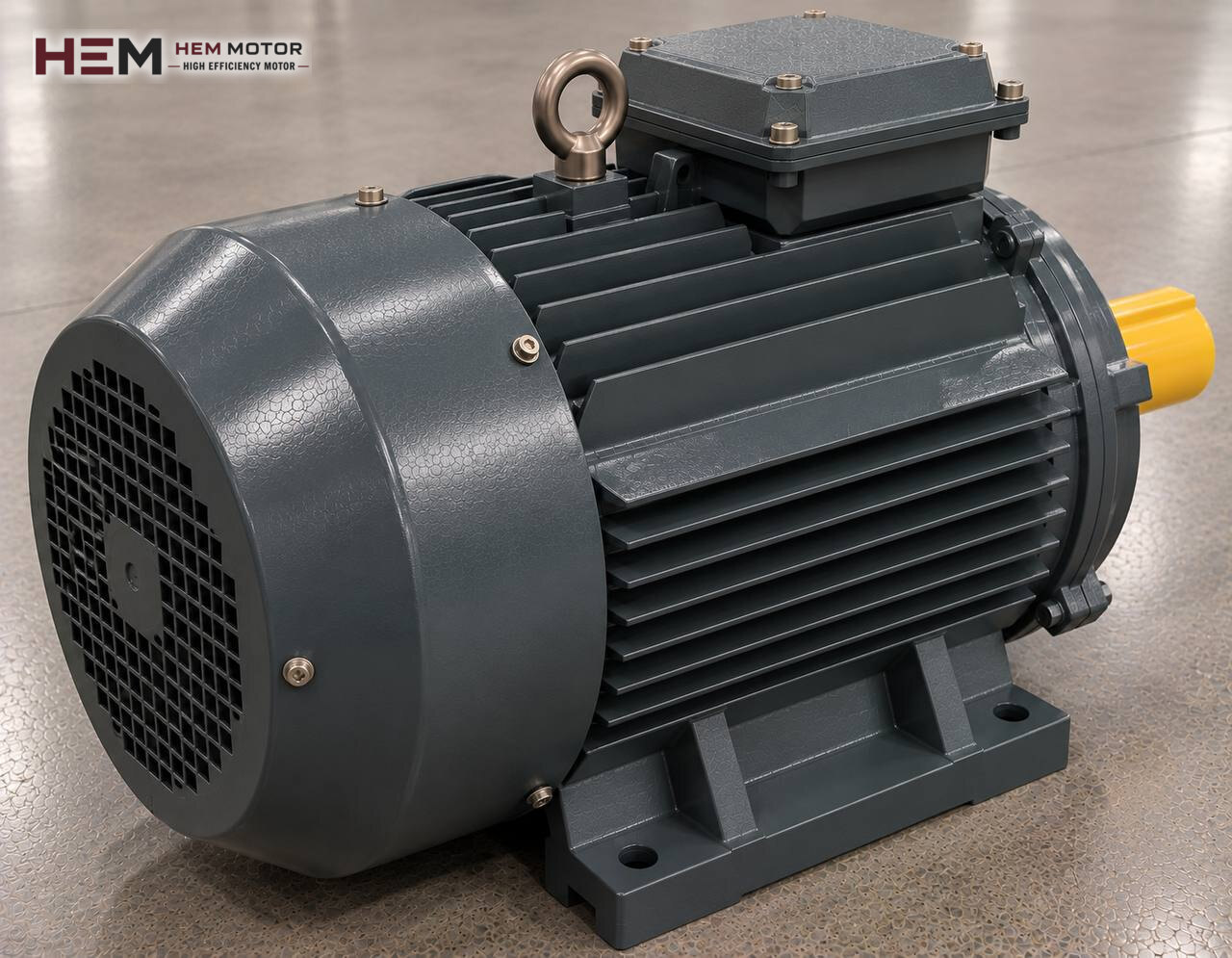
In hotel, hospital and contract laundries, linen moves along a line: it is washed, dewatered, dried, ironed and folded. This page explains which machines in an industrial laundry use a standard three-phase motor and where the machine's own dedicated drive should be kept. For other machines in the textile group, see the textile machinery electric motors page.

Where the Motors Sit in a Laundry
Walking through a laundry, you barely see the motors; they run behind machine panels, under pulley guards or inside ducts in the ceiling. By task they still fall roughly into five groups:
Washer-extractors: turn the drum at low speed back and forth for washing, then at high speed for extraction.
Tunnel washers: in large plants a long drum transfers linen from compartment to compartment, fed by a press and conveyors.
Flatwork ironers (calenders): the rotation of the heated rolls and the extraction fan that draws off steam are separate drives.
Folding and feeding machines: contain many small belt and roller motors.
Auxiliary installation: water and chemical dosing pumps, hot water circulation, exhaust fans and overhead rail systems.
Tumble dryers and stand-alone centrifugal extractors are also part of a laundry; because their motor topic is specific, they are only named on this page. Their details are covered on their own pages.
The Reality of Dedicated Drives in Washer-Extractors
In most modern washer-extractors the drum motor is the machine maker's own design. These motors are matched with the machine's drive to run at very different speeds for washing, distribution and extraction; frame size, shaft output and fixing points are also shaped to the machine. When the drum motor of such a machine fails, the right course is usually to consider the maker's spare part or a rewind.
A standard IEC motor can only be considered in that case under these conditions: the machine is an older, belt-and-pulley, fixed-speed design, the motor sits on a standard foot or flange fixing, and the drive or contactor arrangement can be adapted to the new motor. Before deciding, it is best to send us the old motor's nameplate, fixing dimensions and drive type. If the old machine uses a motor running at two separate speeds, that is also discussed separately at the quotation stage.
Machines Where a Standard Motor Belongs
Ironer roll and extraction fan
In a calender the rolls turn slowly through a gearbox and chain or gear transmission. The bands that press the sheet firmly against the roll take their motion from the same drive. Because ironing speed changes with sheet type and moisture, this motor usually runs on a frequency converter. Our three-phase series is suitable for this kind of speed adjustment; if it will run at full load at low speed for long periods, the need for a separate cooling fan, and if the cable between drive and motor is long, the need for a filter, are assessed at the order stage. Details are on the inverter-compatible electric motors page.
The extraction fan that pulls steam and heat away from the roll is a direct-coupled or belt-driven fan. Its motor works near hot, humid air, so mounting the fan motor on the cool side of the duct where possible, rather than right above the heat source, extends its life.
Folding, feeding and conveyors
The belt and roller motors in folding machines are low-power, stop and start frequently and usually run with a gearbox. Overhead rail systems and soiled-linen conveyors have drives of the same character. In this group, lightweight aluminium-frame motors are a practical choice.
Pumps and tunnel line
Water, hot water and chemical pumps are motorised according to the pump maker's data. On tunnel lines, turning the large drum and the hydraulic unit of the linen press need standard motors of higher power; since the press force comes from the hydraulic system, the motor is selected by the pump's flow and pressure. This is explained on the electric motors for hydraulic pumps page.
A Hot, Humid and Lint-Laden Environment
Laundry air carries three things together: heat, humidity and cotton lint. Lint collects between the motor's cooling fins and in the fan cover grille, gradually blocks the airflow and the motor heats up. Cleaning the cover and fins with compressed air at regular intervals is the most effective maintenance in this environment.
Our motors are IP55 and come with class F insulation. This construction suits dusty areas with splashing water; however, washing the motor directly, steam blowing onto it or keeping it permanently under water are outside the design scope of this rating. If such a risk exists, the machine maker's protective measure is needed; if you have a different requirement, state it in your order. For motors that stand overnight and start in a humid room in the morning, an anti-condensation heater, and for drives with frequent starts a PTC winding sensor, can be requested as order options.
Example HEM Models for a Laundry
| Machine | Motor's task | Value to check | Example HEM model |
|---|---|---|---|
| Folding machine belt | Light, frequent starts | Gearbox connection | 0.37 kW, 1,340 rpm, 71M2-4 aluminium |
| Ironer roll drive | Slow, speed-controlled | Converter, cooling | 1.5 kW, 1,445 rpm, 90L-4 aluminium |
| Ironer extraction fan | Continuous, hot air | Fan speed, mounting location | 2.2 kW, 2,895 rpm, 90L-2 aluminium |
| Older belt-driven washer | Fixed speed, heavy start | Pulley ratio, fixing dimensions | 4 kW, 1,450 rpm, 112M-4 cast iron |
The models in the table are examples; the final selection is based on the machine maker's data, required speed, pulley ratio and mounting type. If you are replacing a motor, the nameplate of the removed motor is the most reliable reference.
For light drives in small laundries with a single-phase supply, the single-phase electric motor series in the 0.18–5.5 kW range is an option.
What Information Is Needed for a Quotation?
Write to us with the machine the motor will be fitted to (ironer, folder, fan, pump, conveyor or washer), the required power and speed, the mains voltage, the mounting type, the pulley or gearbox connection and the quantity. Depending on the frame, B3, B5, B14, B34, B35 designs and V1, V3, V5, V6 and V15 vertical positions can be prepared; flange and shaft dimensions are confirmed at the order stage.
A nameplate photo of the old motor makes finding an equivalent easier. All models are listed on the buy electric motors page; prices are on the product pages. Reach us on WhatsApp or by phone for your requests; details are on the contact page.
Frequently Asked Questions
If my washer's drum motor burns out, can I fit a standard motor?
If the machine uses a dedicated motor matched to its drive, usually not; the right course is the maker's spare part or a rewind. On older, belt-driven, fixed-speed machines a standard motor can be considered if the fixing dimensions match. Sending the nameplate and a photo of the fixing makes the decision easier.
Why does the ironer roll motor get hot?
The most common causes are long periods at full load at low speed and lint collected on the fan cover. Cleaning the cover is the first step. If the roll always runs slowly, a separately ventilated cooling option can be evaluated at the order stage.
Which maintenance matters most for laundry motors?
Lint removal, checking belt tension and listening to bearing noise. Having insulation resistance measured before starting a motor that has stood for a long time in a humid environment is also a good habit.
Does replacing the extraction fan motor with a more powerful one help?
The power a fan draws depends on its speed and impeller; fitting a larger motor at the same speed does not increase the air volume. If the fan must move more air, the impeller or speed has to change, and this should be done with the fan maker's calculation.