In dust collection systems the fan is the heart of the filter collector: it draws dusty air from the extraction points through bags or cartridges and discharges the cleaned air. When a fan motor burns out, or a worn motor is due for renewal, most plants read the kW value on the nameplate and order the same. This often works; but if the impeller has been changed, the pulley ratio altered or the system extended, the old nameplate may no longer reflect the real requirement. In this article we explain step by step how to check a dust collection fan motor replacement within the triangle of impeller, speed and power.
How is the fan load created? The relationship between flow, pressure and speed
The power a fan draws from its shaft depends on the amount of air it moves and the resistance it overcomes. On a dust collection line this resistance is made up of duct length, bends, extraction hoods and, above all, the loading of the filter elements. From the motor's point of view the most important point is this: as fan speed increases, the power drawn rises very quickly.
The approximate relationships known as the fan laws state the following for the same fan and the same system:
Flow changes roughly in direct proportion to speed.
Pressure changes with the square of speed.
Shaft power changes with the cube of speed.
This cube relationship is very critical in practice. For example, if the fan speed is increased by one tenth by changing the pulley, shaft power rises by roughly one third. A decision to "enlarge the pulley a little" for more suction can easily push the existing motor into overload. The reverse is also true: reducing speed lowers power considerably, but suction weakens as well.
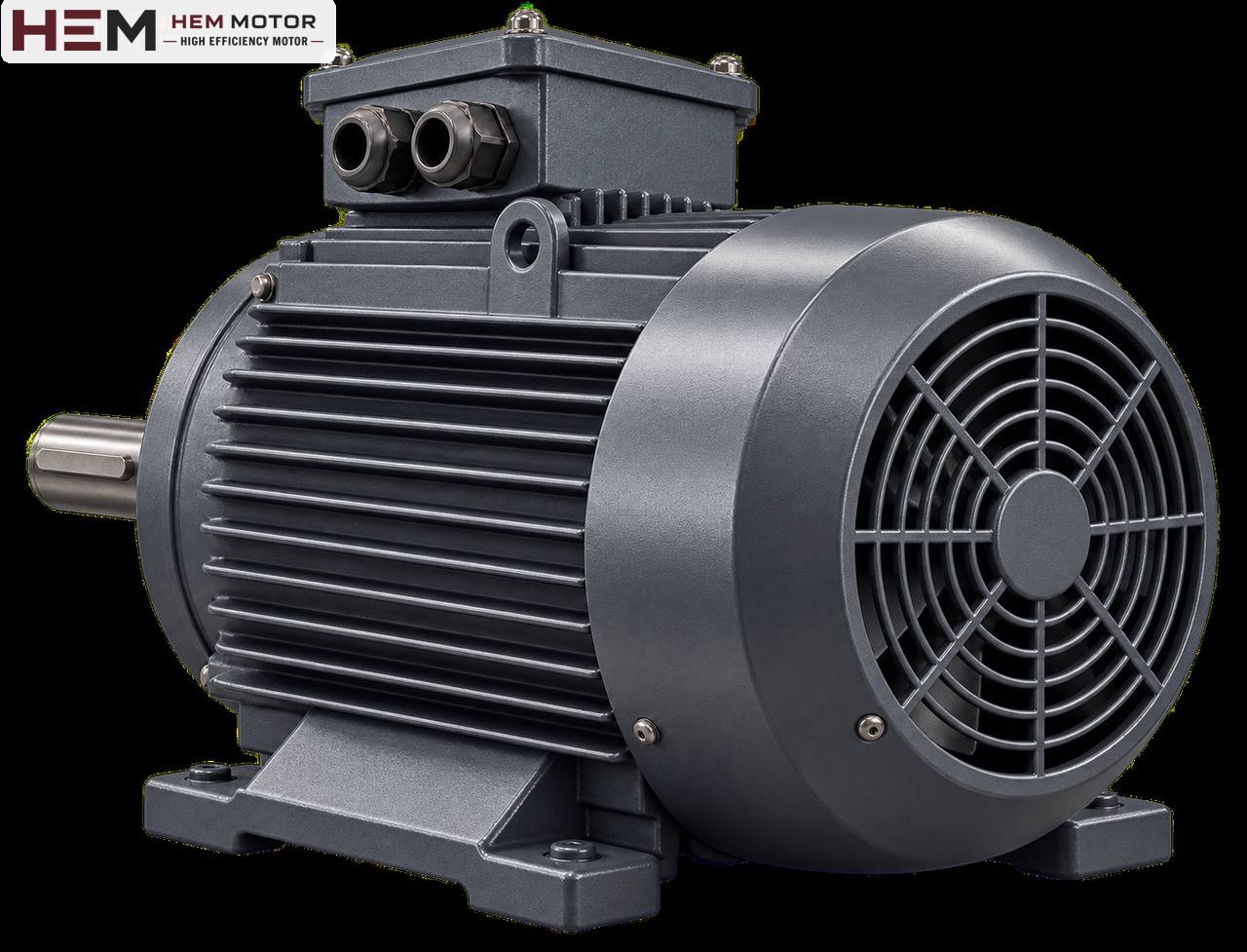
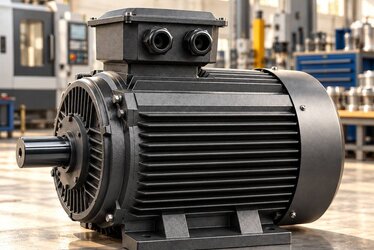
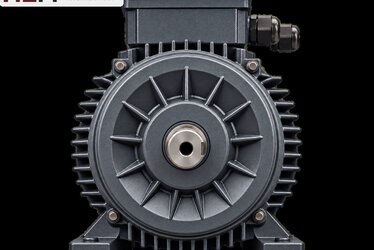
The motor's own cooling fan should not be confused with the impeller of the dust collection fan (representative image).
Impeller check: look at the fan before choosing the motor
If a motor is replaced without examining the fan itself, the problem continues with the new motor. The following points about the impeller feed directly into motor selection:
Impeller type: With backward-curved blades, power does not rise much beyond a certain point as flow increases. With radial (straight) and forward-curved blades, power keeps rising as flow increases. Radial-blade impellers, common on lines with high dust loads, are the type that loads the motor most when the filter is clean.
Has the impeller been changed? If a larger diameter impeller or one with a different blade angle was fitted during an earlier repair, the old motor nameplate may not meet the needs of the new impeller. Note the diameter and type of the impeller.
Balance and build-up: Dust sticking to the blades both makes the impeller heavier and upsets its balance. An unbalanced impeller returns to the motor bearings as vibration. Having the impeller cleaned and its balance checked before fitting the new motor protects the life of the new motor.
Inertia: Large, heavy impellers take a long time to accelerate at start-up. Throughout this time the motor draws high current; thermal protection and the starting arrangement must be set accordingly.
Speed matching: direct-coupled and belt-driven fans
Direct-coupled fan
If the impeller is mounted directly on the motor shaft or connected by a coupling, fan speed equals motor speed. In this case the new motor must have exactly the same number of poles. If a 4-pole model is fitted in place of a 2-pole motor, fan speed halves and suction becomes very weak; the reverse overloads the motor and the fan and may exceed the permitted tip speed of the impeller. The nameplate speed is the rated speed: a motor known as "3,000 rpm" shows, for example, 2,930 or 2,945 rpm on its nameplate, and this is normal because of slip.
Belt and pulley fan
Fan speed comes from the motor speed and the pulley ratio. Here it is theoretically possible to change the number of motor poles and compensate with pulleys, but every change alters torque, belt speed and shaft load. The safest course is to keep the speed of the existing motor and leave the pulleys unchanged. If you are moving the pulley to the new shaft, compare the shaft diameter and key size in the technical drawings; dimensions are also given in the 2026 technical and product catalogue.
Prices and technical data are on the product pages; choose a model and order online.
Power matching: when should the nameplate value be questioned?
If one of the following situations applies, re-evaluate the system instead of copying the kW value of the old motor directly:
The old motor tripped its thermal overload frequently, or its frame became too hot to touch.
New extraction points were added to the line, the ductwork was extended or the filter type was changed.
The impeller or pulley was replaced during an earlier repair.
The current of the old motor was measured and found to be above the nameplate current.
In these checks the most valuable data is the current measured on the running system. Take measurements both when the filter has just been cleaned and before cleaning. On radial fans, when the filter is clean or the damper is fully open, air resistance falls, flow increases and the motor is loaded more. The motor needs to be assessed for this most heavily loaded condition. Power cannot be derived from the fan diameter or the collector size alone; for an exact value, the fan manufacturer's data or on-site measurement is used.
Using the damper at start-up
On radial fans, starting with the inlet damper closed reduces the power drawn during acceleration. On large fans with long start-up times, this practice is considered together with the choice of starting method (direct-on-line, star-delta, soft starter or drive).
Operation with a frequency inverter
Plants that want to adjust flow by speed rather than by damper use a drive. Our three-phase series are suitable for speed control with a frequency inverter; for long periods of full-torque operation at low speed an external fan may be required, and if the cable between drive and motor is long a dv/dt or sine filter is considered; these conditions are stated with the order. For details, see the question on inverter operation. Because the torque requirement of a fan load also falls quickly as speed drops, this arrangement is common on fans; however, going above 50 Hz with a drive quickly pushes the motor into overload because of the cube relationship above.
Environment and layout: where is the motor in the dusty air?
Most dust collection fans are placed on the clean-air side of the filter; in this way the impeller and motor meet relatively clean air. On fans running ahead of the filter, on the dusty-air side, the impeller wears and dust accumulates around the motor. Our models on sale are IP55-rated with class F insulation. If the motor's cooling fins and fan cowl become clogged with dust, cooling is impaired; regular cleaning should be planned. If the conveyed air is hot, the motor frame is positioned outside this air flow, with suitable cooling. If combustible dust or an explosive atmosphere is present, this must be reported before ordering; it may fall outside the scope of a standard motor.
Example models and a hypothetical replacement scenario
The models below are examples of powers and speeds commonly found on dust collection fans. The exact choice is made according to your fan's data and measurements.
132S1-2 cast iron frame: 5.5 kW (7.5 HP), 2 poles, 2,930 rpm rated, IEC 132S, 400/690 V (Δ/Y), 50 Hz.
160M1-2 cast iron frame: 11 kW (15 HP), 2 poles, 2,945 rpm rated, IEC 160M, 400/690 V (Δ/Y), 50 Hz.
160M-4 cast iron frame: 11 kW (15 HP), 4 poles, 1,465 rpm rated, IEC 160M, 400/690 V (Δ/Y), 50 Hz.
The 160M1-2 and 160M-4 models of the same power are both in a 160M frame; yet their speeds differ by half. For this reason, a matching frame code does not mean the motor suits your fan; the number of poles must match as well. The current price is on each model's product page.
Hypothetical example: The following sequence is not a real customer application. Suppose that in a furniture workshop the motor of a direct-coupled radial dust collection fan has burned out. The nameplate reads 11 kW and 2,945 rpm. First the impeller is checked: stuck wood chips are cleaned off, the balance is checked and it is confirmed that the impeller has not been changed before. Since no new extraction point has been added to the line, the power is kept; the number of poles must remain the same, so the 2-pole 160M1-2 is considered. After the motor is commissioned, the current is measured with a clean filter and compared with the nameplate current. Because wood dust is combustible, the ambient conditions are stated separately in the order.
Conclusion: what to send before ordering
The right motor for a dust collection fan is found when the impeller type and condition, the fan speed and the real load of the system are assessed together. The nameplate value is a good starting point, but if the impeller, pulley or ductwork has changed it is not enough on its own. To determine the right model together, send us the following information:
Power, speed and a nameplate photo of the existing motor
How the fan is connected (direct-coupled, coupling or belt) and, if applicable, the pulley ratio
Impeller type and diameter, and whether the impeller has been changed
Mounting arrangement (foot-mounted, flange or vertical), network voltage and starting method
Operating current, if measured; ambient conditions (dust type, temperature, combustibility)
The cards show example models related to the topic. A suitable motor is not chosen by power alone: compare speed, voltage, mounting, shaft and connection dimensions on the product page; if unsure, send a photo of the existing motor’s nameplate on WhatsApp.
When replacing the drying fan motor of a glass washing machine, three things must stay the same as on the old motor: the number of poles (and therefore the fan speed), the motor's ... More Details
On a cold storage condenser, a standard three-phase motor can be used if the fan propeller is fitted to the shaft of a separate IEC-frame motor or driven by a belt. In external-rot... More Details
The motor for the circulation pump of a fabric dyeing machine is chosen not by looking at the machine's capacity but according to the pump's own data: flow, head, pump speed and th... More Details
When a stenter fan motor is replaced, two conditions are decisive: the temperature where the motor sits must be at a level a standard IP55, class F motor can work in, and the new m... More Details
A standard three-phase motor is the right choice for the hot air fan of a shrink packaging machine only if the motor frame stays outside the hot zone of the tunnel. The fan impelle... More Details
What strains the pump motor on a bottle washing machine is often not the electrical load but the motor's surroundings: steam rising from hot caustic solution, label pulp stripped o... More Details
We use necessary and optional cookies to improve your experience, enhance content and analyse traffic. Under the GDPR, optional (analytics/marketing) cookies are only used with your explicit consent. Please choose your preference below.
Cookie Policy
 English
 Français
 Türkçe
 Español
 Русский