English
 Français
 Türkçe
 Español
 Русский

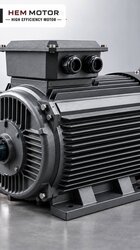
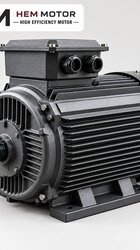
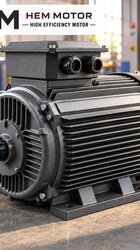

The motor of a boiler induced draft fan is selected according to the shaft power at cold start-up, when the fan moves its densest air, the speed the impeller was designed for and the boiler's continuous operating regime. The power on the nameplate is often calculated for flue gas at operating temperature; if cold start, damper position and load changes are not taken into account, the motor struggles at the first firing. This article covers these three topics through the real operating pattern of a boiler room.
On site, the term "induced draft fan" usually refers to the fan that draws flue gas out of the boiler and pushes it into the stack (ID fan). The fan that blows combustion air into the burner is the forced draft or combustion air fan. The assessment below mainly describes the induced draft fan; points that differ are noted separately.
Where does the fan operate: induced draft fan versus combustion air fan
The conditions the two fans impose on the motor differ:
- Induced draft fan: It carries the hot flue gas leaving the boiler. The impeller sits in the hot gas, while the motor is outside the fan casing, usually connected through a bearing unit and a coupling or belt. The gas can carry ash and dust; over time the impeller wears and loses its balance.
- Combustion air fan: It blows clean, relatively cool boiler room air to the burner. The impeller is often mounted directly on the motor shaft. The motor load is steadier; the air temperature equals the boiler room temperature.
A standard three-phase motor is not designed to run inside flue gas or on a hot surface next to the gas duct. The motor belongs outside the gas flow, at a point where it can draw cool air. Heat transfer between the hot gas and the motor is handled by the fan's bearing unit, cooling disc and casing insulation; these parts are the fan manufacturer's responsibility.
Power: which operating point determines the motor?
A fan's shaft power is directly proportional to the density of the gas it moves. Hot flue gas is much lighter than cold air. For this reason, when the boiler is started cold and the duct still holds cold air, the induced draft fan draws noticeably more power than at operating conditions. If the power value in the fan data sheet is given only for hot gas, this difference can overload the motor.
In practice three approaches are used:
- A motor that covers the cold power: The motor is selected for the fan's shaft power in cold air. This is the simplest and safest solution; in operation the motor is less heavily loaded.
- Starting with a damper: The fan starts with the inlet or outlet damper throttled; the damper opens as the boiler warms up. With this arrangement, make sure the damper control works correctly; if the damper stays open, the motor is fully loaded with cold gas.
- Frequency inverter: The fan is held at low speed until the boiler warms up. Because the power drawn falls rapidly as speed drops, the cold-start problem largely disappears.
Ask the fan manufacturer separately for the shaft power at operating temperature and in cold air. Motor power is not estimated from the boiler's capacity or fuel type; two boilers of the same capacity can have very different duct resistance and fan design.
Speed: why is the impeller speed kept?
On a direct-drive fan the impeller turns at the motor's rated speed. Changing the number of poles changes the fan's pressure with the square of the speed and its power roughly with the cube of the speed. Fitting a 2-pole model in place of a 4-pole motor overloads the motor several times over and can exceed the impeller's permitted tip speed. When replacing, the speed on the old motor's nameplate is the reference.
On belt-driven fans the speed is set by the pulley ratio; if the motor's number of poles changes, the pulleys must be recalculated. On induced draft fans carrying ash, the impeller is often run at a relatively low speed to reduce wear. That is why 4- and 6-pole motors are more common on induced draft fans and 2-pole motors on clean-air combustion fans. This is a tendency; the decision is based on the fan's own design speed.
Operating regime: continuous operation and load changes
A boiler fan usually runs without stopping throughout the heating season, and all year round on steam boilers. The motor must be suitable for continuous (S1) operation at its rated power; the temperature the boiler room reaches in summer and the motor location are stated with the order.
- Stepped and modulating load: As burner output changes, the fan flow is adjusted with a damper or a drive. The motor is selected so that it can deliver the power of the highest load stage continuously.
- Number of starts: Even if the burner cycles often, the induced draft fan is usually left running. If the fan also stops in every cycle, state the number of starts per hour with the order; frequent starts with a high-inertia impeller heat the winding.
- Vibration: Ash build-up and wear on the impeller create imbalance; this vibration is passed first to the motor bearings. Cleaning the impeller and checking its balance before the motor is replaced protects the new motor.
- Spare motor: If the fan stops, the boiler stops too. In critical plants a spare motor of the same frame and speed can be kept ready; to keep a stored motor in good condition, see the article on keeping a spare motor on the shelf.
If speed control is used, the general statement on the site applies: our three-phase series are suitable for speed control with a frequency inverter; during long periods of full-torque operation at low speed an external fan may be required, and if the cable between drive and motor is long a dv/dt or sine filter is considered; these conditions are stated with the order. Because the torque demand of a fan load also falls at low speed, this arrangement is common on boiler fans.