English
 Français
 Türkçe
 Español
 Русский

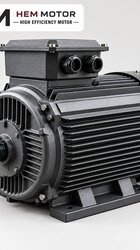

When the fan motor of an air handling unit is replaced, the new motor must match not only in power and speed but also work with the existing fan's mechanical connection and with the settings of the inverter that drives the unit. The right motor is chosen with the same number of poles and frame and a shaft end able to carry the fan impeller; the new motor's nameplate values are then entered into the drive. This article explains, in order, the replacement steps for plug (free-wheel) and belt-driven AHU fans and the inverter-related checkpoints.
Get to know the fan arrangement in the unit
In air handling units, the fan sits in a separate section inside the casing and the motor is often in the same airstream as the fan. Before the replacement, identify which arrangement you are dealing with, because the checklist changes accordingly.
- Plug fan (free-wheel, direct drive): The impeller is mounted directly on the motor shaft and there is no scroll housing. The motor is usually foot-mounted on a base or frame. The motor shaft directly carries the weight and unbalance of the impeller.
- Belt-driven double-inlet centrifugal fan: The fan turns in its own bearings, the motor sits on separate slide rails and transmits power through belts and pulleys. The motor replacement is mechanically more independent.
- EC motor fan modules: The motor and its electronics form a single unit. Replacing this unit with a standard induction motor and a separate inverter is not just a motor replacement but a change of drive and control arrangement; it is assessed as a separate project.
Motor replacement on a plug fan: shaft, impeller hub and balance
On plug fans, the most critical point is that the impeller hub fits the new motor shaft exactly. The hub bore, keyway and length are machined to suit the old motor's shaft end. When the new motor is chosen in the same IEC frame and pole number, the shaft dimension is expected to match; but this must be confirmed before ordering. Dimensions are in the 2026 technical and product catalogue and the 2D technical drawings.
- Shaft end and hub: The shaft diameter, shaft extension length and key size must be the same as the hub. If the hub does not seat fully on the shaft, the impeller runs out of true.
- Position of the impeller on the shaft: The further the impeller is from the motor's drive-end bearing, the greater the load on the bearing. Fit the impeller in its former position, keeping the gap to the inlet cone.
- Inlet cone gap: The clearance between the impeller and the inlet directly affects fan performance. If the shaft shoulder of the new motor is at a different point from the old one, the impeller moves forward or back; measure and adjust this clearance.
- Balance: After the impeller is fitted to the new shaft, vibration should be measured and, if necessary, field balancing carried out. On a plug fan, unbalance is transmitted directly to the motor bearings.
- Direction of rotation: Plug fan impellers are efficient in one direction only. An impeller running in reverse still moves air but at reduced airflow, and the motor draws unnecessary current; the direction is checked at first start-up.
Motor replacement on a belt-driven AHU fan
In a belt-driven arrangement, motor replacement is usually easier. If the new motor is chosen with the same number of poles, the pulley ratio and fan speed are preserved. The foot holes of the motor slide rails must match the new frame, the motor pulley must be fitted close to the shaft shoulder and the belt tension must be readjusted. If you are thinking of changing the pulley ratio, have the power requirement at the new speed recalculated, since fan power changes with the cube of speed.
On AHU fans the mounting arrangement is usually foot-mounted (B3). According to the general information on our site, B3, B5, B14, B34, B35 and vertical V1/V3/V5/V6/V15 arrangements are offered according to the frame; the flange size is confirmed with the order.
Inverter compatibility: what to do on the drive after the replacement
AHU fans are mostly driven by frequency inverters; airflow is adjusted by a pressure sensor or a building automation signal. When the motor is changed, the drive continues to "know" the old motor. So the replacement is not complete until the motor parameters in the drive have been updated.
Our three-phase series are suitable for speed control with a frequency inverter; for long periods of operation at low speed with full torque, a separate fan may be needed, and if the cable between drive and motor is long, a dv/dt or sine filter is considered; these conditions are stated with the order. For details, see the question on inverter use.
- Enter the nameplate values: Rated power, rated voltage, rated current, rated speed, frequency and, if given, power factor are entered into the drive from the new motor's nameplate. The connection (Δ or Y) is made according to the drive's output voltage; a motor rated 400/690 V is connected in delta on a drive with 400 V output.
- Motor identification (auto-tune): On vector-controlled drives, the motor parameters are re-identified by measurement. If this step is skipped, the drive works with the wrong model.
- Current limit and protection: The motor overload protection in the drive must be set to the new rated current. A higher value left over from the old motor can leave the new motor unprotected.
- Frequency range: Pay attention if the maximum operating frequency is set above 50 Hz. Because fan power rises with the cube of speed, above 50 Hz the motor loads up very quickly; in addition, the impeller's maximum permissible speed must not be exceeded.
- Cable and filter: If the drive is in a panel room and the motor is inside the rooftop unit, the cable may be long. With a long cable, voltage peaks occur at the motor terminals; a dv/dt or sine filter is considered in this case. If a filter is already fitted, it is used with the new motor as well.
- Cooling at low speed: With a fan load, torque falls as speed falls; heating at low speed is therefore more limited than with constant-torque loads. Even so, if the unit runs for long periods at very low frequency, state this with the order.
Browse suitable HEM Motor models and current prices in the online sales section. For general information on HVAC applications, see the HVAC sector electric motors page.