English
 Français
 Türkçe
 Español
 Русский
 العربية
 Deutsch
 Italiano

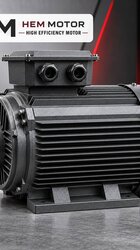
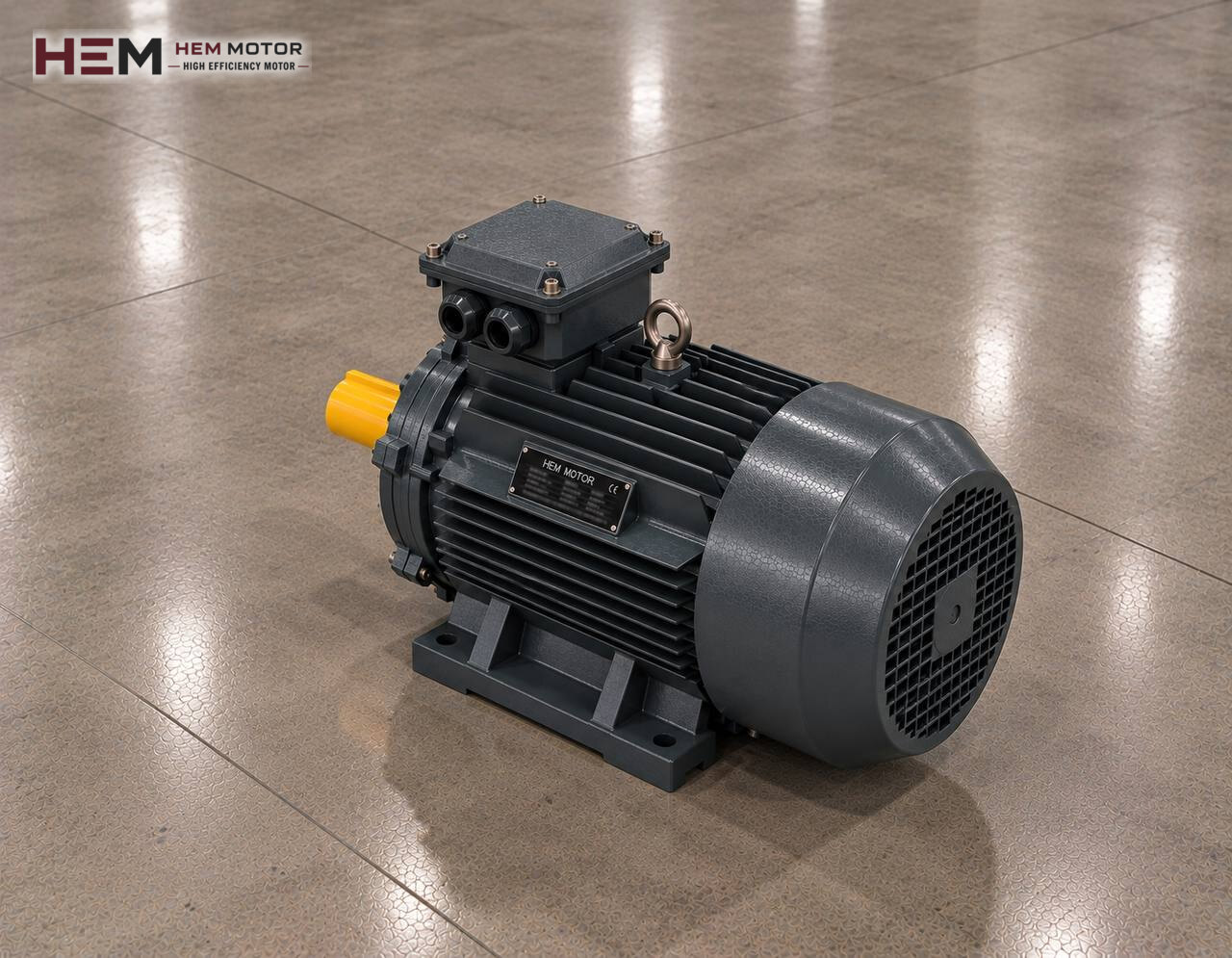

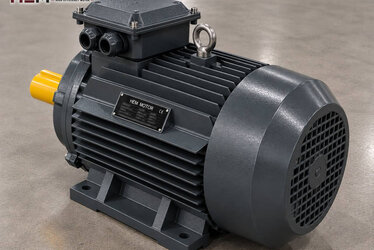
A six-pole electric motor pays off when the driven machine wants to turn at around 1000 rpm or slower and needs more shaft torque for the same kW. It reduces the gearbox ratio, balances belt pulleys and allows a direct coupling on large fans and drums; in return the frame grows and the price rises at the same power.
At what speed does a six-pole motor run and why is its torque higher?
On a 50 Hz supply the rotating field of six poles makes 1000 turns per minute; under load the rotor lags slightly behind, between 940 and 990 rpm. At constant power, torque rises as speed falls. At the same kW the shaft gets roughly fifty percent more Nm than with a four-pole motor.
The calculation is short (general information; confirm with the machine manufacturer): T [Nm] = 9550 × P [kW] / n [rpm]. A 7.5 kW motor gives about 49 Nm at 1460 rpm, while at 970 rpm the figure climbs to 74 Nm. The relation used for the rotating field speed is ns = 120 × f / p, where p is the total number of poles.
The first person to see the difference on site is the fitter removing the coupling.
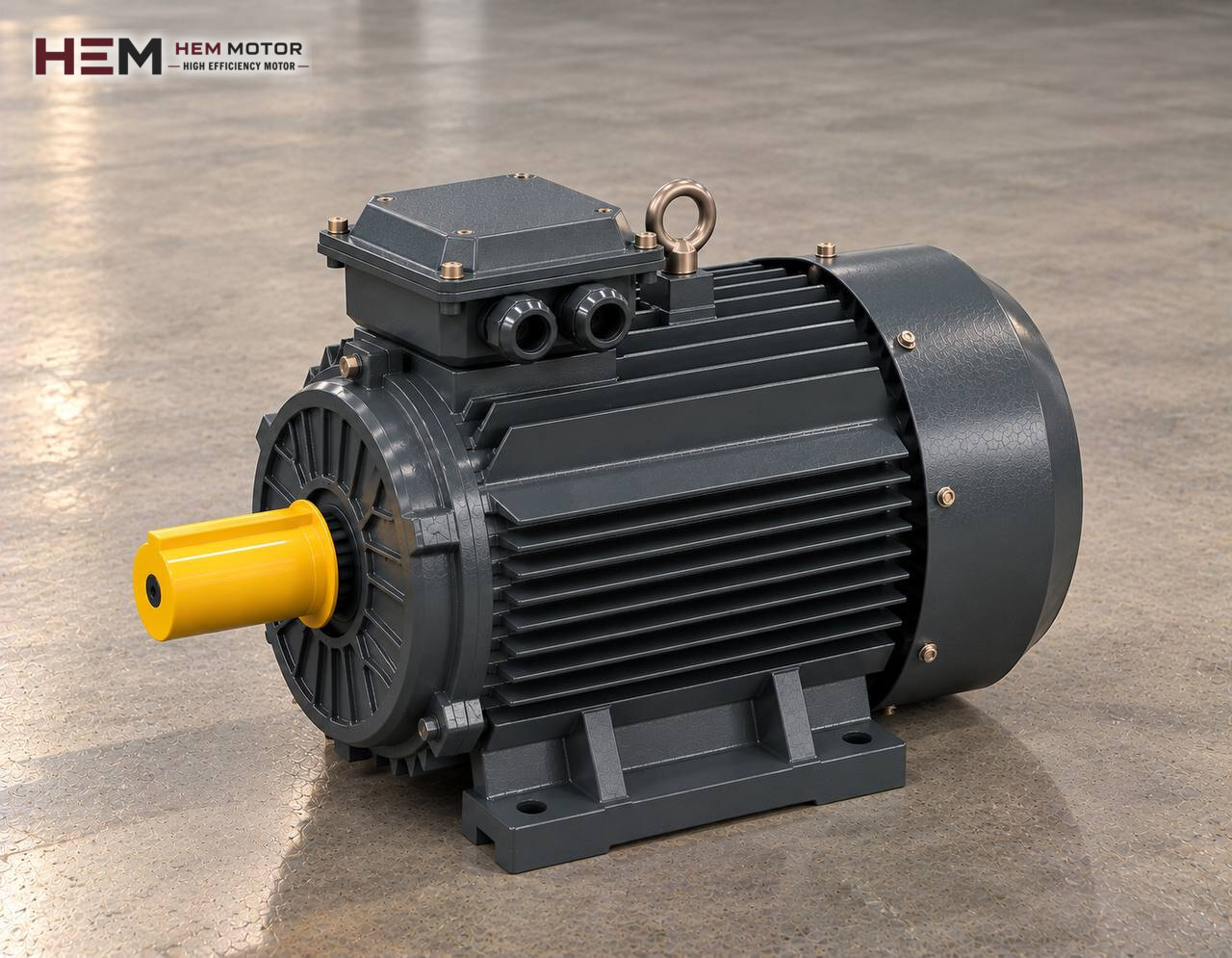
Of two motors with the same kW on the plate, the six-pole one has a visibly thicker shaft end and coupling hub, because that shaft is sized to carry a larger twisting moment and the coupling is selected on that moment too.
How is the gain calculated through gearbox ratio and pulley diameter?
The gain comes from a smaller reduction ratio needed to reach the speed the machine wants. As the ratio shrinks, a gearbox stage may be dropped and the large pulley of a belt drive gets smaller.
A hypothetical example: a drying drum wants 160 rpm. With a four-pole motor (1460 rpm) the ratio needed is 1460 / 160 ≈ 9.1. With a six-pole motor (970 rpm) the same target is reached with 970 / 160 ≈ 6.1. In a single-stage belt drive a 9:1 ratio leaves the small pulley tiny, the belt wraps it over only a short arc and slips. A 6:1 ratio is far easier to build.
With a gearbox the picture is similar. If the ratio can drop one step in the catalogue, the gearbox housing may get smaller. There is one condition.
Because output torque stays the same, torque on the input shaft rises, so no motor order should be placed before checking in the input torque column of the gearbox catalogue that the input shaft and its key can take that value. For the flange match between motor and gearbox, the page on electric motors for gearboxes gives guidance.
On which machines can a six-pole motor be coupled directly?
On machines with an operating speed in the 900–1000 rpm band, a six-pole motor can be coupled with no transmission element in between. Large-diameter axial fans, some centrifugal fans, pumps meant to turn slowly and some hammer mills belong to this group.
On a large-diameter fan, blade tip speed sets the limit. The bigger the diameter, the slower the rotation needed to reach the same tip speed. That is why six poles are common on cooling tower and drying oven fans. Once the belt is gone, tensioning, pulley alignment and belt dust also drop off the maintenance list. Only a coupling guard takes their place.
On the pump side, slurry pumps handling thick or abrasive media wear their casing and impeller more slowly when they turn slowly. If the pump maker's performance curve is drawn for 980 rpm, running the same pump with four poles pushes flow and head off the curve.
What changes in frame size, current and power factor?
A six-pole frame is usually one IEC step larger than a four-pole motor of equivalent power; rated current is slightly higher and power factor slightly lower. The reason is that the share of current spent exciting the magnetic circuit grows as the pole count rises.
A concrete comparison: at 7.5 kW the four-pole model draws 14.3 A in a 132M frame, while the six-pole model draws 15.4 A in a 160M frame. On the panel side, the thermal relay and contactor are chosen for this higher current. Cable size and protective devices are recalculated by the panel engineer from the new motor's plate current, starting current and line length.
Since the frame grows, the old base may not fit. Foot fixing holes, shaft centre height above the floor and shaft end size should be compared one by one against the frame drawings on the technical drawings page.