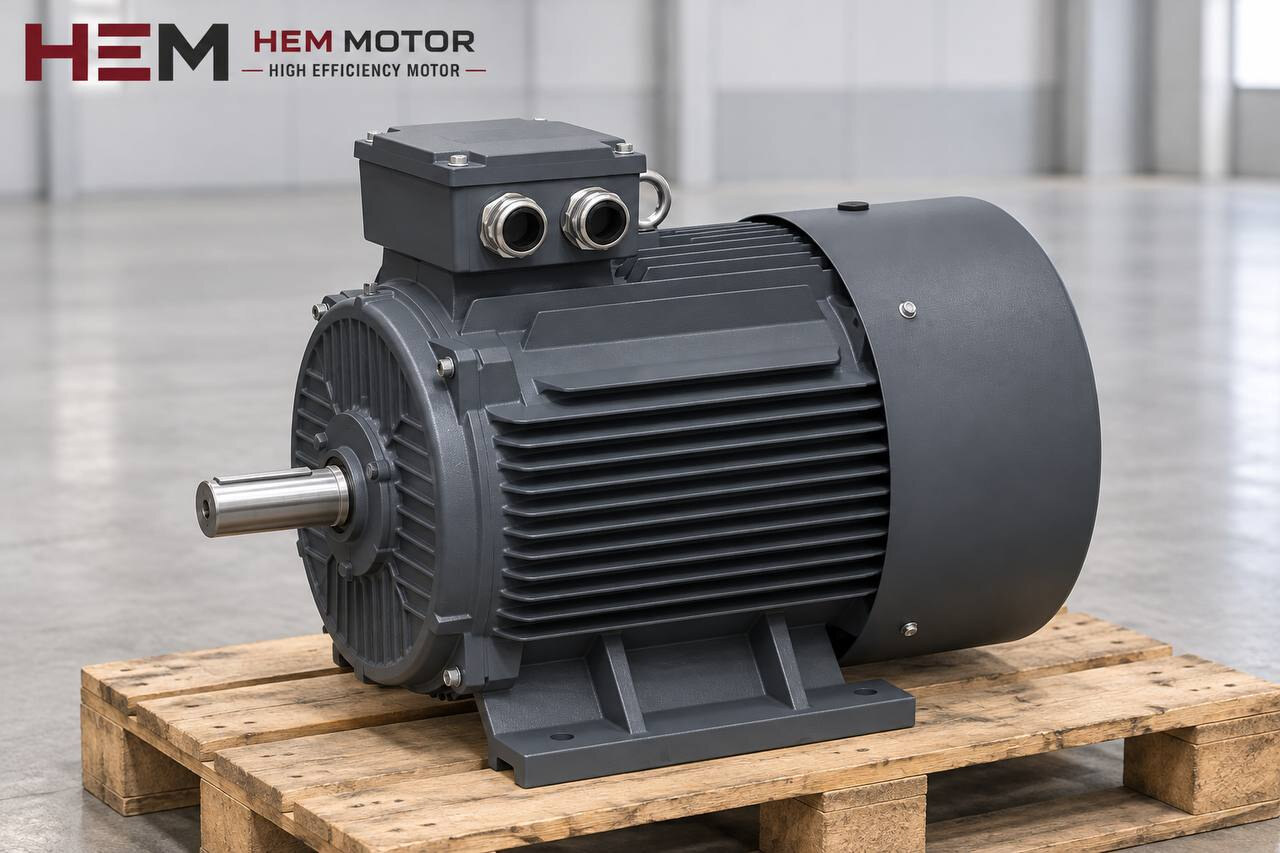
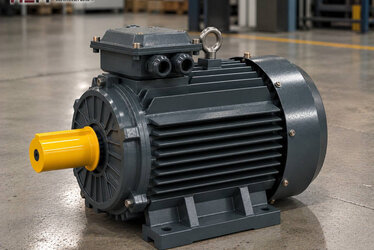
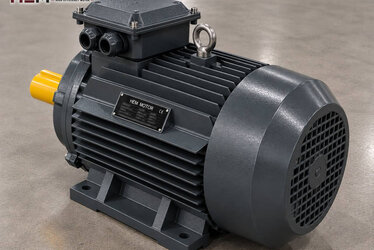
3000 rpm is the theoretical field speed that the 50 Hz supply creates in a 2-pole electric motor and that the shaft never catches; around 2900 rpm is the speed actually measured at the shaft of the same motor at rated load. They are not two different motors but two separate values of the same motor. The gap of roughly 100 rpm comes from slip and shifts a little with the motor's power, its load and the supply voltage.
Where does the 3000 figure in the catalogue come from?
3000 is the number of revolutions per minute of the magnetic field in the stator, and it is set by only two things: the supply frequency and how many poles the winding is built with. The calculation is one line: ns = 120 × f / p. For 50 Hz and 2 poles, 120 × 50 / 2 = 3000 rpm (general information; confirm with the machine manufacturer).
That is why catalogue headings, shop filters and order language say "3000 rpm motor". What is meant is the motor's class: the two-pole, high-speed group. By the same logic, 4-pole motors are called 1500 rpm and 6-pole motors 1000 rpm.
Field speed carries no load, does not heat up, does not wear.
Why does the shaft turn at around 2900?
For the rotor to produce torque it has to stay slightly behind field speed; rotor bars turning at the same speed would have no current induced in them. This lag is called slip, and the rated speed on the nameplate is the shaft speed measured while the motor delivers its rated power.
The slip ratio is found with s = (3000 − n) / 3000. On a motor with 2895 rpm on the nameplate this gives (3000 − 2895) / 3000 = 0.035, or about 3.5%. That is all there is to it: the reason for 2900 is not a fault, a manufacturing tolerance or a "weak motor", but physics itself.
On HEM Motor's 2-pole models, nameplate speed changes with power as follows:
Model
Power
Nameplate speed
Slip
Rated torque
80M1-2
0.75 kW
2880 rpm
4.0%
2.49 Nm
90S-2
1.5 kW
2895 rpm
3.5%
4.95 Nm
112M-2
4 kW
2905 rpm
3.2%
13.1 Nm
160M1-2
11 kW
2945 rpm
1.8%
35.7 Nm
200L1-2
30 kW
2960 rpm
1.3%
96.8 Nm
280S-2
75 kW
2975 rpm
0.8%
240.8 Nm
The trend is clear. In small motors the share of rotor resistance is large, so slip is large too; in big frames the nameplate speed approaches 3000. In practice "2900 rpm" is a rounding that describes two-pole motors between 1 and 5 kW. Each model's nameplate data is also shown on its product card in our shop.
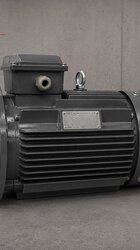
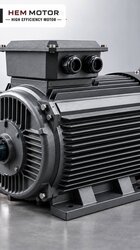
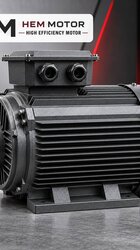
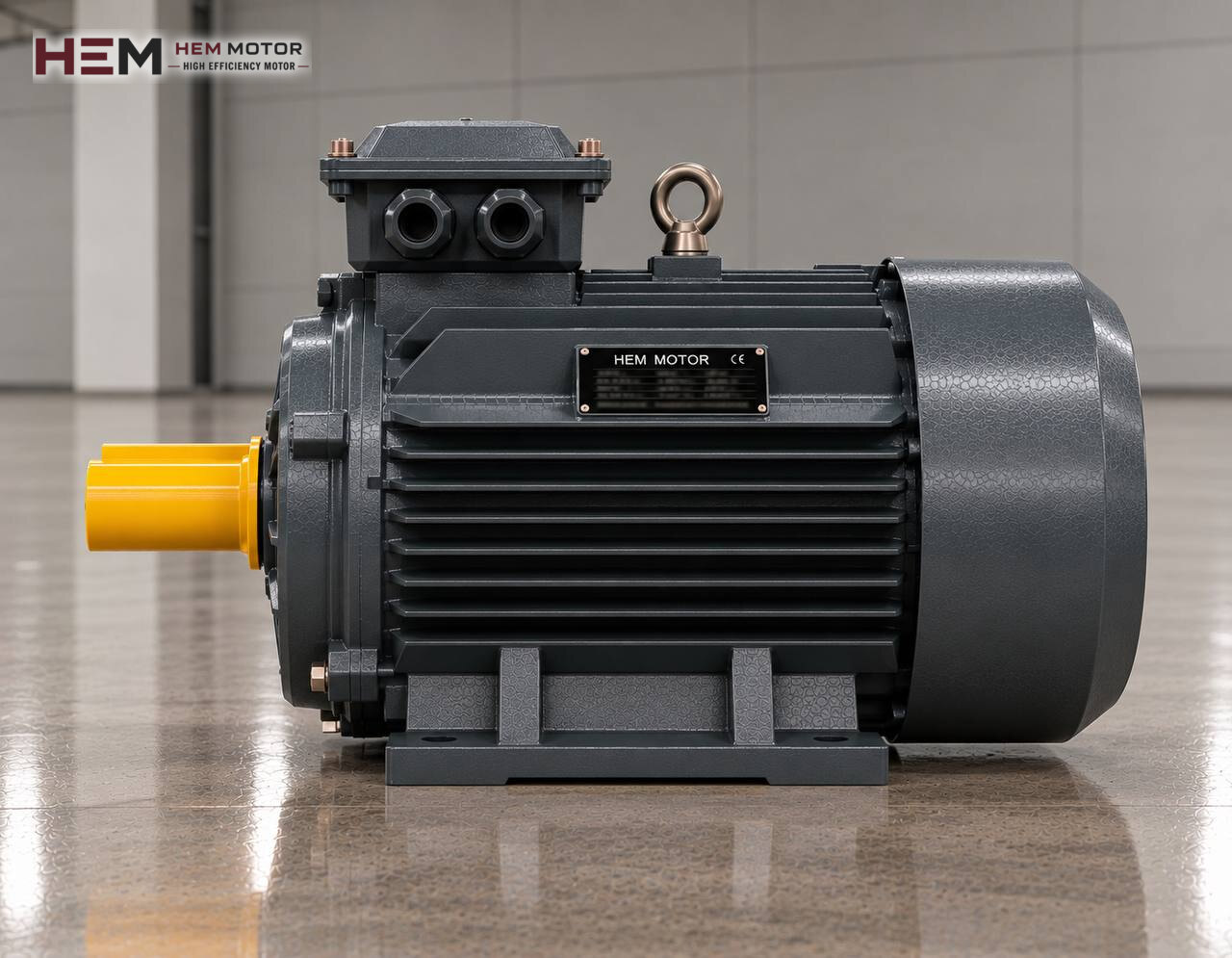
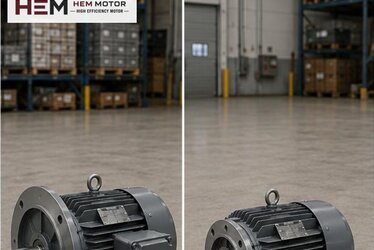
For speed measurement, reflective tape is stuck to the shaft end or the coupling hub (representative image).
Why might nameplate speed and the speed read on site disagree?
Nameplate speed applies at full load, rated voltage and rated frequency; if any of these three conditions changes, the figure on the optical tachometer shifts too. If the motor is at half load, slip drops roughly by half and the shaft can climb to around 2950.
Take the measurement in this order: stick a small piece of reflective tape on the shaft end or coupling hub, wait until the machine has settled under load, take three tachometer readings and write down the average. At the same time note phase currents with a clamp meter and line-to-line voltage with a multimeter. Speed alone says nothing; if current is close to nameplate value while speed has dropped to around 2850, either voltage is low or the motor is carrying more load than its power.
On a motor driven by a frequency converter, also record the "Hz" value on the converter display. A 2-pole machine turning at 48 Hz has a field speed of 2880 rpm, and the shaft stays below even that.
Prices and technical data are on the product pages; choose a model and order online.
What does a 100 rpm difference change in a pump or fan?
In centrifugal pumps and fans, flow rises or falls in the same ratio as shaft speed, the head the pump delivers with the square of that ratio, and the power needed to turn the shaft with its cube (affinity laws; general information, confirm with the pump manufacturer's curve). A hundred rpm looks small. The mark it leaves on pressure and power is measurable.
A hypothetical example: the old motor of a booster pump that held the required pressure exactly at 2900 rpm was removed and a larger-frame motor with 2950 rpm on the plate was fitted. The speed ratio is 2950 / 2900 ≈ 1.017. Flow rises by the same ratio, head to 1.017² ≈ 1.035 times and pump shaft power to 1.017³ ≈ 1.053 times. A motor chosen at the limit may heat up carrying this extra power. The pressure switch also cuts in and out earlier than before.
The reverse happens too. A motor with lower nameplate speed may fail to reach target pressure on the same pump, and flow weakens at the taps at the end of the line. In a fan, the equivalent is a drop in the air velocity measured at the grille at the end of the duct.
Which mistakes are made when replacing a motor?
The most frequent mistake is writing "2900 rpm motor" on the order form without stating the pole count. The supplier reads this as two-pole, but the correct power and frame only become clear with the full nameplate.
The second mistake is calculating pulley diameter from the old motor's nameplate speed in belt drives and never checking the new motor's nameplate speed. The difference looks small, but in a screw conveyor doing precise feeding, capacity per minute changes. The third is fitting a 2-pole motor in place of a 4-pole one because "it will be stronger". Speed doubles and the driven machine may not withstand it.
There is one more point: because the bearings and fans of 2-pole motors run at high speed, vibration and balance tolerances are kept tight. Commissioning without checking coupling alignment with a dial gauge shows up in the first weeks as rising bearing temperature. Maintenance teams usually spot this with an infrared thermometer on the bearing cover; if there is a clear temperature difference between the fan side and the drive side, the first places to look are the coupling and the shims under the feet. After the alignment is corrected, taking a daily reading from the same point for a week shows whether the problem is really solved. A rise in noise often accompanies this picture as well.
Which HEM model fits a 3000 rpm requirement?
If you are looking for a 2-pole motor for a pump, a fan or a high-speed gearbox input, the choice starts not from nameplate speed but from the power and torque requirement; then the effect of the speed difference on the pump or pulley calculation is checked. Sample models:
90S-2: cast iron, 1.5 kW, 2895 rpm, 3.06 A at 400 V, 230/400 V. For small booster and circulation pumps.
112M-2: cast iron, 4 kW, 2905 rpm, 13.1 Nm, 400/690 V. A step often seen on mid-size centrifugal pumps.
160M1-2: cast iron, 11 kW, 2945 rpm, 19.6 A at 400 V. With smaller slip, nameplate speed is closer to 3000.
High-speed input choices for geared applications are explained on the electric motors for gearboxes page. If you want to compare torque values by pole count, the torque table makes the job easier. All two-pole steps and prices are listed in our electric motor shop.
If the old motor's plate shows a different speed such as 2850 or 2950 and pump pressure matters to you, send the plate photo together with the pump label via our find-an-equivalent-from-the-nameplate page; we will assess the effect of the speed difference on pressure together. For prices and other power steps, you can also look at the HEM Motor sales page.
Frequently Asked Questions
Are a 2900 rpm motor and a 3000 rpm motor different products?
No, both describe a 2-pole motor. 3000 is field speed, around 2900 is shaft speed under load.
Can a motor with 2880 on the plate replace one marked 2950?
Electrically it can, but in a pump or fan pressure and flow drop slightly. In a sensitive application, check the pump curve first.
The motor turns at 2990 at no load; is that normal?
Yes. At no load slip becomes very small, so the shaft approaches field speed; once load comes on, speed falls to the nameplate value.
Can a frequency converter take the motor above 3000 rpm?
The converter can raise the frequency. Whether the bearings, fan blades and driven machine can withstand that speed is a separate question and must be stated when ordering.
HEM Motor Models Related to This Article
The cards show example models related to the topic. A suitable motor is not chosen by power alone: compare speed, voltage, mounting, shaft and connection dimensions on the product page; if unsure, send a photo of the existing motor’s nameplate on WhatsApp.
Rated torque is the torque an electric motor can deliver continuously without overheating its winding; breakdown torque is the peak value the motor can produce for a short time, an... More Details
A six-pole electric motor pays off when the driven machine wants to turn at around 1000 rpm or slower and needs more shaft torque for the same kW. It reduces the gearbox ratio, bal... More Details
The choice is set by the shaft speed the machine needs: if the load is a centrifugal pump, fan or grinding spindle that wants about 2900 rpm directly, choose two poles; if it is a ... More Details
The pole count of an electric motor is easiest to read from the rated speed on the nameplate: on a 50 Hz supply, a speed just under 3000 rpm means 2 poles, just under 1500 means 4 ... More Details
1500 rpm is the speed of the rotating magnetic field of a 4-pole electric motor on a 50 Hz supply; 1450 rpm is the rated speed the same motor's shaft reaches at full load. The 50 r... More Details
An electric motor's shaft torque is found from power and speed with a single relationship: T (Nm) = 9550 × P (kW) / n (rpm). In this formula n is not the synchronous speed but the ... More Details
We use necessary and optional cookies to improve your experience, enhance content and analyse traffic. Under the GDPR, optional (analytics/marketing) cookies are only used with your explicit consent. Please choose your preference below.
Cookie Policy
 English
 Français
 Türkçe
 Español
 Русский
 العربية
 Deutsch
 Italiano