Electric Motor Torque Calculation: Examples from kW and Speed to Nm

Electric Motor Torque Calculation: Examples from kW and Speed to Nm

An electric motor's shaft torque is found from power and speed with a single relationship: T (Nm) = 9550 × P (kW) / n (rpm). In this formula n is not the synchronous speed but the rated speed on the nameplate; at the same power, a motor with a lower speed delivers more torque in proportion to the drop in speed. Below we explain step by step where the formula comes from, examples with nameplate values, how to calculate torque behind a gearbox or belt, and the typical mistakes made at start-up.

Where does the 9550 constant come from?

Mechanical power is the product of torque and angular velocity: P (W) = T (Nm) × ω (rad/s). Angular velocity is obtained from speed with ω = 2π × n / 60. Writing power in kilowatts and speed in revolutions per minute and rearranging gives 60 × 1000 / (2π) ≈ 9549; on site this value is rounded to 9550. The constant is only a unit conversion.

The same logic applies in older machine documents that work in horsepower; first convert to kilowatts with 1 HP = 0.746 kW, then apply the formula (general knowledge; confirm with the machine manufacturer's data). Because some sources use a different factor for metric horsepower, it is worth checking which definition the HP value on the nameplate follows.

Why do motors of the same power have different torques?

Torque is inversely proportional to speed. Three 11 kW motors with different numbers of poles show clearly what the formula means in practice. The values below were derived from the rated speeds on HEM Motor product cards:

ModelPowerNameplate speedTorque from the formula
160M1-2 (2-pole)11 kW2945 rpm9550 × 11 / 2945 ≈ 35.7 Nm
160M-4 (4-pole)11 kW1465 rpm9550 × 11 / 1465 ≈ 71.7 Nm
160L-6 (6-pole)11 kW970 rpm9550 × 11 / 970 ≈ 108.3 Nm

According to the table, at the same kilowatt rating the load on the shaft of the 6-pole motor is close to three times that of the 2-pole motor. That is why matching only the kilowatts when replacing a motor does not always provide the torque the machine needs. The speed must also be the same as before. Calculated values for every power and pole number are listed on the electric motor torque table page.

Why does calculating with synchronous speed produce a small error?

The calculation should use the nameplate value, such as 1465 rpm, not the synchronous value such as 1500 rpm; under load the rotor lags slightly behind the magnetic field and turns slower by the amount of slip. Torque found with the synchronous value comes out about two to three percent short. This margin may seem negligible. But on a motor selected at the limit it can decide whether the thermal relay trips or not.

How is torque at the gearbox output found?

A gearbox increases torque as it reduces speed. Output torque is motor torque multiplied by the ratio (i) and the gearbox efficiency (η): M2 = M1 × i × η, while output speed is n2 = n1 / i. The efficiency value varies markedly with gearbox type. It is high for helical gears and, for worm types, falls as the ratio grows. The value should be taken from the gearbox manufacturer's catalogue.

Hypothetical example: an 11 kW four-pole motor with a nameplate speed of 1465 rpm drives a helical gearbox with a ratio of i = 25 and an assumed efficiency of 0.95. Motor torque is 71.7 Nm, output speed 1465 / 25 ≈ 58.6 rpm and output torque 71.7 × 25 × 0.95 ≈ 1703 Nm.

The same calculation can be done in reverse. If the output torque and speed the machine requires are known, motor torque and power can be worked back.

Options suitable for geared drives are grouped under electric motors for gearbox connection; for flange and shaft compatibility, the frame number and technical drawing should be checked together.

How are torque and speed converted in a belt and pulley drive?

In a belt drive the ratio is the ratio of the pulley diameters: i = Dmachine / Dmotor. If the machine pulley is larger than the motor pulley, speed falls and torque rises. Because of belt losses, efficiency is usually taken as slightly lower than for a gearbox, and slip increases as belt tension falls (general knowledge; confirm with the belt manufacturer's data).

Hypothetical example: a fan is belt-driven from a motor turning at 1465 rpm; the motor pulley is half the diameter of the machine pulley. The ratio is 2, the fan turns at about 730 rpm, and with an assumed efficiency of 0.95 the torque at the fan shaft is about 1.9 times the motor torque. This calculation is used to check whether the fan's real requirement exceeds the motor's rated torque.

Three-phase electric motor connected to a helical gearbox
A gearbox reduces speed and multiplies motor torque by the ratio and efficiency (representative image).

Prices and technical data are on the product pages; choose a model and order online.

How does starting torque differ from rated torque?

The value found with the formula is the rated, or continuous, torque. At start-up the motor can produce several times this torque; this ratio is given in the product catalogue as the ratio of starting torque to rated torque. For machines that meet their load at the moment of starting, such as conveyors, crushers or a mixer starting full, the machine's starting resistance should be compared with this value.

The starting method changes this picture. With star-delta starting, both the initial current drawn from the supply and the initial torque at the shaft fall to about one third of direct-on-line starting (general knowledge; confirm with the machine manufacturer). On a load that is hard to start, this is decisive. If star-delta is chosen, the motor's reduced starting torque may not be enough to set the load in motion. The remedy is to consider a larger motor or a different starting method.

Which torque calculation mistakes are most common on site?

  • Calculating with synchronous speed: using 1500 or 3000 rpm instead of rated speed shows torque lower than it is.
  • Forgetting efficiency: if the efficiency factor behind a gearbox or belt is skipped, output torque is calculated higher than it is.
  • Judging the start by rated torque: on a machine with a heavy start, continuous torque may look sufficient while the start fails.
  • Mixing units: using old values given in kgf·m without converting them to Nm (1 kgf·m ≈ 9.81 Nm).
  • Treating current as directly proportional to torque: at part load current does not fall linearly with torque; magnetising current is always present.

For the last point, the electric motor current table is useful if you want to look at typical currents by kilowatt. You can see the powers and speeds that match the calculated torque, together with the rated torque value on the product cards, in our electric motor shop.

Example models that match the calculated torque

The pairings below are hypothetical, based on the examples above; they must be confirmed with the machine's actual torque and speed requirement.

  • For a conveyor needing about 1700 Nm at the gearbox output, the 11 kW, 4-pole 160M-4; rated speed 1465 rpm, rated torque 71.7 Nm.
  • For a low-speed mixer or fan without a gearbox, the 11 kW, 6-pole 160L-6; it delivers 108.3 Nm at 970 rpm.
  • For a centrifugal pump that needs high speed, the 11 kW, 2-pole 160M1-2; it produces 35.7 Nm at 2945 rpm.

Turning the calculation into an order

The result of a torque calculation is not a model code on its own. It gains meaning together with the machine's speed, starting method and mounting type.

If you share the torque, speed, ratio and efficiency values used in your calculation via our contact page, we will determine the right frame by checking both the rated and the starting side together. For alternatives that meet the same torque requirement with different pole numbers, the HEM Motor product shop can be filtered by speed and power.

Frequently Asked Questions

How is torque found if it is not on the motor nameplate?

The kilowatts and speed on the nameplate are entered into T = 9550 × P / n. If the nameplate shows only HP, first multiply by 0.746 to convert to kilowatts.

How does switching from a 4-pole to a 6-pole motor at the same kW affect the machine?

Torque rises by about fifty percent while speed falls by a third. If the belt ratio or gearbox is not readjusted, the machine's speed changes.

How does torque change when speed is reduced with a frequency converter?

Below rated frequency the motor generally runs in the constant torque region, and power falls in proportion to speed. Our three-phase series are suitable for speed control with a frequency converter; for long periods at low speed with full torque, a separate fan may be required; if the drive-to-motor cable is long, a dv/dt or sine filter is considered; these conditions are stated in the order.

Which value should be used if gearbox efficiency is unknown?

Because efficiency varies markedly with gearbox type and ratio, the value in the manufacturer's catalogue should be used rather than a guess. Without a catalogue, the calculation should be done conservatively, that is with a low efficiency.

HEM Motor Models Related to This Article

The cards show example models related to the topic. A suitable motor is not chosen by power alone: compare speed, voltage, mounting, shaft and connection dimensions on the product page; if unsure, send a photo of the existing motor’s nameplate on WhatsApp.

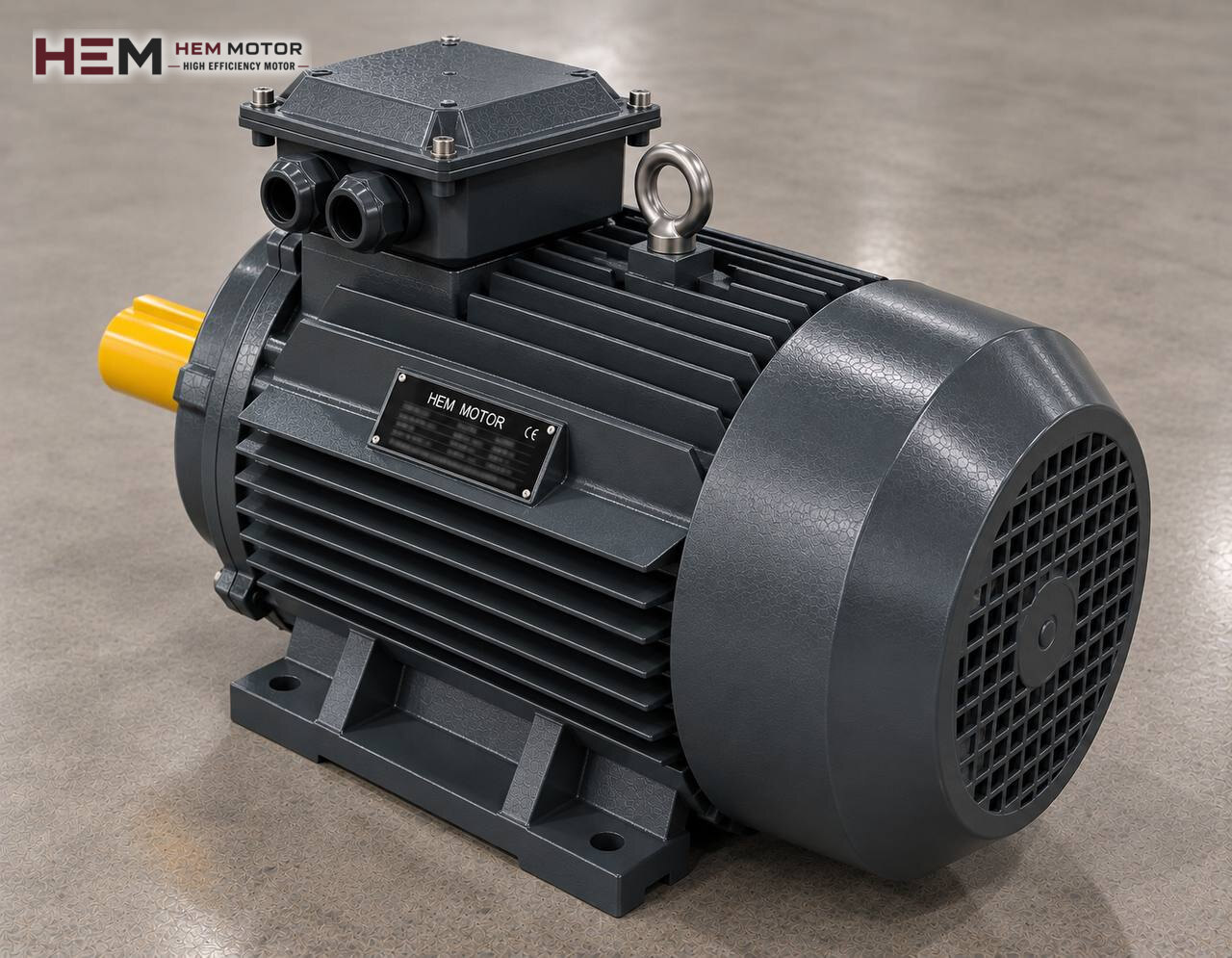
11 kW 1500 rpm Cast Iron Frame Electric Motor 160M-4

160M-4

11 kW · 1500 rpm

  • Cast iron frame · IEC 160M
  • 1465 rpm · IP55
  • Mounting: B3 foot; flange (B5/B14/B35) depending on frame, confirmed with the order

US$557.82 (€510.52)

View product
11 kW 1000 rpm Cast Iron Frame Electric Motor 160L-6

160L-6

11 kW · 1000 rpm

  • Cast iron frame · IEC 160L
  • 970 rpm · IP55
  • Mounting: B3 foot; flange (B5/B14/B35) depending on frame, confirmed with the order

US$656.04 (€600.42)

View product
11 kW 3000 rpm Cast Iron Frame Electric Motor 160M1-2

160M1-2

11 kW · 3000 rpm

  • Cast iron frame · IEC 160M
  • 2945 rpm · IP55
  • Mounting: B3 foot; flange (B5/B14/B35) depending on frame, confirmed with the order

US$517.78 (€473.89)

View product

Similar Articles