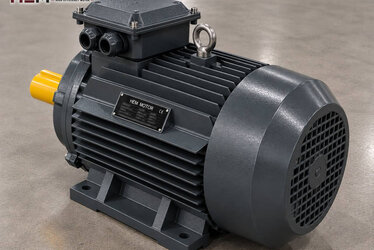
Rated torque is the torque an electric motor can deliver continuously without overheating its winding; breakdown torque is the peak value the motor can produce for a short time, and if it is exceeded the speed collapses. The two are compared as a ratio: the machine's peak load must stay below the breakdown torque after allowing for voltage drop, while the average load must not exceed rated torque.
How is rated torque found from the nameplate power and speed?
Shaft power in kW and rated speed in rpm are put into the relation T = 9550 × P / n. The resulting value in Nm agrees with the rated torque column in the catalogue to within a few decimals. For an 11 kW, 4-pole motor with a nameplate speed of 1465 rpm, 9550 × 11 / 1465 ≈ 71.7 Nm. The 6-pole equivalent turns at 970 rpm and gives about 108.3 Nm. Power is unchanged, torque has risen. That is why the torque seen at the shaft goes up as speed is reduced at a gearbox input or in a belt drive (general information; confirm with the machine manufacturer).
The calculation uses the rated speed on the nameplate, not synchronous speed. The difference looks small. Even so, at larger ratings writing 1500 instead of 1465 leaves a deviation of a few Nm, and in gearbox selection that deviation can tip a borderline decision the wrong way.
Under what condition does breakdown torque appear?
Breakdown torque is the highest torque point the motor can reach as slip grows with increasing load. If load rises a little beyond this point, torque starts to fall, speed drops quickly and the motor approaches standstill.
The torque-speed curve of an asynchronous motor has three distinct points: starting (locked-rotor) torque, pull-up torque at the dip of the curve, and breakdown torque at the peak. Normal operation lies to the right of the peak, in a narrow band close to synchronous speed. Catalogues usually give breakdown torque as a ratio to rated torque, in the form Tb/Tn. For HEM Motor models this ratio is not on the product page, so the value is confirmed from the catalogue or with the order.
Torque values are calculated from nameplate power and rated speed, peak values are taken from the catalogue (representative image).
By what ratio should the two values be compared?
The comparison comes down to one question: is the machine's torque demand at its heaviest moment safely below the breakdown torque the motor can deliver at the voltage present at that moment? The margin is chosen according to how suddenly the load arrives and how far the voltage can sag.
Torque type
Where it comes from
What it is compared with
Rated torque (Tn)
9550 × P / n or catalogue
The machine's average or effective (RMS) load
Starting torque (Ts)
Ts/Tn ratio in the catalogue
The breakaway resistance of the machine at standstill
Pull-up torque (Tu)
In the catalogue, sometimes on the curve
The load's torque demand during acceleration
Breakdown torque (Tb)
Tb/Tn ratio in the catalogue
Short peak loads arriving during operation
The last two rows of the table are often skipped. Material piling up on a conveyor, a large lump entering a crusher, dough thickening in a mixer: events like these push against breakdown torque; even if average current looks normal, the motor approaches its peak in those seconds.
How does voltage drop change breakdown torque?
Peak torque falls roughly in proportion to the square of voltage. If voltage drops by 10%, peak torque falls by about 19%, leaving roughly 0.81 of the value on paper (general information; confirm with the machine manufacturer).
On site this effect shows up most on long cable runs and in plants where a compressor or mill fed from the same transformer starts at exactly that moment. To check, read the line-to-line voltage at the motor terminals under load. The panel value does not show the drop along the cable. A measurement taken with a clamp meter and a multimeter at the same time gives the real situation at the moment of peak load.
Prices and technical data are on the product pages; choose a model and order online.
Hypothetical calculation: how do you confirm a motor can handle the peak load?
Suppose an inclined belt conveyor has a measured peak torque demand of 120 Nm at the motor shaft, at the gearbox input, and a normal running torque of 55 Nm. The candidate motor is 11 kW, 1465 rpm, with a rated torque of 71.7 Nm.
Average load check: 55 Nm is below 71.7 Nm; for continuous duty the motor is adequate.
Take the Tb/Tn ratio from the catalogue. As an example, assume 2.5: 71.7 × 2.5 ≈ 179 Nm.
Add the voltage drop. If a 10% drop has been measured at the terminals, 179 × 0.81 ≈ 145 Nm remains.
Calculate the margin: 145 / 120 ≈ 1.21. For shock loads this margin may be considered narrow; if peak load comes often and suddenly, a motor one size larger or a 6-pole option with a recalculated gearbox ratio is considered.
The 2.5 ratio and the 120 Nm peak in the example are hypothetical. In a real calculation the Tb/Tn ratio must come from the catalogue of the model to be used, and the peak torque from the machine manufacturer or a torque measurement.
If peak load comes often, how is heating checked?
Even if breakdown torque covers the peak load, the winding heats up when the load repeats often. In that case the decision is made with the effective (RMS) torque: Trms = √(Σ Ti² × ti / Σ ti).
If in an example cycle the motor delivers 55 Nm for 50 seconds and 120 Nm for 10 seconds, Trms = √((55² × 50 + 120² × 10) / 60) ≈ 71 Nm. The value is almost equal to the rated torque of 71.7 Nm; in a plant with high ambient temperature this motor runs at its limit. With loads like this a thermal overload relay sometimes trips late, sometimes early, because it estimates heating from current. A PTC winding sensor can be chosen with the order and monitors winding temperature directly.
On site the heating problem shows itself like this: the motor runs for hours without complaint, but in the busiest hour of the shift the overload trips and the frame is too hot to touch. A familiar picture.
Which example models fit this comparison?
Three cast iron models close to the torque range of the hypothetical calculation are listed below; rated torque values are taken from the product pages. We confirm breakdown and starting torque ratios together with the order. Other ratings and speeds are listed with torque data in our electric motor shop.
132M-4: 7.5 kW, 1460 rpm, rated torque 49.1 Nm, 14.3 A at 400 V. The step to look at for light conveyors whose peak load stays below 100 Nm.
160M-4: 11 kW, 1465 rpm, rated torque 71.7 Nm, 20.4 A at 400 V. The candidate in the example calculation.
160L-6: 11 kW, 970 rpm, rated torque 108.3 Nm, 22.0 A at 400 V. Clearly more shaft torque without a change in power; if the gearbox ratio is recalculated, it gives room in the peak margin.
If you have a peak torque measurement for your machine or a load curve from its manufacturer, send it with the nameplate of the existing motor via the contact page; we will compare the Tb/Tn ratio with the catalogue and work out the margin together. For prices and frame options, the HEM Motor sales page can be used.
Frequently Asked Questions
Is a motor with higher breakdown torque always better?
It is an advantage for machines with peak loads. Under continuous load, though, heating is governed by rated torque and effective torque, so it is not taken as the only criterion.
What happens if the motor reaches its breakdown point?
Speed falls quickly and current rises to values close to starting current; if the protection does not trip, the winding reaches a dangerous temperature within a few minutes. On site this is seen as the machine stopping suddenly, followed by the overload tripping.
Does a frequency converter increase breakdown torque?
It does not enlarge the motor's own peak torque, but the drive can supply torque close to rated torque at low speed too and reduces the effect of voltage drop. Our three-phase series are suitable for speed control with a frequency converter; long running at low speed with full torque may need a separate fan; with a long drive–motor cable a dv/dt or sine filter is considered; these conditions are stated with the order.
Are the torque ratios written on the nameplate?
Most nameplates show only power, speed, current and voltage. Ts/Tn and Tb/Tn ratios are given in catalogues; for HEM Motor models these values are confirmed with the order.
HEM Motor Models Related to This Article
The cards show example models related to the topic. A suitable motor is not chosen by power alone: compare speed, voltage, mounting, shaft and connection dimensions on the product page; if unsure, send a photo of the existing motor’s nameplate on WhatsApp.
A six-pole electric motor pays off when the driven machine wants to turn at around 1000 rpm or slower and needs more shaft torque for the same kW. It reduces the gearbox ratio, bal... More Details
The choice is set by the shaft speed the machine needs: if the load is a centrifugal pump, fan or grinding spindle that wants about 2900 rpm directly, choose two poles; if it is a ... More Details
The pole count of an electric motor is easiest to read from the rated speed on the nameplate: on a 50 Hz supply, a speed just under 3000 rpm means 2 poles, just under 1500 means 4 ... More Details
3000 rpm is the theoretical field speed that the 50 Hz supply creates in a 2-pole electric motor and that the shaft never catches; around 2900 rpm is the speed actually measured at... More Details
1500 rpm is the speed of the rotating magnetic field of a 4-pole electric motor on a 50 Hz supply; 1450 rpm is the rated speed the same motor's shaft reaches at full load. The 50 r... More Details
An electric motor's shaft torque is found from power and speed with a single relationship: T (Nm) = 9550 × P (kW) / n (rpm). In this formula n is not the synchronous speed but the ... More Details
We use necessary and optional cookies to improve your experience, enhance content and analyse traffic. Under the GDPR, optional (analytics/marketing) cookies are only used with your explicit consent. Please choose your preference below.
Cookie Policy
 English
 Français
 Türkçe
 Español
 Русский
 العربية
 Deutsch
 Italiano