The choice is set by the shaft speed the machine needs: if the load is a centrifugal pump, fan or grinding spindle that wants about 2900 rpm directly, choose two poles; if it is a slower, torque-hungry load driven through a belt, gearbox or coupling, choose four poles. At the same kW a four-pole electric motor produces roughly twice the torque at the shaft; the two-pole one is smaller and faster.
How does the number of poles set the shaft speed?
Synchronous speed is found by dividing the supply frequency by the number of pole pairs, and on a 50 Hz supply it is 3000 rpm for two poles and 1500 rpm for four poles. Under load the rotor never reaches this value and lags a few percent behind; this lag is called slip.
ns = 120 × f / p
In the formula f is the supply frequency and p the number of poles in the stator. The nominal speed in the catalogue includes slip. For example, the cast iron 132S1-2 turns at 2930 rpm at rated load, while the 132S-4 of the same power turns at 1460 rpm.
Whichever of these two figures is closer to the input speed written on the machine plate or in its technical file is the first candidate. The most common mix-up on site starts right here. If the old motor's nameplate is worn off, measuring shaft speed with an optical tachometer takes a few minutes: stick reflective tape on the shaft and take the reading while the motor runs under load. A value in the 2900s means two poles, the 1450s mean four.
Why does torque double at the same kW?
Shaft power equals torque times rotational speed; when speed is halved, torque has to double to deliver the same power.
T [Nm] = 9550 × P [kW] / n [rpm]
Catalogue data confirms it. At 5.5 kW the two-pole model gives 17.9 Nm nominal torque, the four-pole model 36 Nm. At 15 kW the gap is the same: 48.6 Nm for the 160M2-2, 97.8 Nm for the 160L-4.
Torque also affects frame length. Rotor diameter and core length grow with the torque to be delivered, so at the same power a 1500 rpm motor often moves up to a larger IEC frame. In the 15 kW example the two-pole motor is in frame 160M and the four-pole in 160L. At 5.5 kW both are 132S, but that does not hold at every power step. When replacing, do not order before comparing the foot fixing dimensions and shaft centre height on the technical drawings page. The nominal torque of all power steps sits side by side in the electric motor torque table.
For which machines are two poles the right choice?
Two poles are chosen when the load itself is designed to run at high speed and is connected to the motor directly by a coupling.
Typical examples: centrifugal water pumps, booster sets, high-pressure fans, blowers, grinding and sanding spindles, some screw compressors. A pump impeller or fan wheel is calculated for a particular speed. Connecting a four-pole motor to the same pump cuts the head to roughly a quarter; under the affinity rules flow is proportional to speed and pressure to the square of speed (general information; confirm against the pump manufacturer's curve).
Two poles have a cost too. Bearings run faster and the relubrication interval shortens. Fan noise rises noticeably, and sensitivity to vibration on the bearing side increases. A small coupling misalignment that goes unnoticed at 1500 rpm shows up in bearing temperature at 3000 rpm. The maintenance team usually finds this out within the first month, by touching the bearing cap.
Prices and technical data are on the product pages; choose a model and order online.
For geared drives, conveyors, mixers, crushers and machines slowed down by belts, four poles are generally the better starting point.
The design speed of a gearbox input shaft is mostly around 1500 rpm. If a two-pole motor is fitted, the reduction ratio has to double, the gearbox input side spins faster and oil temperature rises. Do not connect a two-pole motor without reading the maximum input speed on the gearbox nameplate.
The situation is similar with belt drives. On a machine that wants 700 rpm at the output, pulley diameters stay at roughly 2 to 1 with a four-pole motor; with two poles the ratio rises to 4 to 1, the small pulley becomes very small and the belt bends more sharply. Belt life shortens and slip increases.
On heavy-starting loads, such as a full mixer or a loaded belt conveyor, the extra torque a 1500 rpm motor carries at the shaft also makes starting easier. Suitable frame and flange options for geared and belt applications can be seen together on the electric motors for gearboxes page. You can compare all models by power and speed in the electric motor shop.
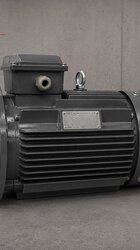
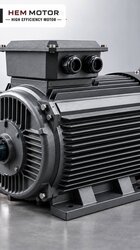
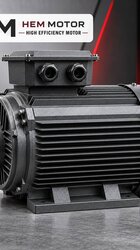
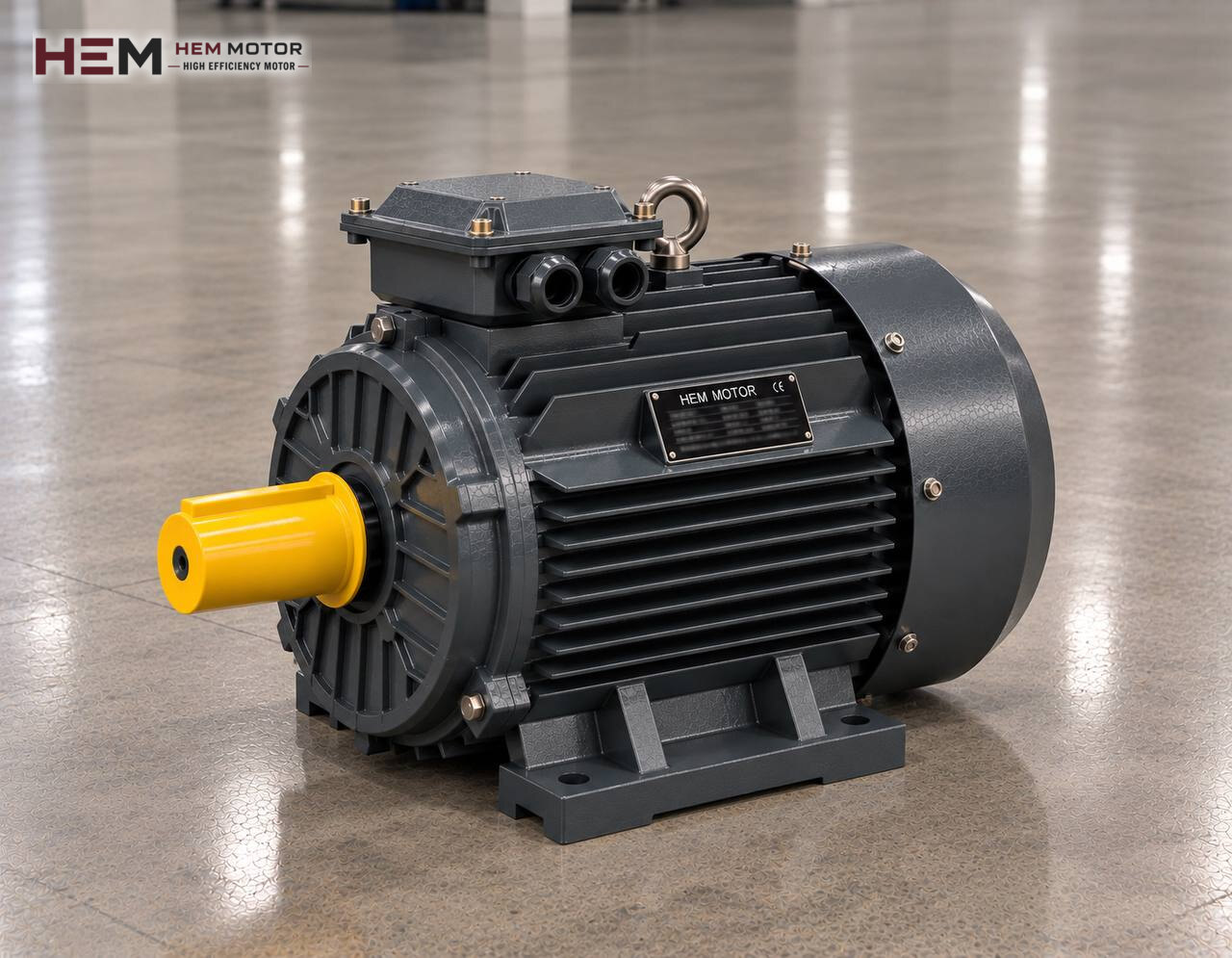
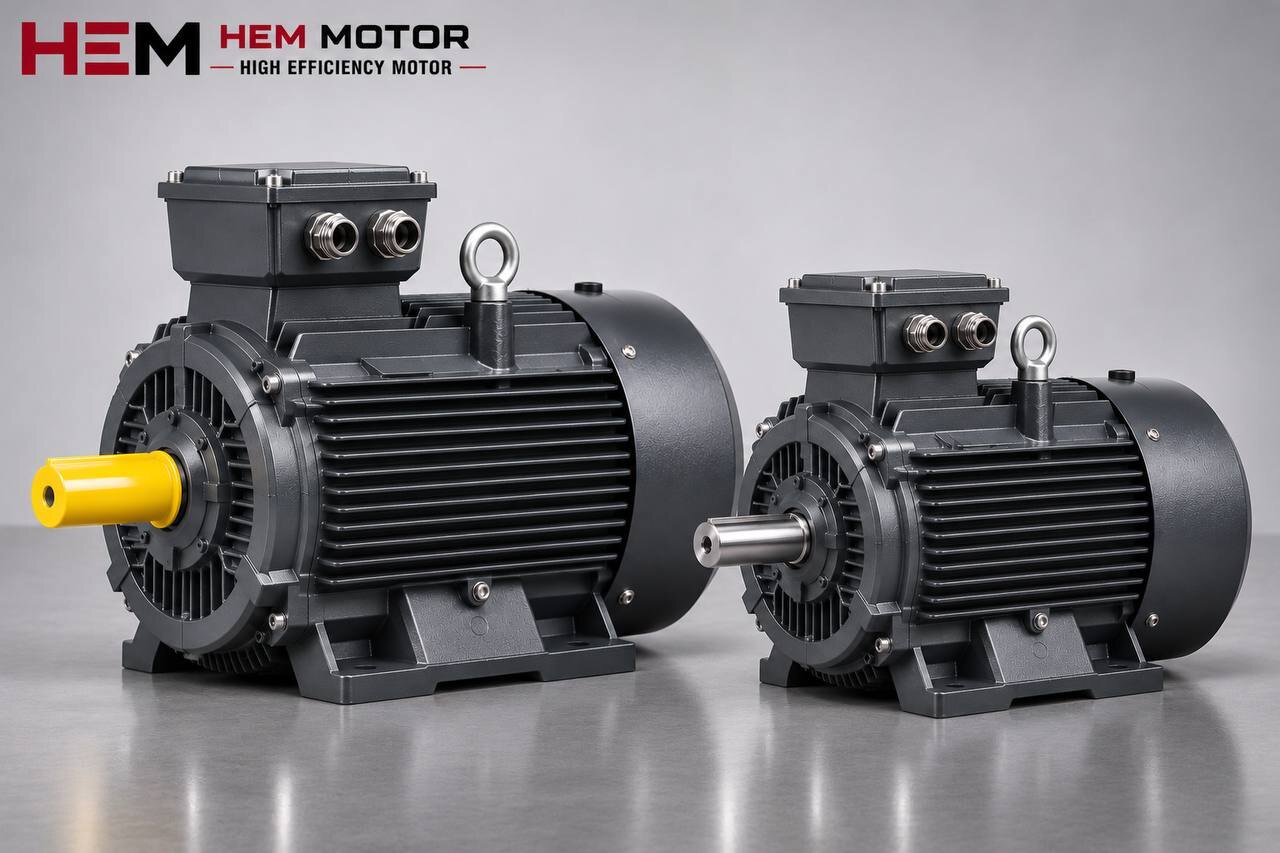
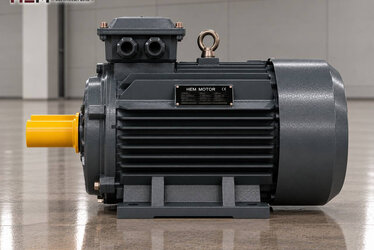
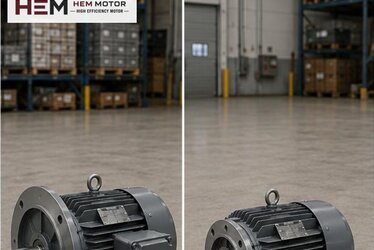
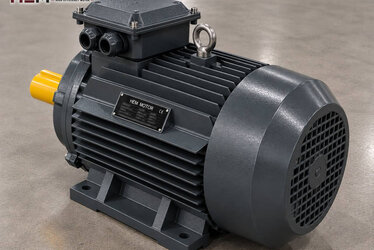
At the same power a 1500 rpm motor produces twice the torque, so it is often longer or one frame size up (representative image).
How do two-pole and four-pole motors compare side by side?
The table below shows two power steps from the package data on the same rows. Current values are for 400 V.
Model
Power
Nominal speed
Nominal torque
Current (400 V)
IEC frame
132S1-2
5.5 kW
2930 rpm
17.9 Nm
10.1 A
132S
132S-4
5.5 kW
1460 rpm
36 Nm
10.7 A
132S
160M2-2
15 kW
2945 rpm
48.6 Nm
26.5 A
160M
160L-4
15 kW
1465 rpm
97.8 Nm
27.3 A
160L
The currents are close, with the four-pole one drawing slightly more. The difference comes from the somewhat lower cos φ of the four-pole design. On the panel and protection side this gap stays small, but the electrical engineer who calculates cable and thermal protection must work from the nameplate current. The current table can be used for all steps.
What is seen on site if the wrong pole number is chosen?
The symptoms depend on the type of load. When a motor that is too slow drives a fan or pump, flow drops and the process team reports that pressure is not enough. In the opposite case, when a two-pole motor is fitted to a fan calculated for four poles, the required power grows with the cube of speed, the motor is overloaded and the thermal relay trips within minutes.
On a geared conveyor, two poles drive the belt at twice the speed. Product spills at the transfer points and the gearbox heats up.
The checking order can be kept simple: first confirm the present speed with the nameplate and a tachometer, then compare the current under load with the nameplate current using a clamp meter, and finally read the machine's required input speed from the technical file. If the three do not agree, the problem most likely lies in the pole choice.
A frequency converter is sometimes used to bridge this gap. Our three-phase series are suitable for speed control with a frequency converter; for long operation at low speed with full torque a separate fan may be needed; if the drive-to-motor cable is long, a dv/dt or sine filter is considered; these conditions are stated with the order. Even so, slowing a two-pole motor to 1500 rpm with a converter does not give the torque of a four-pole motor; at the same current the torque limit does not change.
If the input speed and drive arrangement of your machine are known, write to us with the motor nameplate through our contact page; we will pin down the pole number and frame together according to the load type. Models for the pole number and power you select are listed with speed and torque values in the HEM Motor shop.
Frequently Asked Questions
Does a two-pole motor use more energy than a four-pole one?
At the same shaft power, energy use depends more on efficiency class and load ratio than on the number of poles. The real difference is that two poles do the same job with lower torque at higher speed.
Can I bring a four-pole motor up to two-pole speed with pulleys?
Speed can be raised with the pulley ratio, but motor torque falls by the same ratio and belt speed goes up. If a pump or fan wants 3000 rpm directly through a coupling, a two-pole motor is the simpler solution.
How can the pole number of a motor with an unreadable nameplate be found?
Measure shaft speed with a tachometer while it runs under load: the 2900s mean two poles, the 1450s four, the 950s six. Together with the frame number, this is enough to find the replacement model.
Can a two-pole motor be connected to a gearbox?
It can, if the input speed allowed by the gearbox manufacturer covers 3000 rpm. Most standard gearboxes are designed for a 1500 rpm input, so check the gearbox nameplate and catalogue first.
HEM Motor Models Related to This Article
The cards show example models related to the topic. A suitable motor is not chosen by power alone: compare speed, voltage, mounting, shaft and connection dimensions on the product page; if unsure, send a photo of the existing motor’s nameplate on WhatsApp.
Rated torque is the torque an electric motor can deliver continuously without overheating its winding; breakdown torque is the peak value the motor can produce for a short time, an... More Details
A six-pole electric motor pays off when the driven machine wants to turn at around 1000 rpm or slower and needs more shaft torque for the same kW. It reduces the gearbox ratio, bal... More Details
The pole count of an electric motor is easiest to read from the rated speed on the nameplate: on a 50 Hz supply, a speed just under 3000 rpm means 2 poles, just under 1500 means 4 ... More Details
3000 rpm is the theoretical field speed that the 50 Hz supply creates in a 2-pole electric motor and that the shaft never catches; around 2900 rpm is the speed actually measured at... More Details
1500 rpm is the speed of the rotating magnetic field of a 4-pole electric motor on a 50 Hz supply; 1450 rpm is the rated speed the same motor's shaft reaches at full load. The 50 r... More Details
An electric motor's shaft torque is found from power and speed with a single relationship: T (Nm) = 9550 × P (kW) / n (rpm). In this formula n is not the synchronous speed but the ... More Details
We use necessary and optional cookies to improve your experience, enhance content and analyse traffic. Under the GDPR, optional (analytics/marketing) cookies are only used with your explicit consent. Please choose your preference below.
Cookie Policy
 English
 Français
 Türkçe
 Español
 Русский
 العربية
 Deutsch
 Italiano