The pole count of an electric motor is easiest to read from the rated speed on the nameplate: on a 50 Hz supply, a speed just under 3000 rpm means 2 poles, just under 1500 means 4 poles and just under 1000 means 6 poles. If the plate is unreadable, measuring no-load speed with a tachometer or turning the shaft by hand and counting the needle swings on a winding gives the same answer.
Which formula links speed and pole count?
The speed of the rotating field is found by multiplying supply frequency by 120 and dividing by the total number of poles: ns = 120 · f / p. The p in the formula is all the poles, not pole pairs. That detail trips people up most often in the field.
For 50 Hz the arithmetic is quick. 2 poles give 3000, 4 poles 1500 and 6 poles 1000 rpm.
The rotor cannot catch this speed. Nor should it. If the rotor turned at the same speed as the field, its bars would cut no field lines, no current would circulate in them and no force would reach the shaft. The proportion by which the rotor lags is slip: s = (ns − n) / ns × 100. In small machines the gap is larger, while on machines of hundreds of kilowatts speed comes very close to synchronous (general information; confirm with the machine manufacturer).
If the nameplate does not state the pole count, what do you look at?
Most nameplates do not list pole count separately, but rated speed is almost always there, and it gives the pole count with certainty. Matching the plate speed to the nearest synchronous speed is enough. You do not even need a calculator.
Three examples from HEM Motor's sales list show this. The plate speeds of three 4 kW models are 2905, 1450 and 968 rpm; these correspond to synchronous speeds of 3000, 1500 and 1000 rpm, that is to 2, 4 and 6 poles. The digit after the dash in the model code carries the same information: 112M-2, 112M-4, 132M1-6.
A technician who sees a value between 1400 and 1480 on the plate should not hesitate between 1500 and 1000. An asynchronous motor never runs above synchronous speed and does not fall far below it either; if 1450 is printed, there is no chance of it being a 6-pole machine.
How is the pole count found in the field on a motor whose nameplate is lost?
The first choice is to spin the motor unloaded and read shaft speed. Reflective tape goes on the shaft end, an optical tachometer is aimed at the tape and the reading is compared with the synchronous speeds. Because no-load slip is very small, a value such as 2985 clearly points to 2 poles and 1496 to 4 poles.
If running the motor is not safe, there is a manual method. Remove the links in the terminal box and connect an analogue microammeter, or an analogue milliammeter on a low range, across the two ends of a single phase winding. Turn the shaft one full revolution slowly and evenly. Rushing spoils the reading. Residual magnetism left in the rotor induces a small voltage in the winding; the number of times the needle swings back and forth in one turn gives the number of pole pairs. Three full swings mean 3 pole pairs, in other words 6 poles.
The method can give a weak result on freshly rewound motors or ones that have sat in storage for a long time, because residual magnetism has faded. An analogue instrument is preferred since digital multimeters cannot catch the fast change (general information; confirm with the instrument maker's instructions).
A third clue is the ratio of frame to shaft.
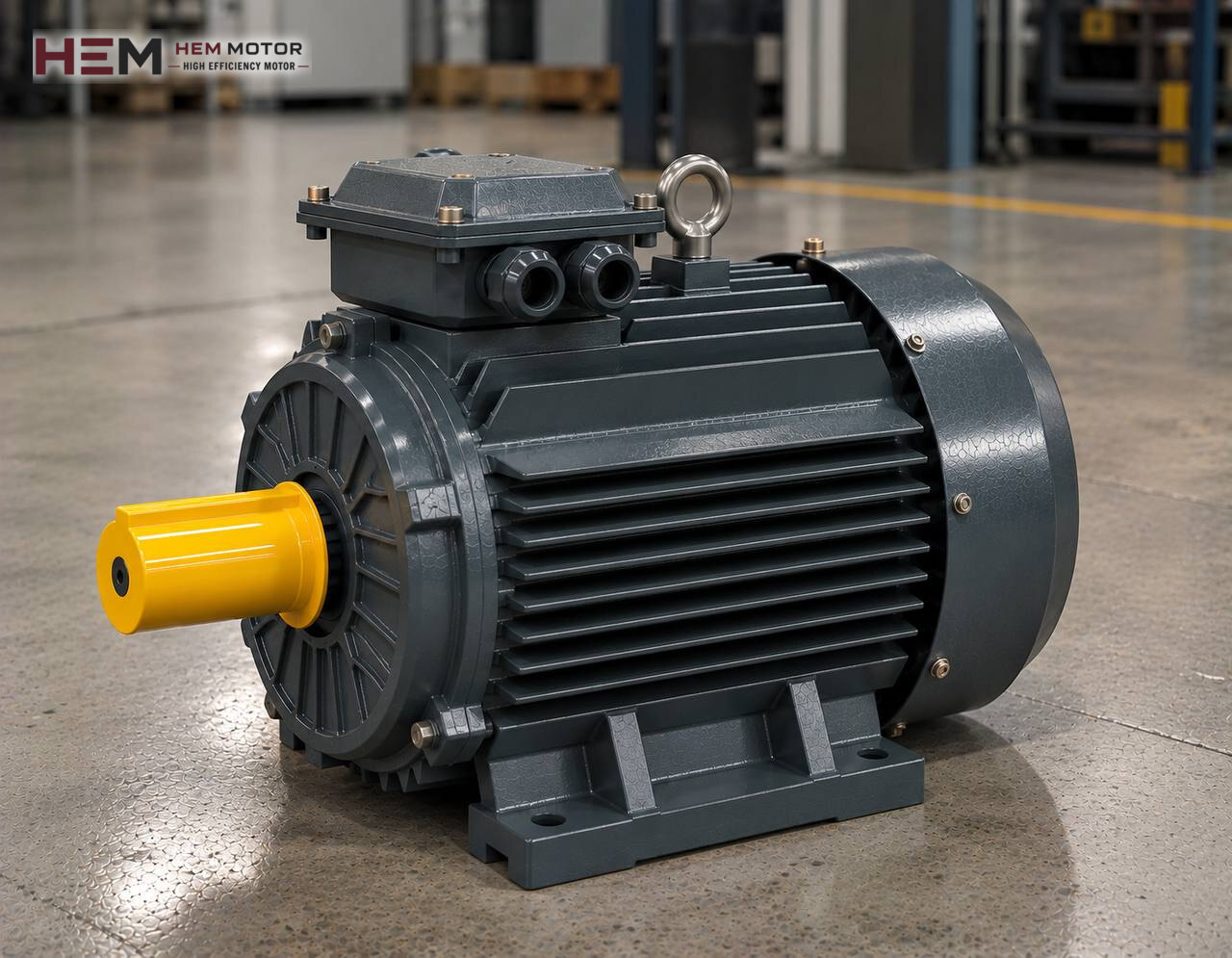
A slower machine delivers the same kilowatts with a larger turning force; for that reason most six-pole motors sit one frame size above their two-pole counterpart and have a thicker shaft end. This is not a firm criterion, only an observation that supports the speed measurement.
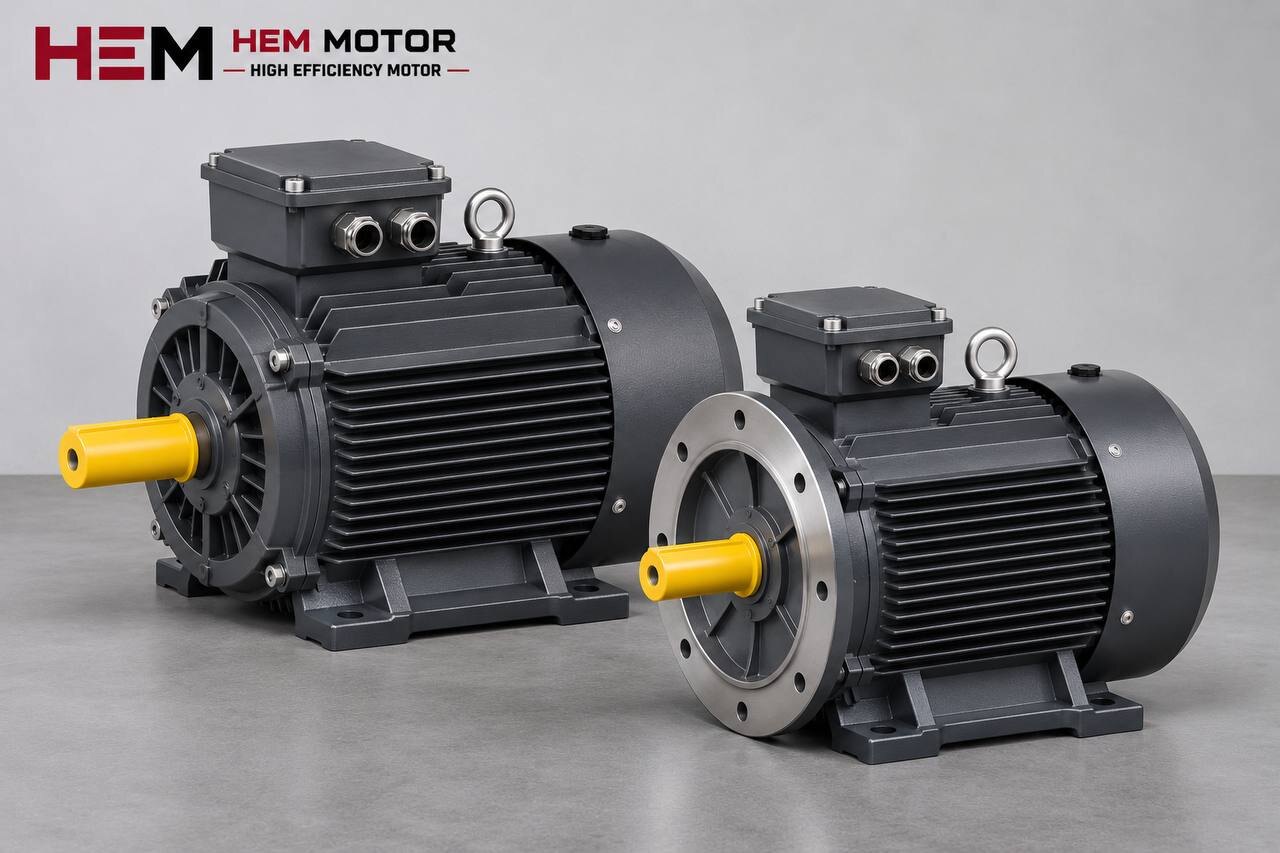
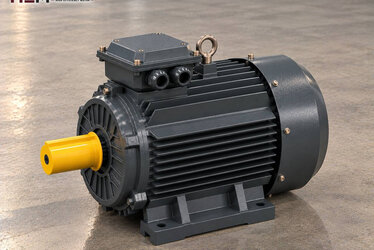
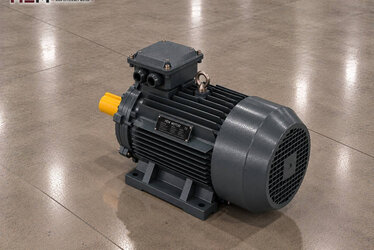
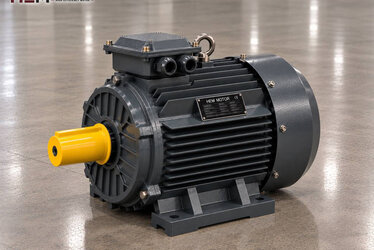
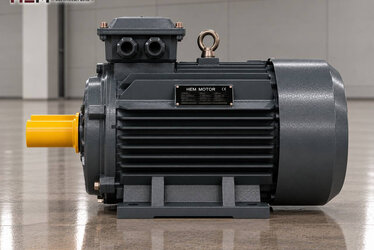
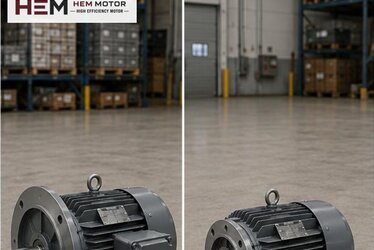
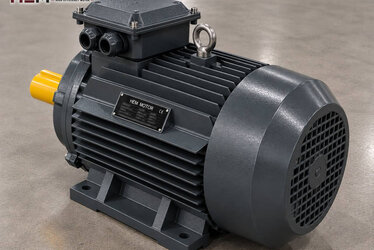
Even at the same kilowatt rating, frame and shaft can grow as the pole count rises (representative image).
Prices and technical data are on the product pages; choose a model and order online.
How do torque and frame change when pole count changes at the same power?
When shaft speed halves while kilowatts stay the same, turning moment at the shaft doubles. The calculation uses T [Nm] = 9550 · P [kW] / n [rpm].
Model
Poles
Synchronous speed
Plate speed
Rated torque
IEC frame
112M-2
2
3000 rpm
2905 rpm
13.1 Nm
112M
112M-4
4
1500 rpm
1450 rpm
26.3 Nm
112M
132M1-6
6
1000 rpm
968 rpm
39.5 Nm
132M
The table shows that all three models are 4 kW, yet the 6-pole model moves up one frame because of its torque. In a geared drive, choosing a different pole count when replacing the motor changes gearbox output speed and output torque in the same ratio. A conveyor that suddenly runs at half or double speed is the most common result of this mistake.
All torque values by power and speed are listed in the electric motor torque table. The 2, 4 and 6-pole versions of one kilowatt rating sit side by side on the store page.
What problems does misreading the pole count cause on site?
The costliest error is coupling a motor with a different pole count to a speed-sensitive centrifugal machine. According to the affinity laws, the power a centrifugal impeller demands grows with the cube of speed; double the speed and power demand rises to about eight times. A 4-pole circulation pump driven by a 2-pole motor by mistake trips the overload within seconds or damages the winding through heat (general information; confirm with the pump manufacturer).
The reverse causes trouble as well. Driving a 2-pole fan with a 4-pole motor leaves the air short. The drying tunnel stays damp, the dust extraction hood does not pull. The motor stays cool and the ammeter reads low, so the problem may escape everyone's notice for weeks.
The third typical mistake is ordering a new motor without checking the belt pulley or coupling of the old one. Some machine builders set the required output speed through the pulley ratio. If the pole count is not kept the same, the pulley ratio must be recalculated as well.
How is the pole information verified in a replacement order?
On the order form, write the kilowatts, speed, supply voltage and frame code read from the plate side by side; speed tells you the poles, while the frame code is the first sign of whether it will fit. The final decision comes after comparing shaft dimensions and mounting faces with the 2D technical drawing.
In the 4 kW class, three examples from HEM Motor's cast iron series show concretely how pole count affects the frame: 112M-2 (2905 rpm, 7.45 A at 400 V), 112M-4 (1450 rpm, 7.95 A) and 132M1-6 (968 rpm, 8.99 A). All three are 400/690 V, IP55, with class F insulation. HEM Motor's range for sale consists of 2, 4 and 6-pole models.
For motors that will sit in front of a gearbox, we have grouped the frames matching the input speed under geared drive motors.
If you are looking for a replacement for a motor whose plate has worn off, send the no-load speed you measured and photos of the shaft end and feet through our contact page; we will pin down the pole count and frame together. Other power steps sit in the HEM Motor product list, sorted by speed.
Frequently Asked Questions
How many poles does 1440 rpm on the nameplate indicate?
1440 rpm is closest to the 1500 rpm synchronous speed, so the motor has 4 poles. The 60 rpm difference is slip.
Does the pole count determine the motor's power?
It does not; the same power can be built with 2, 4 or 6 poles. Pole count sets speed and therefore torque.
How is the pole count found on a motor driven by a frequency inverter?
The 50 Hz rated speed on the plate is still valid information. To confirm by measurement, set the inverter to 50 Hz and read no-load speed with a tachometer.
Is the digit at the end of the model code always the pole count?
In HEM Motor codes the digit after the dash is the pole count; 112M-4 has four poles. Other manufacturers may code differently, so check against the speed on the nameplate.
HEM Motor Models Related to This Article
The cards show example models related to the topic. A suitable motor is not chosen by power alone: compare speed, voltage, mounting, shaft and connection dimensions on the product page; if unsure, send a photo of the existing motor’s nameplate on WhatsApp.
Rated torque is the torque an electric motor can deliver continuously without overheating its winding; breakdown torque is the peak value the motor can produce for a short time, an... More Details
A six-pole electric motor pays off when the driven machine wants to turn at around 1000 rpm or slower and needs more shaft torque for the same kW. It reduces the gearbox ratio, bal... More Details
The choice is set by the shaft speed the machine needs: if the load is a centrifugal pump, fan or grinding spindle that wants about 2900 rpm directly, choose two poles; if it is a ... More Details
3000 rpm is the theoretical field speed that the 50 Hz supply creates in a 2-pole electric motor and that the shaft never catches; around 2900 rpm is the speed actually measured at... More Details
1500 rpm is the speed of the rotating magnetic field of a 4-pole electric motor on a 50 Hz supply; 1450 rpm is the rated speed the same motor's shaft reaches at full load. The 50 r... More Details
An electric motor's shaft torque is found from power and speed with a single relationship: T (Nm) = 9550 × P (kW) / n (rpm). In this formula n is not the synchronous speed but the ... More Details
We use necessary and optional cookies to improve your experience, enhance content and analyse traffic. Under the GDPR, optional (analytics/marketing) cookies are only used with your explicit consent. Please choose your preference below.
Cookie Policy
 English
 Français
 Türkçe
 Español
 Русский
 العربية
 Deutsch
 Italiano