A 7.5 kW (10 HP) three-phase motor is one of the most requested ratings for conveyors, pumps, fans, mixers and workshop machinery. When buying, the power is usually already known; the real questions are how the motor will sit on the machine and what environment it will run in. In this article we use HEM Motor's six 7.5 kW models on sale to explain the order in which you should settle the frame material, the IEC frame size and the mounting arrangement.
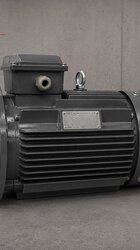
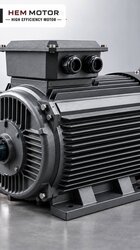
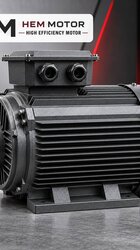
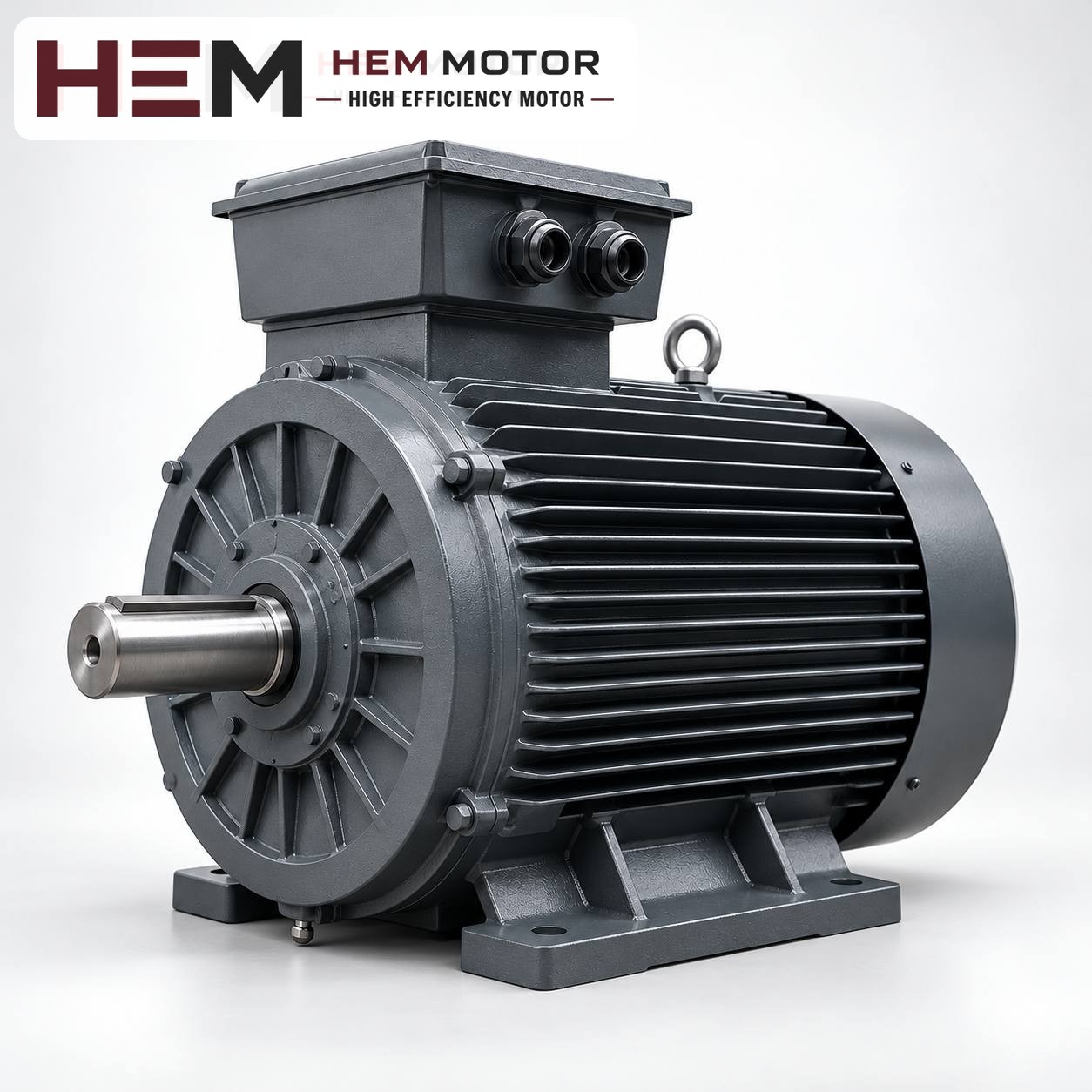
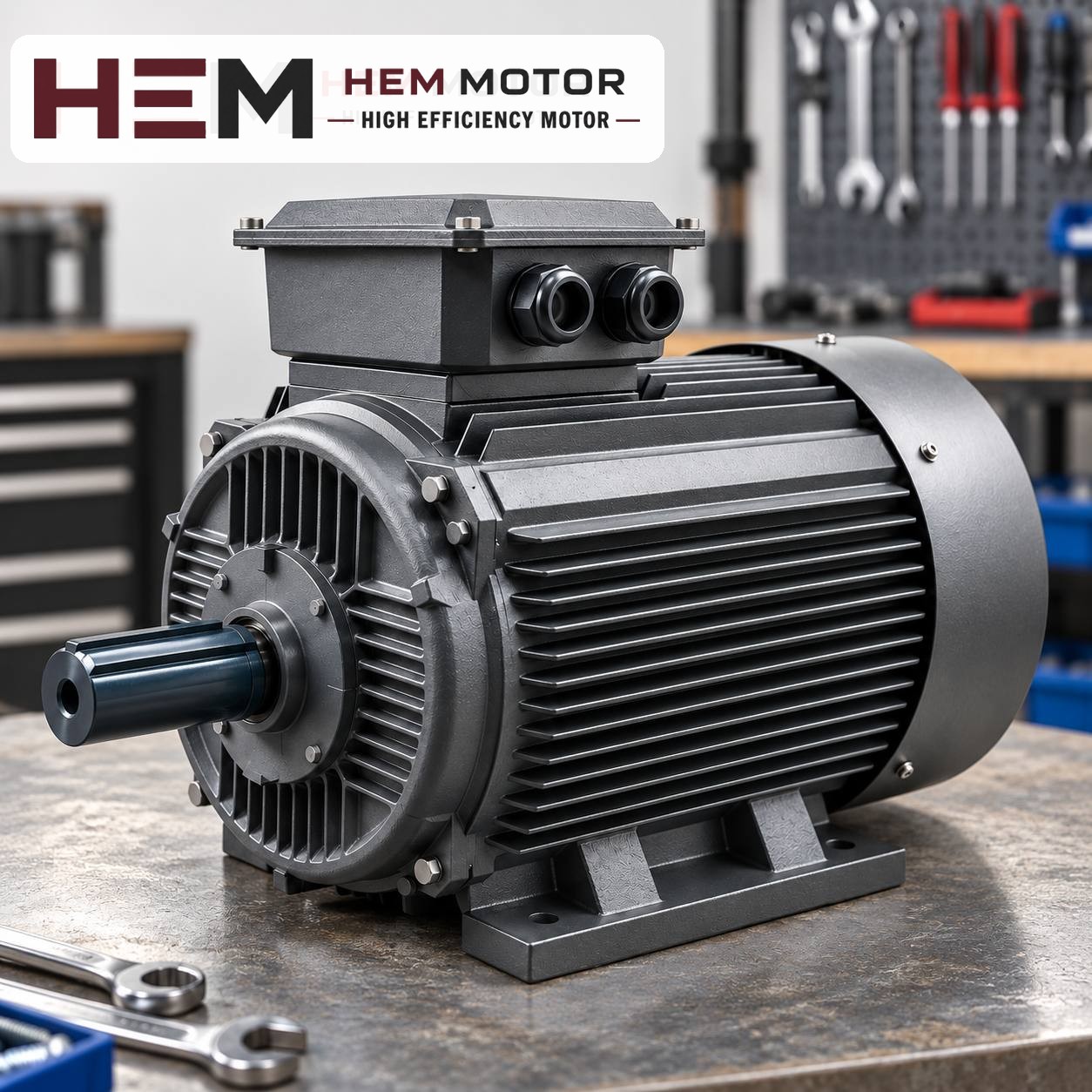
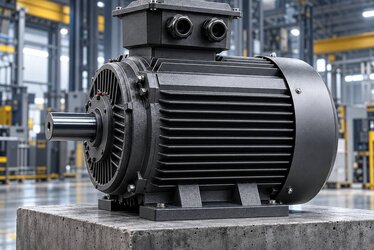
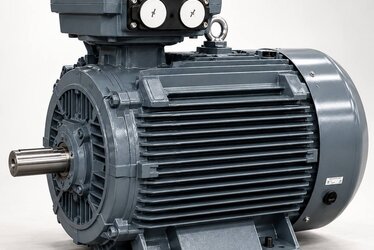
Before installation, the motor's frame size and connection type are checked (representative image).
Six options at 7.5 kW: three speeds, two frame materials
At HEM Motor, 7.5 kW is offered at 1,000, 1,500 and 3,000 rpm synchronous speed, with both an aluminium and a cast iron frame. That gives six models for the same power. The model code changes with speed, not with frame material: the aluminium and the cast iron 1,500 rpm models both carry the code 132M-4. Their electrical values are also identical. All models have IP55 protection, class F insulation and a 400/690 V (Δ/Y), 50 Hz supply.
The rated speed in the table is the speed under load that you will see on the motor nameplate. A model searched for as a "1,500 rpm motor" shows 1,460 rpm on its nameplate; this difference is the natural slip of an induction motor, not a defect.
Why does the frame grow when speed drops at the same power?
The most striking point in the table is that the 1,000 rpm model uses a 160M frame, while the 1,500 and 3,000 rpm models use a 132 frame. The reason is torque. Power depends on the product of torque and speed; if the speed is halved, almost twice the torque must be transmitted to the shaft to deliver the same power. At 7.5 kW, rated torque is 24.4 Nm on the 3,000 rpm model and rises to 73.8 Nm on the 1,000 rpm model. Higher torque means a larger rotor, more iron and copper, and therefore a larger frame.
By standard, the number in the IEC frame code describes the shaft height above the foot base; the letter (S, M, L) indicates the frame length and the foot hole spacing class. That is why 132S and 132M share the same shaft height but do not have their foot holes in the same place. 160M is both a higher and a larger frame.
When replacing an existing motor
Compare the frame code on the old motor's nameplate (e.g. 132M) with that of the new model. If the code is the same, the baseframe, base and coupling alignment will most likely stay unchanged.
Do not change the speed by looking at power alone: putting a 1,000 rpm model in place of a 1,500 rpm motor both changes the machine's speed and, because of the larger frame, requires adapting the base.
If the frame code on the nameplate cannot be read, measure the foot hole spacing and the shaft height on site and compare them with the technical drawing; do not order on guesswork.
Aluminium or cast iron?
Both frames have the same protection and insulation class; the choice depends on where the motor will run and on the structure of the machine. The list below is a decision framework, not a strict rule.
Aluminium frame: Lighter, easier to carry and install. Preferred for fans, pumps, packaging machines and mobile equipment running in enclosed, relatively clean environments. The low weight also helps in applications where the motor hangs on the machine by its flange.
Cast iron frame: A more rigid structure that is more resistant to impact. It stands out in environments with dust, vibration and mechanical shock; in stone, mining, woodworking and heavy-industry machinery, as well as on damp and demanding sites.
What they share: Both options have IP55 protection, class F insulation and the same electrical values. The frame material does not change the motor's power or speed.
If there are conditions beyond IP55, such as continuous water jets, chemical vapour or extreme temperature, state them separately in the order; such conditions may fall outside the scope of a standard motor.
Prices and technical data are on the product pages; choose a model and order online.
Mounting arrangement: B3, B5, B14, B35, B34 and vertical
The mounting arrangement determines from which surface the motor is fixed to the machine, and it is where one of the most common ordering mistakes happens.
B3 (foot-mounted): The motor is bolted to a base or baseframe by its feet; power is transmitted through a coupling, pulley and belt or a chain. It is the most common arrangement for conveyors and general machine drives.
B5 (large flange) and B14 (small flange): The motor is connected directly to a gearbox, pump or machine body through the flange on its front end shield; there are no feet.
B35 and B34: Combine feet and a flange (B35 = B3 + B5, B34 = B3 + B14). Used in layouts where the motor is flange-connected but should also be supported by its feet.
Vertical mounting (V1, V3, V5, V6, V15): Operation with the shaft pointing down or up; seen in vertical pumps and mixers.
The site does not list the mounting arrangement per model. B3, B5, B14, B34, B35 and vertical V1/V3/V5/V6/V15 options are offered according to the frame; the flange size is confirmed with the order. A flange being called simply "B5" or "B14" does not prove that it fits the connection on your machine. You can find the shaft, flange and foot dimensions in the 2026 technical and product catalogue and in the 2D technical drawings prepared per frame size. The available arrangements are also summarised in the mounting arrangements question.
Example scenario: a 1,500 rpm B3 foot-mounted motor for a conveyor
The flow below is a hypothetical example, not a real customer application. Assume that a belt conveyor's gearbox was selected for a 1,500 rpm input speed and that a 7.5 kW requirement was determined on the drive side.
Fix the power and speed: 7.5 kW, 1,500 rpm synchronous speed. This points to the model with the code 132M-4; the nameplate will show 1,460 rpm.
Define the connection: If the motor will stand on a baseframe and be coupled to the gearbox, the B3 foot-mounted arrangement is chosen. If the gearbox will sit directly on the motor flange, a flanged option is discussed and the flange size is matched to that of the gearbox.
Assess the environment: If the conveyor is in an enclosed, clean packaging line, the aluminium frame 132M-4 is sufficient. If it is on a crushing and screening site with heavy dust and impact, the cast iron frame 132M-4 is a better fit.
Check the layout: If the old motor is also a 132M frame, a swap without touching the base is expected; if it is a different frame, compare the foot spacing and shaft height using the technical drawing.
Confirm the supply: A motor rated 400/690 V (Δ/Y) is connected in delta (Δ) on a 400 V network. State the starting method (direct, star-delta, drive) in the order.
Which model makes sense where?
160M-6 aluminium frame (7.5 kW, 6 poles, 970 rpm, IEC 160M, 400/690 V): For mixers and slow-running drives that need high torque at low speed; make sure there is room for the larger frame.
132M-4 aluminium frame (7.5 kW, 4 poles, 1,460 rpm, IEC 132M, 400/690 V): The most common choice for general-purpose machines, conveyors and pump drives.
132M-4 cast iron frame (7.5 kW, 4 poles, 1,460 rpm, IEC 132M, 400/690 V): The same electrical values; for dusty and vibrating sites.
132S2-2 cast iron frame (7.5 kW, 2 poles, 2,930 rpm, IEC 132S, 400/690 V): For high-speed centrifugal pumps and fans; for installations in demanding environments.
The current price is on each model's own product page.
What to send us before ordering
To identify the right 7.5 kW model the first time, send the following information together:
Power (kW or HP) and the required speed (1,000, 1,500 or 3,000 rpm)
Mounting arrangement (B3, B5, B14, B34, B35 or vertical) and, if flanged, the size of the part it will connect to
Supply voltage and starting method
Application and environment (dust, humidity, vibration, outdoors)
If you are replacing a motor, a photo of the old motor's nameplate
You can review the suitable models and current prices on the buy electric motors page. If you are replacing an existing motor, send us the motor nameplate and we will identify the equivalent model together; for any other questions, reach us through our contact page.
HEM Motor Models Related to This Article
The cards show example models related to the topic. A suitable motor is not chosen by power alone: compare speed, voltage, mounting, shaft and connection dimensions on the product page; if unsure, send a photo of the existing motor’s nameplate on WhatsApp.
When choosing a replacement for a three-phase motor whose nameplate shows HP (horsepower), the right approach is to convert the HP value to kW and fit it to a standard kW rating: 1... More Details
For a 160 kW three-phase asynchronous electric motor, the frame choice depends on speed: in the HEM Motor 2026 catalog, the 2-pole and 4-pole 160 kW models use a 315L frame, while ... More Details
With a 132 kW three-phase asynchronous electric motor, the real work begins after the motor has been chosen: if the cable, switchgear and transformer capacity feeding a load that d... More Details
When choosing a 90 kW three-phase asynchronous electric motor, the first decision is the speed; frame, current, torque and even the base preparation follow from that decision. In H... More Details
On a thickness planer, what determines main motor power is the volume of chips removed in a pass: the amount of wood removed per minute, obtained by multiplying board width, depth ... More Details
On a low-speed conveyor, the choice between a 4-pole and a 6-pole motor does not change the torque that pulls the belt at the gearbox output; for the same power and the same drum s... More Details
We use necessary and optional cookies to improve your experience, enhance content and analyse traffic. Under the GDPR, optional (analytics/marketing) cookies are only used with your explicit consent. Please choose your preference below.
Cookie Policy
 English
 Français
 Türkçe
 Español
 Русский