On a sesame grinding mill making tahini, the electric motor is hardest pressed at start-up: with the stones packed with cooled, thickened sesame paste, the motor must deliver a breakaway torque well above the torque it needs in continuous running. Motor power is therefore chosen for the steady load and, just as much, for the starting torque of a full mill and the starting method.
What sets the torque demand of a stone mill?
Three things set the torque demand: the gap between the stones, the viscosity of the paste and the rotational speed of the stone. As the gap narrows and the paste thickens, the friction load grows; the motor delivers more torque to hold the same speed.
Roasted, hulled sesame enters through the eye in the centre of the upper stone, is crushed between the stones, releases its oil and leaves the rim as a flowing paste. The paste runs freely while warm. As it cools it thickens and behaves like a layer gluing the stones together.
In continuous running the mill draws a roughly constant load. Torque mainly changes when feeding becomes irregular: when the sesame supply stops the stones run dry, and when too much arrives the paste clogs. Operators recognise the change by the ammeter needle swinging and the stones' sound getting deeper.
Why does the motor struggle at the first start in the morning?
Paste left between the stones cools and thickens overnight, so at the first morning start the motor meets a breakaway torque far above the warm running load. That moment puts the highest stress on the motor, coupling and belt.
Three signs appear on site. The motor hums for a long time at start and cannot accelerate. The thermal relay trips within a few seconds. On belt drives the belt slips on the pulley and a smell of burnt rubber follows. The common cause is that starting torque cannot overcome the breakaway torque of the load.
Fitting a bigger motor is not the only fix. Stopping the mill at the end of the day after flushing it with some plain sesame or oil, opening the stone setting slightly for the morning start and closing it once running, and keeping the room warm all reduce the starting load noticeably. The order and limits of these settings come from the machine builder's instructions.
How is motor torque converted to stone-shaft torque?
Torque at the shaft follows from power and speed: T = 9550 × P / n (power in kilowatts, speed in revolutions per minute). Torque at the stone shaft equals motor torque multiplied by the transmission ratio and transmission efficiency: Tstone ≈ Tmotor × i × η.
A hypothetical calculation: a 7.5 kW, 970 rpm motor gives 9550 × 7.5 / 970 ≈ 73.8 Nm. Reduced by an overall 1:4 through belt and gearbox, with a transmission efficiency of 0.9, the stone shaft receives about 73.8 × 4 × 0.9 ≈ 266 Nm of continuous torque. How many times this value the motor can reach in the first seconds is given by the starting torque to rated torque ratio in the catalogue (general information; confirm with the machine builder).
The real input for the calculation is the stone speed and required stone-shaft torque supplied by the machine builder. If these are missing, work backwards from the existing motor's nameplate and the current measured on site: if the running current is close to rated current, the motor is at its limit.
Rated torque and speed for the models matching the example powers are listed on each product page in the HEM Motor shop.
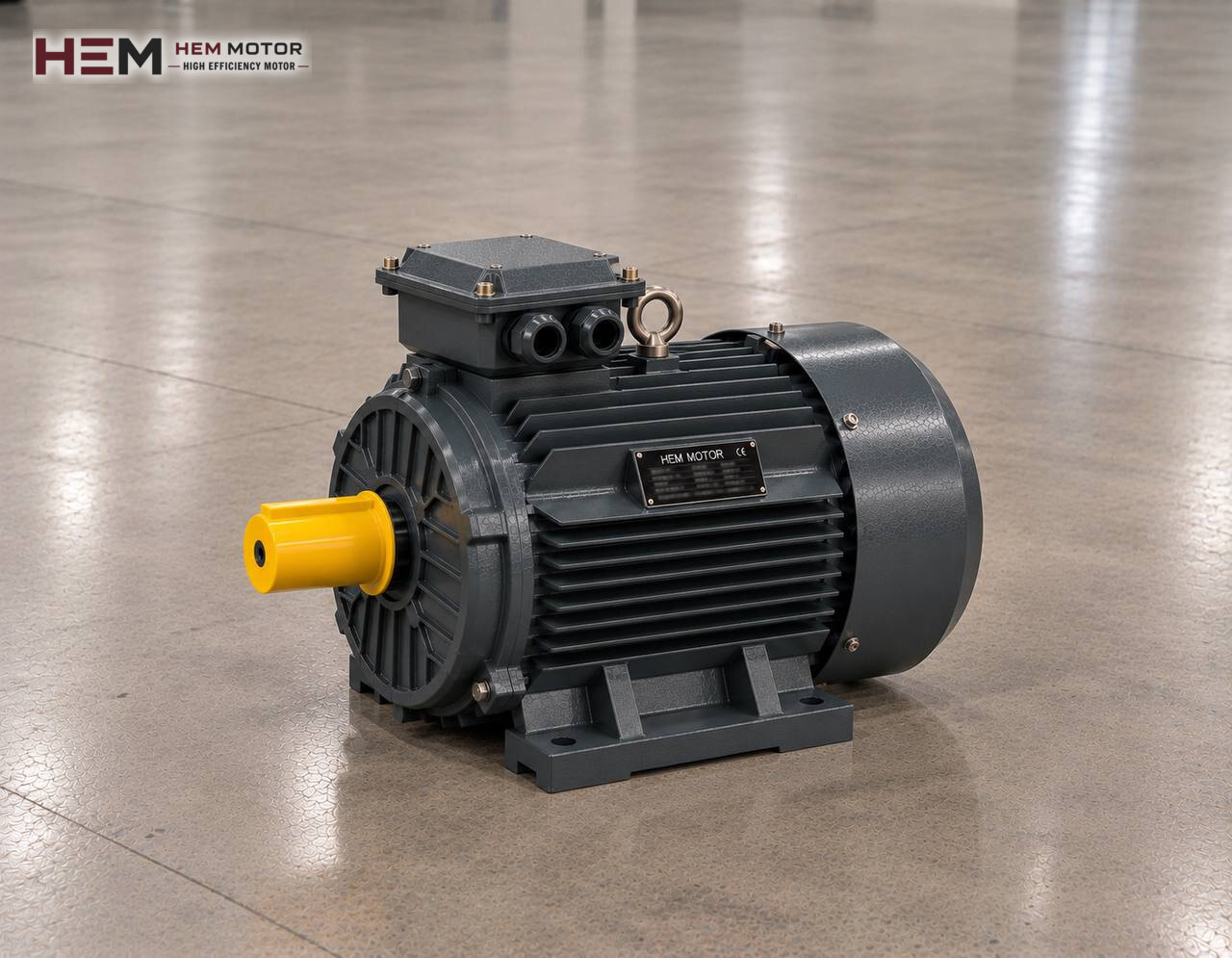
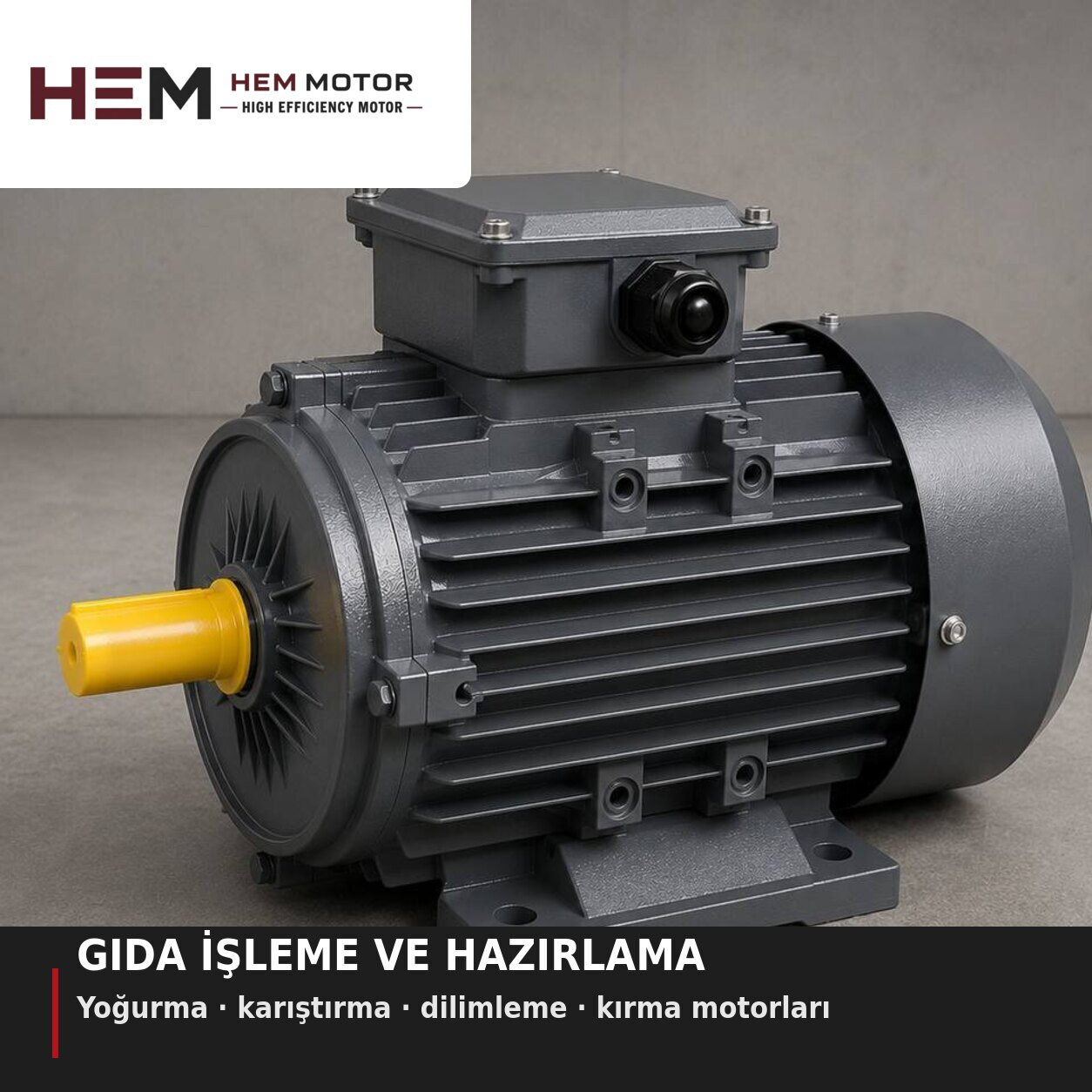
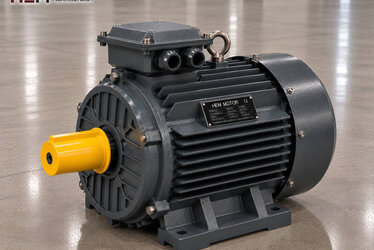
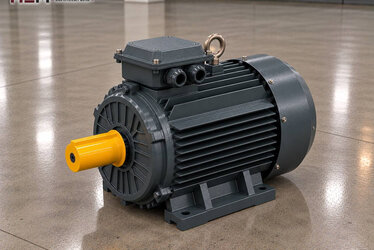
On a stone mill, motor power is chosen for the starting torque of a full mill (representative image).
Prices and technical data are on the product pages; choose a model and order online.
How does the choice of starting method affect the mill?
The starting method directly sets the torque the motor can deliver at start. On a mill starting with full stones, the wrong method makes even a correctly sized motor look too small.
With star-delta starting, starting current and torque fall to roughly one third of direct-on-line values (general information; confirm with the machine builder). That may be enough for a warm, empty mill. With a mill full of cold paste in the morning, however, the motor cannot pick up speed in star, and when the timer switches it to delta the panel ammeter needle briefly hits the stop.
A frequency converter gives a slow start with high torque at low speed and also lets the stone speed be adjusted to the product consistency. Our three-phase series are suitable for speed control with a frequency converter; long periods at low speed with full torque may need a separate fan; with a long drive-to-motor cable a dv/dt or sine filter is considered; these conditions are stated with the order. A soft starter cuts the voltage to the motor terminals to limit inrush current; the price is that torque also falls with the square of the voltage. On a mill with full stones it may not be enough on its own.
How are ambient conditions for the motor assessed in a food plant?
In a tahini plant the motor faces splashes of oily paste, sesame dust, heat from the roasting section and water used for cleaning. The standard series has IP55 protection and class F insulation. IP55 is sufficient to keep sesame dust from entering and building up and to cope with water droplets hitting the frame during cleaning.
An application washed directly with pressurised water, located in the food contact zone or needing a stainless hygienic housing is different: this duty needs a special motor; it may fall outside the scope of the standard series in HEM Motor's 2026 catalogue, so ask us with the nameplate and application details. Placing the motor beside the stone rather than under it, or behind a guard, stops paste from seeping into the fan cover and terminal box.
A mix of sesame dust and oil sticking to the fan cover quickly spoils cooling. Adding the fan cover grille to the weekly cleaning list is the easiest way to prevent overheating.
Which power and speed steps suit a sesame grinding mill?
Because the stone turns slowly, the drive calls for high torque at low speed; in practice a 6-pole (1000 rpm) or 4-pole (1500 rpm) motor is connected through a belt or gearbox. The exact power is set by the value the machine builder gives for the stone diameter and capacity.
160M-6: the motor used in the hypothetical calculation; 7.5 kW, delivers 73.8 Nm at 970 rpm, rated current 15.4 A.
160L-6: one step up for mills with large stones or hard morning starts; 11 kW, 970 rpm, 108.3 Nm, 22.0 A.
132M-4: for drives with a higher transmission ratio; 7.5 kW, 1460 rpm, 49.1 Nm, 14.3 A.
A cast iron frame copes better with mill vibration and an oily environment. Details of the series are on the cast iron frame series page, and general-purpose information on the industrial motors page. Mounting types: B3, B5, B14, B34, B35 and vertical V1/V3/V5/V6/V15 are offered depending on frame size; flange size is confirmed with the order.
Share your mill's current motor nameplate, stone diameter and the symptoms seen at the morning start through our contact page; we will discuss the right step together with the starting method and pick the match from the product list.
Frequently Asked Questions
Which pole number suits a tahini mill better?
Because the stone turns slowly, a 1000 rpm motor reaches the same stone torque with a smaller reduction ratio. A 1500 rpm motor can also be used with a larger pulley or gearbox ratio; the machine's drive design decides.
The motor trips in the morning but runs fine in the afternoon; why?
Cooling paste thickens between the stones and raises the starting torque. Flushing the mill before stopping in the evening and opening the stone setting slightly in the morning usually solves it.
Is star-delta starting enough for a tahini mill?
It may be enough for an empty, warm mill but usually not for a full, cold one. For heavy starting a frequency converter is a better route.
Can the motor withstand washing water?
Standard motors are IP55 and withstand water splashes. If direct washing with pressurised water is planned, a special motor is needed; ask us with the application details.
HEM Motor Models Related to This Article
The cards show example models related to the topic. A suitable motor is not chosen by power alone: compare speed, voltage, mounting, shaft and connection dimensions on the product page; if unsure, send a photo of the existing motor’s nameplate on WhatsApp.
When choosing an electric motor for a feed dosing screw, the real goal is for every turn of the screw to carry the same amount at low flow; to achieve this, before moving on to mot... More Details
When choosing electric motors for a corrugated board line, two groups are thought about separately: the main drives that carry line speed and the many auxiliary drives around them.... More Details
In a rubber compound mixer the electric motor carries two loads at once: the continuous torque from the high viscosity of the compound and the impact peaks that occur every batch a... More Details
On a scrap metal separation belt the electric motor is chosen by the shaft power the belt load requires and by the type of magnet unit; a magnetic head pulley adds load to the belt... More Details
An electric motor for a PET bottle crusher works, in wet crushing, against a steadier load that the water cools and lubricates, and in dry crushing against a harsher, impact-heavy ... More Details
On a cable granulator the motor carries two separate loads: the continuous cutting load as the knives on the cutting rotor chop the cable, and the sudden impacts caused by cable bu... More Details
We use necessary and optional cookies to improve your experience, enhance content and analyse traffic. Under the GDPR, optional (analytics/marketing) cookies are only used with your explicit consent. Please choose your preference below.
Cookie Policy
 English
 Français
 Türkçe
 Español
 Русский
 العربية
 Deutsch
 Italiano