In a rubber compound mixer the electric motor carries two loads at once: the continuous torque from the high viscosity of the compound and the impact peaks that occur every batch as bales and carbon black enter the rotors. The kW on the nameplate is not enough on its own when sizing the motor; the RMS value of the current swings over the cycle, the margin to breakdown torque and the impact strength of coupling and gearbox are assessed together.
How does viscosity change the motor load in a mixer?
Rubber compound softens as it warms, but its resistance also changes with shear rate. Cold and stiff at the start of the cycle, the mix heats up as it is kneaded between the rotors, its viscosity falls and motor current slowly drops.
On the operator screen the current curve draws a typical shape. A sharp peak appears at charging. A second rise follows when the ram comes down. As the mix becomes homogeneous the curve flattens and reaches its lowest level near discharge. That curve is the most valuable record you have for understanding the motor's thermal load.
When the recipe changes, so does the curve. A stiff compound with a high filler content draws noticeably more current on the same machine, while a soft mix leaves the motor at ease. Motor selection is based on the heaviest recipe.
A motor sized on the average recipe hits its limit on the first stiff batch.
How does impact load stress the motor and the drive train?
Impact load means torque jumping to several times its rated value within a very short time. When a large piece of rubber jams between the rotor wings or the ram comes down with sudden pressure, the rotor slows for an instant; the motor answers by increasing slip and drawing more current.
An induction machine tolerates torque overshoot lasting a few seconds; its ceiling is breakdown torque. If peak torque approaches that value, speed falls quickly, the motor nears stall and the protection trips. The real damage is usually seen not in the motor but in the parts in between: torn coupling elements, pitting on gear teeth, a crushed shaft key.
A familiar mistake on site: the coupling element is replaced every month, maintenance fits a harder one, and this time the impact passes into the gearbox. Hardness is not the problem. The source of the impact is. Sorting out the charging sequence and ram pressure gives a more lasting result than changing parts.
How is motor power verified under cyclic load?
Under cyclic load, motor heating is set not by the peak but by the RMS value of the current. Because winding heat rises with the square of current, high but short peaks produce more heat than the average current suggests.
For the calculation the cycle is split into a few slices, and the current and duration of each slice are recorded: Irms = √(Σ Ik² × tk / Σ tk). Hypothetical example: if a 4-minute cycle shows 160 A for 30 seconds, 110 A for 90 seconds and 70 A for 120 seconds, RMS current comes out at about √((160² × 30 + 110² × 90 + 70² × 120) / 240) ≈ 100 A. The motor's rated current must stay above that; peak torque staying below breakdown torque is checked separately.
The wait between discharge and charging helps cooling, and because the motor keeps turning the fan keeps working; if the motor stops completely, cooling slows. Logging several cycles with a three-phase power analyser gives a far more reliable result than a single clamp meter reading.
Rated current and torque of the models matching the power from the RMS calculation are listed on each product page in the HEM Motor shop.
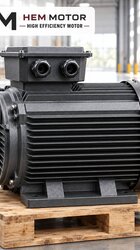
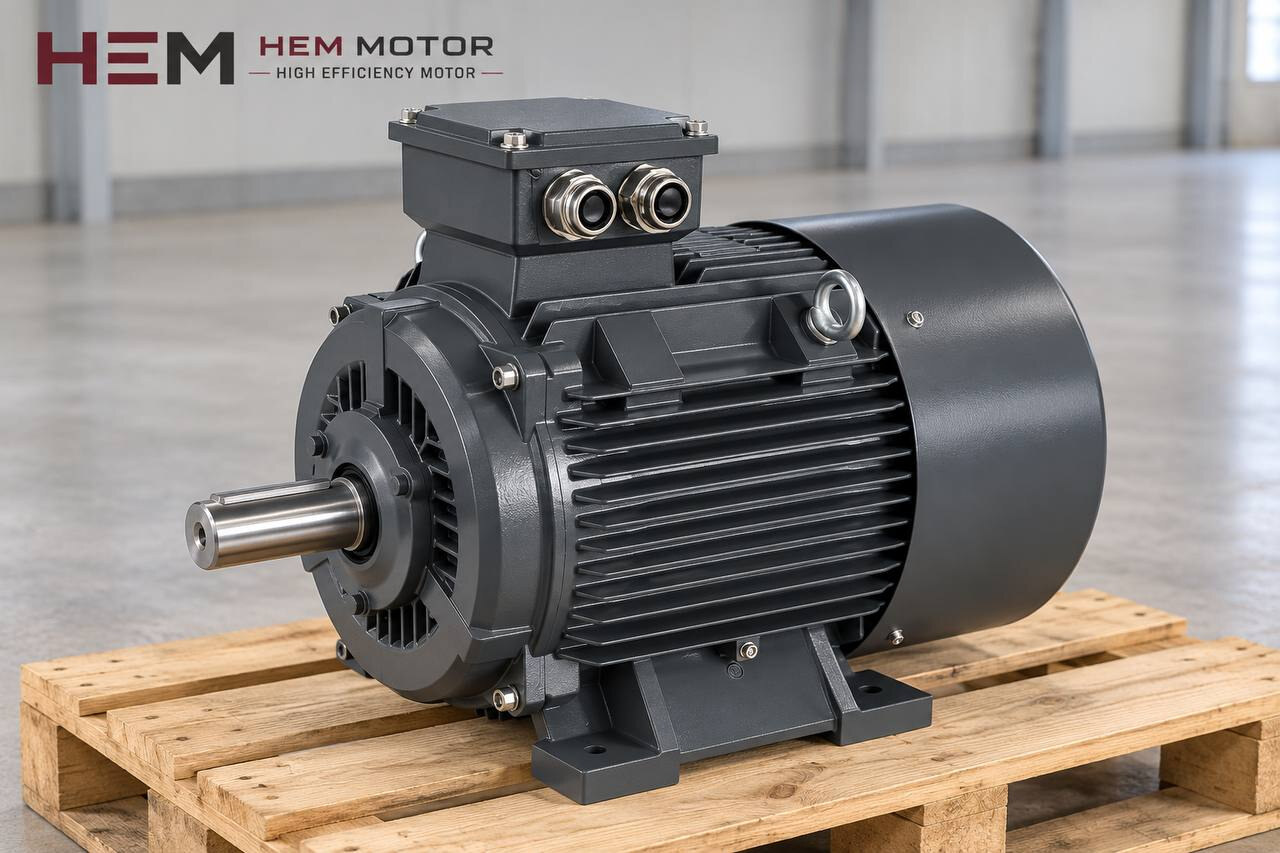
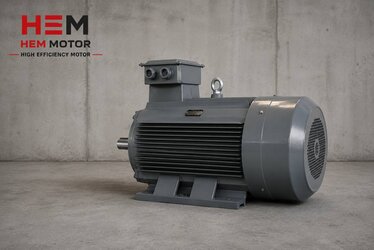
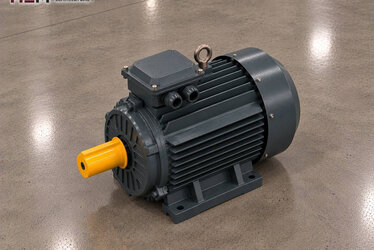
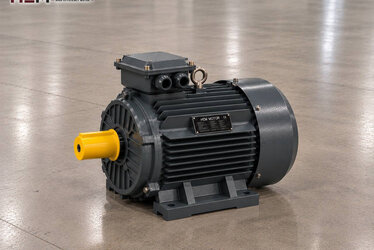
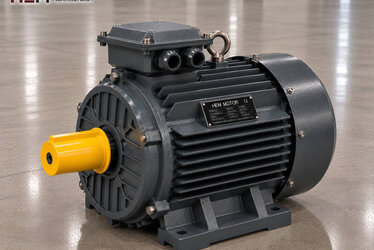
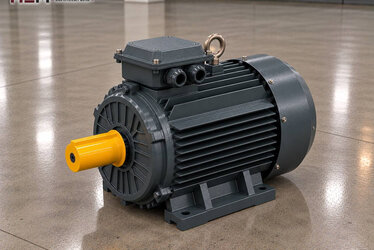
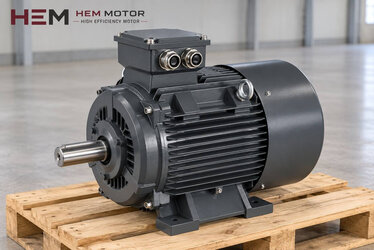
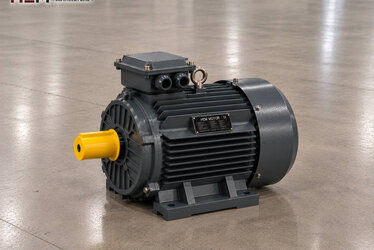
On a rubber mixer the motor is chosen by the RMS current over the cycle and the impact peaks (representative image).
Prices and technical data are on the product pages; choose a model and order online.
How are starting and speed control planned on a mixer?
In normal operation the mixer starts with an empty chamber. When power fails on a night shift and half a batch is left inside, however, the motor may have to be turned again with a full chamber. Starting with a full chamber can strain even direct-on-line starting torque; forcing it without emptying the chamber is risky for coupling and gearbox.
Empty the chamber first, then start; losing a few minutes costs less than a gearbox.
A frequency converter helps adjust rotor speed to the recipe and control mix temperature, and its torque limit function clips impact peaks before they reach the drive train. Our three-phase series are suitable for speed control with a frequency converter; long periods at low speed with full torque may need a separate fan; with a long drive-to-motor cable a dv/dt or sine filter is considered; these conditions are stated with the order.
When choosing the drive, look at the peak current in the cycle, not the motor's rated current. A drive sized for heavy duty that can carry fifty per cent overcurrent for one minute rides through the charging peak without faulting (general information; confirm with the drive maker's overload rating).
What do environment and mounting call for in a rubber plant?
In the internal mixer area, carbon black and calcite dust hang in the air, heat radiates from the compound and the floor vibrates. In the standard series the frame is protected to IP55 and windings come with class F insulation. To keep conductive carbon dust out of the terminal box, the box gasket and cable glands are checked at every service. To carry vibration properly, the motor is fixed to a common rigid base with the gearbox; alignment is measured again after hot running. Cold alignment lies. A dust layer on the fan cover spoils cooling and quickly pushes a motor whose RMS current is already at the limit into overheating.
An area with combustible dust or solvent vapour needs an explosion-protected motor. This duty needs a special motor; it may fall outside the scope of the standard series in HEM Motor's 2026 catalogue, so ask us with the nameplate and application details.
Which motor steps are considered for a rubber compound mixer?
Mixer rotors turn at low speed; the drive usually puts a 1500 rpm class motor behind a high-ratio gearbox. The exact power is set by the value the mixer builder gives for chamber volume and recipe, together with the RMS current measured on site.
225S-4: for medium-volume mixers; 37 kW, 1485 rpm, 237.9 Nm, rated current 66.1 A.
250M-4: one step up for stiff recipes; 55 kW, rated current 97.6 A, 353.7 Nm at 1485 rpm.
280S-4: for lines with large chambers; 75 kW, 1486 rpm, 482 Nm, 129 A.
A cast iron frame suits the mixer's vibration and dusty surroundings; series details are on the cast iron frame series page and sector information on the plastics and rubber processing motors page. Mounting types: B3, B5, B14, B34, B35 and vertical V1/V3/V5/V6/V15 are offered depending on frame size; flange size is confirmed with the order.
Send your mixer's current motor nameplate, the current curve of the heaviest recipe and the cycle time through our contact page; we will work out the RMS current together and pick the right step from the product list.
Frequently Asked Questions
The mixer motor peaks above rated current; is that dangerous?
Short peaks are normal for an induction motor. What matters is that RMS current over the cycle stays below rated current and that peak torque does not approach breakdown torque.
The coupling element keeps tearing; is a harder element the answer?
Usually not; a harder element passes the impact into the gearbox. Charging sequence, ram pressure and torque limiting in the drive are more lasting fixes.
Is a frequency converter needed on a mixer?
It is not mandatory; it helps when speed adjustment and torque limiting are wanted. The drive is chosen by the peak current in the cycle, not by the motor's rated current.
Can the motor restart with a full chamber?
Motor torque may be enough, but coupling and gearbox take a heavy blow. Where possible, the chamber is emptied before starting, following the mixer builder's instructions.
HEM Motor Models Related to This Article
The cards show example models related to the topic. A suitable motor is not chosen by power alone: compare speed, voltage, mounting, shaft and connection dimensions on the product page; if unsure, send a photo of the existing motor’s nameplate on WhatsApp.
When choosing an electric motor for a feed dosing screw, the real goal is for every turn of the screw to carry the same amount at low flow; to achieve this, before moving on to mot... More Details
When choosing electric motors for a corrugated board line, two groups are thought about separately: the main drives that carry line speed and the many auxiliary drives around them.... More Details
On a scrap metal separation belt the electric motor is chosen by the shaft power the belt load requires and by the type of magnet unit; a magnetic head pulley adds load to the belt... More Details
An electric motor for a PET bottle crusher works, in wet crushing, against a steadier load that the water cools and lubricates, and in dry crushing against a harsher, impact-heavy ... More Details
On a cable granulator the motor carries two separate loads: the continuous cutting load as the knives on the cutting rotor chop the cable, and the sudden impacts caused by cable bu... More Details
For an icing sugar mill, the electric motor is usually a 2-pole unit at about 2900 rpm, because pin and hammer mills need a high peripheral speed for fine grinding and the rotor is... More Details
We use necessary and optional cookies to improve your experience, enhance content and analyse traffic. Under the GDPR, optional (analytics/marketing) cookies are only used with your explicit consent. Please choose your preference below.
Cookie Policy
 English
 Français
 Türkçe
 Español
 Русский
 العربية
 Deutsch
 Italiano