On a cable granulator the motor carries two separate loads: the continuous cutting load as the knives on the cutting rotor chop the cable, and the sudden impacts caused by cable bundles arriving at the feed throat. That is why power is found from hourly capacity multiplied by specific energy, with an impact margin on top. The cutting rotor is usually belt-driven by a 4-pole motor; a heavy flywheel and a long start become decisive in motor selection.
What jobs does the motor do on a granulating line?
A typical cable recycling line consists of a pre-shredder, a granulator (cutting mill), an air separator and a shaking table or electrostatic separator. The cutting mill reduces the cable to granules a few millimetres in size, freeing the copper from the insulation. This is the point on the line that draws the most energy.
Inside the mill, the knives on the rotating rotor cut like scissors as they pass the counter-knives fixed to the housing.
The screen underneath holds back pieces that are not yet small enough. The narrower the holes, the more laps a piece makes in the chamber. That means every tonne costs the motor more.
There are auxiliary motors too: feed belt, fan, separator table. They are small, but because they are fed from the same panel as the main cutter motor, the starting sequence matters. First the fan and separator, then the cutter, and finally the feed belt are switched on.
How is the power requirement of the cutting rotor calculated?
The starting point is the capacity and specific energy given by the machine manufacturer:
Pshaft ≈ Q × e × kimpact
Q is the hourly feed (t/h), e the energy used per tonne of cable (kWh/t), and kimpact a multiplier added for feed fluctuation and thick cable pieces. Specific energy varies widely with cable type: thin automotive wire, thick power cable, telephone cable and enamelled wire behave differently (general information; confirm with the machine manufacturer).
Hypothetical example: 1 t/h of mixed cable
Assume 1 tonne of mixed cable per hour, a specific energy of 18 kWh/t as an example and an impact factor of 1.25. Shaft power comes out at 1 × 18 × 1.25 ≈ 22.5 kW. In that case the 30 kW step is comfortable, while 22 kW is borderline and may cause overload trips with batches of thick cable. You can compare the steps with their torque values in the electric motor shop.
Testing the assumption is simple. On an existing machine, log motor current for one shift and weigh the granulate produced in the same period. The amplitude of the current fluctuation tells you directly about the impact factor.
How does the feed load make the motor fluctuate?
Cable does not enter the granulator as a smooth flow. Pieces from the pre-shredder vary in length; every so often there is a thick-section piece or a tied bundle among them. When it reaches the knives, motor current shoots up for a moment, speed drops, then recovers.
On site you hear it too: the mill's sound deepens and the belts squeal for an instant. If belt slip repeats, either tension is low or feed is too high.
The flywheel is there to smooth this fluctuation. The total inertia of rotor and pulley stores energy during short impacts and gives it back; the peak current seen by the motor gets smaller.
The price is a long start. A cutter with a heavy flywheel needs a long time to reach rated speed, and the winding heats during that time.
Adjusting feed belt speed according to cutter motor current is the least costly way to absorb impacts on the feed side instead of in the motor. When current exceeds the set limit the belt slows or stops, and speeds up again when current falls. For the electrician installing it, the job is a current transformer, an analogue input and a few parameters; it gives a much smoother result than an operator switching the belt on and off by hand, because the human eye notices rising current only when the belts start to squeal.
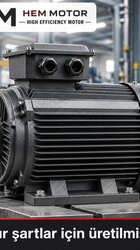
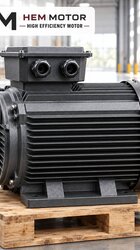
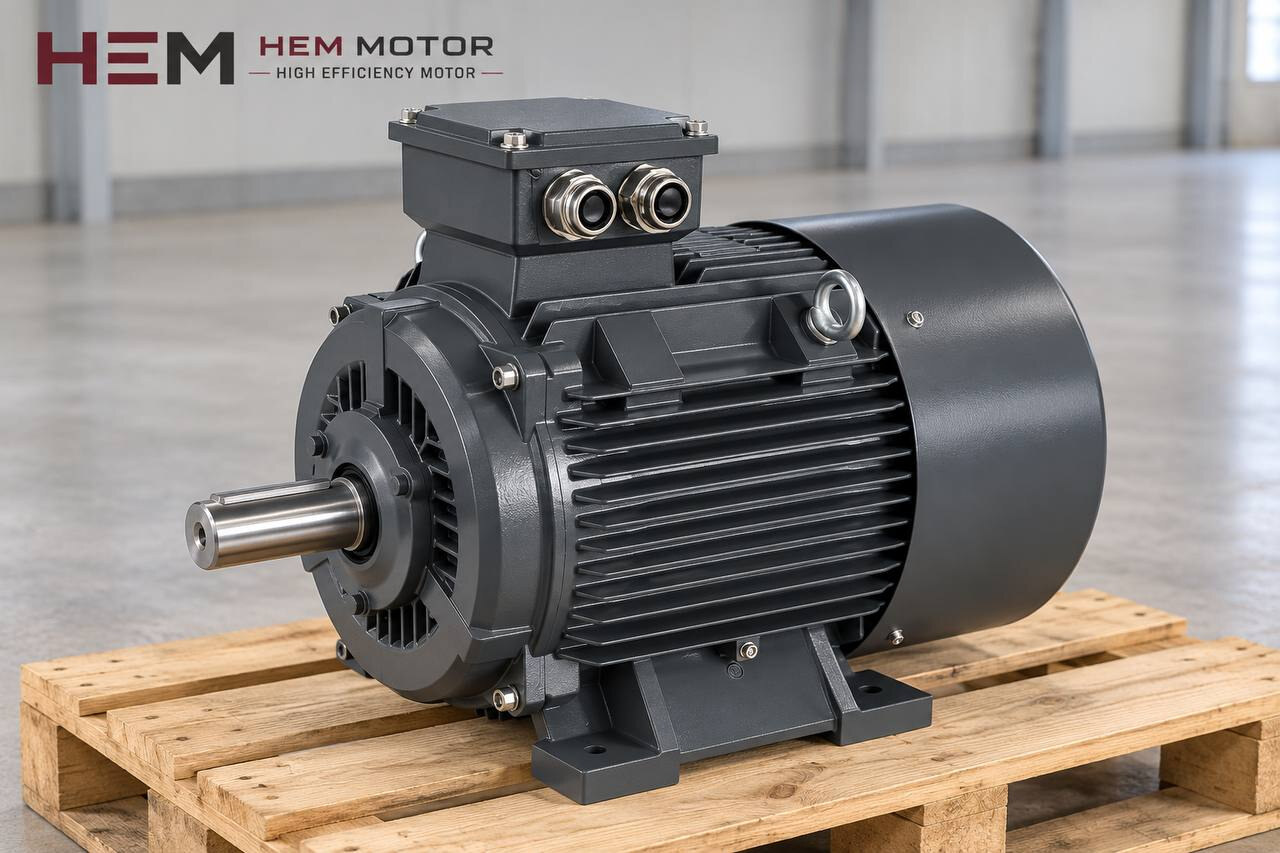
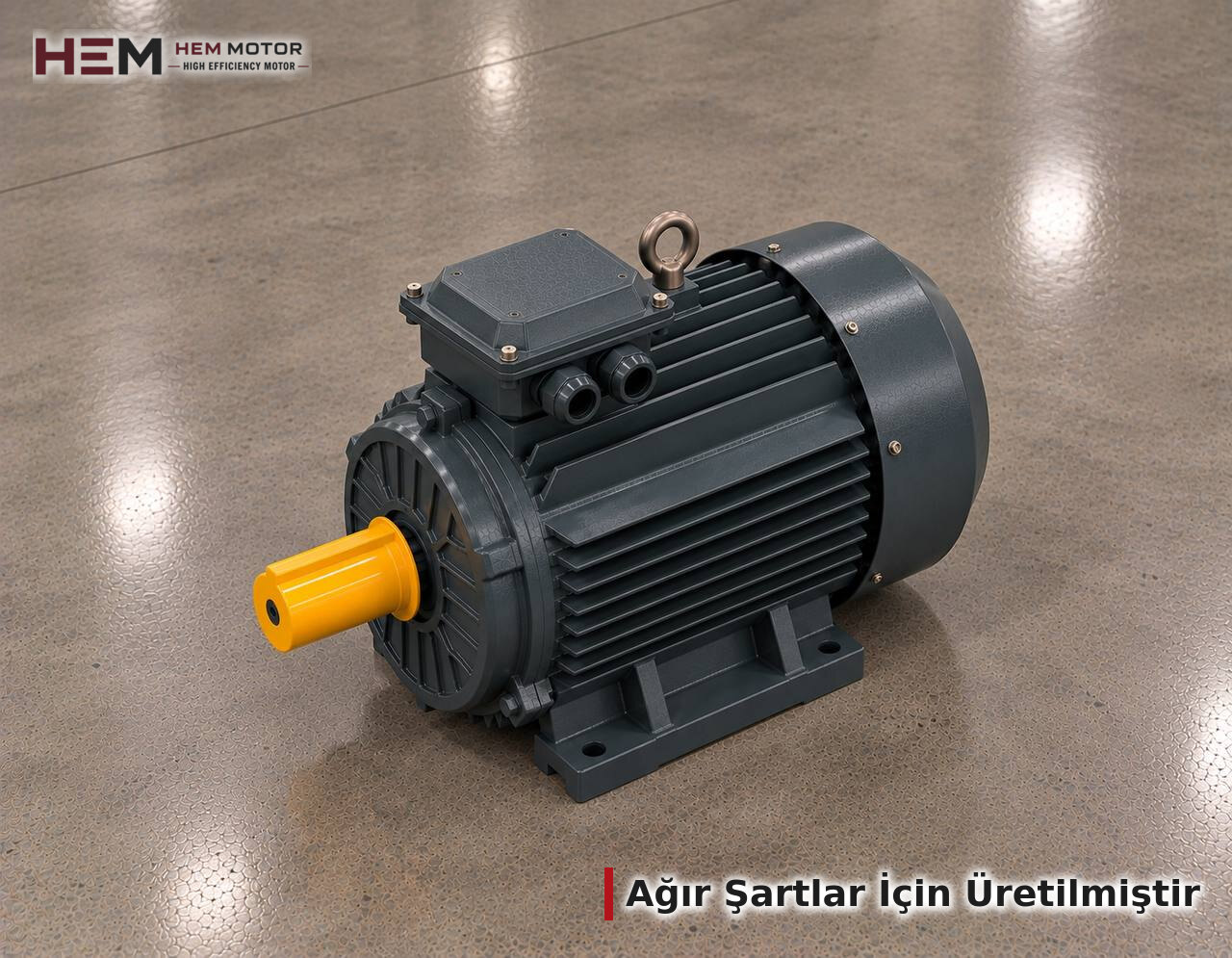
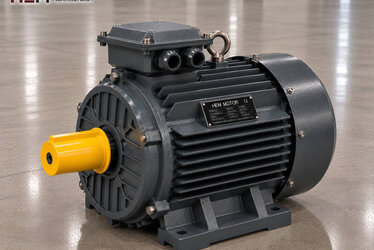
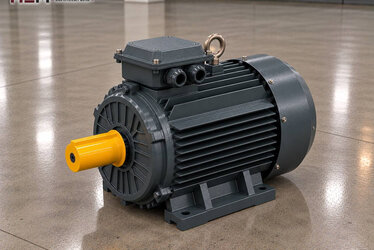
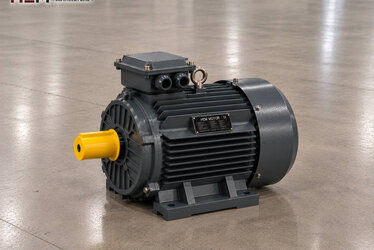
On a granulating line the motor works in dust and under fluctuating load; keeping the frame clean is part of cooling (representative image).
Prices and technical data are on the product pages; choose a model and order online.
The cutting mill must always start empty. If material was left in the chamber during a stop, the first job is to clear it; starting with a full chamber strains both the motor and the knives.
At the 30 kW step the winding is 400/690 V; on a 400 V network it is connected in Δ and can be started Y/Δ. On a cutter with a heavy flywheel, the time in star must be long enough for the rotor to accelerate most of the way.
A soft starter limits current, but torque comes down with it; if flywheel inertia is large, starting time lengthens. The soft starter's ramp time must be chosen so the motor's thermal limit is not exceeded.
The trip class of the overload relay must suit the starting time. A relay chosen for a short start will trip during start on a heavy-flywheel machine.
If rotor balance is disturbed after a knife change, vibration soon tires the bearings. A maintenance technician who puts a hand on the frame after the change feels the difference at once.
One measurement is enough. With a clamp meter, use a stopwatch to catch the moment starting current falls to its rated value. The resulting seconds are the most valuable piece of information to give the machine manufacturer and the motor supplier. The starting arrangement and protection values are set by the plant's electrical engineer.
How do dust and metal particles affect the motor?
On a granulating line the air carries fine PVC dust and copper fragments. This dust fills the fan cover grille and the gaps between the cooling fins; cooling weakens. Although the load has not changed, the frame runs a little hotter every week.
The series is IP55 protected; this keeps harmful amounts of dust out of the frame, but it does not remove the need to keep the outer surface clean. Weekly cleaning of the fan cover with compressed air and a check of the fins should be written into the maintenance list. Copper fragments getting into the terminal box can cause leakage current; the box gasket and cable glands must be tight.
Measuring frame temperature once a week at the same spot with a handheld thermometer and noting it shows dust build-up before a fault appears. If temperature creeps up, check cleanliness first, then load.
Which HEM models suit a granulator?
On belt-driven cutting mills, 4-pole cast iron motors are a common choice; frame rigidity and heat dissipation suit harsh conditions. Around the hypothetical 1 t/h line:
160L-4: 15 kW, 1465 rpm, 27.3 A at 400 V, 97.8 Nm; for smaller-capacity machines or those processing only thin cable.
180M-4: 18.5 kW, 1470 rpm, 33.5 A at 400 V, 120.2 Nm; for mixed cable lines around half a tonne per hour.
200L-4: 30 kW, 1475 rpm, 53.8 A at 400 V, 194.2 Nm; the choice with impact margin in the example calculation.
Detailed family data are on the cast iron electric motors and industrial motors pages. All three models come with an IP55 frame, class F insulation and CE marking; they are offered with IE3, IE4 or IE5 efficiency, and the class is set per model at the order. The shaft end that takes the pulley and the foot holes are given per frame on the technical drawings page; prices and other steps are in the electric motor shop.
Send the machine nameplate, the cable type to be processed and a current log of the existing motor through our contact page; together with the starting time we will choose the right step together. All options are in the HEM Motor product list.
Frequently Asked Questions
Why does the granulator motor trip the overload relay at starting?
Most often the starting time of the heavy-flywheel machine exceeds the trip class of the overload relay. The starting time must be measured and the relay class chosen accordingly; material left in the chamber has the same effect.
Does reducing the screen hole size increase motor load?
It does. Material stays longer in the chamber and energy per tonne rises; current should be logged again after a screen change.
Can the cutter motor be driven by a frequency converter?
It can; it lowers starting current and allows speed to be adjusted to the material. Long operation at low speed and the cable length are stated with the order.
Does knife wear show in the current?
It does. A blunt knife crushes rather than cuts; at the same capacity current rises slowly and granule size becomes irregular.
HEM Motor Models Related to This Article
The cards show example models related to the topic. A suitable motor is not chosen by power alone: compare speed, voltage, mounting, shaft and connection dimensions on the product page; if unsure, send a photo of the existing motor’s nameplate on WhatsApp.
When choosing an electric motor for a feed dosing screw, the real goal is for every turn of the screw to carry the same amount at low flow; to achieve this, before moving on to mot... More Details
When choosing electric motors for a corrugated board line, two groups are thought about separately: the main drives that carry line speed and the many auxiliary drives around them.... More Details
In a rubber compound mixer the electric motor carries two loads at once: the continuous torque from the high viscosity of the compound and the impact peaks that occur every batch a... More Details
On a scrap metal separation belt the electric motor is chosen by the shaft power the belt load requires and by the type of magnet unit; a magnetic head pulley adds load to the belt... More Details
An electric motor for a PET bottle crusher works, in wet crushing, against a steadier load that the water cools and lubricates, and in dry crushing against a harsher, impact-heavy ... More Details
For an icing sugar mill, the electric motor is usually a 2-pole unit at about 2900 rpm, because pin and hammer mills need a high peripheral speed for fine grinding and the rotor is... More Details
We use necessary and optional cookies to improve your experience, enhance content and analyse traffic. Under the GDPR, optional (analytics/marketing) cookies are only used with your explicit consent. Please choose your preference below.
Cookie Policy
 English
 Français
 Türkçe
 Español
 Русский
 العربية
 Deutsch
 Italiano