In an electric motor, the thermal margin is the difference between the hottest point the winding reaches in service and the temperature allowed by the insulation class; because an IE4 class motor has lower losses, this difference is usually larger at the same load. Since insulation life depends exponentially on temperature, even a few degrees of margin noticeably change how many years the winding will last.
Exactly which two temperatures make up the thermal margin?
The thermal margin is the difference between the temperature the insulation class allows in continuous operation and the winding's hottest point at that moment. The winding's hottest point is itself the sum of three components: ambient temperature, the winding's average temperature rise, and the extra difference between the average and the hottest point.
The letter "F" on the nameplate shows the temperature class the insulation materials can withstand; it does not mean the motor runs at that temperature. The letter is a limit, not a reading. Many designs use class F insulation but keep the winding temperature rise at the limit of the class below (B); the difference is the safety margin left for operation. The HEM Motor series comes with class F insulation; the class limit at which the temperature rise of a given model is kept should be confirmed with the order (general information; confirm with the motor manufacturer's data).
How do lower losses affect winding temperature?
Every watt turned into heat inside the motor has to be carried out through the frame and the fan; if losses fall, the winding stays cooler with the same cooling arrangement. Fewer losses mean a cooler winding. The IE4 efficiency class means fewer losses than IE3 at the same shaft power, and this difference directly lowers heating.
The subtle point is that not all losses heat the winding to the same extent. Stator copper loss is produced inside the winding itself; iron loss arises in the lamination stack, and friction loss in the bearings and fan. In high-efficiency designs the biggest gain usually comes from the copper and iron items, so the drop in winding temperature can be more marked than the overall loss ratio suggests. The actual value depends on the design; make the comparison from the manufacturer's heat run test report.
We have collected the general features of motors in this class on our IE4 Super Premium Efficiency Electric Motors page; the efficiency class in which a listed model is supplied is confirmed with the order.
What does the ten-degree rule say about insulation life?
According to a general engineering assumption, when the continuous operating temperature of the winding rises by about 10 °C, the expected insulation life is roughly halved, and when it falls by 10 °C, it roughly doubles. Ten degrees cost half the life. This relationship comes from the observation that the rate of chemical ageing rises exponentially with temperature, and it is meant for estimation.
Hypothetical comparison: if one of two motors running at the same load has a winding that runs 10 °C cooler than the other, then, all else being equal, the cooler one's insulation can theoretically be expected to last about twice as long. The rule does not give an exact figure; moisture, vibration, voltage surges and contamination accelerate ageing on top of it (general information; confirm with the insulation manufacturer's data).
The practical consequence of this relationship is that thermal margin is a buffer protecting the motor against overload, and just as much a reserve that slows the quiet ageing of the winding.
How is winding temperature rise measured by the resistance method?
Winding temperature rise is calculated from the ratio of the winding resistance measured when the motor is cold and immediately after it reaches thermal equilibrium; because copper resistance rises with temperature at a known rate, this method gives the average temperature of the winding.
With the motor stopped for hours, record the ambient temperature (θ1) and the resistance between two phase terminals (R1) with a micro-ohmmeter.
Run the motor at its normal load until the temperature stops rising; equilibrium is assumed when the frame temperature no longer rises within half an hour.
As soon as the motor stops, measure the resistance (R2) between the same two terminals and note the ambient temperature at that moment (θa). Delay lowers the result; taking several readings and extrapolating back in time is more accurate.
For a copper winding, calculate the temperature rise: Δθ = (R2 − R1) / R1 × (235 + θ1) + θ1 − θa.
Hypothetical example: cold at 20 °C, R1 = 1.20 Ω; hot, R2 = 1.56 Ω; and ambient at the moment of measurement 30 °C. Δθ = 0.36 / 1.20 × 255 + 20 − 30 = 76.5 − 10 ≈ 66.5 K. This is the average rise; the hottest point is a few kelvin above it. Comparing the result with the class limit given by the motor manufacturer shows you the remaining margin.
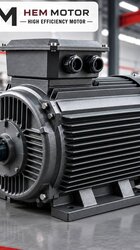
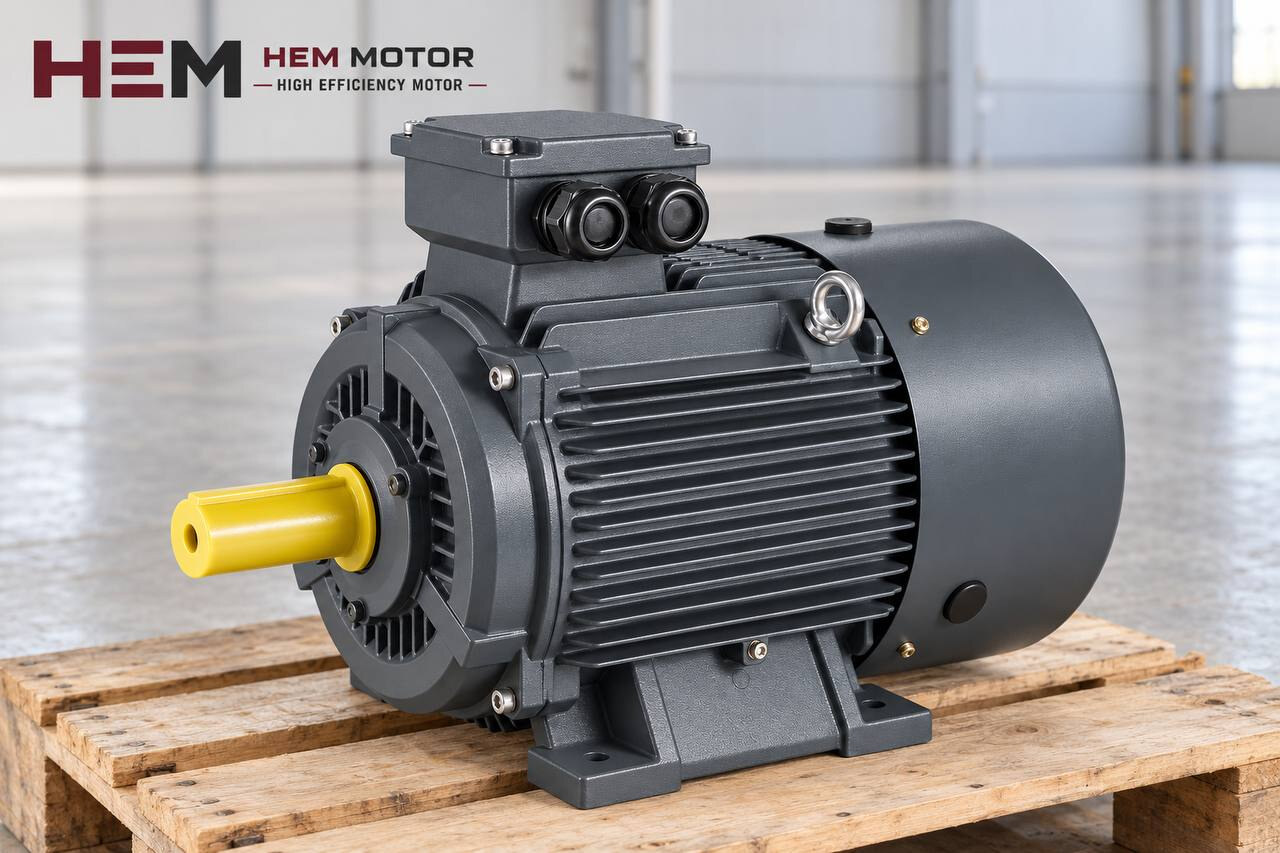
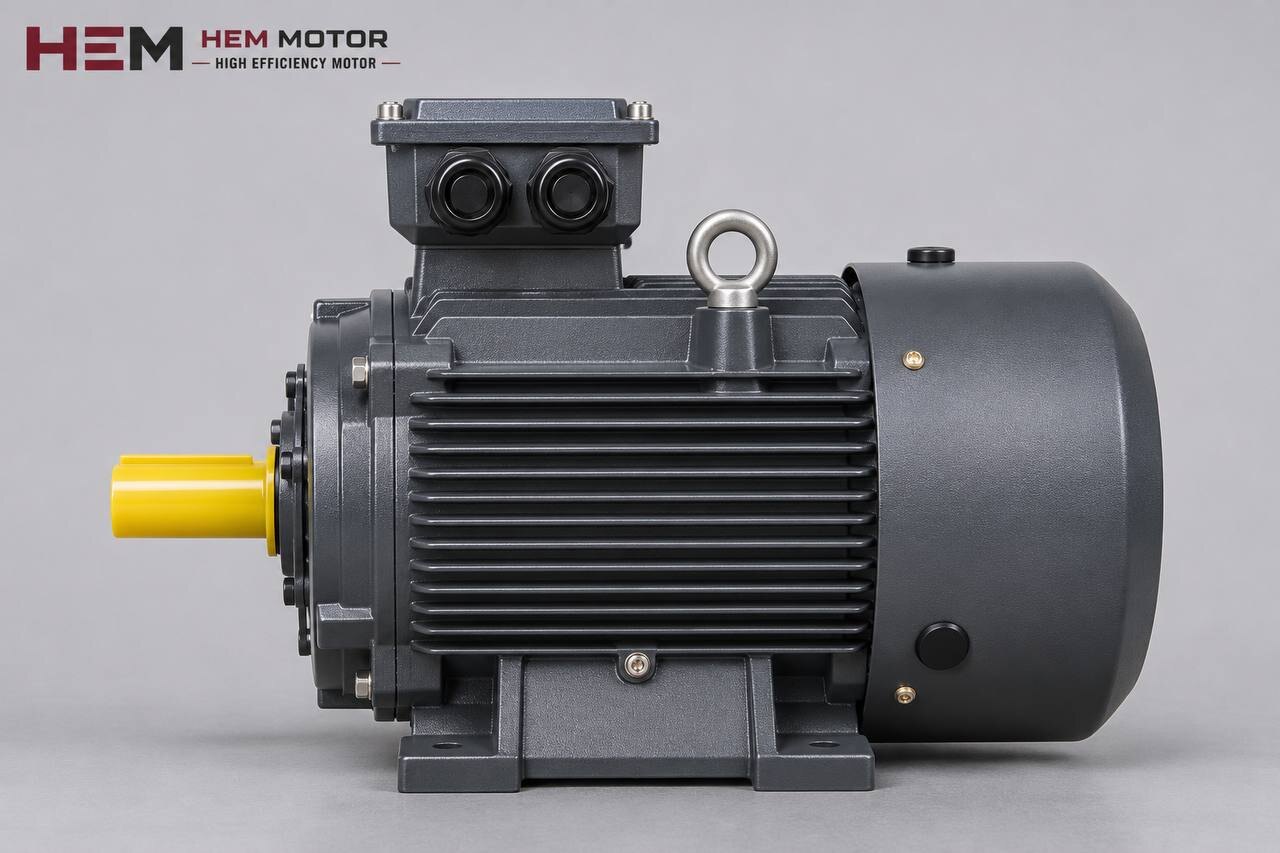
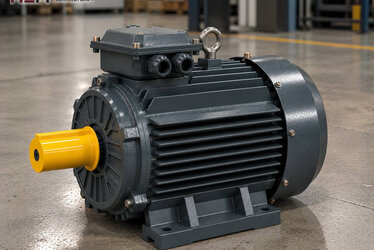
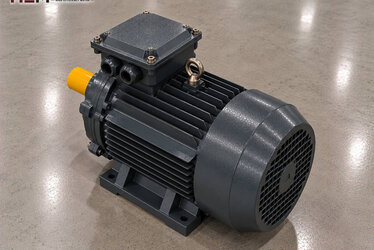
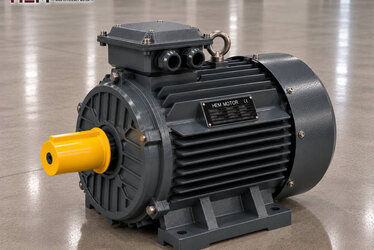
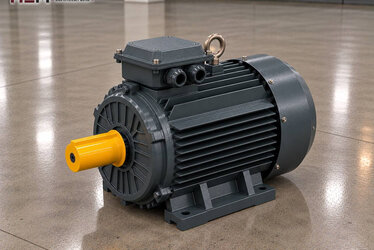
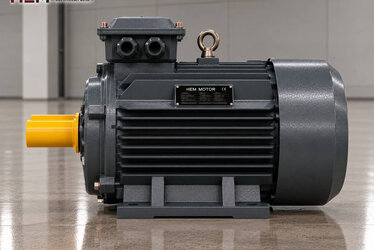
Heat produced in the winding is carried away through the frame fins and the fan; clean fins directly affect the thermal margin (representative image).
Prices and technical data are on the product pages; choose a model and order online.
The nameplate values apply to a given ambient temperature and an altitude close to sea level. Every situation outside these conditions uses up part of the margin on paper.
Site condition
How it uses up the margin
How to check
High ambient temperature (boiler room, under the roof)
Winding temperature rises with the ambient
Temperature logging around the motor; ventilation
High altitude
Thin air weakens cooling
State the altitude in the order; derating is obtained from the manufacturer
Voltage unbalance
Unbalanced phase currents, extra copper loss
Measure the three phase voltages separately
Low speed on a frequency converter
The shaft-mounted fan slows down, harmonics create extra loss
State the speed range; a separate fan if needed
Dust and oil build-up on the fins
Heat dissipation from the frame drops
Periodic cleaning; keep the fan cowl inlet clear
Frequent starting
Each start briefly heats the winding with high current
Ask the manufacturer about starts per hour
The wider margin of an IE4 motor provides a buffer against these conditions, but does not remove them. Even a small unbalance between the three phase voltages can create a much larger unbalance in the currents; no one should say "the motor runs cool" without a measurement.
Which order options are there for monitoring the winding?
A PTC thermistor or PT100 sensor embedded in the winding and an anti-condensation heater that prevents condensation at standstill are options that can be requested with the order. A PTC suddenly increases its resistance at a set temperature and stops the motor via a relay; a PT100 reads the winding temperature continuously and allows trend monitoring.
A thermal overload relay monitors current; it does not know the winding's real temperature. Current does not tell temperature.
On motors running at low speed, in hot surroundings or with frequent starts, the winding can heat up while the current looks normal; a sensor option should be considered on these drives. Which fault each protection device responds to is explained in the motor protection article, and the differences between cooling arrangements on the cooling methods page. Insulation in a higher temperature class is available only as a special order option.
Example electric motors for keeping the thermal margin
Below are examples from the series for 4- and 6-pole drives that will run in a hot pump room or on a converter-driven conveyor. You can review other powers and speeds in the electric motor shop.
132S-4 cast iron, 5.5 kW, 1460 rpm, 400/690 V; for small drives in hot surroundings, such as a boiler room circulation pump.
132M-4 cast iron, 7.5 kW, 1460 rpm, 400/690 V; for leaving margin by choosing one step larger when the measured load is close to 5.5 kW.
160L-6 cast iron, 11 kW, 970 rpm, 400/690 V; for low-speed, high-torque conveyor and mixer drives.
HEM Motor offers the IE3, IE4 and IE5 efficiency classes; the class in which these models are supplied, the temperature rise value and the sensor options are confirmed with the order. The series comes with IP55 protection and class F insulation; general information on the family is on the asynchronous electric motors page. Our three-phase series are suitable for speed control with a frequency converter; prolonged running at low speed with full torque may require a separate fan; if the drive-to-motor cable is long, a dv/dt or sine filter is considered; these conditions are stated in the order.
If you send the temperature rise found by resistance measurement, the ambient temperature and the motor's nameplate photo through the find an equivalent from the nameplate page, we will assess the remaining thermal margin together and, if needed, a power step that will run cooler. The HEM Motor model list is open for comparing steps.
Frequently Asked Questions
If the motor frame is too hot to touch, has the winding overheated?
Not always; a frame too hot to hold by hand is normal on many motors. The decision is based not on the frame but on the winding temperature found by the resistance method or a winding sensor.
Is it right to push a motor with class F insulation up to the class limit?
It may be acceptable for short periods, but approaching the limit in continuous operation clearly shortens insulation life according to the ten-degree rule. To preserve the margin, load together with ambient conditions and the cooling arrangement are considered as a whole.
Does moving to an IE4 motor change the existing thermal relay setting?
If the new motor's nameplate current is different, the relay is reset to that value. The setting is always made according to the rated current on the nameplate of the motor actually installed.
Which motors need an anti-condensation heater?
It is considered for motors standing idle for long periods in humid surroundings with a large day-night temperature difference. It keeps the winding slightly warmer than the surroundings at standstill and reduces moisture build-up.
HEM Motor Models Related to This Article
The cards show example models related to the topic. A suitable motor is not chosen by power alone: compare speed, voltage, mounting, shaft and connection dimensions on the product page; if unsure, send a photo of the existing motor’s nameplate on WhatsApp.
When choosing an IE4 electric motor, a constant load is judged at a single operating point, while a variable load is judged across the whole load profile. For a constant load the c... More Details
IE4 and IE3 electric motor models of the same power do not always share the same frame. The frame number is often kept, but to raise efficiency the core length may be extended, the... More Details
The catalogue efficiency of an IE4 electric motor is measured under laboratory conditions defined in the standard, at rated load, with a balanced, sinusoidal 50 Hz voltage; on site... More Details
Yes, an IE4 electric motor also saves energy when it runs without a drive, fed directly from the supply, because it delivers the work at the shaft while wasting less heat inside, a... More Details
No, they are not the same thing: efficiency shows what share of the active power an electric motor takes from the supply reaches the shaft, while power factor shows what share of t... More Details
For an IE4 electric motor, the efficiency difference is expressed in percentage points, while the reduction in losses and in consumption are each calculated separately as a "percen... More Details
We use necessary and optional cookies to improve your experience, enhance content and analyse traffic. Under the GDPR, optional (analytics/marketing) cookies are only used with your explicit consent. Please choose your preference below.
Cookie Policy
 English
 Français
 Türkçe
 Español
 Русский
 العربية
 Deutsch
 Italiano