For an IE4 electric motor, the efficiency difference is expressed in percentage points, while the reduction in losses and in consumption are each calculated separately as a "percentage difference"; the two are not the same number. In a hypothetical example where efficiency rises from 0.90 to 0.92 the difference is 2 points, but while losses fall by roughly one fifth, the power drawn from the supply drops only by a small proportion.
Why are percentage points and percentage difference confused?
Because efficiency is already written as a percentage, and the difference between two percentages is again spoken of with the word "percent". When 91% and 93% stand side by side in a catalogue the reader says "2 percent better"; the correct expression is "2 percentage points higher efficiency".
A percentage point is the arithmetic difference between two ratios. A percentage difference is the relative change of one quantity against another and depends on which quantity is taken as the base. The base may be efficiency itself, the losses or the power drawn from the supply. The same 2-point efficiency gain gives three different ratios against these three bases.
In a purchasing meeting the confusion usually starts here. The technical team talks about the reduction in losses, the finance team takes it as a drop in the bill, and expectations rise far above reality.
How are efficiency, losses and input power linked?
Input power is obtained by dividing shaft power by the efficiency ratio: Pin = Pshaft / η. Losses are the difference between the two: Ploss = Pin − Pshaft.
These two lines are the skeleton of the whole comparison.
Shaft power stays the same when you change the motor, because the pump or fan goes on doing the same work. Only the motor's own losses change: copper loss in the winding, iron loss in the lamination stack, rotor loss, friction in the bearings and the energy used by the impeller on the shaft end to push air. In high-efficiency designs each of these items is reduced a little; changes such as better lamination steel, fuller slots and a better fan profile add up to a few hundred watts. In the 15 kW class this is a very small part of shaft power, but a large share when viewed within the losses; the gulf between percentage points and percentage difference comes precisely from this disproportion.
The point to watch in the formula is that efficiency changes with load ratio. Catalogue efficiency is at rated load; if the motor runs continuously at half load, the calculation must use the efficiency at that load (general information; confirm with the manufacturer's part-load efficiency data).
How do the three ratios come out in a hypothetical 15 kW example?
Compare a motor with an efficiency of 0.90 and one with 0.92 at 15 kW shaft power; the values are for illustration and are not the catalogue efficiency of any particular model.
Quantity
Efficiency 0.90
Efficiency 0.92
Difference
Shaft power
15.0 kW
15.0 kW
Unchanged
Input power (15 / η)
16.67 kW
16.30 kW
0.36 kW
Losses (input − shaft)
1.67 kW
1.30 kW
0.36 kW
Efficiency (as a percentage)
90
92
2 percentage points
The same 0.36 kW difference produces three separate ratios depending on the base. The relative increase against efficiency is 2 / 90 ≈ 0.022. The reduction against losses is 0.36 / 1.67 ≈ 0.22, a little over one fifth. The reduction against power drawn from the supply is 0.36 / 16.67 ≈ 0.022.
The ratio that reaches the bill is the last one. That is, the one based on input power. The one-fifth reduction in losses is correct but does not mean the electricity bill will also fall by one fifth; this confusion is the calculation error heard most often on site.
Prices and technical data are on the product pages; choose a model and order online.
What information is needed to calculate the annual kWh difference?
The annual difference is the product of the kW difference between the two input powers and the annual operating hours: ΔE = (Pshaft / η1 − Pshaft / η2) × hours. In the hypothetical example, if the machine runs 6000 hours a year it comes to 0.36 × 6000 ≈ 2170 kWh.
The monetary value is your own calculation: kWh difference × your site's unit energy price. No price figures are given in this article; current motor prices are on the model pages in the HEM Motor store.
Four pieces of information are needed to set up the calculation correctly:
The motor's real load ratio: found with a clamp meter and speed measurement, not from plate power.
Efficiency at that load ratio: taken from the manufacturer's part-load table.
Annual operating hours: read from the panel meter or an energy analyser, not from the shift plan.
Unit energy price: the site's own tariff.
On motors without a meter record, connecting a portable energy analyser for a week takes the annual hours estimate out of guesswork. Real hours often turn out lower than the shift schedule suggests.
What mistakes spoil the calculation on site?
The most common mistake is presenting the reduction in losses as a reduction in the bill. The second is assuming the motor runs at rated load; on a motor running at half load the kW difference is roughly half of the difference at rated load.
The third mistake concerns speed. High-efficiency motors usually have smaller slip. At the same pole number they turn a few rpm faster. Because the power consumed by centrifugal pumps and fans rises roughly with the cube of speed, the new motor does slightly more work and may draw more power from the supply than expected (general information; confirm with the pump manufacturer). If measurement before and after the replacement is not made at the same flow or pressure point, this effect quietly spoils the calculation.
The fourth mistake is the comparison base. If the old motor has been rewound, its efficiency may have fallen below its plate value; comparing the new motor with the measured input power of the old one, rather than with its plate, gives a more realistic result.
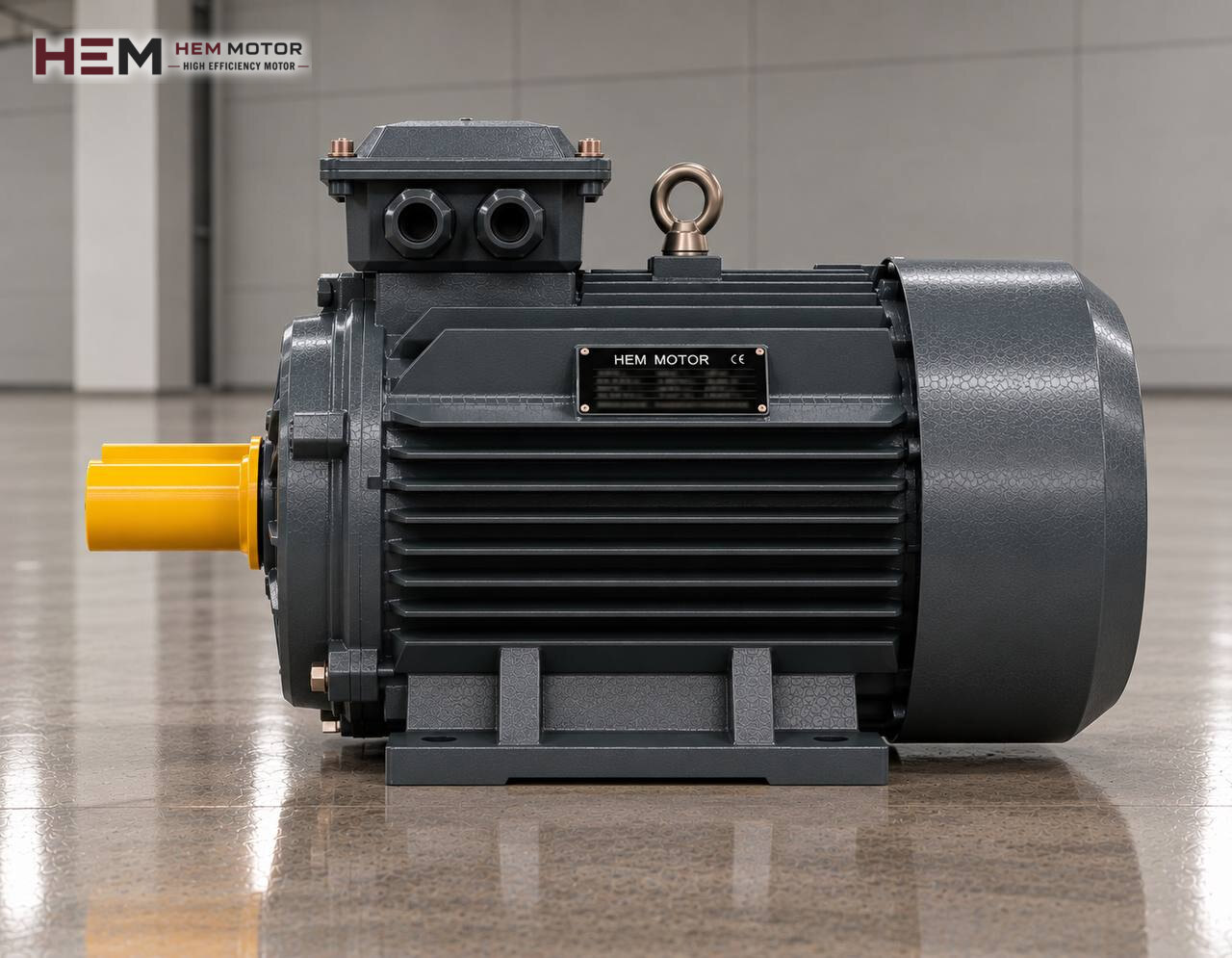
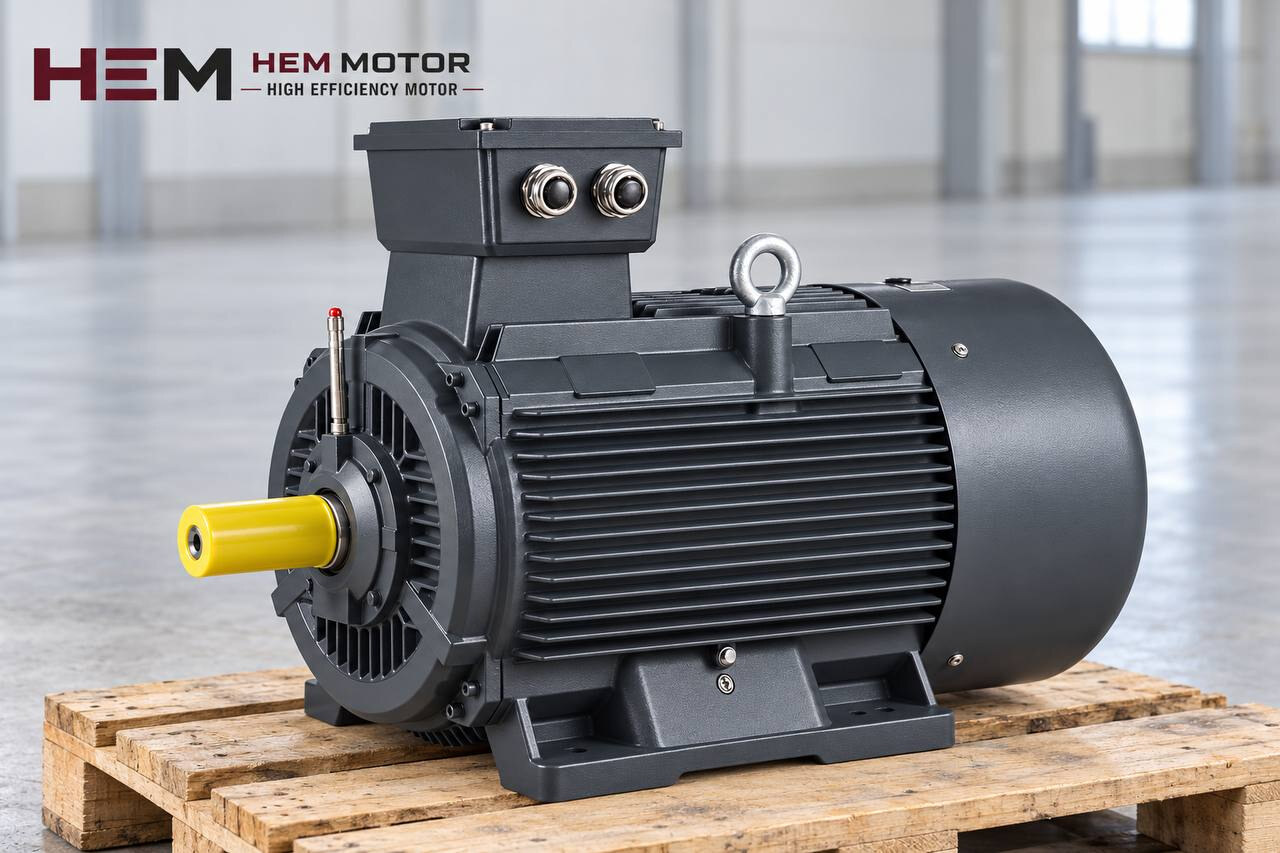
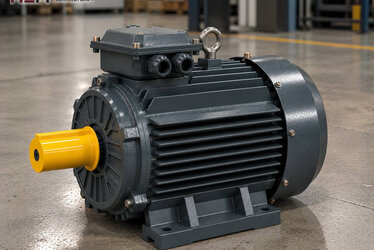
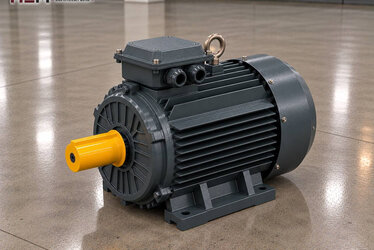
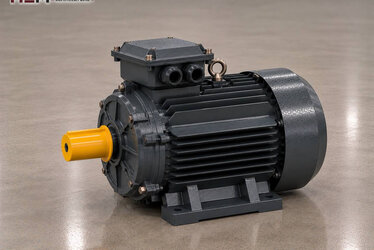
In an efficiency comparison shaft power stays constant; only the motor's own losses change (representative image).
What question should be asked in an IE4 decision?
The right question is not "how many points more efficient" but "how large is this motor's annual kWh difference, and will that difference materialise under the site's operating conditions". On a water pump, ventilation fan or air compressor running day and night at steady load the difference grows; on a machine switched on only briefly during a shift it stays small.
HEM Motor offers motors in the IE3, IE4 and IE5 efficiency classes; which class can be supplied for a particular model is confirmed with the order. For class definitions and family pages see the IE4 class product page and the IE3 class product page. Whatever the class, frame, pole and speed options are gathered on the asynchronous electric motors page.
4-pole steps often compared in continuous duty:
160L-4, cast iron, 15 kW, 1465 rpm, 400/690 V, 27.3 A at 400 V. The same step as the shaft power in the hypothetical example.
180L-4, cast iron, 22 kW, 1470 rpm, 400/690 V, 39.7 A at 400 V.
200L-4, cast iron, 30 kW, 1475 rpm, 400/690 V, 53.8 A at 400 V.
Which efficiency class and catalogue efficiency these models will be supplied with is settled with the order; that value must go into the calculation. If you have measured input power, operating hours and the old motor's plate, send them through the contact page; we will calculate the kWh difference with your site data and choose the right step from the sales list.
Frequently Asked Questions
By what percentage does the bill fall when moving from IE3 to IE4?
There is no single figure; the reduction is the ratio of the two motors' input power difference at that load ratio to total consumption. The relative reduction in losses looks much larger than this ratio and is not used in bill calculations.
Does catalogue efficiency also apply at part load?
No, catalogue efficiency is for rated load. At part load efficiency usually drops back a little; the calculation should use the efficiency at the real load ratio.
Why can a higher speed increase consumption?
In centrifugal pumps and fans power rises quickly with speed. If the new motor turns a few rpm faster the machine does slightly more work; if the comparison is not made at the same flow point, the gain looks smaller than it is.
HEM Motor Models Related to This Article
The cards show example models related to the topic. A suitable motor is not chosen by power alone: compare speed, voltage, mounting, shaft and connection dimensions on the product page; if unsure, send a photo of the existing motor’s nameplate on WhatsApp.
When choosing an IE4 electric motor, a constant load is judged at a single operating point, while a variable load is judged across the whole load profile. For a constant load the c... More Details
IE4 and IE3 electric motor models of the same power do not always share the same frame. The frame number is often kept, but to raise efficiency the core length may be extended, the... More Details
The catalogue efficiency of an IE4 electric motor is measured under laboratory conditions defined in the standard, at rated load, with a balanced, sinusoidal 50 Hz voltage; on site... More Details
Yes, an IE4 electric motor also saves energy when it runs without a drive, fed directly from the supply, because it delivers the work at the shaft while wasting less heat inside, a... More Details
No, they are not the same thing: efficiency shows what share of the active power an electric motor takes from the supply reaches the shaft, while power factor shows what share of t... More Details
The extra price paid for an IE4 electric motor comes back faster the longer and the more heavily the motor runs each year and the more expensive each kilowatt-hour is. The time in ... More Details
We use necessary and optional cookies to improve your experience, enhance content and analyse traffic. Under the GDPR, optional (analytics/marketing) cookies are only used with your explicit consent. Please choose your preference below.
Cookie Policy
 English
 Français
 Türkçe
 Español
 Русский
 العربية
 Deutsch
 Italiano