English
 Français
 Türkçe
 Español
 Русский
 العربية
 Deutsch
 Italiano

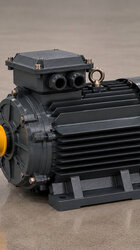
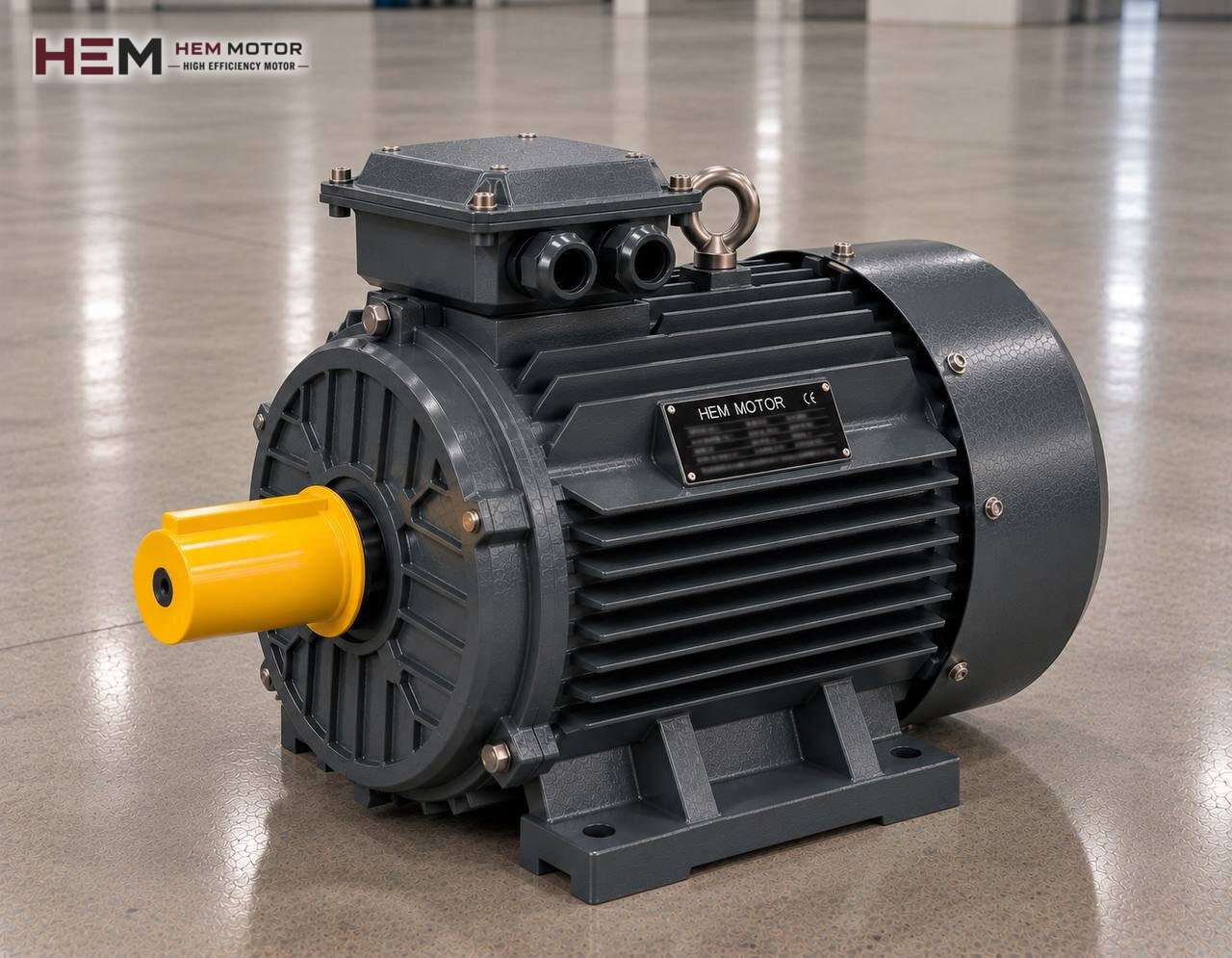

Yes, an IE4 electric motor also saves energy when it runs without a drive, fed directly from the supply, because it delivers the work at the shaft while wasting less heat inside, and this difference builds up in every operating hour regardless of speed. How large the gain is depends on the load ratio, the annual running time and how the driven machine reacts to a rise in speed.
Where does an IE4 motor reduce losses without a drive?
The loss reduction happens inside the motor; it has nothing to do with speed control. In an asynchronous machine heat comes from five places: the winding resistance in the stator, the rotor bars, hysteresis and eddy currents in the lamination stack, bearing friction plus the fan, and stray losses that grow with load. In IE4 designs several of these items are reduced together.
To do this the stack is usually lengthened, thicker wire is placed in the slots, steel with a low loss figure is chosen and the fan blade is reshaped (general information; confirm with the machine manufacturer). None of this needs a drive. A pump motor connected directly to the supply and a compressor motor starting in star-delta both benefit from the same loss reduction.
A drive does a different job. It cuts the power drawn by the machine by setting flow with speed instead of a throttling valve.
Motor efficiency and drive savings are two items that can be added together but are calculated separately.
How is the difference calculated on a machine running at constant speed?
With shaft power held constant, the difference between the power the two motors take from the supply comes from the difference of the reciprocals of their efficiencies. The annual energy difference is that multiplied by running hours:
ΔE = Pshaft × (1/ηold − 1/ηnew) × t
Hypothetical example: an 11 kW cooling tower pump runs 6000 hours a year with about 9 kW at the shaft. Let the old motor's efficiency at this load be 0.905 and the IE4 candidate's 0.935 (values are for illustration; real data come from the motors' test reports). Power drawn from the supply is 9 / 0.905 ≈ 9.94 kW and 9 / 0.935 ≈ 9.63 kW respectively. The difference is about 0.32 kW, roughly 1900 kWh a year.
Multiplying this kWh difference by your plant's unit energy price gives the money value. How many years the price difference takes to recover is found by dividing the difference between the two motor quotes by this annual amount; the calculation must be done with the plant's own figures. The current list for the quote difference can be seen on the electric motor sales page.
On site the input to this calculation is measurement, not estimation. The current of all three phases is read with a clamp meter, phase-to-phase voltage at the same time and, if possible, power factor with a power analyser; shaft power is roughly derived from these and the old motor's efficiency curve.
Why can the slip difference reduce the gain on fans and pumps?
High-efficiency motors usually run with less slip, that is, a few revolutions faster; on centrifugal fans and pumps this small speed increase enlarges the load, so part of the gain may be given back. The affinity laws say that on these machines power grows roughly with the third power of speed (general information; confirm with the machine manufacturer).
Hypothetically, if the old motor turns at 1455 and the new one at 1475 rpm, the speed ratio is about 1.014; its cube is about 1.04. If the pump's power demand rises by this ratio, a large part of the gain from the efficiency difference is spent on extra flow. If the flow is really needed there is no problem; if not, the gain is lost.
The fix is usually simple. On a pump the impeller is trimmed or the valve position reset, on a belt-driven fan the pulley diameter is reduced. After the change, no energy comparison should be made before flow and pressure are brought back to the old values. On constant-torque machines such as conveyors, crushers and piston compressors this effect is very small; power rises linearly with speed and the speed difference can be ignored. Two bills compared without this distinction give a misleading result.
Is the efficiency difference kept on a motor running at part load?
Mostly yes, but if the motor is very lightly loaded the absolute gain shrinks. The efficiency curve is usually flat between half and full load and drops quickly below quarter load. IE4 motors behave the same way.
A common situation on site is a motor running at less than half of its plate power. Replacing such a motor with an IE4 of the same rating reduces losses, but stepping down one power size should be evaluated separately. That decision takes starting torque, peak loads and ambient temperature into account.
The practical way to find the load ratio is to measure current and speed with the motor under load. If speed is very close to the no-load value the motor is lightly loaded; if it is close to the rated speed on the plate it is near full load.