No, they are not the same thing: efficiency shows what share of the active power an electric motor takes from the supply reaches the shaft, while power factor shows what share of the current drawn carries useful work to the shaft. The IE4 class sets a lower limit for efficiency only; it says nothing about power factor, and the cosφ of an IE4 motor can come out higher or lower than that of an IE3 motor.
What do efficiency and power factor measure?
Efficiency (η) is shaft power divided by active power drawn from the supply; the gap between the two turns into heat in the winding, the lamination stack, the bearings and the fan. Power factor (cosφ) is the kW value divided by the kVA value, and it describes how much reactive current the motor draws to build its magnetic field.
The two end up on different bills. Every point of efficiency shows up on the meter as kWh. Power factor is not lost energy but reactive current circulating in the lines and needlessly loading cables, transformers and breakers; the active meter does not count it, the reactive meter does.
One describes where the energy goes, the other the shape of the current.
Where do the two sit in the formula?
The line current of a three-phase motor is found from this relation:
I = Pshaft / (√3 × U × η × cosφ)
Current is multiplied by efficiency and power factor in the same denominator. That is why a motor with high efficiency but slightly lower power factor can draw almost the same current as one with lower efficiency but higher power factor. A clamp meter cannot tell these two motors apart (general information; confirm with the machine manufacturer).
Why does an IE4 motor not always give a higher cosφ?
The efficiency classes in IEC 60034-30-1 are defined for η only; power factor is not part of the classification. To raise efficiency a designer can enlarge the copper cross-section, use better lamination steel, and change the air gap and slot geometry; some of these choices can raise magnetising current and lower cosφ slightly.
Pole count matters as well. At equal kW, a 6-pole motor usually has a lower power factor than a 2- or 4-pole one, because relatively more current is needed to build the magnetic field. The ratio also drops at small ratings. A buyer comparing two quotations should put the catalogue cosφ for the same kW and pole count next to the class label.
The cosφ on the nameplate is the value at rated load. When the motor runs at part load, power factor drops quickly.
Which one deteriorates faster at part load?
Power factor. The efficiency curve is usually fairly flat down to half load, but cosφ falls clearly as load decreases; on a motor with the coupling removed, cosφ stays far below the nameplate value.
The reason is simple. Magnetising current is almost independent of load, and as load drops its share of total current grows. Active current shrinks while reactive current stays put. An IE4 motor chosen too large for its job may not fully show the expected efficiency gain on the meter and makes the compensation panel work harder. That is why, when moving to a high-efficiency motor, rechecking the power step against the real load can make more difference than raising the class.
Prices and technical data are on the product pages; choose a model and order online.
Hypothetical calculation: same current, different losses
Let us compare two 11 kW, 4-pole motors of different design at rated load on 400 V. The values were chosen to show the method; they are not catalogue data for any model.
Quantity
Motor A
Motor B
Efficiency (η)
0.92
0.94
Power factor (cosφ)
0.84
0.82
Active power drawn from supply
11 / 0.92 ≈ 11.96 kW
11 / 0.94 ≈ 11.70 kW
Line current
≈ 20.5 A
≈ 20.6 A
Reactive power (P × tanφ)
≈ 7.7 kvar
≈ 8.2 kvar
The ammeter shows almost the same current on both motors. Yet motor B draws about 0.26 kWh less active energy per hour. Multiply that by your annual operating hours and your own kWh unit price; that is the savings calculation. The same motor needs about 0.5 kvar more reactive power; the plant's compensation system covers it.
The lesson from the calculation on site: to see an efficiency difference, measure active power with a power analyser, not current.
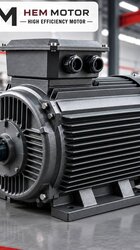
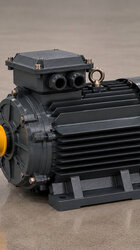
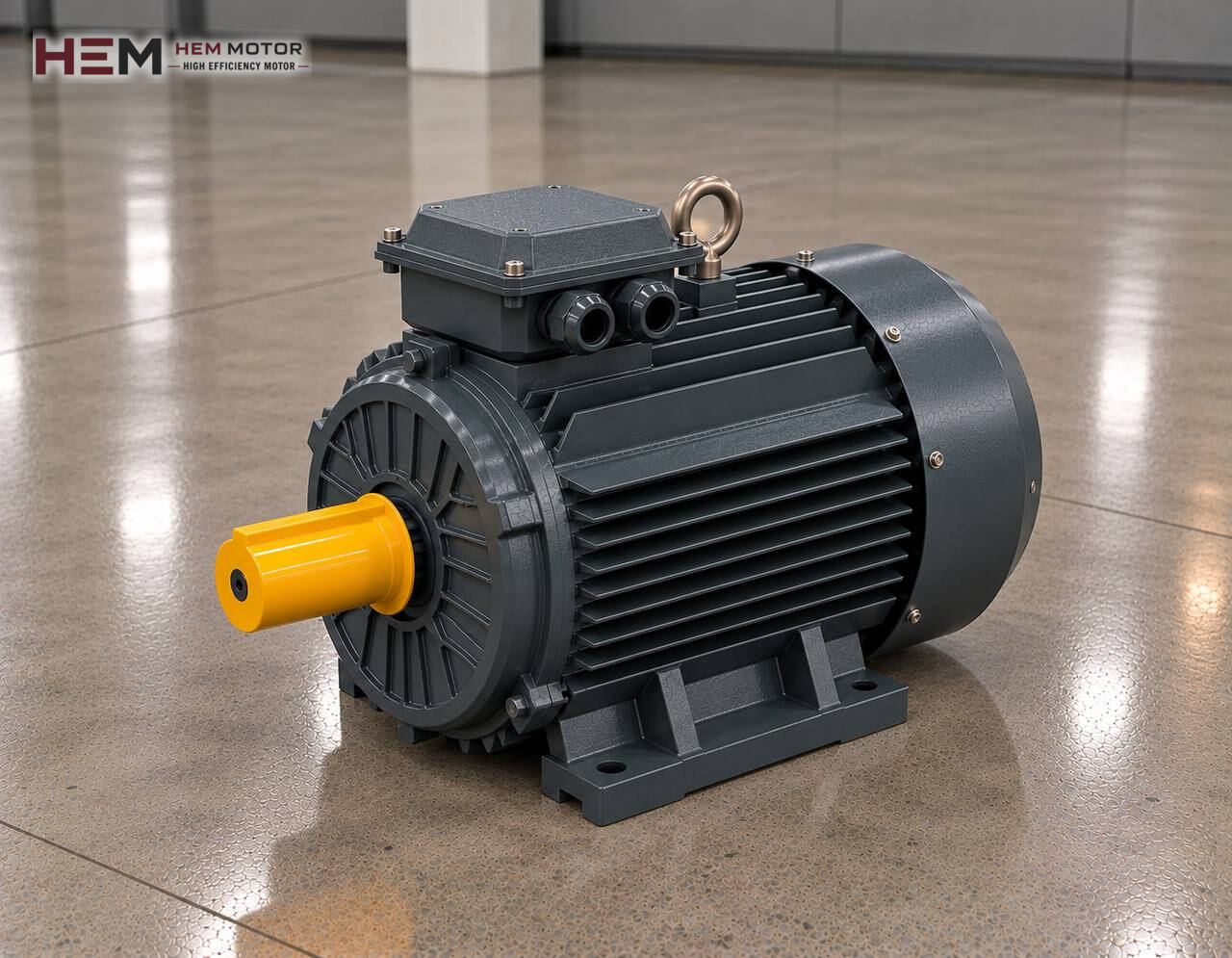
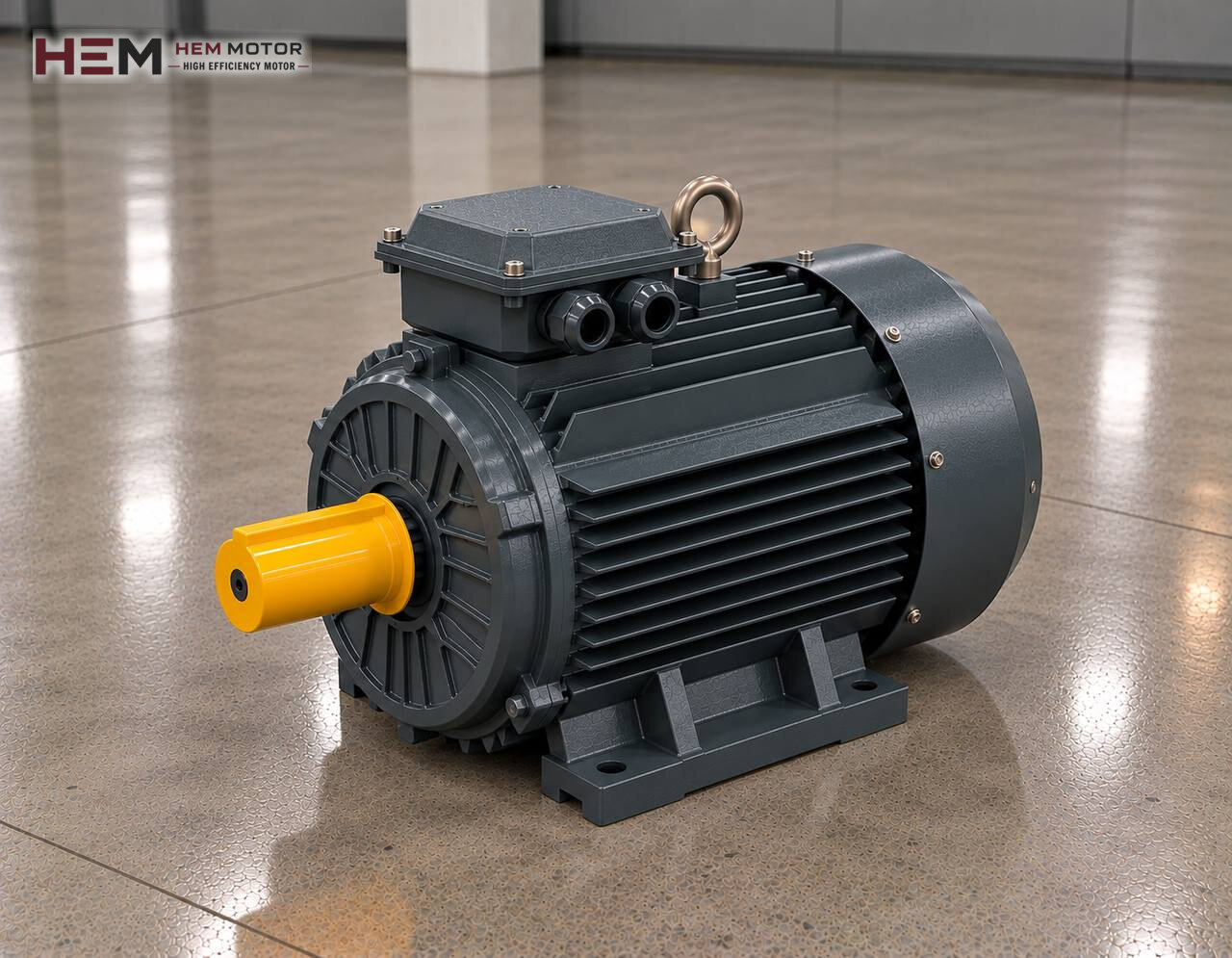
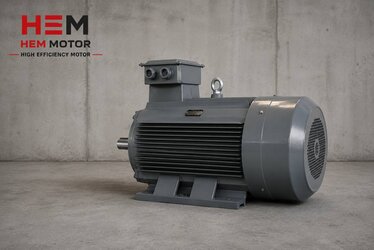
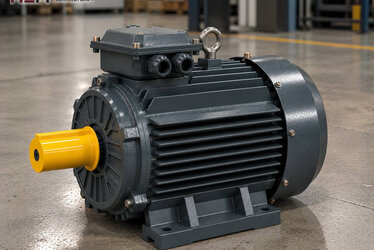
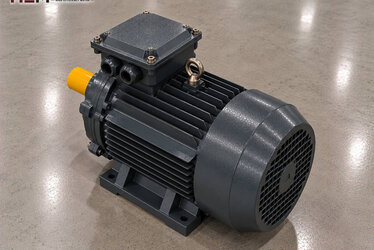
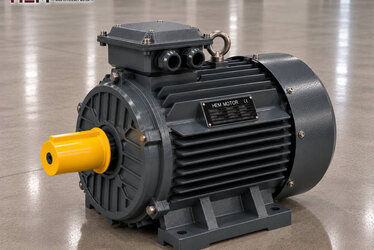
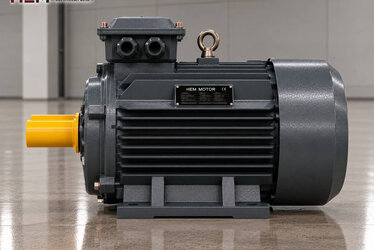
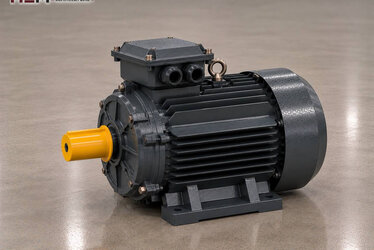
The efficiency class is printed on the nameplate; power factor is a separate line and changes with load (representative image).
How are the two measured separately on site?
A power analyser that reads all three phases at once gives active power (kW), reactive power (kvar), apparent power (kVA) and power factor together. The measurement is taken close to the motor terminals, with a steady load and for at least several minutes.
Clamp the current probes on the three phases and connect the voltage leads to the three phases at the same point; check that the arrow on each clamp points towards the load.
Look at voltage balance first; unbalanced voltage also spoils the power factor reading.
Record active power, reactive power and cosφ at typical production load; repeat at the lowest load.
If you cannot measure shaft power directly, make a rough load estimate by multiplying active power by the nameplate efficiency and note it as an assumption.
On motors with a frequency converter, the measuring point changes the result. At the converter input the displacement power factor seen by the supply is usually close to one, but harmonic currents lower the total power factor. The cosφ on the motor side is not passed to the supply. Our three-phase series are suitable for speed control with a frequency converter; long operation at low speed with full torque may require a separate fan; if the drive-to-motor cable is long, a dv/dt or sine filter is considered; these conditions are stated with the order.
Which values should be placed side by side in a quotation?
Next to the IE class, the purchasing table should list efficiency at rated load, cosφ at rated load and, if possible, the values at 75% and 50% load. Looking only at the class can bring surprises in a plant whose compensation is already at its limit.
HEM Motor offers motors in IE3, IE4 and IE5 efficiency classes; which model code is supplied in which class, and the efficiency and power factor values for that class, are confirmed with the order. Class-specific pages are in the IE4 class motor page and asynchronous electric motors sections. You can compare power and speed steps in the electric motor shop. Three 4-pole cast iron examples, with current values taken from our package data:
160M-4: 11 kW, 1465 rpm, 400/690 V, 20.4 A at 400 V, 71.7 Nm; the power step used in the hypothetical calculation.
225S-4: 37 kW, 1485 rpm, 66.1 A at 400 V, 237.9 Nm; on a fan or pump running day and night, the efficiency difference builds up every hour.
280S-4: 75 kW, 1486 rpm, 129 A at 400 V, 482 Nm; at this size the share of reactive power on the transformer and compensation becomes significant.
All three models have IP55 protection, class F insulation and CE marking. If you have kW, kvar and cosφ records taken with a power analyser, send them with a nameplate photo of the existing motor through our contact page; we will settle the right power step and class for the measured load together. Other options are listed by power in the HEM Motor product list.
Frequently Asked Questions
Does switching to an IE4 motor make the compensation panel unnecessary?
No. The IE4 class sets no lower limit for power factor; the need for reactive power remains and may increase if the motor runs at part load.
Does a motor with low power factor use more electricity?
It does not directly increase active energy, but it circulates more current in the lines. That current slightly increases cable and transformer losses and can push reactive energy limits.
Is the cosφ on the nameplate valid at part load?
No; the nameplate value is for rated load. Power factor drops clearly as load decreases, so the real value is found by measurement.
Can I see an efficiency difference with a clamp meter?
You cannot; current depends on both efficiency and power factor. An efficiency difference needs a power analyser that measures active power.
HEM Motor Models Related to This Article
The cards show example models related to the topic. A suitable motor is not chosen by power alone: compare speed, voltage, mounting, shaft and connection dimensions on the product page; if unsure, send a photo of the existing motor’s nameplate on WhatsApp.
When choosing an IE4 electric motor, a constant load is judged at a single operating point, while a variable load is judged across the whole load profile. For a constant load the c... More Details
IE4 and IE3 electric motor models of the same power do not always share the same frame. The frame number is often kept, but to raise efficiency the core length may be extended, the... More Details
The catalogue efficiency of an IE4 electric motor is measured under laboratory conditions defined in the standard, at rated load, with a balanced, sinusoidal 50 Hz voltage; on site... More Details
Yes, an IE4 electric motor also saves energy when it runs without a drive, fed directly from the supply, because it delivers the work at the shaft while wasting less heat inside, a... More Details
For an IE4 electric motor, the efficiency difference is expressed in percentage points, while the reduction in losses and in consumption are each calculated separately as a "percen... More Details
The extra price paid for an IE4 electric motor comes back faster the longer and the more heavily the motor runs each year and the more expensive each kilowatt-hour is. The time in ... More Details
We use necessary and optional cookies to improve your experience, enhance content and analyse traffic. Under the GDPR, optional (analytics/marketing) cookies are only used with your explicit consent. Please choose your preference below.
Cookie Policy
 English
 Français
 Türkçe
 Español
 Русский
 العربية
 Deutsch
 Italiano