The catalogue efficiency of an IE4 electric motor is measured under laboratory conditions defined in the standard, at rated load, with a balanced, sinusoidal 50 Hz voltage; on site the same motor usually runs below rated load, on an unbalanced or harmonic-laden supply and at a different ambient temperature. That is why site efficiency can come out slightly lower than the catalogue value; the gap stems more from operating conditions and measuring method than from the quality of the motor.
Under which conditions is catalogue efficiency measured?
Efficiency classes are defined in IEC 60034-30-1, and the measuring method is described in IEC 60034-2-1. Under this method the motor runs on a test bench at rated voltage and frequency until it reaches a specified temperature; losses are measured and calculated one by one (general information; for test details see the standard itself).
The figure in the catalogue is the value at rated load under these conditions. Most manufacturers also give efficiency at 75 and 50 percent load; those, too, are measured under the same laboratory conditions.
On the test bench the voltage is stable, the three phases are equal and the waveform is clean. On a factory supply, these three are rarely met at the same time.
What are the main factors that lower efficiency on site?
On site, efficiency is affected most by partial load, voltage unbalance, harmonics, high ambient temperature and mechanical losses. Each is a separate loss mechanism, and often several are present at once.
Factor
What happens
How it shows on site
Partial load
Share of fixed losses (iron, friction, fan) grows
Current far below nameplate value, low cos φ
Voltage unbalance
Negative-sequence current raises rotor losses
The three phase currents do not match
Harmonic supply
Additional copper and iron losses
Converters or large rectifier loads nearby
High or low voltage
Magnetising or load current rises
Higher no-load current or higher current under load
Hot ambient, dirty cooling
Resistance of the hot winding rises, I²R loss grows
High frame temperature, dusty fins
Misaligned coupling, tight belt
Bearing losses rise
High bearing temperature, vibration
How much loss these effects create varies from motor to motor and with the severity of the problem. Assigning a general percentage to any of them would be wrong.
Why is partial-load efficiency so decisive?
Because most motors on site run below rated load, and as load falls the share of fixed losses in the total grows. Iron loss, fan and bearing friction are almost independent of load; the motor carries these losses at half load too.
In high-efficiency motors the efficiency curve is usually flat over a wide range and may peak around 75 percent. The real drop starts below about 40 percent. In plants that drive a fan or pump with a motor two steps too large "just in case", the site efficiency of an IE4 motor therefore stays clearly below the catalogue.
The practical way to find the load is to calculate active power from current and voltage. A power analyser reads active power directly (P = √3 × U × I × cos φ); without one, current is taken with a clamp meter and voltage with a multimeter, and the measured cos φ is used instead of the nameplate value. Load ratio is the estimated shaft power divided by nameplate power. If the calculation shows the motor could drop one step, the current and torque values of neighbouring steps sit side by side on our shop page.
Prices and technical data are on the product pages; choose a model and order online.
How is efficiency measured on site, and how reliable is the result?
On site, efficiency is not measured directly but estimated, because measuring shaft power needs a torque meter, which most plants do not have. Electrical input power is measured precisely with a good power analyser, but shaft power is found approximately by the slip or current method.
The slip method works like this: shaft speed is read with an optical tachometer, its difference from synchronous speed is compared with nameplate slip, and the load ratio is estimated from that. If a 4-pole motor with 1470 rpm on the plate turns at 1480 rpm on site, slip is about two thirds of the nameplate value and the motor is loaded roughly in that ratio. Because voltage and temperature affect slip, the result is a rough estimate (general information; confirm with the machine manufacturer).
A hypothetical example: the power analyser shows 16.3 kW electrical power on a pump motor, and the slip method gives a shaft power of around 15 kW. Calculated efficiency comes to 15 / 16.3 ≈ 0.92. When comparing this figure with the rated efficiency in the catalogue, two things must not be forgotten: a few percent of uncertainty in shaft power passes straight into efficiency, and the motor may not be at rated load at that moment.
For a sounder comparison, measurements on the same motor at different times with the same method are tracked. Drawing a conclusion from the difference between one measurement and the catalogue usually means blaming the motor for measurement uncertainty.
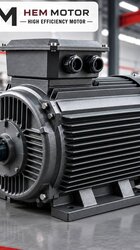
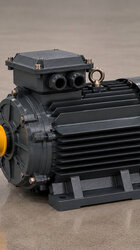
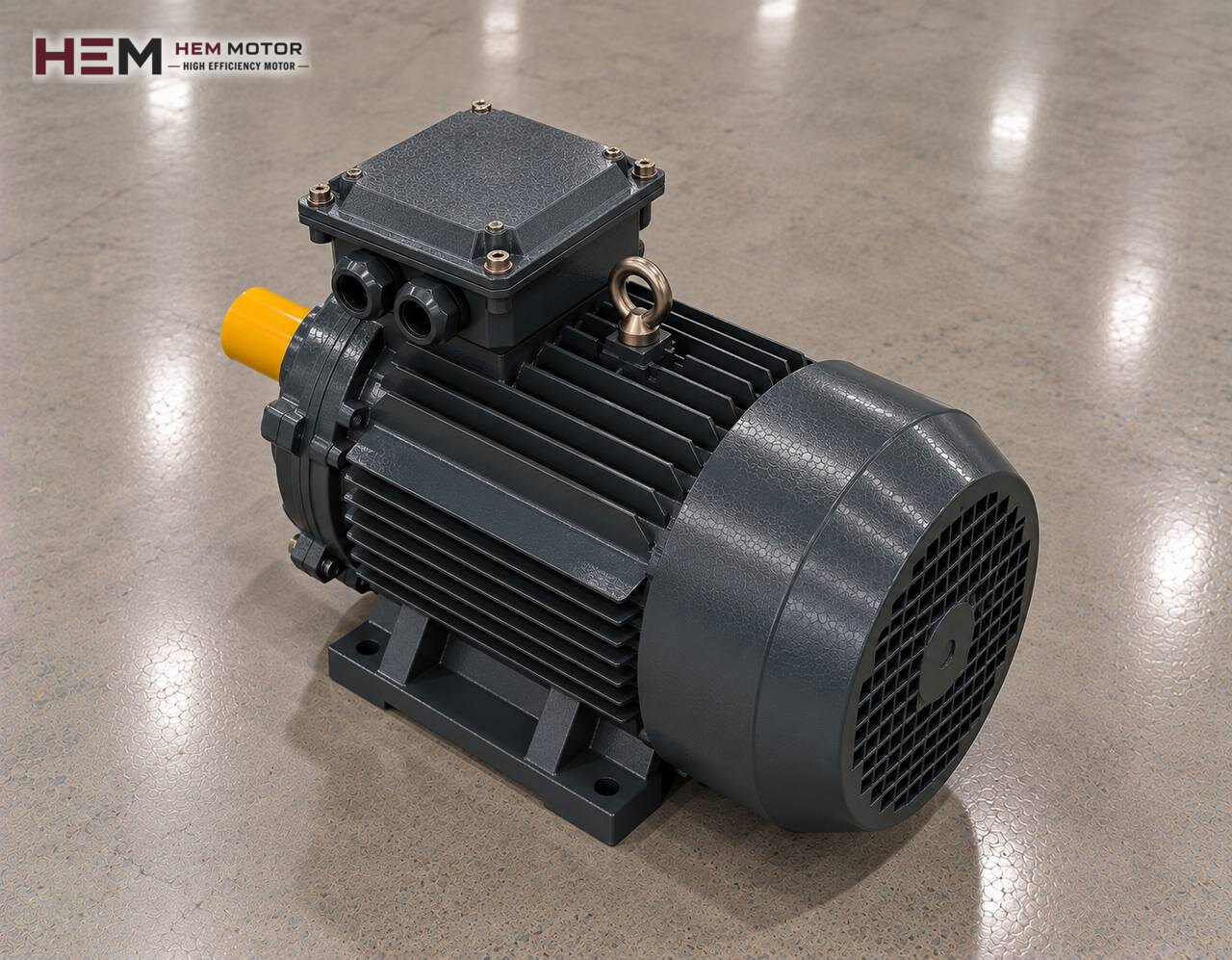
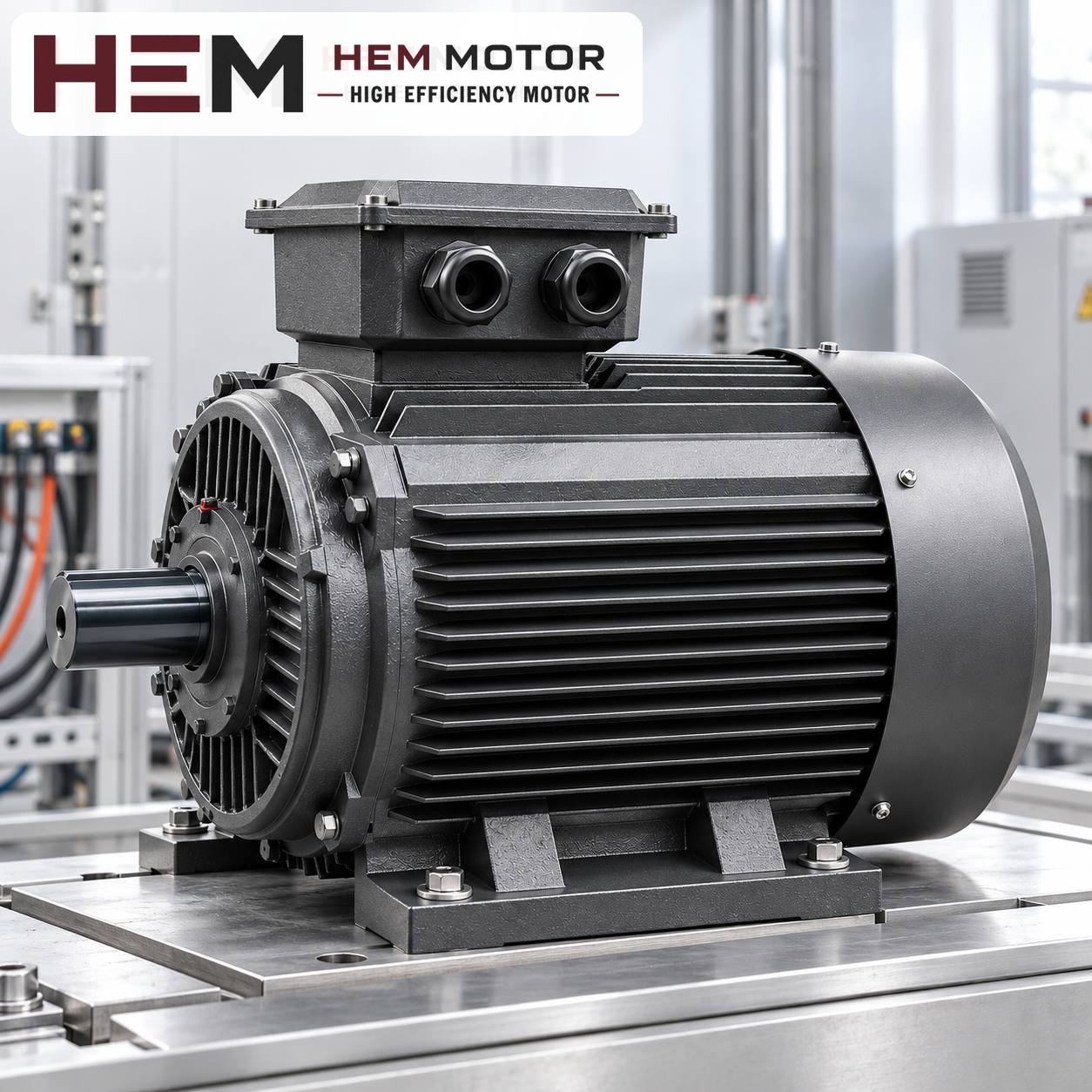
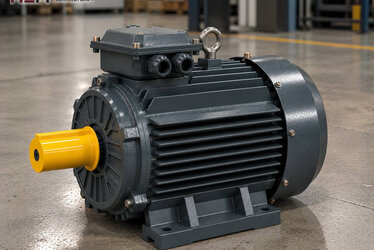
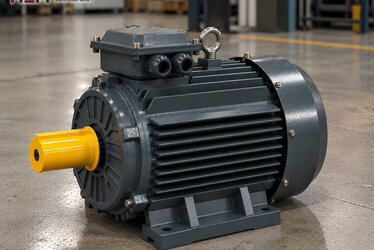
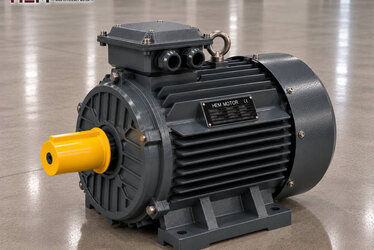
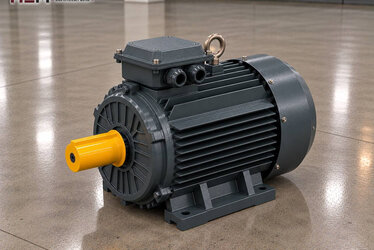
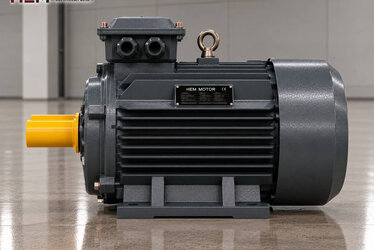
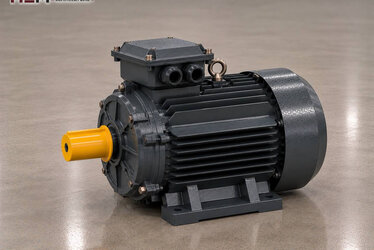
Catalogue efficiency is determined on a test bench at stable voltage and controlled temperature (representative image).
How does a frequency converter affect the efficiency of an IE4 motor?
In a converter-fed motor, the harmonic content of the output voltage creates additional loss; the motor's own efficiency therefore drops slightly compared with direct supply. The converter's own loss is added to this. System efficiency requires motor and drive to be assessed together.
The converter, for its part, can cut the system's total energy use in pumps and fans because it lowers speed instead of throttling with a valve or damper. The small drop in motor efficiency and the gain achieved in the system should not be confused. Our three-phase ranges are suitable for speed control with a frequency converter; for long running at low speed with full torque a separate fan may be needed; if the drive-to-motor cable is long, a dv/dt or sine filter is considered; these conditions are stated when ordering.
How do you keep the expected benefit of an IE4 motor on site?
Sizing the motor to the load, keeping the voltage balanced, keeping cooling clean and getting alignment right are the four steps that bring you closest to catalogue efficiency. None of them is expensive; most are solved by adding a few lines to the maintenance plan.
At the selection stage, knowing the load profile matters. On a compressor delivering at full load day and night, the IE4 motor's advantage is clear. On an extractor running a few hours a day at half load, choosing the right size changes more than the efficiency class does. HEM Motor offers IE3, IE4 and IE5 efficiency classes; which class is supplied in which frame and power is settled when ordering. The IE4 details are on our IE4 product page, and for comparison see the IE3 premium efficiency motors page.
4-pole steps often chosen at medium and high power are below; frame options are on the cast iron electric motors page:
160L-4: cast iron, 15 kW, 1465 rpm, 27.3 A at 400 V, 97.8 Nm. For pump and fan drives.
180L-4: cast iron, 22 kW, 1470 rpm, 39.7 A at 400 V. For compressors and large conveyors.
200L-4: cast iron, 30 kW, 1475 rpm, 53.8 A at 400 V. For continuously running process drives.
Which efficiency class these models are supplied in is confirmed when ordering. All power steps are listed in our electric motor shop.
If you share the current, voltage and speed values you measured on site together with a photo of the motor nameplate via our contact page, we will assess the load ratio and the right step together. Prices are on the HEM Motor sales page.
Frequently Asked Questions
If the efficiency I measured on site is lower than the catalogue, is the motor faulty?
Usually not. Partial load, voltage unbalance and measurement uncertainty explain most of the gap; these three are checked first.
Is an IE4 motor highly efficient at half load too?
The efficiency curve of high-efficiency motors is flat over a wide range, but at very low load efficiency falls in every motor. That is why sizing to the load matters.
Which instrument is needed to measure efficiency?
A three-phase power analyser for input power and an optical tachometer for estimating shaft power are a sufficient start. An exact measurement requires a torque meter.
Does driving an IE4 motor with a converter lower efficiency?
The motor's own efficiency may drop slightly and the converter's loss is added. In pumps and fans, however, speed control usually cuts system consumption by more than that.
HEM Motor Models Related to This Article
The cards show example models related to the topic. A suitable motor is not chosen by power alone: compare speed, voltage, mounting, shaft and connection dimensions on the product page; if unsure, send a photo of the existing motor’s nameplate on WhatsApp.
When choosing an IE4 electric motor, a constant load is judged at a single operating point, while a variable load is judged across the whole load profile. For a constant load the c... More Details
IE4 and IE3 electric motor models of the same power do not always share the same frame. The frame number is often kept, but to raise efficiency the core length may be extended, the... More Details
Yes, an IE4 electric motor also saves energy when it runs without a drive, fed directly from the supply, because it delivers the work at the shaft while wasting less heat inside, a... More Details
No, they are not the same thing: efficiency shows what share of the active power an electric motor takes from the supply reaches the shaft, while power factor shows what share of t... More Details
For an IE4 electric motor, the efficiency difference is expressed in percentage points, while the reduction in losses and in consumption are each calculated separately as a "percen... More Details
The extra price paid for an IE4 electric motor comes back faster the longer and the more heavily the motor runs each year and the more expensive each kilowatt-hour is. The time in ... More Details
We use necessary and optional cookies to improve your experience, enhance content and analyse traffic. Under the GDPR, optional (analytics/marketing) cookies are only used with your explicit consent. Please choose your preference below.
Cookie Policy
 English
 Français
 Türkçe
 Español
 Русский
 العربية
 Deutsch
 Italiano