English
 Français
 Türkçe
 Español
 Русский
 العربية
 Deutsch
 Italiano

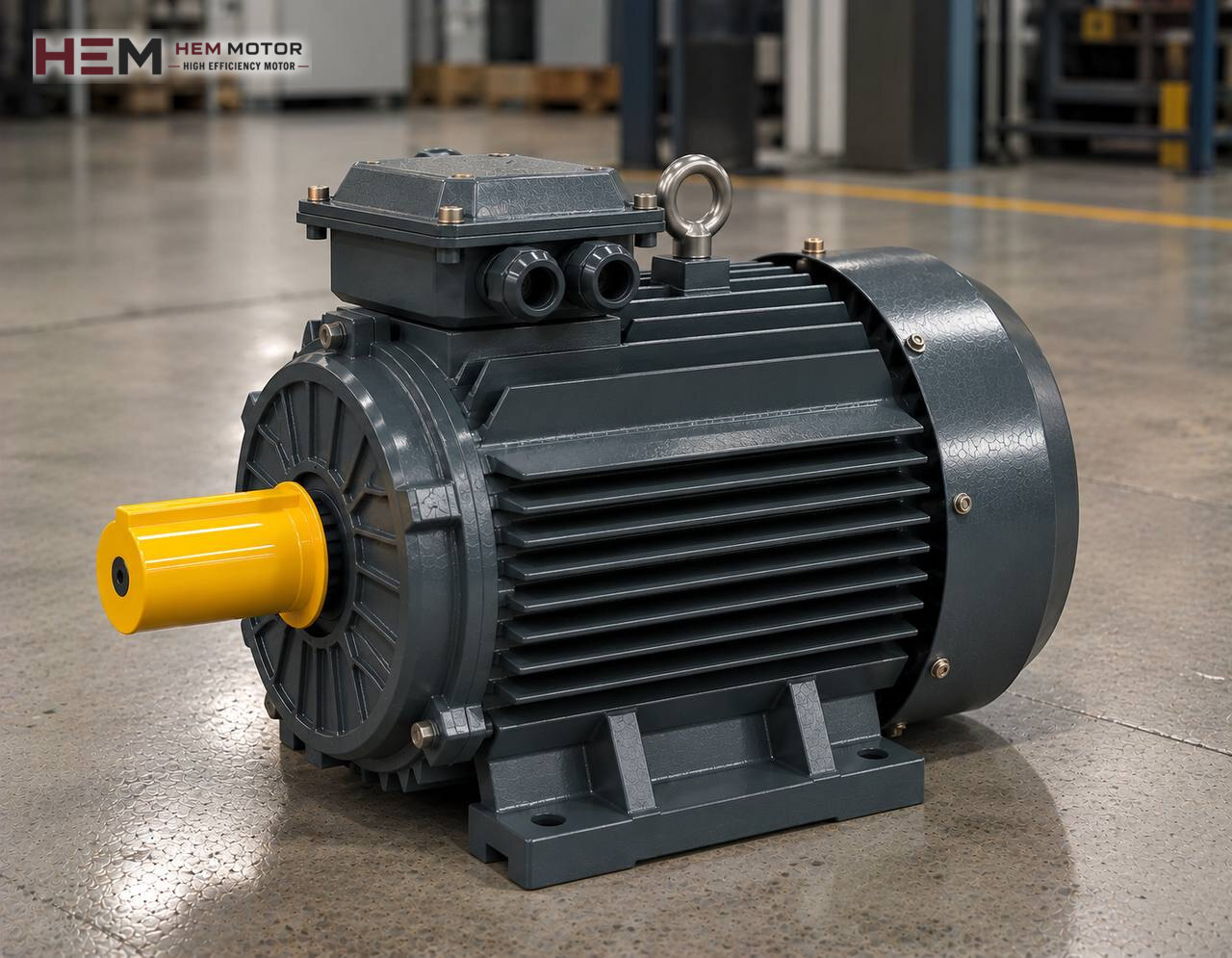

IE4 and IE3 electric motor models of the same power do not always share the same frame. The frame number is often kept, but to raise efficiency the core length may be extended, the frame may move from M to L length, or some manufacturers may step up one frame size; so before a replacement the shaft height, foot fixing points, shaft end, flange and overall length are compared one by one.
What does the frame number tell you, and what does it not?
The number in an IEC frame designation is the height of the shaft axis above the foot base in millimetres; the letter groups the distance between the rear and front foot bolts as S, M or L. A motor marked 160M has its shaft axis 160 mm above the base.
The number says nothing about the motor's overall length, the position of the terminal box, its weight or how far the fan cover protrudes. Two motors carrying the same 160M designation can differ by a few centimetres at the rear because one has a longer stator core.
The pairing between standard frame and power is based on dimensional standards such as IEC 60072 and EN 50347. This pairing has created a habit: say 11 kW 4-pole and people think 160M. Still, the standard does not bind the manufacturer to this pairing (general information; confirm with the relevant standard text and the manufacturer's catalogue).
What can change in the frame when the efficiency class goes up?
Lowering losses usually means adding material: the stator and rotor cores get longer, more copper goes into the slots, and the laminations become thinner and better. Some of this fits in the existing frame, some does not.
On site this change usually shows up in three different forms.
- The frame number and foot dimensions stay the same; only the overall length grows.
- The shaft height stays the same but the letter changes, such as 160L instead of 160M. The rear foot holes then fall in a different place.
- The motor moves up one frame; shaft height, foot spacing and often shaft diameter also change.
Which one applies is shown by the model's technical drawing. The power line in the catalogue alone does not give enough information. To see power and frame steps side by side, the lists on the shop page can be used.
Is there a concrete example of a different frame at the same power?
There is, and it is independent of efficiency class. In the HEM Motor catalogue, two 11 kW, 4-pole aluminium frame models appear with the same nameplate values in different frames.
| Value | 160M-4 | 132M-4K (compact) |
|---|---|---|
| Power | 11 kW (15 HP) | 11 kW (15 HP) |
| Rated speed | 1465 rpm | 1465 rpm |
| Rated current at 400 V | 20.4 A | 20.4 A |
| Rated torque | 71.7 Nm | 71.7 Nm |
| Shaft height | 160 mm | 132 mm |
The electrical values are identical.
The mechanical connection, however, is entirely different. When a 132M frame replaces a 160M frame, the shaft axis sits 28 mm lower; coupling alignment, pulley line and foot bolts all have to be worked out again. The same logic applies between the 5.5 kW 4-pole 132S-4 and the compact 112M-4K.
This example shows that the frame must be read from the drawing, not from the power. When moving from IE3 to IE4, the question to ask is whether the new model's drawing matches the old one.
Which dimensions are compared before a replacement?
The comparison is made by placing the old motor's mounting dimensions next to the new model's technical drawing. The letters used in IEC drawings are largely common across manufacturers.
| Dimension | What it means | What happens if it does not match |
|---|---|---|
| H | Shaft height | Coupling alignment is lost, shims are needed |
| A and B | Transverse and longitudinal spacing of foot holes | New holes are drilled in the base frame |
| D and E | Diameter and length of the shaft end | Coupling or pulley hub changes |
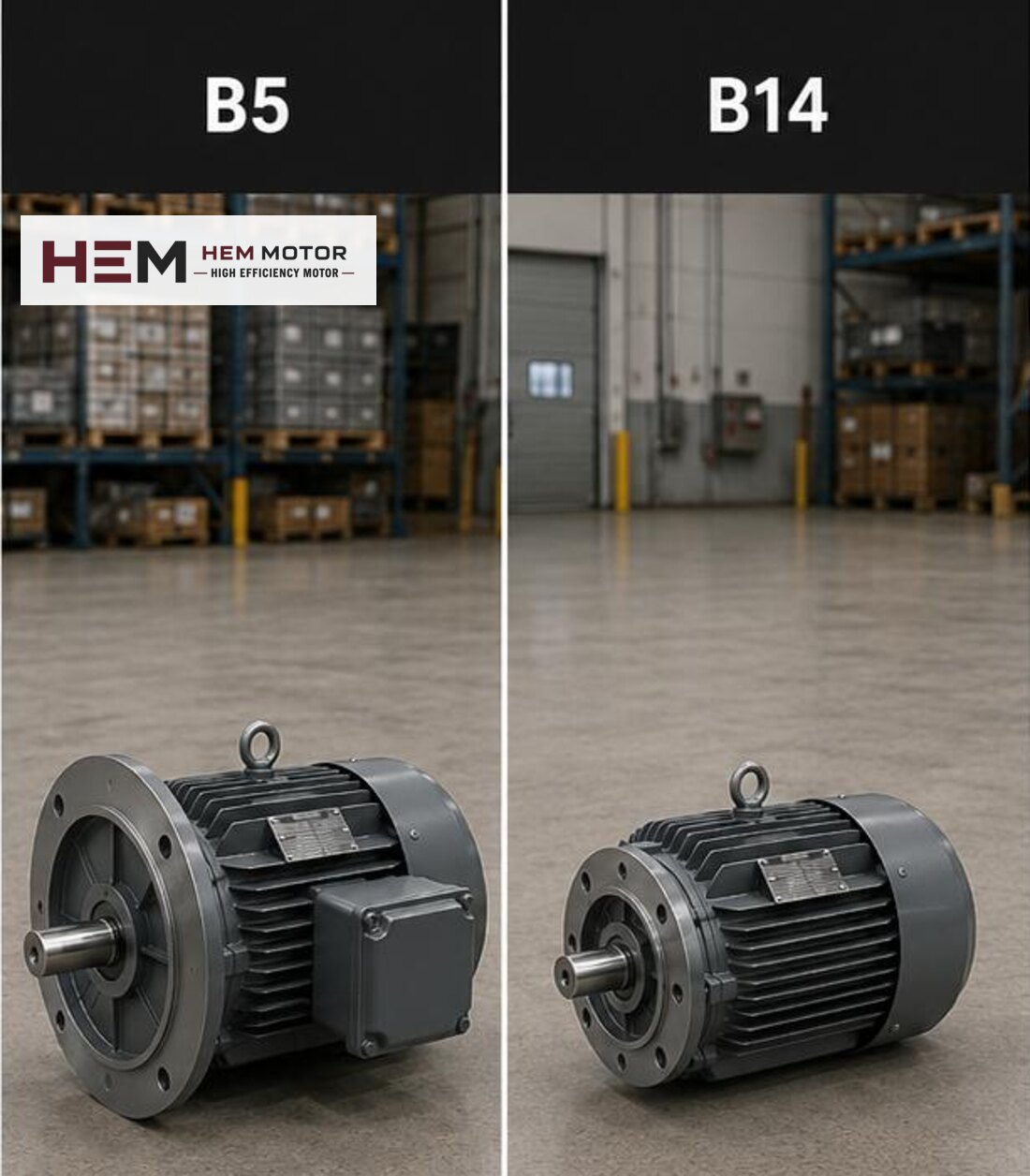
| Flange P, M, N | Flange outer diameter, bolt circle and spigot | It cannot be fitted to the gearbox or pump |
| L | Overall length | A guard or wall gets in the way |
The position of the terminal box and the side the cable enters from are also added to the list. Behind a narrow panel, the box may need to move from the top to the side. Weight difference matters especially in flange and vertical mounting. A motor with a longer core puts a larger moment on the flange and gearbox housing.