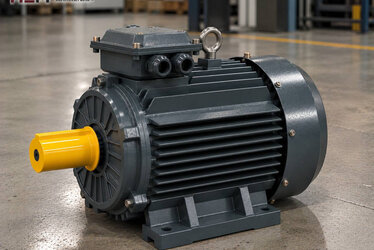
In pump applications, the energy cost of an electric motor falls most when the pump is run at the flow and pressure the process actually needs; the motor's efficiency class is the second step. A throttled valve, a bypass line that is always open or an oversized impeller will waste power even with the most efficient motor. Below we go through the losses in the pump room one by one, from booster sets and chiller circulation to process pumps and irrigation stations.
What really drives the electricity bill in a pumping plant?
The annual consumption of a pump is roughly the product of three things: the power the motor draws from the grid, the yearly operating hours and how much of that time the water is actually doing useful work. A circulation pump in a boiler room or a cooling tower pump runs for thousands of hours a year, while a fire pump only runs during tests and emergencies. Energy measures start with the pump that has the most hours.
A hypothetical example: a cooling water pump with a 15 kW nameplate runs 6,000 hours a year and draws an average of 12 kW when measured. This single pump uses about 72,000 kWh a year. A 37 kW fire pump in the same plant that only turns during the weekly test consumes a small fraction of that. That is why the list should be ranked not by kilowatts but by kilowatts × hours.
For fire pumps the priority is not energy but being able to start on the first command at any moment; the selection criteria for these motors are covered on the fire pump electric motors page.
Why do a throttled valve and an open bypass burn money?
If the pump was chosen slightly too large in the original design, the flow is often set during commissioning by throttling the discharge valve. The pump still turns at full speed, and the extra pressure it produces turns into heat and noise inside the valve. The electricity meter pays for that heat too.
The motor does not notice this loss; because it runs below its nameplate current, everything looks "fine".
A bypass line is a more hidden loss. While the process asks for little water, the surplus flow is sent back to the tank or the suction side, and the pump pushes the same water round and round. Every litre sent back was pumped for nothing. The first task on site is to note how far open the valve stands, how long the bypass stays open and where the discharge pressure gauge reading falls on the pump curve.
How does a frequency converter pay off on a pump with changing flow demand?
On a centrifugal pump, lowering the speed a little reduces the flow in the same proportion, the pressure by the square of that ratio and the shaft power by roughly its cube (affinity laws; general information, confirm with the pump manufacturer). Because of this relationship, reducing speed in circulation and pressure-boosting circuits whose flow changes during the day uses far less power than throttling a valve.
There is a limit: where the static head of the system is large, for example in a lifting station that pumps water to a high reservoir, the pump delivers no water at all once the speed drops below a certain value. On such lines the speed range is kept narrow and the gain is smaller than in closed-loop circulation.
Our three-phase models are suitable for operation with a frequency converter. If the pump stays at low speed and close to full torque for long hours, the shaft-mounted cooling fan may not move enough air and a separate cooling fan comes into question; if the panel is far from the pump room, a dv/dt or sine filter at the drive output is considered. Simply state the speed range and cable length in your order.
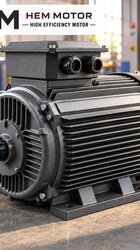
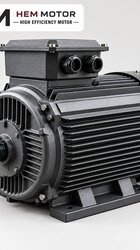
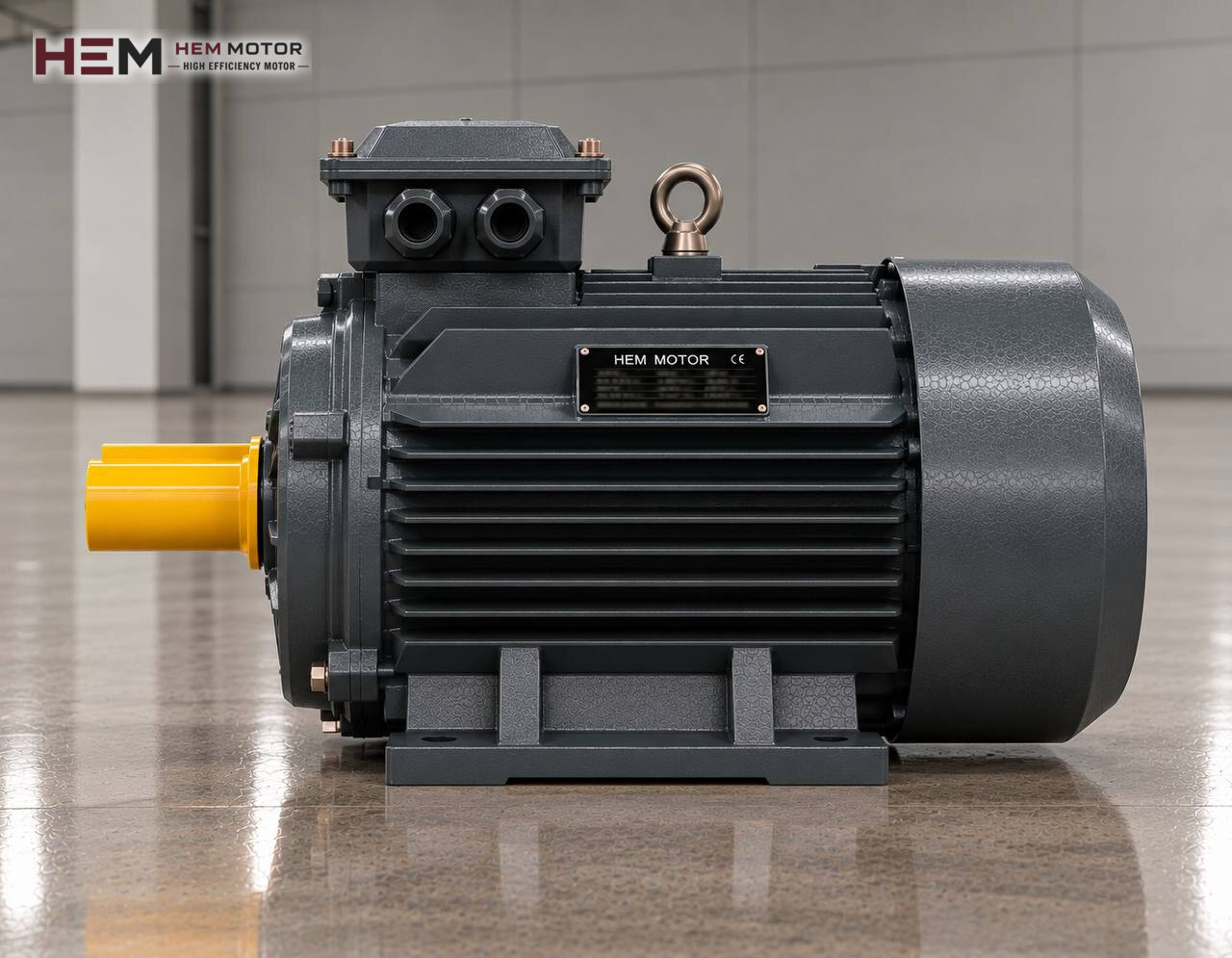
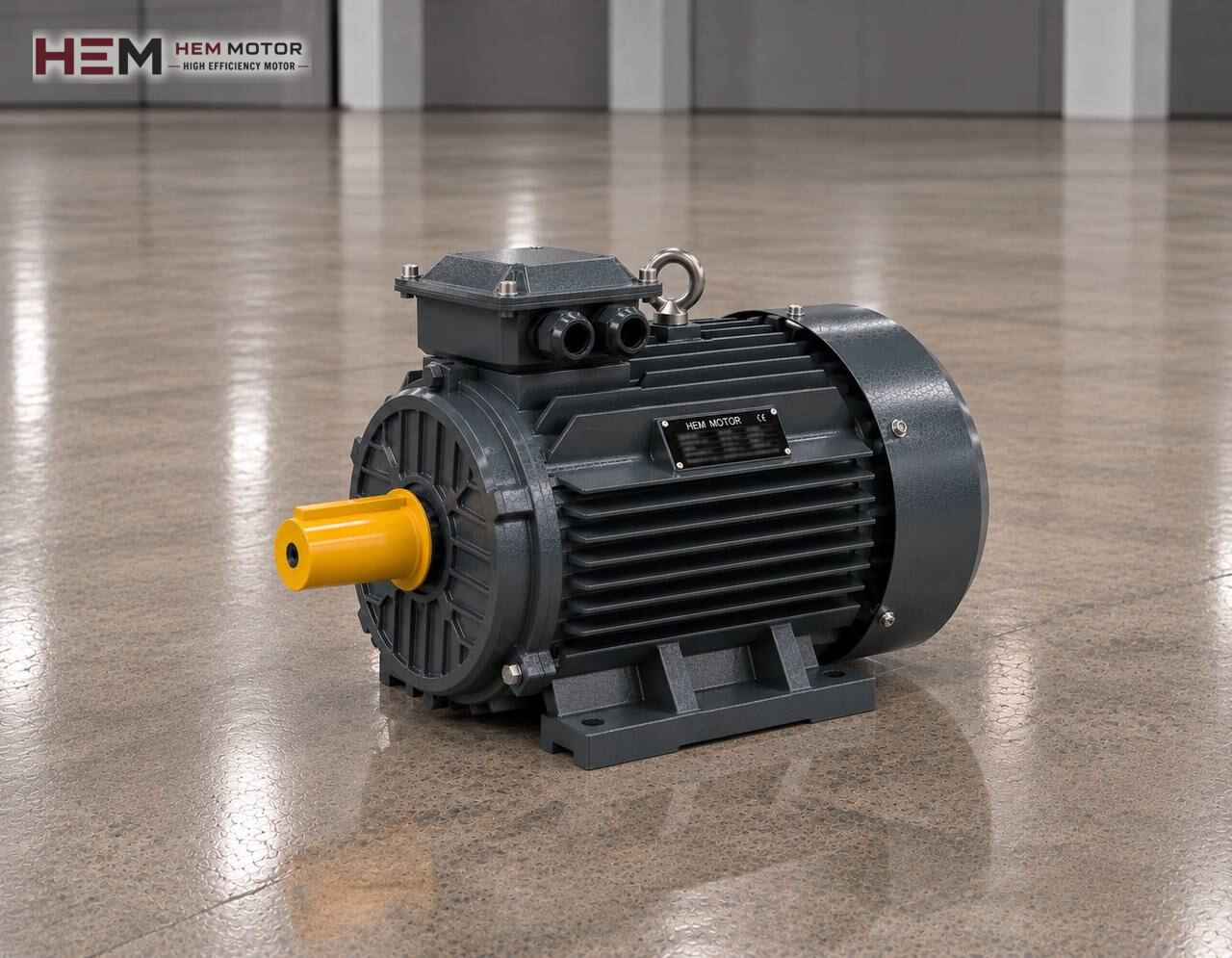
Pump and electric motor in a pressure-boosting set (representative image).
Impeller trimming or a smaller electric motor?
If the valve stays permanently throttled, the pump is larger than needed. Where the speed will stay fixed, the most lasting solution is to trim the impeller or switch to a smaller impeller diameter, with the pump manufacturer's approval. With a smaller impeller the pump needs less shaft power, and sometimes an electric motor one size down becomes sufficient.
When downsizing the motor, the pump's heaviest operating moment must also be kept in view: while an empty system is filled for the first time, or while one of the parallel pumps is out of service, the flow of the remaining pump grows and the shaft power it demands climbs. The motor must not be overloaded at these moments. The decision is made by the pump curve, the impeller diameter and the measured current together.
Prices and technical data are on the product pages; choose a model and order online.
Staged operation in booster and pressure-boosting sets
In building and factory booster systems, water demand drops almost to zero at night and peaks in the morning and at midday. Instead of one large pump, sets in which two or three pumps cut in one after another run only one pump at low demand and so bring energy use closer to demand.
In sets controlled by a pressure switch, the volume and pre-charge pressure of the expansion tank determine the number of starts per hour. If the tank is too small or its membrane has burst, the pump starts every time a tap is opened; at every start the motor draws several times its rated current and the winding temperature climbs.
Tank maintenance is therefore both an energy item and a service-life item.
On which pump does an efficiency class upgrade pay back?
Once the hydraulic losses have been removed, it is the motor's turn. HEM Motor offers options in the IE3, IE4 and IE5 efficiency classes. The extra cost of a higher class is recovered quickly on a pump with long operating hours, and very late on a pump that runs only a few hundred hours a year.
Pump duty
Typical operating pattern
Priority energy measure
Chiller and boiler circulation
Day and night throughout the season
Speed control, then a higher efficiency class
Cooling tower and condenser water
Continuous during production
Correcting the valve position, impeller matching
Booster and pressure boosting
Variable, frequent starts
Staged set, tank maintenance
Process and transfer pump
Batch dependent
Closing the bypass, correct power
Agricultural irrigation
Seasonal, long hours
Pump-motor matching, voltage check
Fire pump
Tests and emergencies
Not energy, but starting reliability
When renewing an ageing pump motor, the IEC frame number is the first clue; the exact fit becomes clear once the mounting arrangement, shaft diameter and length, foot hole spacing, flange and electrical values are laid side by side. You can check the dimensions on the technical drawings by frame size page.
Example electric motor choices for pump applications
Once the shaft power and speed the pump needs are known, choosing a model becomes easier. Multistage and high-pressure centrifugal pumps mostly run with two-pole motors; four poles are common on high-flow circulation pumps.
For high-pressure centrifugal and multistage pumps, the cast iron frame 160M2-2: 15 kW, rated 2945 rpm, 400/690 V.
For medium-sized circulation and condenser water pumps, the aluminium frame 160M-4: 11 kW, rated 1465 rpm.
For cooling tower and large transfer pumps, the 225S-4: 37 kW, rated 1485 rpm, cast iron frame.
For dry-installed pumps, mounting arrangements such as B3 foot, B5 flange and B35, as well as vertical V1 and V3 layouts, are offered according to frame size; we confirm the flange size together with you at the order stage. A submersible pump running immersed inside the well is a different story: this duty requires a special motor and may fall outside the standard range in HEM Motor's 2026 catalogue; you can ask us with the nameplate and well details. For surface pumps at the wellhead, see the deep well pump electric motor page. The kilowatt and pole combinations beyond these three models can be found in the electric motor shop, separated into aluminium and cast iron frames.
Taking the first measurements in the pump room
Starting the energy plan with a clamp meter, the pump curves and a one-week record of operating hours gives far more accurate results than estimates on paper. Pumps with a throttled valve, an open bypass or a tired tank usually reveal themselves in the first week. You can compare models matching the power and speed of the pumps to be renewed in our shop, sorted by kilowatt and speed, and read the application notes on the pump electric motors page. If you send us the nameplate of the motor you plan to replace, together with the pump's flow and pressure values, through the nameplate submission page, we will work out together which frame fits for speed-controlled or fixed-speed operation.
Frequently Asked Questions
Does fitting a drive to a circulation pump mean the motor must be replaced too?
If the existing motor is sound, this is usually not necessary; only if it will stay at low speed for long periods should cooling and cable length be assessed. If the motor is old and its winding tired, renewing it together with the drive may make more sense.
The motor current is low on a pump running with a throttled valve; doesn't that count as saving energy?
The current drops a little, but the extra pressure produced by the pump turns into heat in the valve. Achieving the same flow by lowering the speed or reducing the impeller needs much less power.
The booster pump starts very often; is that a problem for energy and for the motor?
At the moment of starting, the motor draws several times its rated current and the winding tires a little more each time. Measuring the air pressure in the expansion tank and checking the membrane is the first step towards fewer starts.
Does it make sense to choose IE4 for a fire pump motor?
Since a fire pump runs very few hours a year, the effect of the efficiency class on the bill is small. What matters on this pump is that the motor starts reliably at every test and in an emergency.
HEM Motor Models Related to This Article
The cards show example models related to the topic. A suitable motor is not chosen by power alone: compare speed, voltage, mounting, shaft and connection dimensions on the product page; if unsure, send a photo of the existing motor’s nameplate on WhatsApp.
For a filter press feed pump, the electric motor is selected for the heaviest moment of the cycle; on a press with a centrifugal pump this moment is usually the start of filling, b... More Details
When choosing an electric motor for a dosing pump, the adjustment range is the flow band produced jointly by the stroke length setting and the motor speed. Mounting dimensions are ... More Details
When choosing an electric motor for a mono pump (progressive cavity pump with a helical rotor), the decisive factor is often not running power but the breakaway torque at the first... More Details
When choosing a motor for a peristaltic pump, the deciding value is not flow or pressure but the torque the rotor needs to squeeze the hose. The rotor turns slowly, so a gearbox al... More Details
When choosing an electric motor for a vegetable washing drum, two things are considered together: how well the motor will withstand splashing and wash water, and at what speed and ... More Details
The gap between an electric motor's fan cover and the wall behind it is the only inlet section through which cooling air reaches the fan; if this gap is smaller than the open area ... More Details
We use necessary and optional cookies to improve your experience, enhance content and analyse traffic. Under the GDPR, optional (analytics/marketing) cookies are only used with your explicit consent. Please choose your preference below.
Cookie Policy
 English
 Français
 Türkçe
 Español
 Русский
 العربية
 Deutsch
 Italiano