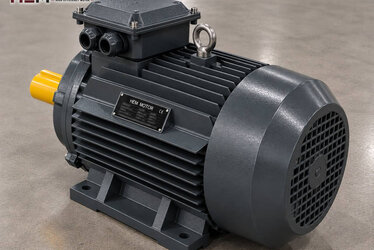
The gap between an electric motor's fan cover and the wall behind it is the only inlet section through which cooling air reaches the fan; if this gap is smaller than the open area of the fan cover grille, the motor is starved of air and heats up even with a clean grille. In practice the required clearance can be estimated with a simple annular area calculation from the fan cover diameter and grille open area, then finalised by comparing it with the value in the motor manufacturer's installation instructions. Below we explain this calculation, the layout mistakes common in the field and how to verify the result by measurement.
How does a rear wall narrow the fan inlet?
In a surface-cooled motor the fan draws air through the holes in the rear face of the fan cover. If there is enough space between the cover and the wall, air arrives freely from all directions. As the wall comes closer, the air is forced to pass through the narrow ring around the cover and change direction before entering the grille. This ring becomes a new bottleneck where the air speeds up and loses pressure.
The problem usually arises at installation. To save space in a pump room, the pump-motor set is pushed against the wall; in a compressor enclosure the motor sits close to the rear panel; or a sheet-metal screen is fitted behind the motor inside the machine frame. On commissioning day the motor runs without trouble; the heating appears in summer when the ambient temperature rises.
How much clearance is needed between the fan cover and the wall?
The clearance needed is enough to keep the inlet section between wall and cover no smaller than the open area of the grille; this section can be pictured as a cylindrical surface running around the circumference of the cover:
Aring = π × D × s
Here D is the outer diameter of the fan cover and s is the distance between cover and wall. This section must not be smaller than the open area of the grille (Agrille); otherwise the bottleneck moves from the grille to the wall. Setting them equal gives the minimum distance:
smin ≈ Agrille / (π × D)
A hypothetical example: assume the open area of the grille is about 40 percent of the cover area. Since the cover area is π × D² / 4, Agrille ≈ 0.4 × π × D² / 4 = 0.1 × π × D². Substituting gives smin ≈ 0.1 × D. Under this assumption, the distance should not be less than one tenth of the cover diameter. Because the air changes direction as it enters the ring, extra losses occur; in the field it is therefore wise to stay above this rough value and confirm the exact figure with the motor manufacturer's installation instructions or technical drawings (general fluid mechanics; confirm with the machine manufacturer).
Since the fan cover diameter varies with frame size, the dimensions of each frame are given in the technical drawings; the installation layout should be planned from these drawings.
Risk table by layout type
The same motor meets very different cooling conditions in different layouts. The table below compares, qualitatively, the arrangements seen most often on site.
Layout
Main risk
Recommended fix
Fan cover facing a flat wall
Narrow ring section, air starvation
Move the motor forward or turn the set around
Motor squeezed into a corner between two walls
Air arrives from one side only
Increase the distance, open a vent in the side wall
Inside a machine frame, rear closed by a sheet panel
Hot air accumulates in the closed volume
Open a grilled vent or a hole in the panel level with the fan cover
Vertical motor, fan cover near the ceiling or a rain canopy
Inlet restricted from above, hot air collects at the top
Leave enough opening between canopy and cover
Several motors in a row
One motor's exhaust air heads into the next one's inlet
Line the motors up facing the same way, with spacing
In vertical mounting, especially the shaft-down V1 arrangement, the fan cover faces upwards and the distance between rain canopy and cover is assessed with the same ring logic. Other details of this arrangement are explained in our vertical mounting article.
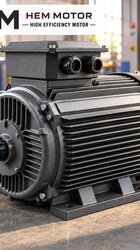
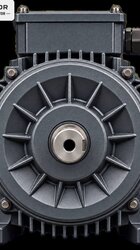
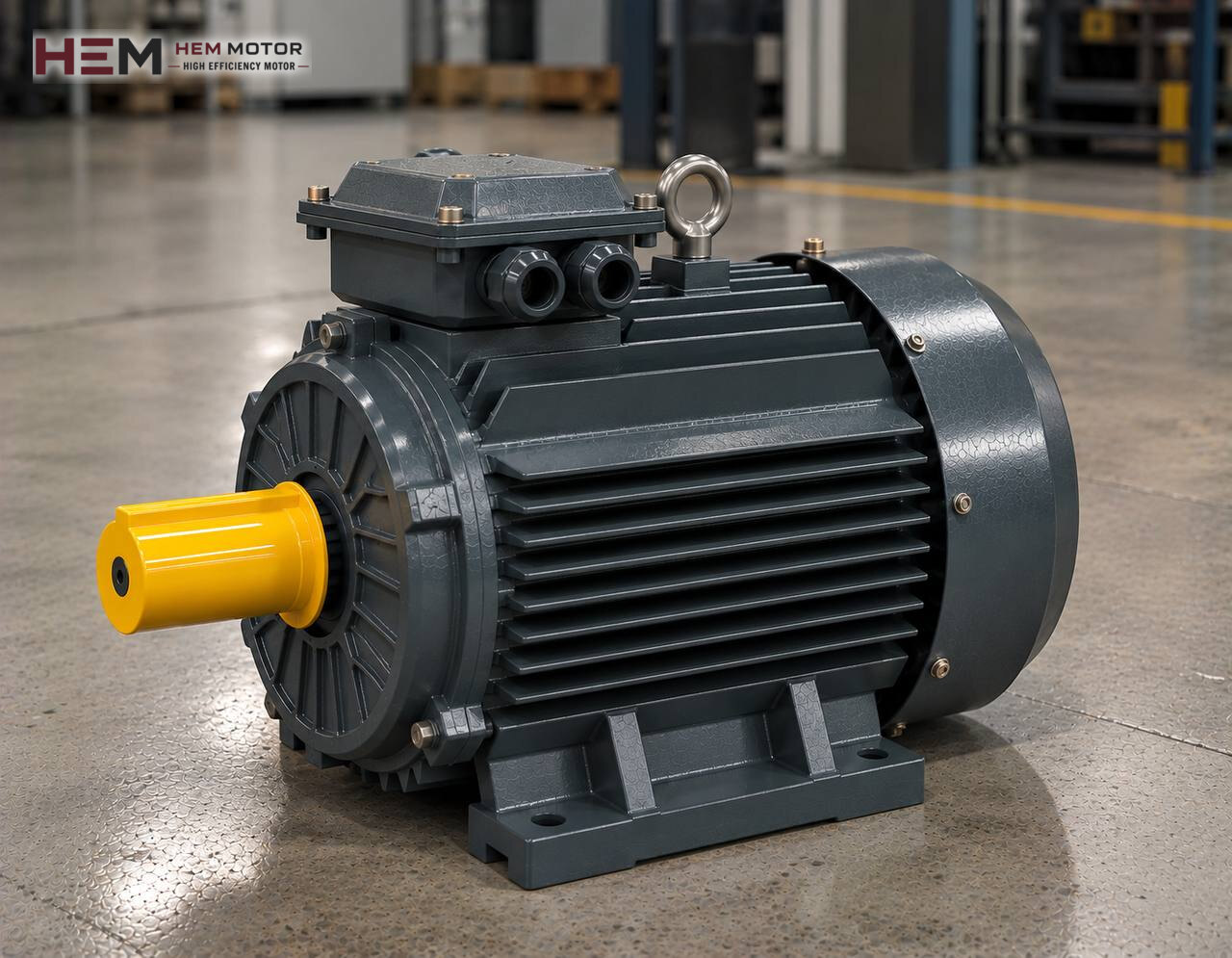
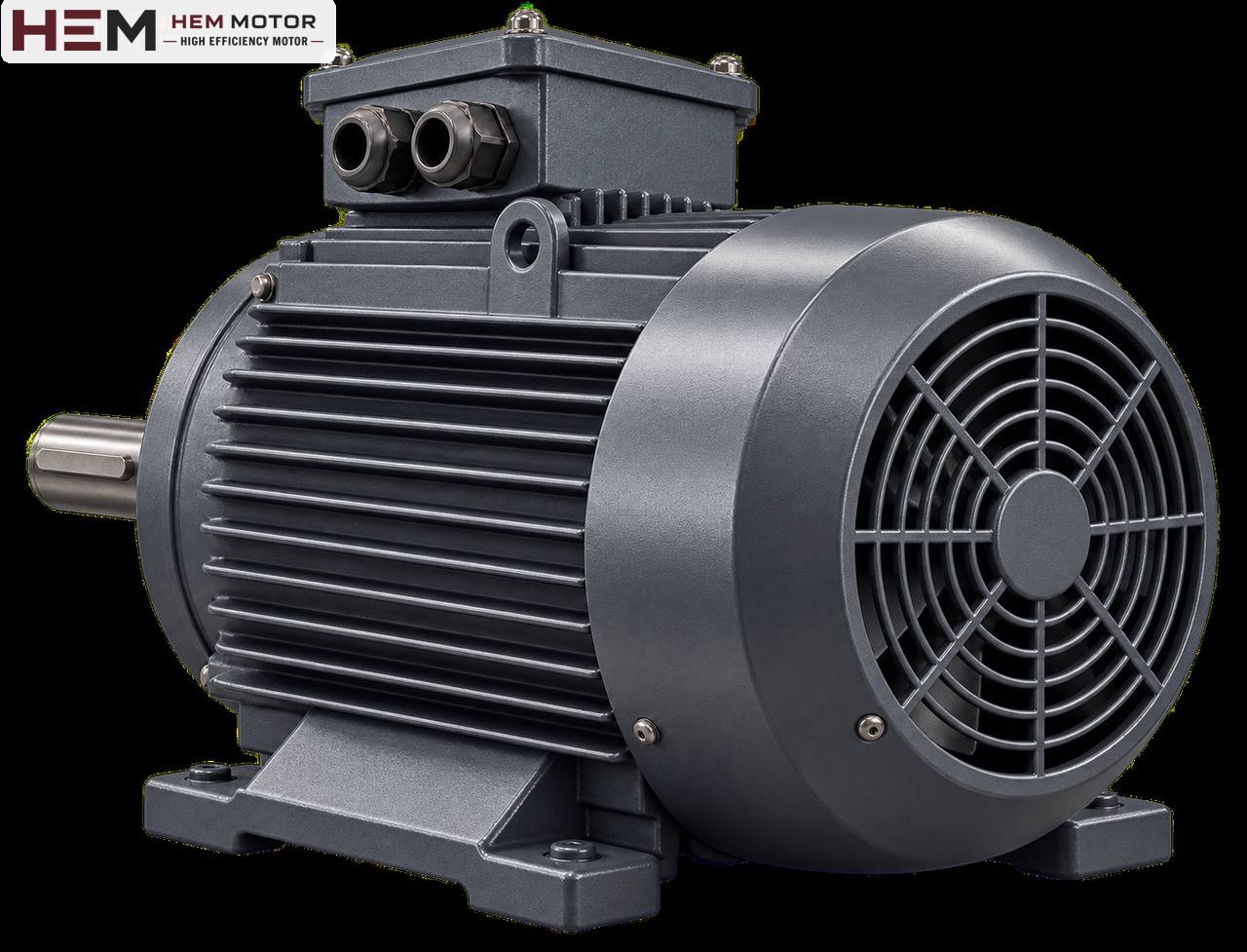
The ring between the rear face of the fan cover and the wall is the section through which cooling air reaches the fan (representative image).
Prices and technical data are on the product pages; choose a model and order online.
Why does the ambient temperature rise in a confined space?
When a motor is placed inside a recess, enclosure or machine body, the heat rejected by the frame warms the air of that small volume. So the clearance issue is not limited to the inlet section. The fan no longer draws 30 °C room air but air the motor has heated itself, perhaps at 40–45 °C. Even if the frame-to-air temperature difference stays the same, the absolute winding temperature rises by the amount of the ambient increase.
The power on the motor nameplate is given for a certain maximum ambient temperature; if this value is exceeded, derating may be needed (general information; confirm with catalogue values). In closed enclosures, measuring the internal temperature while the motor runs is the simplest check of the installation decision. Opening a ventilation vent or adding an enclosure fan is often less trouble than oversizing the motor.
How can you tell after installation whether the clearance is enough?
A few simple field measurements show whether the clearance is enough; the calculation is only a starting point:
Run the motor at its normal load for at least an hour; measure the ambient temperature a few metres away from the motor and the frame temperature at a fixed point (for example below the terminal box).
Measure separately the temperature of the air between fan cover and wall; if it is clearly higher than room temperature, the motor is drawing in its own waste heat.
If possible, temporarily move the motor forward or remove the obstruction on the wall side, and repeat the measurement at the same load.
The difference in frame temperature between the two measurements shows directly what the layout costs the motor.
For a more precise result, the temperature rise can be measured with the winding resistance method; for comparing layouts, however, a frame measurement taken at the same point usually gives a good enough picture. If of two motors drawing the same current the one closer to the wall runs clearly hotter, the problem is plainly the clearance.
Example electric motors for cramped pump and compressor installations
Mounting close to a wall is found most often in pump rooms and compressor enclosures; notes specific to these drives are on the pump electric motors page. If the layout cannot be changed, choosing with a wider thermal margin is an option; you can compare power and frame alternatives in the electric motor shop. Example models suited to this situation:
100L2-4: 3 kW, 1450 rpm, aluminium frame, 230/400 V; common on small circulation and pressure boosting pumps.
132S1-2: 5.5 kW, 2930 rpm, cast iron frame; a class often seen on centrifugal pump sets placed against a wall.
160L-4: 15 kW, 1465 rpm, 27.3 A on a 400 V supply; in closed volumes such as compressor enclosures the ambient temperature must also be taken into account.
Foot and flange mounting types are offered according to frame size as B3, B5, B14, B34, B35 and vertical V1/V3/V5/V6/V15; the flange size is confirmed with the order. If there is no way to add ventilation in the enclosure, options such as an external fan or a winding sensor should be discussed with the order.
If a motor of yours running close to a wall or panel is overheating, share a photo of the layout and the cover-to-wall distance together with the nameplate data through our contact page; we will weigh up together whether the installation or the motor selection needs to change. To see alternative powers and frames side by side, you can use the list on the purchase page.
Frequently Asked Questions
How many centimetres should I leave between the fan cover and the wall?
Rather than a single fixed value, think of a distance that varies with the frame. The annular area calculation in the article gives a rough lower limit; the exact value should be taken from the motor's installation instructions and technical drawing.
Is turning a motor near a wall around so the fan cover faces open space a solution?
It is often the most effective solution. If the pump or machine layout allows, turning the set is simpler than oversizing the motor or adding an extra fan.
What can be done for a motor inside a closed machine body?
A grilled vent should be opened in the body level with the fan cover, and a second opening left for the hot air to escape. If the air inlet and outlet are at the same point, the motor draws back in the air it has just heated.
Does the distance between two motors side by side matter?
Yes. If the hot air travelling along one motor's frame heads into the fan cover of the motor just in front of it, the second motor heats up. Arranging the motors with spacing and facing the same way reduces this interaction.
HEM Motor Models Related to This Article
The cards show example models related to the topic. A suitable motor is not chosen by power alone: compare speed, voltage, mounting, shaft and connection dimensions on the product page; if unsure, send a photo of the existing motor’s nameplate on WhatsApp.
For a filter press feed pump, the electric motor is selected for the heaviest moment of the cycle; on a press with a centrifugal pump this moment is usually the start of filling, b... More Details
When choosing an electric motor for a dosing pump, the adjustment range is the flow band produced jointly by the stroke length setting and the motor speed. Mounting dimensions are ... More Details
When choosing an electric motor for a mono pump (progressive cavity pump with a helical rotor), the decisive factor is often not running power but the breakaway torque at the first... More Details
When choosing a motor for a peristaltic pump, the deciding value is not flow or pressure but the torque the rotor needs to squeeze the hose. The rotor turns slowly, so a gearbox al... More Details
When choosing an electric motor for a vegetable washing drum, two things are considered together: how well the motor will withstand splashing and wash water, and at what speed and ... More Details
As the holes in an electric motor's fan cover clog, the cooling airflow drops and the winding temperature climbs not in proportion to the blocked area but along an increasingly ste... More Details
We use necessary and optional cookies to improve your experience, enhance content and analyse traffic. Under the GDPR, optional (analytics/marketing) cookies are only used with your explicit consent. Please choose your preference below.
Cookie Policy
 English
 Français
 Türkçe
 Español
 Русский
 العربية
 Deutsch
 Italiano