When choosing the motor for an industrial vacuum pump, three questions are decisive: at what speed was the pump designed to run, how is the motor connected to the pump, and how many hours a day, in what pressure range, does the pump operate? The power value comes from the pump's nameplate; but the motor's service life is determined by speed matching, coupling alignment and heat during continuous operation. In this article we look at motor selection for rotary vane, liquid ring and dry vacuum pumps under these three headings.
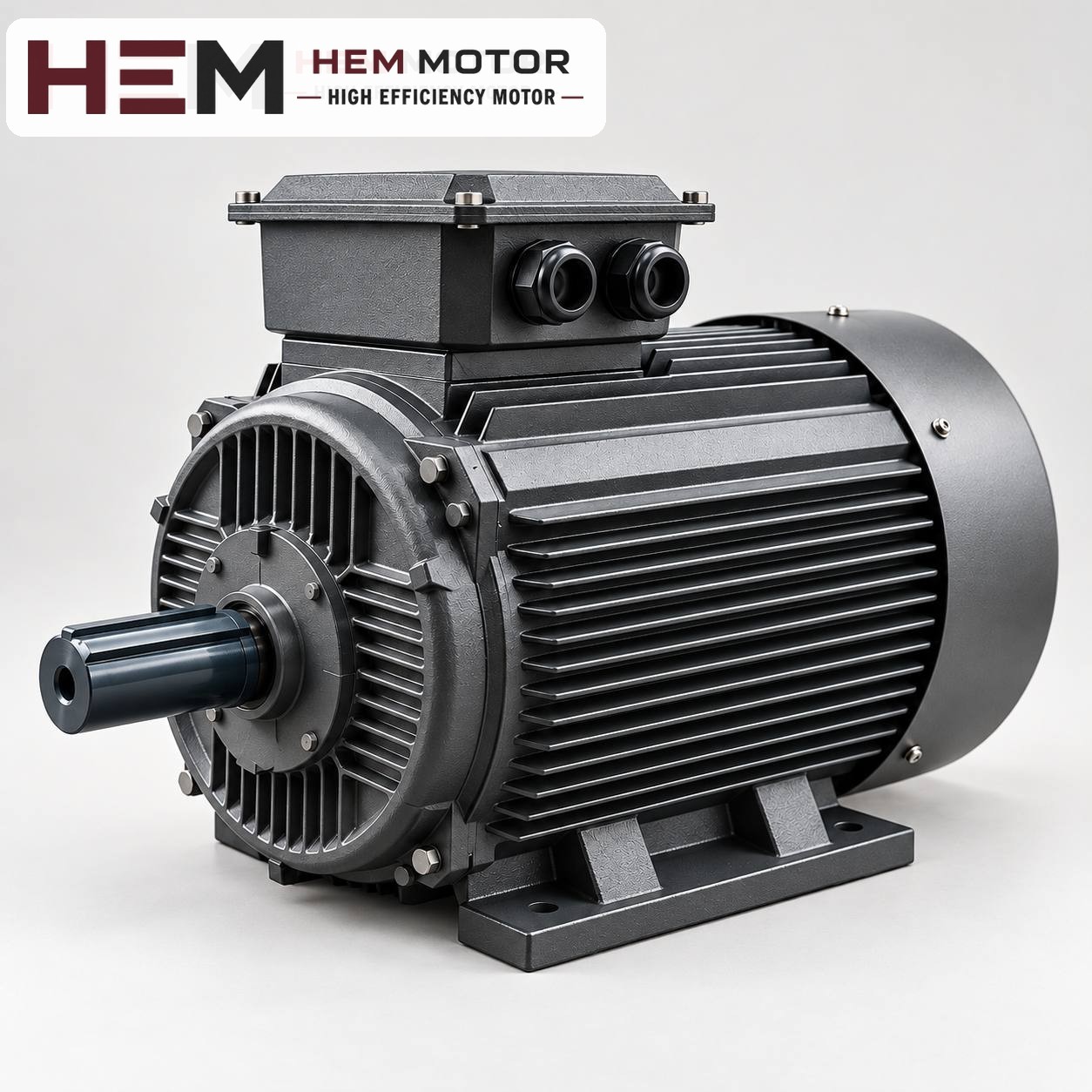
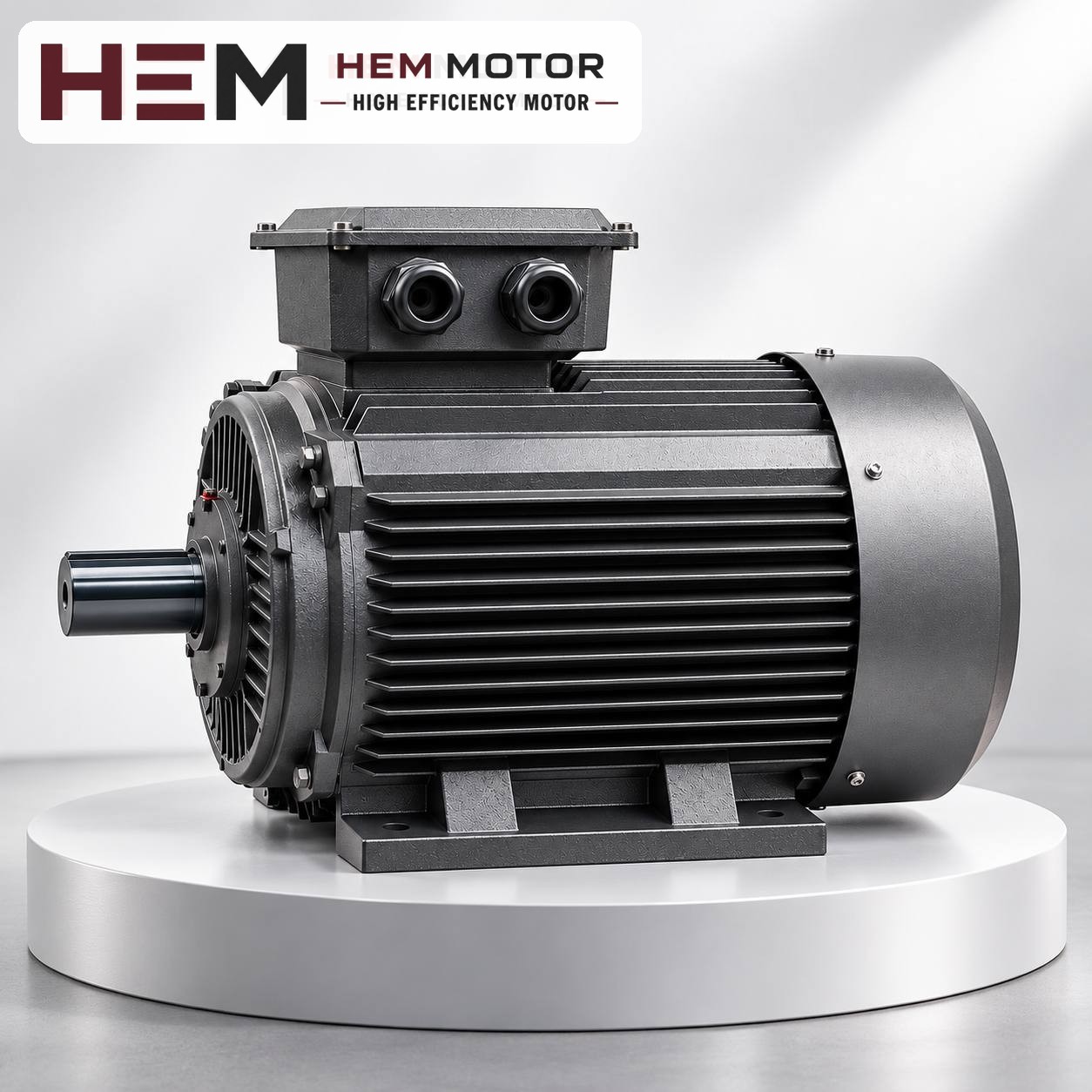
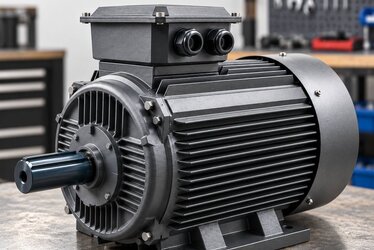
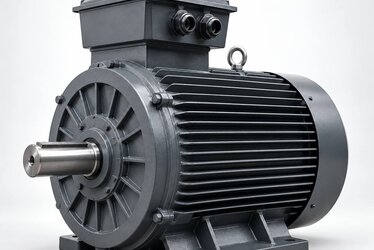
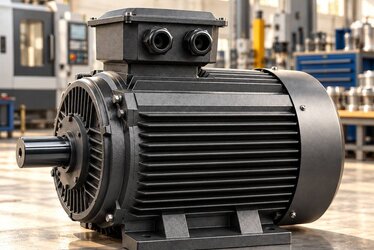
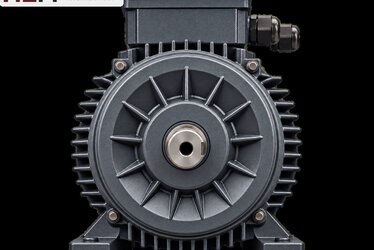
On a vacuum pump motor, the flange, shaft end and speed are checked together (representative image).
The load the motor sees, by vacuum pump type
A vacuum pump draws gas out of a volume and discharges it to atmosphere. The power the motor must deliver to the shaft varies with the pump type and the suction pressure at that moment. So the answer to "how many kW is the pump?" is not a single number but the power curve provided by the pump manufacturer.
Oil-lubricated rotary vane pumps: Common in packaging, CNC vacuum tables, thermoforming and laboratory lines. Most are connected directly to the motor. Cold oil makes the vanes move stiffly in their slots at the first start and increases the starting load.
Liquid ring pumps: Used for wet gas, vapour and dirty process air. Because the impeller turns the ring of water inside, the motor carries both the gas and the sealing liquid. If the pump is filled with more liquid than necessary before starting, the motor starts heavily.
Dry pumps (screw, claw, with Roots booster stage): Preferred in chemical and food processes for oil-free operation. There is no contact between the rotors; sensitivity to speed and alignment is high.
In many vacuum pumps, the power drawn peaks when the suction port is close to atmosphere or in the intermediate pressure range, and falls at deep vacuum. A leak in the line, the first evacuation of a tank or a process that is frequently opened to atmosphere keeps the motor in the heavy region of the curve. Do not reduce the motor power below the value on the pump nameplate.
Speed: the motor adapts to the pump, not the other way round
A vacuum pump's pumping speed (m³/h) and the ultimate pressure it can reach are given at its design speed. Most directly coupled rotary vane pumps run on a 50 Hz network with a four-pole motor, i.e. about 1,450–1,470 rpm under load. Some small pumps are two-pole, while some large liquid ring pumps are driven by a four- or six-pole motor or by belt.
The consequences of changing the speed are typical:
Higher speed: In a rotary vane pump, vane tip speed and temperature rise; the oil degrades quickly and the vanes and housing wear. In a liquid ring pump, the power requirement rises markedly.
Lower speed: The pumping speed falls; in a rotary vane pump the vanes may not press against the housing enough under centrifugal force, and the ultimate vacuum worsens.
If the process needs a different capacity, a frequency inverter is an option; but find out from the pump manufacturer the speed range the pump allows. Our three-phase series are suitable for speed control with a frequency inverter; for long periods of operation at low speed with full torque, a separate fan may be needed, and if the cable between drive and motor is long, a dv/dt or sine filter is considered; these conditions are stated with the order.
Coupling, bell housing and flange
On directly coupled vacuum pumps there is usually a bell housing (lantern) and a flexible coupling between the motor and the pump. The motor sits on the bell housing by its B5 flange; the bell housing keeps the two shafts on the same axis. On larger pumps, the motor and pump are joined on a common baseplate, with a foot-mounted (B3) motor and a separate coupling.
Flange size: The name B5 or B14 alone is not enough; the flange outside diameter, spigot diameter and hole pattern must be compared with the old motor. According to the general information on our site, B3, B5, B14, B34, B35 and vertical V1/V3/V5/V6/V15 arrangements are offered according to the frame; the flange size is confirmed with the order.
Shaft end and coupling hub: The shaft diameter, length and key must match the hub exactly. If the coupling element has hardened or cracked, renew it together with the motor.
Axial gap: If the gap specified by the manufacturer is not left between the coupling halves, the motor bearing carries an axial load.
Direction of rotation: Rotary vane and dry pumps are sensitive to reverse rotation. At first start-up, check the direction with a short jog; if necessary, swap two phases.
Continuous operating conditions: heat, environment and number of starts
Industrial vacuum systems often run throughout a shift, sometimes uninterrupted all day. This is the S1 continuous duty, and the motor's rated power is given for this duty. Points to watch in continuous operation are:
Pump heat: The casing of rotary vane and dry pumps heats up noticeably during operation. This heat passes through the flange and bell housing to the motor's front end shield. Arrange the installation so that the motor fan can draw cool air; do not direct the pump's hot exhaust at the motor.
Oil mist and moisture: If the oil mist from the exhaust of oil-lubricated pumps is drawn in by the motor fan, it forms a layer of dirt on the frame and weakens cooling. Liquid ring pumps involve water splashing and vapour. Our motors are IP55 protected with class F insulation; if there are direct water jets, heavy vapour or high ambient temperatures, state this with the order.
Number of starts: In systems that switch on and off according to vacuum level, the motor may see many starts per hour. Frequent starting repeatedly heats the winding with starting current. In such systems, state the number of starts with the order; speed control by frequency inverter or an unloaded start arrangement (starting with the suction valve closed) can be considered.
Protection: The motor protection switch or thermal relay must be set according to the rated current. The motor protection selection article covers this in detail.
Vacuum systems that draw explosive gas or solvent vapour are a separate matter. This duty requires a special motor; it may fall outside the scope of the standard range in HEM Motor's 2026 catalogue. Ask us with the application details.
Example models and a hypothetical replacement
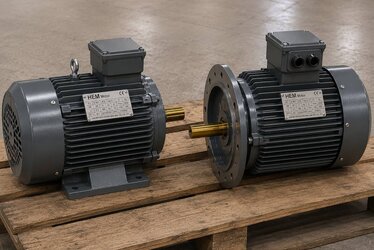
Below are examples of four-pole models often seen on directly coupled vacuum pumps. All are IP55, class F insulated, 50 Hz and supplied at 400/690 V (Δ/Y).
Hypothetical example: on a packaging line, suppose the 4 kW, 1,450 rpm, 112M-frame motor of a rotary vane vacuum pump mounted to the motor via a bell housing has a winding failure. The pump nameplate specifies a four-pole motor and clockwise rotation. The 112M-4 is chosen as the new motor; the flange size and shaft end are compared with the old motor and confirmed with the order. The coupling element is renewed, the bell housing is cleaned, oil deposits in front of the motor fan are removed and the direction of rotation is checked at first start-up. As the line is in a closed, clean environment, an aluminium frame is sufficient; had the pump room been damp and dirty, the cast iron option would have been considered.
Conclusion: information to send for a vacuum pump motor
The right motor is chosen together with the pump's design speed, a flange and shaft that fit the bell housing, cooling suited to continuous operation and the starting arrangement. When requesting a quote, send the following:
The vacuum pump type and nameplate data (capacity, speed, motor power)
A photo of the old motor's nameplate and its frame code
Mounting arrangement (B5 bell housing connection, B3 baseplate, etc.), flange and shaft dimensions
Daily operating time, starts per hour and ambient conditions
Supply voltage and starting method
Send a photo of your current motor's nameplate, its speed and mounting details through the nameplate submission page and request a quote for the right model. You can compare models in the buy electric motors section and write to us via our contact page with any other questions.
Frequently Asked Questions
Can I increase capacity by replacing the vacuum pump motor with a two-pole motor?
This is not recommended. At twice the speed the pump overheats and wears, and the motor draws much more power; a capacity increase should be achieved through pump selection.
Why does a rotary vane vacuum pump start with difficulty in the cold?
Cold oil has a high viscosity and hinders the movement of the vanes. Use the oil recommended by the pump manufacturer and state cold-environment starting conditions with the order.
Why does the motor start heavily on a liquid ring pump?
If the pump has filled with too much sealing liquid before starting, the impeller has to turn a heavy mass of water at the first moment. Set the liquid level according to the manufacturer's instructions.
Is a vacuum pump motor suitable for continuous operation?
Standard three-phase motors are rated at their nominal power for S1 continuous duty. It is enough that the cooling air is not obstructed and the number of starts is stated.
HEM Motor Models Related to This Article
The cards show example models related to the topic. A suitable motor is not chosen by power alone: compare speed, voltage, mounting, shaft and connection dimensions on the product page; if unsure, send a photo of the existing motor’s nameplate on WhatsApp.
When replacing the drying fan motor of a glass washing machine, three things must stay the same as on the old motor: the number of poles (and therefore the fan speed), the motor's ... More Details
On a cold storage condenser, a standard three-phase motor can be used if the fan propeller is fitted to the shaft of a separate IEC-frame motor or driven by a belt. In external-rot... More Details
The motor for the circulation pump of a fabric dyeing machine is chosen not by looking at the machine's capacity but according to the pump's own data: flow, head, pump speed and th... More Details
When a stenter fan motor is replaced, two conditions are decisive: the temperature where the motor sits must be at a level a standard IP55, class F motor can work in, and the new m... More Details
A standard three-phase motor is the right choice for the hot air fan of a shrink packaging machine only if the motor frame stays outside the hot zone of the tunnel. The fan impelle... More Details
What strains the pump motor on a bottle washing machine is often not the electrical load but the motor's surroundings: steam rising from hot caustic solution, label pulp stripped o... More Details
We use necessary and optional cookies to improve your experience, enhance content and analyse traffic. Under the GDPR, optional (analytics/marketing) cookies are only used with your explicit consent. Please choose your preference below.
Cookie Policy
 English
 Français
 Türkçe
 Español
 Русский