On greenhouse and poultry house fans, the propeller speed must be kept, because the propeller diameter and blade angle were chosen for a particular speed: if the speed rises the motor is quickly overloaded, and if it falls the air exchange needed by the animals or plants is not achieved. When the motor is replaced, the number of poles, the pulley ratio and the direction of rotation are kept the same as before, as well as the power. This article explains why and how the propeller speed is preserved when a burnt-out fan motor is replaced.
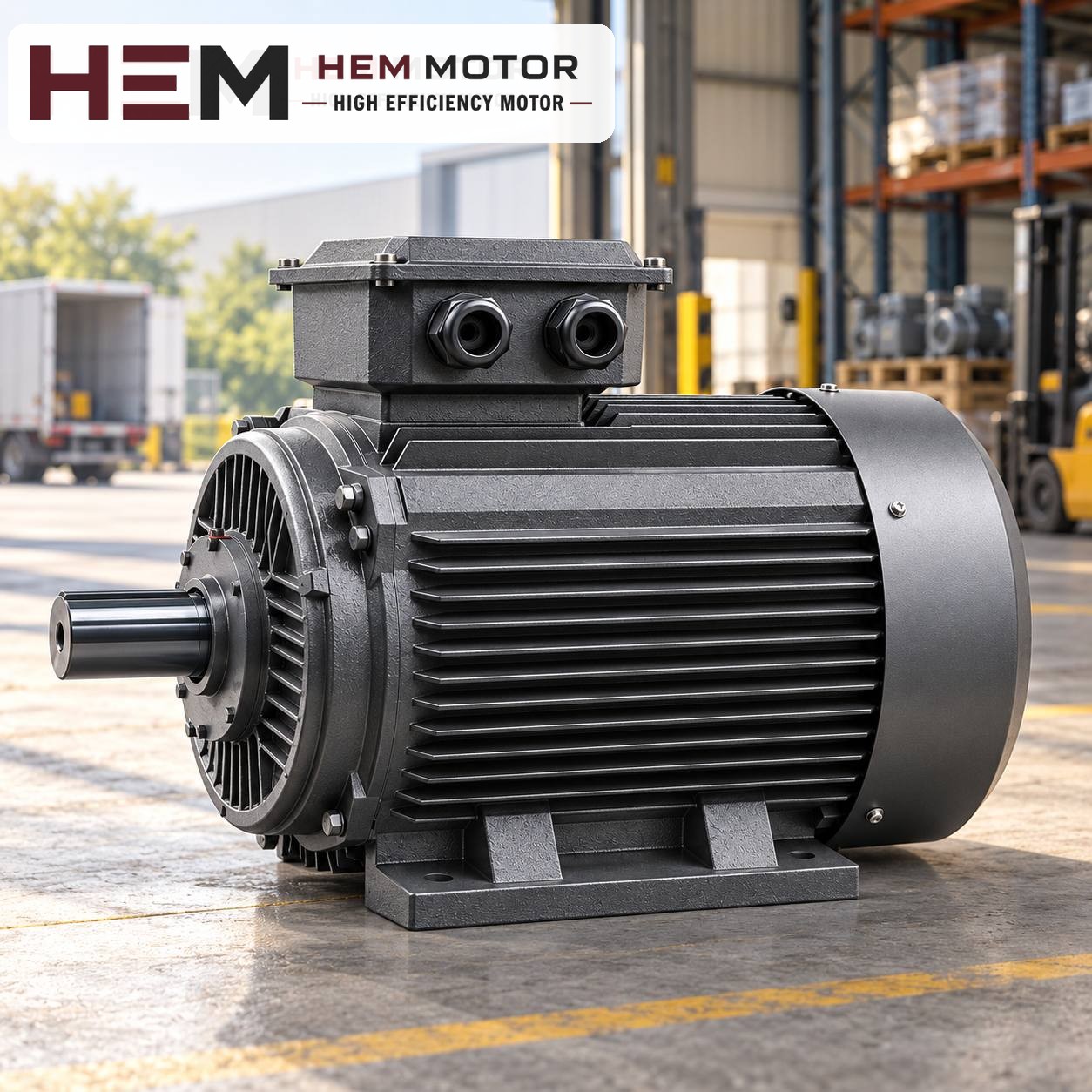
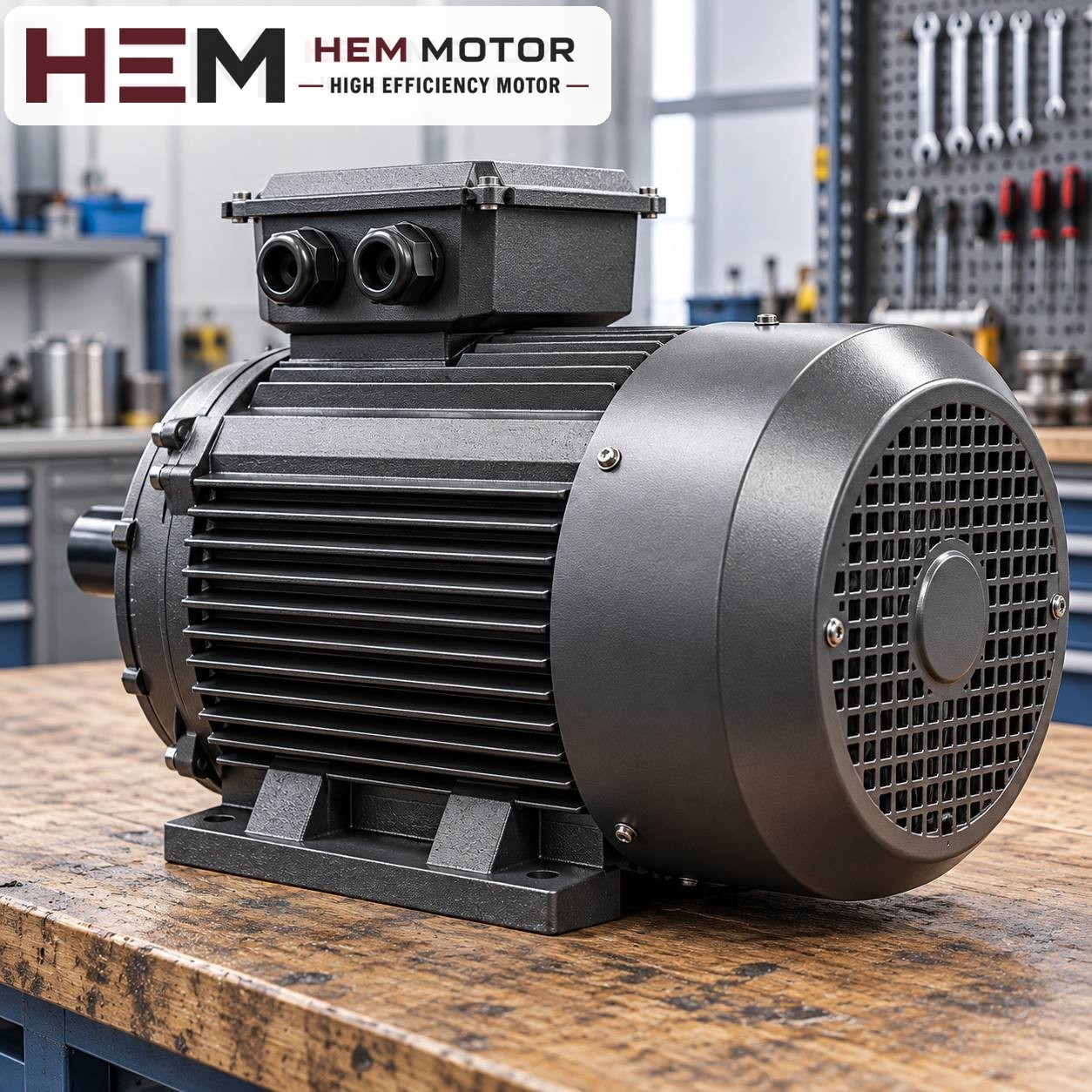
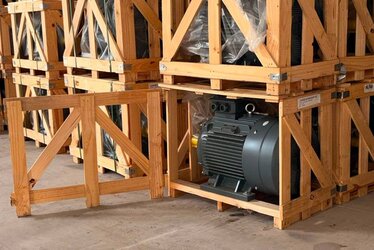
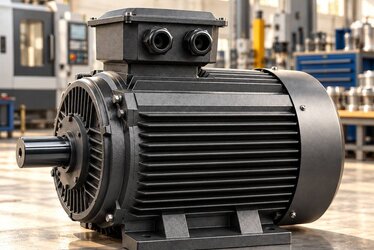
Ventilation fans usually use low-power 4- or 6-pole motors (representative image).
Two drive arrangements on greenhouse and poultry house fans
How the motor is selected depends on how the fan drives the propeller. Two arrangements are common on site:
Belt-driven box fans: A large-diameter propeller is driven by pulley and belt. The motor is usually fixed to a small bracket on top of or beside the fan housing. The propeller speed is much lower than the motor speed and is set by the pulley ratio.
Direct-drive axial fans: The propeller is mounted directly on the motor shaft. The propeller speed equals the motor's rated speed; the motor is usually fixed by flange or feet to a support in the middle of the fan ring.
In both arrangements the motor runs in the air the fan moves. In poultry houses this air carries dust, feathers, moisture and ammonia; in greenhouses there is high humidity and, at times, spraying vapour. That is why ambient conditions are the second most important topic after speed.
What happens if the speed changes? Fan laws in practice
For the same fan and the same building, the air moved by the propeller changes roughly in proportion to speed, the pressure it creates with the square of speed and the shaft power roughly with the cube of speed. In practice this means:
Change
Airflow
Motor load
Result on site
Speed rises by about 10%
Rises by about 10%
Rises by about one third
Motor overheats, thermal relay trips; noise increases
Speed falls by about 10%
Falls by about 10%
Falls markedly
Insufficient ventilation in summer heat, heat stress
2 poles instead of 4 (direct drive)
Tends to roughly double
Rises several times
Motor burns out; propeller may exceed its permitted speed
6 poles instead of 4 (direct drive)
Falls by about one third
Drops below half
Fan appears to run but air exchange is not enough
The ratios in the table are approximate results of the fan laws; actual values vary with the fan and the building. But the direction is always the same: a small rise in speed loads the motor disproportionately. In a poultry house, the number of fans and their stages are calculated for stocking density and the need on the hottest day; even one fan turning more slowly can upset the balance of staged ventilation.
How is speed preserved on belt-driven fans?
On a belt-driven box fan, the propeller speed results from the motor's rated speed and the ratio of the pulley diameters. Points to watch when replacing:
Keep the number of poles: If the old motor was 4-pole, the new motor must also be 4-pole. Fitting a motor with a different number of poles and compensating by changing the pulley is possible, but it must be confirmed by calculation that the new ratio gives the speed specified by the fan manufacturer.
Look at the rated speed: The speed on the nameplate is not synchronous but the speed under load. For example, the 4-pole 1.1 kW model shows 1,445 rpm and the 0.75 kW model 1,420 rpm. This small difference can change the propeller speed by a few percent; that is another reason why replacing at the same power is preferred.
Move the pulley to the new shaft: The bore and keyway of the motor pulley must fit the new motor's shaft. Shaft dimensions vary with the frame; the values are in the 2026 technical and product catalogue.
Tension the belt correctly: An overtight belt loads the motor's front bearing, while a loose belt slips and lowers the propeller speed. Belt slip is a common reason why ventilation stays insufficient despite a new motor.
What the motor must handle on direct-drive fans
When the propeller is mounted directly on the shaft, the motor carries not only the torque but also the propeller's weight and thrust. Therefore:
The shaft diameter and length of the new motor must suit the propeller hub, and the hub must be fitted at its previous position on the shaft. If the propeller's position relative to the ring changes, the tip clearance is disturbed and airflow drops.
Whether the fan runs horizontally or inclined determines the motor's mounting position. Mounting arrangements are offered according to the frame; the flange size is confirmed with the order.
The propeller's direction of rotation must match the arrow on the fan housing. On a three-phase motor the direction is reversed by swapping two phases. A propeller turning backwards moves much less air, but it may go unnoticed because the motor appears to be running.
A propeller with broken or dust-coated blades is unbalanced. Clean the propeller before fitting the new motor and replace it if damaged; otherwise the vibration passes to the new motor's bearings.
Prices and technical data are on the product pages; choose a model and order online.
The three-phase models sold by HEM Motor are IP55 protected and have class F insulation. IP55 protects against dust and water jets from any direction; however, condensation in very humid air, long-term corrosion in ammonia-laden air and washing with pressurised water push the limits of this protection. If the fans are to be washed with pressurised water during poultry house cleaning, the motor should be covered or water should not be aimed directly at it. These conditions must be stated clearly with the order.
If the motor's cooling fins fill with feathers and dust, the motor heats up; add the motor frame to the cleaning schedule.
On fans that stand idle for long periods (for example tunnel fans switched off in winter), moisture can build up in the winding; having the insulation resistance measured before the first start of the season is good practice.
The cable entries of the terminal box must stay sealed and the cover gasket must be in place.
If the fans are switched in stages by thermostat or their speed is adjusted with a drive, the general statement on the site applies: our three-phase series are suitable for speed control with a frequency inverter; during long periods of full-torque operation at low speed an external fan may be required, and if the cable between drive and motor is long a dv/dt or sine filter is considered; these conditions are stated with the order.
Example models for the power ratings found on ventilation fans
Motor power on greenhouse and poultry house fans is usually small. The aluminium frame models below are light and therefore a suitable option for fan brackets and supports; all are supplied at 230/400 V (Δ/Y), 50 Hz and are connected in star on a 400 V network.
80M2-4 aluminium: 0.75 kW (1 HP), 4 poles, 1,420 rpm, IEC 80M, 1.75 A. A common power rating on belt-driven box fans.
90L-4 aluminium: 1.5 kW (2 HP), 4 poles, 1,445 rpm, IEC 90L, 3.30 A. For large tunnel fans.
90L-6 aluminium: 1.1 kW (1.5 HP), 6 poles, 945 rpm, IEC 90L, 2.69 A. For direct-drive fans whose propeller is designed for about 1,000 rpm.
Review suitable HEM Motor models and current prices on the buy electric motors page. If your site has a single-phase supply, HEM Motor's single-phase models can also be considered; ask us for a suitable model. Further information for agricultural applications is on the agricultural machinery motors and ventilation motors pages.
Hypothetical example: rising temperature in the poultry house after a replacement
The situation below has been constructed for explanation. Suppose that in a broiler house the 1.1 kW, 4-pole motor of one of the belt-driven tunnel fans has burnt out and a 1.1 kW, 6-pole motor that happened to be at hand has been fitted. The fan turns, but on hot days the temperature rises in the area in front of the fan.
Because the pulleys were not changed, the propeller speed has dropped by about one third and the airflow by the same proportion.
As a solution, a 90S-4 model with the same number of poles as before is fitted; the pulley and belt are returned to their previous position.
At commissioning, the direction of rotation is checked against the fan arrow, the current is measured and compared with the nameplate value.
Conclusion: information to prepare before replacement
On a ventilation fan, the right motor is the one that gives the same speed as the old one. Send us the following:
A photo of the old motor's nameplate: power, number of poles or rated speed, voltage
The fan's drive arrangement (belt or direct drive) and pulley diameters, if any
Mounting arrangement and shaft/hub details
Environment: poultry house, greenhouse, whether washing is carried out
Supply (three-phase/single-phase) and control arrangement (thermostat, drive)
You can see the models and current prices in our online shop. Send a photo of your current motor's nameplate, its speed and mounting details through the nameplate submission page and request a quote for a suitable model. The contact page is also open for your questions.
Frequently Asked Questions
Will ventilation improve if I fit a faster motor to a poultry house fan?
Airflow rises a little, but the motor load increases roughly with the cube of the speed. The motor overheats and the propeller may exceed its safe speed limit; the speed must be kept.
Can I use a 4-pole motor instead of a 6-pole motor on a belt-driven fan?
Only if the pulley ratio is recalculated and the propeller is brought back to its previous speed. If the pulleys stay the same, the propeller speeds up and the motor is overloaded.
Why might the fan move less air after a new motor has been fitted?
The most common reasons are a different number of poles, reversed direction of rotation, a slipping belt or a change in the propeller's position relative to the ring.
Can I wash a poultry house fan motor with pressurised water?
IP55 protects against water jets but is not designed for direct washing with pressurised water. Cover the motor during washing and do not aim the water directly at it.
HEM Motor Models Related to This Article
The cards show example models related to the topic. A suitable motor is not chosen by power alone: compare speed, voltage, mounting, shaft and connection dimensions on the product page; if unsure, send a photo of the existing motor’s nameplate on WhatsApp.
When replacing the drying fan motor of a glass washing machine, three things must stay the same as on the old motor: the number of poles (and therefore the fan speed), the motor's ... More Details
On a cold storage condenser, a standard three-phase motor can be used if the fan propeller is fitted to the shaft of a separate IEC-frame motor or driven by a belt. In external-rot... More Details
The motor for the circulation pump of a fabric dyeing machine is chosen not by looking at the machine's capacity but according to the pump's own data: flow, head, pump speed and th... More Details
When a stenter fan motor is replaced, two conditions are decisive: the temperature where the motor sits must be at a level a standard IP55, class F motor can work in, and the new m... More Details
A standard three-phase motor is the right choice for the hot air fan of a shrink packaging machine only if the motor frame stays outside the hot zone of the tunnel. The fan impelle... More Details
What strains the pump motor on a bottle washing machine is often not the electrical load but the motor's surroundings: steam rising from hot caustic solution, label pulp stripped o... More Details
We use necessary and optional cookies to improve your experience, enhance content and analyse traffic. Under the GDPR, optional (analytics/marketing) cookies are only used with your explicit consent. Please choose your preference below.
Cookie Policy
 English
 Français
 Türkçe
 Español
 Русский