The tightening torque of the fastening screws on an electric motor is determined by the screw diameter, property class, whether the thread is lubricated or dry, and the material being clamped; the correct value is the torque that creates the required preload in the bolt. On site, the most practical approach is to apply the value given by the motor and machine manufacturer with a torque wrench and, if no value is given, to read the bolt manufacturer's table according to the thread condition. Foot bolts, flange screws, end-shield screws and terminal nuts carry different duties, so each needs its own tightening procedure.
What is the real job of a bolt: torque or preload?
The real job of a bolt is to create preload. When we tighten a bolt, the aim is not to apply torque but to stretch the bolt like a spring and create a force that presses the parts together. This force is called preload. What presses the motor foot onto the base, holds the flange against the gearbox face and stops the joint slipping under vibration is not the torque itself but this preload.
Most of the applied torque does not turn into preload; it is spent on friction in the thread and under the nut or screw head. Friction consumes most of the torque. According to a general engineering assumption, only a small portion of the torque goes into stretching the bolt. That is why the same torque produces much higher preload on a lubricated thread than on a dry one; tightening a lubricated bolt to the dry table can take it beyond its yield point.
What is the relationship between torque and preload?
Tightening torque is roughly the product of the torque coefficient, preload and nominal diameter. The approximate relationship used in the field is (general information; confirm with the bolt and machine manufacturer's values):
T ≈ K × F × d: T: tightening torque (Nm), K: torque coefficient representing friction (dimensionless), F: required preload (N), d: nominal bolt diameter (m).
The K coefficient varies with surface coating and lubrication; it is higher for dry, uncoated steel and lower for a lubricated thread or one coated with a special paste. A change of a few tenths in the coefficient changes the preload at the same torque by the same proportion.
Hypothetical example: a joint targets 20,000 N preload with a nominal diameter of 0.012 m. Assuming K = 0.20 for a dry thread gives T ≈ 0.20 × 20,000 × 0.012 = 48 Nm. If the same bolt is lubricated and K drops to 0.14, the same 48 Nm produces about 28,600 N preload; roughly forty per cent above the target. The difference is large. The calculation shows why the lubrication condition is critical when choosing the table.
Why are foot, flange, end-shield and terminal joints tightened differently?
Each joint has a different duty, so its tightening procedure differs too.
Foot bolts: They transfer the motor's reaction torque, belt pull and vibration to the base. Low preload lets the foot hammer the base and work loose, while overtightening twists the housing on a warped base. Base flatness and shims are checked first, then the bolts are brought to final torque crosswise and in stages.
Flange screws: In B5 and B14 mounting, the motor hangs on the gearbox or pump housing by the flange alone; all torque and weight pass through these screws. On a B14 flange the screws go into tapped holes in the motor end shield; if thread length and screw length are not chosen correctly, either the thread strips or the screw bottoms out and no preload forms. Points to watch in gearbox connections are summarised under electric motors for gearboxes.
End-shield and terminal box screws: Their job is to compress the sealing gasket evenly. Overtightening crushes the gasket and strips the thread in the casting; undertightening lets dust and water in.
Terminal nuts: These are current-carrying connections. A loose nut raises contact resistance and causes heating, while an overtightened nut can snap the stud or crack the terminal board. Their value should be taken from the motor manufacturer's instructions.
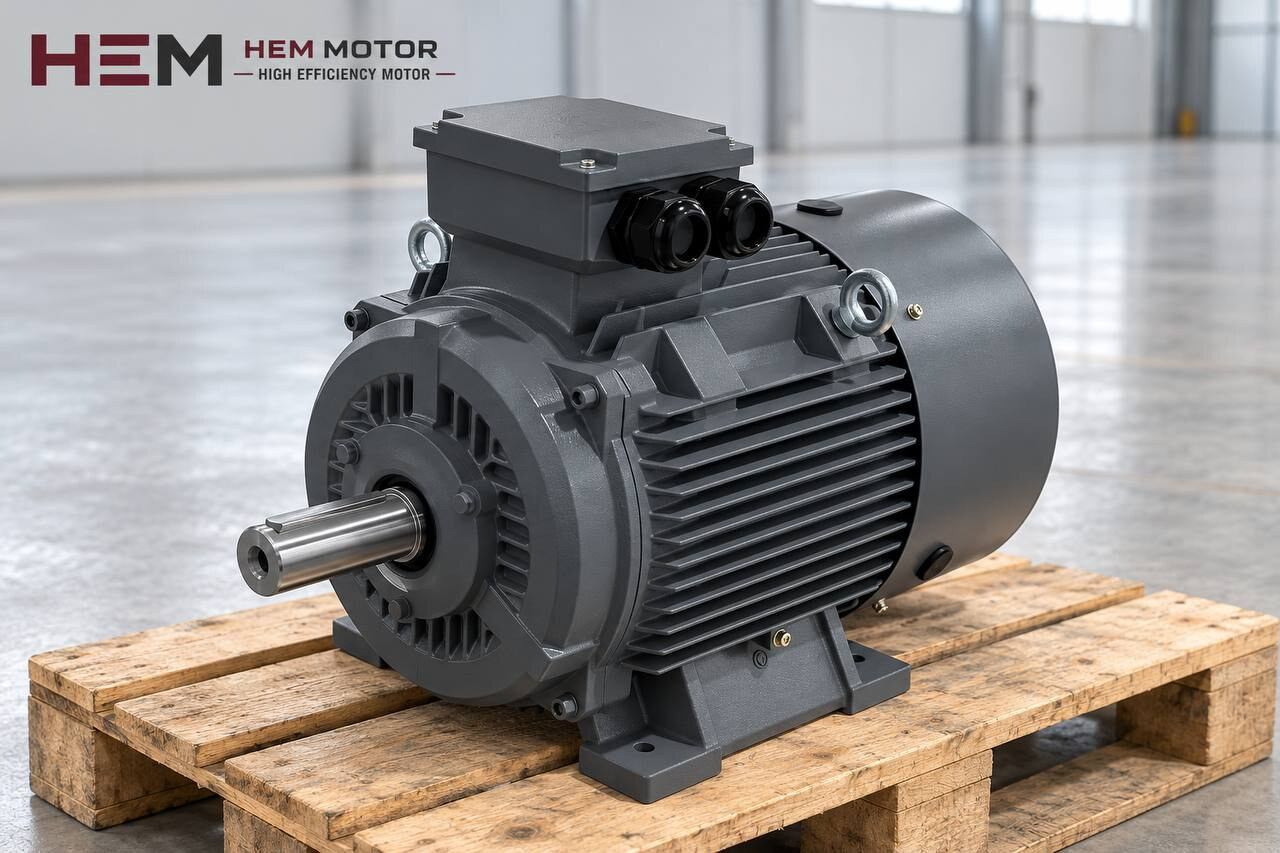
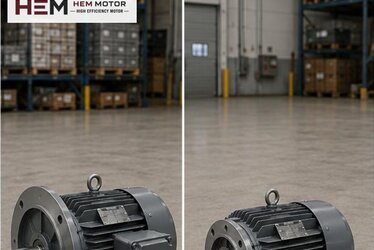
In a flange connection the entire torque and weight of the motor pass through the flange screws into the gearbox (representative image).
Prices and technical data are on the product pages; choose a model and order online.
Bolts are tightened on clean threads, crosswise and in stages. Even the correct torque value spoils the joint if applied in the wrong order. The following sequence suits most motor joints:
Clean the threads and seating surfaces; paint, burrs and old paste reduce preload.
Check which thread condition the value is given for: lubricated, dry or with thread-locking compound?
Seat the bolts by hand, then bring them crosswise to about half of the final torque.
Go to final torque in the same crosswise order; pull the torque wrench with a slow, steady movement.
In a final pass, check all bolts once more; those tightened first may have relaxed while the others were tightened.
The torque wrench must be calibrated at regular intervals. Applying final torque with an impact wrench gives uncontrolled, scattered results; the impact wrench should be used only for pre-tightening. If you plan to fit a new motor in this sequence, you can compare power and frame options in our electric motor shop.
Why do bolts work loose and when should they be retightened?
Joints work loose through settling, vibration and thermal expansion. After the first start-up some settling occurs in the joints: surface roughness is flattened, paint and shims compress, and part of the preload is lost. That is why, on a newly installed or reconnected motor, it is wise to make a second torque check on the foot and flange bolts after the motor has run under load for a while.
Vibration, thermal expansion and shock loads cause loosening over time. Washers, spring washers or thread-locking compound should be chosen according to the joint's duty; it should be known that spring washers are not effective in every application. Repeated loosening points more to base resonance or misalignment than to insufficient tightening; in such a case the problem lies not in the bolt but in the drive arrangement.
Foot hole positions and flange information by frame number are given on the technical drawings page. Screw size and length are confirmed from these drawings and from the drawing of the mating part.
How does motor torque affect bolt load?
The load carried by the flange screws depends directly on motor torque. Rated torque is calculated from power and speed: T = 9550 × P / n (P in kW, n in rpm). At start-up and under shock this value can rise several times; the flange screws must resist this peak torque through friction and preload. The electric motor torque table is a practical starting point for comparing torques by power and speed.
The examples below are chosen from power ratings common in gearbox and conveyor drives; the pairings are hypothetical:
For a light conveyor gearbox, the 4 kW, 4-pole aluminium frame 112M-4: 1450 rpm, rated torque 26.3 Nm.
For a medium-duty screw conveyor drive, the 11 kW cast iron 160M-4: 1465 rpm, 71.7 Nm.
For a heavy mixer gearbox, the 22 kW 180L-4: 1470 rpm, 142.9 Nm.
For instance, if the starting torque of the 22 kW motor reaches twice the rated value, the flange joint briefly carries about 286 Nm; screw and preload selection should be made for this peak value together with the machine manufacturer. The peak value is what counts.
If you send the nameplate of the motor you are replacing and a photo of the connection side through the nameplate submission page, we will check mounting type and frame compatibility together. All models sorted by mounting type are in the HEM Motor product list.
Frequently Asked Questions
Is it right to lubricate motor foot bolts before tightening?
Lubrication reduces friction and increases preload at the same torque. It is correct provided the value given for a lubricated thread is used; tightening a lubricated bolt to the dry table overstresses it.
Why does a B14 flange screw bottom out or strip the thread?
If the screw length is not chosen to suit the thread depth in the end shield, it bottoms out and no preload forms. Excessive torque can also strip the thread in an aluminium or cast end shield.
Where can the tightening torque of terminal nuts be found?
The value is in the motor manufacturer's connection instructions. Since it varies with stud diameter and terminal board material, these instructions should be followed instead of a general table.
Why does a bolt tightened with an impact wrench work loose?
An impact wrench applies torque without control; some bolts end up undertightened and others overtightened. Final torque must always be applied with a calibrated torque wrench.
HEM Motor Models Related to This Article
The cards show example models related to the topic. A suitable motor is not chosen by power alone: compare speed, voltage, mounting, shaft and connection dimensions on the product page; if unsure, send a photo of the existing motor’s nameplate on WhatsApp.
Rated torque is the torque an electric motor can deliver continuously without overheating its winding; breakdown torque is the peak value the motor can produce for a short time, an... More Details
A six-pole electric motor pays off when the driven machine wants to turn at around 1000 rpm or slower and needs more shaft torque for the same kW. It reduces the gearbox ratio, bal... More Details
The choice is set by the shaft speed the machine needs: if the load is a centrifugal pump, fan or grinding spindle that wants about 2900 rpm directly, choose two poles; if it is a ... More Details
The pole count of an electric motor is easiest to read from the rated speed on the nameplate: on a 50 Hz supply, a speed just under 3000 rpm means 2 poles, just under 1500 means 4 ... More Details
3000 rpm is the theoretical field speed that the 50 Hz supply creates in a 2-pole electric motor and that the shaft never catches; around 2900 rpm is the speed actually measured at... More Details
1500 rpm is the speed of the rotating magnetic field of a 4-pole electric motor on a 50 Hz supply; 1450 rpm is the rated speed the same motor's shaft reaches at full load. The 50 r... More Details
We use necessary and optional cookies to improve your experience, enhance content and analyse traffic. Under the GDPR, optional (analytics/marketing) cookies are only used with your explicit consent. Please choose your preference below.
Cookie Policy
 English
 Français
 Türkçe
 Español
 Русский
 العربية
 Deutsch
 Italiano