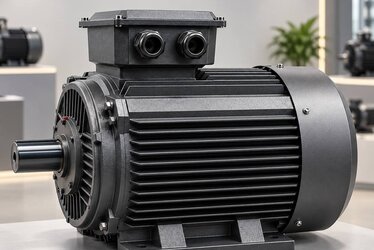
Electric Motor and Gearbox Selection for a Plastic Raw Material Mixer

Electric Motor and Gearbox Selection for a Plastic Raw Material Mixer

On a plastic raw material mixer, the motor and gearbox are selected as a package: the gearbox determines the speed and torque that the mixer shaft needs, and the motor must have enough power to deliver this torque at the gearbox input, even when the mixer is full. Selection starts not from the machine's name but from the mixer type, the shaft speed and the torque required with a full vessel. Understanding how the load builds up in tanks where granules, masterbatch and powder additives are mixed together determines the life of both the motor and the gearbox.

The mixer type determines the load from the outset

In the plastics sector the name "mixer" is used for very different machines. Before deciding on the motor and gearbox, be clear about which one you are working with.

  • Vertical screw mixer: a screw in the centre of a conical or cylindrical tank picks up granules from the bottom, carries them upwards and drops them from the top. The screw speed is relatively low; the motor is usually connected through a gearbox or belt. Torque varies with the tank fill level and the bulk density of the granules.
  • Horizontal ribbon mixer: ribbons rotating in a horizontal trough move the material in two directions. The shaft turns slowly and torque is high; there is almost always a geared drive.
  • Drum or rotating vessel mixer: the vessel itself rotates; the load comes from the unbalanced weight of the vessel and material. A slow, steady motion is required at the gearbox output.
  • High-speed heating-cooling mixer (PVC dry blend): the blades rotate at a very high tip speed and heat the mixture by friction. Two-speed motors or special drives are often used on these machines.

The two-speed drives in the last group require a special motor; they may fall outside the scope of the standard series in HEM Motor's 2026 catalogue, so ask us with the nameplate and application details. This article focuses on geared mixers in the first three groups.

Gearbox selection: output speed, torque and service factor

Three values determine the gearbox. Discussing motor power before these are clear may later end in gear or bearing failure.

Output speed

The mixer shaft speed is a value set by the machine builder according to mixing quality and time. The gearbox ratio is found by dividing the rated speed of the motor by this output speed. For 4-pole motors the rated speed is around 1,450–1,460 rpm, and the ratio is calculated accordingly.

Output torque

The torque required at the mixer shaft comes from the resistance of the material in the vessel. Gearbox catalogues give the permitted output torque for each ratio. The required torque must stay below this value.

Service factor

Gearbox manufacturers recommend a service factor according to load type and daily operating time. Mixers are considered machines with a uniform but fluctuating load; a tank running a few hours a day and a tank turning through every shift do not have the same factor. The gearbox's own catalogue rating is compared with this factor when selecting it.

On the motor side, what matters is that the gearbox input flange fits the motor's IEC frame. Mounting arrangements (B3, B5, B14, B34, B35 and vertical V1/V3/V5/V6/V15) are offered according to the frame and the flange size is confirmed with the order. On a vertical screw mixer the motor usually works on top of the tank, shaft down; in that case the vertical mounting arrangement must be stated in the order.

Calculating motor power from torque

The relationship between power, torque and speed is: power (kW) = torque (Nm) × speed (rpm) / 9,550. This relationship lets you move from the torque at the mixer shaft to the motor power.

The values below are a hypothetical example. Assume that a torque of 1,400 Nm is measured at the shaft of a horizontal ribbon mixer with a full vessel and that the shaft turns at 25 rpm. The shaft power is 1,400 × 25 / 9,550 ≈ 3.7 kW. Assuming a gearbox efficiency of 0.9, about 4.1 kW is needed at the motor shaft. In this case a 4 kW motor is at its limit; a higher fill level, a dense additive or wet material can exceed it. Such a calculation makes a 5.5 kW motor the safer choice, but the gearbox output torque limit must also be checked against this power.

What changes on the mixerEffect on motor and gearbox
Vessel fill level increasesShaft torque increases; motor current rises
Powder or wet additive is addedMaterial resistance increases; starting becomes harder
Mixing time is extendedThe motor stays under load longer and heats up more
A higher shaft speed is wantedThe gearbox ratio changes; motor power is recalculated

If your gearbox ratio and the required power are known, review suitable HEM Motor models and current prices; the motors for gearboxes page also gives an overview of geared drives.
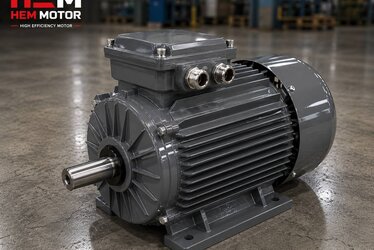

Prices and technical data are on the product pages; choose a model and order online.

Starting with a full vessel and mixing time

Mixers often start full. The granule tank is filled and then started, or material left from the previous batch has settled at the bottom of the tank. On the first turn the ribbons or screw have to break up settled material. For this reason the starting torque can be noticeably higher than the running torque.

  • If possible, start the mixer and then fill it; if a full start is unavoidable, choose the starting method accordingly.
  • With star-delta starting the torque in star is low; a full ribbon mixer may not turn in this position.
  • A frequency inverter is also used to adjust the mixing speed. Our three-phase series are suitable for speed control with a frequency inverter; for long periods of full-torque operation at low speed an external fan may be needed, and if the cable between drive and motor is long a dv/dt or sine filter is considered. These conditions are stated with the order.

With powder-additive mixes, the motor's fan inlet can become clogged with dust. IP55 protection guards against dust ingress, but a layer of dust on the frame reduces cooling; regular cleaning is important for motor life.

Example models

Models from the power range commonly seen on geared plastic mixers are listed below. All are 4-pole, IP55 protection and insulation class F.

  • 100L1-4: 2.2 kW, 1,450 rpm, aluminium frame, IEC 100L, 230/400 V (Δ/Y). For small vertical screw tanks.
  • 112M-4: 4 kW, 1,450 rpm, aluminium frame, IEC 112M, 400/690 V (Δ/Y), rated torque 26.3 Nm.
  • 132S-4: 5.5 kW, 1,460 rpm, cast iron frame, IEC 132S, 400/690 V (Δ/Y), rated torque 36 Nm. The power that fits the hypothetical ribbon mixer calculation above.

The current price is shown on each product page. For other applications in the plastics sector, see the plastic and rubber processing motors page.

Conclusion and what we need for a quotation

On a plastic raw material mixer, the right drive is built by knowing the mixer type, selecting the gearbox by output speed, torque and service factor, and sizing the motor for the torque with a full vessel. Please send us the following:

  • Mixer type, vessel volume and material processed
  • Gearbox nameplate (ratio, input flange) and shaft speed
  • Nameplate photo and mounting arrangement of the existing motor
  • Whether the mixer starts full or empty, and the starting method

You can see suitable models and current prices on the buy electric motors page. Send the nameplate photo, speed and mounting details of your existing motor through the nameplate submission page and request a quotation for a suitable model. For other questions you can reach us via our contact page.

Frequently Asked Questions

How is the gearbox ratio for a mixer calculated?

The rated speed of the motor is divided by the required speed of the mixer shaft. For example, with a 1,460 rpm motor and a 25 rpm shaft, the ratio is about 58; the nearest standard ratio is chosen from the gearbox catalogue.

Does fitting a more powerful motor protect the gearbox?

No. If motor power increases, the torque transmitted to the gearbox at the moment of a jam also increases. The gearbox output torque limit and service factor must be checked for the new power.

With which mounting arrangement is the motor ordered for a vertical screw mixer?

If the motor works on top of the tank, shaft down, the vertical mounting arrangement is stated in the order. Mounting arrangements are offered according to the frame and the flange size is confirmed with the order.

Is a standard motor suitable for a PVC hot mixer?

Two-speed motors or special drives are often used on these machines. Ask us with the nameplate and application details; it may fall outside the scope of the standard series.

HEM Motor Models Related to This Article

The cards show example models related to the topic. A suitable motor is not chosen by power alone: compare speed, voltage, mounting, shaft and connection dimensions on the product page; if unsure, send a photo of the existing motor’s nameplate on WhatsApp.

2.2 kW 1500 rpm Aluminium Frame Electric Motor 100L1-4

100L1-4

2.2 kW · 1500 rpm

  • Aluminium frame · IEC 100L
  • 1450 rpm · IP55
  • Mounting: B3 foot; flange (B5/B14/B35) depending on frame — confirmed with the order

US$178.61 (€159.40)

View product
4 kW 1500 rpm Aluminium Frame Electric Motor 112M-4

112M-4

4 kW · 1500 rpm

  • Aluminium frame · IEC 112M
  • 1450 rpm · IP55
  • Mounting: B3 foot; flange (B5/B14/B35) depending on frame — confirmed with the order

US$241.27 (€215.32)

View product
5.5 kW 1500 rpm Cast Iron Frame Electric Motor 132S-4

132S-4

5.5 kW · 1500 rpm

  • Cast iron frame · IEC 132S
  • 1460 rpm · IP55
  • Mounting: B3 foot; flange (B5/B14/B35) depending on frame — confirmed with the order

US$339.83 (€303.28)

View product

Similar Articles