English
 Français
 Türkçe
 Español
 Русский

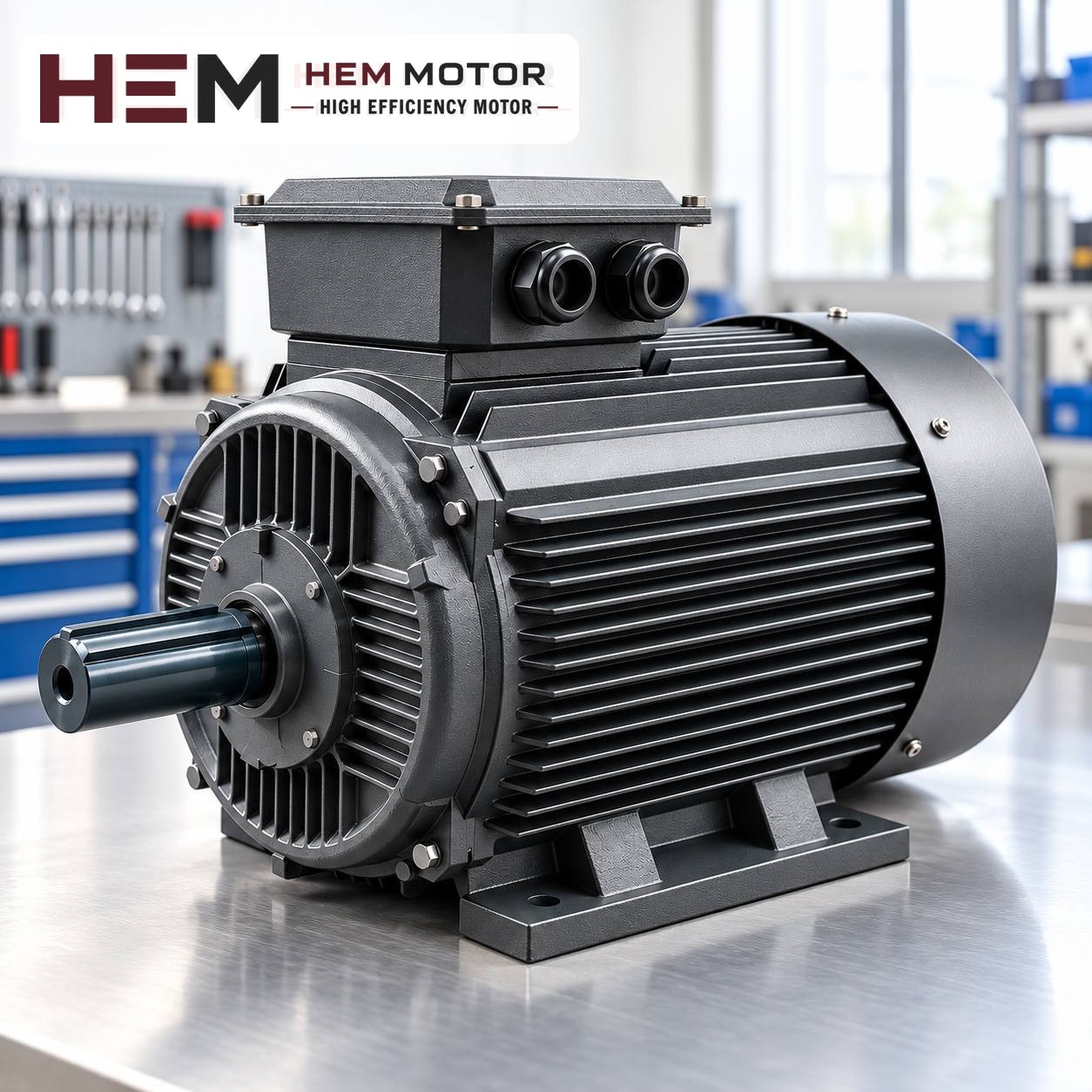

When a packaging conveyor stops and starts dozens or even hundreds of times an hour, the deciding factor in motor selection is not the nameplate power but the heat that builds up inside the motor at every start. The right approach is to assess the number of cycles, the inertia of the conveyor and the stopping method together, and in frequent cycling either to run the motor with ramps on a frequency inverter instead of switching it directly on and off the mains, or to keep the motor running and leave the stopping to the mechanical side. Below we explain step by step which information this decision is based on.
Why does stop-start operation strain a motor more than continuous running?
While accelerating from standstill, an induction motor draws several times its rated current from the mains. Although this period is short, the winding and especially the rotor bars heat up quickly during it. A continuously running motor goes through this peak once a day; a packaging conveyor that stops frequently goes through it again for every product or every tray.
The energy released in the rotor during starting is directly related to the kinetic energy of the mass being accelerated. This means that not only the load on the belt but also the drums, the gearbox gears, the coupling and the motor's own rotor enter the calculation. As the intervals between starts get shorter, the motor cannot cool down before the next start and the winding temperature rises step by step. Thermal protection does not always catch this build-up in time; for the protection side of the subject see our article on thermal relay and fuse selection.
Clarify the number of cycles and the duty type
Values in motor catalogues are generally given for continuous duty (S1). Applications that start more than a certain number of times per hour fall under the intermittent periodic duty types in IEC 60034-1 (S4 with starting, S5 with electric braking). For these duty types, the motor is selected together with the number of starts per hour, the operating ratio in each cycle and the inertia of the load. Do not invent a single figure such as "this many starts per hour are allowed" for any motor; the figure changes with load and inertia.
- Starts per hour: Does the conveyor stop for every product or at certain intervals? Count at the machine's actual operating speed.
- Operating ratio: The time the motor runs versus the time it stands still in one cycle. Long stops allow cooling, short stops do not.
- Load at start: Does the belt start loaded? A loaded belt and heavy trays lengthen the starting time.
- Stopping method: Coasting, mechanical brake, DC braking or inverter ramp. Electrical braking also generates extra heat in the motor.
Four different solutions for frequent cycling
Upsizing the motor for the same conveyor is the first idea that comes to mind, but on its own it is often not enough. We compare the options in the table below.
| Method | Starting current | Starting heat in the rotor | Point to watch |
|---|---|---|---|
| Direct-on-line starting (contactor) | High peak | Full at every start | Simple and sufficient for infrequent cycles; in frequent cycling winding heat builds up |
| Soft starter | Peak is reduced | Not reduced, may increase if the start is longer | Reduces mechanical shock, does not solve the frequent-cycling problem on its own |
| Frequency inverter (ramp) | Can be kept around rated current | Clearly reduced | Ramps are set to suit the conveyor; check cooling during long operation at low speed |
| Continuously running motor + clutch-brake unit | Only at the first start of the day | Not generated in the motor per cycle | Heat is generated in the clutch-brake unit; maintenance is done on the machine side |
Moving up one power rating increases thermal capacity, but the inertia of the larger rotor also grows. On a conveyor dominated by inertia, this gain may be smaller than expected; make the upsizing decision together with the cycle data.
What you need to know when running on a frequency inverter
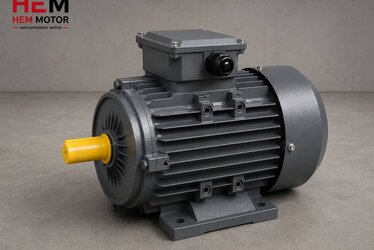
The most common solution on packaging lines is the inverter: the conveyor starts smoothly, the product does not tip over and the starting current does not strain the supply. HEM Motor's three-phase series are suitable for speed control with a frequency inverter; for long periods at low speed with full torque an external fan may be required, and if the cable between the inverter and the motor is long, a dv/dt or sine filter is considered. You need to state these conditions with the order. Details are summarised in the question on inverter operation.
When braking with the inverter, the kinetic energy of the conveyor flows back into the inverter. If cycling is frequent, a braking resistor or an energy regeneration feature on the inverter may be required; this choice is made on the inverter side. If the conveyor must be held in position, the inverter alone is not enough; a brake motor or a holding brake on the gearbox side is needed.
If precise positioning is required
On conveyors that require millimetre-accurate stopping, such as labelling or alignment with a filling nozzle, servo motors or special solutions with encoder feedback are used. This task requires a special motor; it may fall outside the scope of the standard series in HEM Motor's 2026 catalogue. A brake motor is not considered the same as a standard motor either. Send us your application details and we will assess them together.