English
 Français
 Türkçe
 Español
 Русский
 العربية
 Deutsch
 Italiano

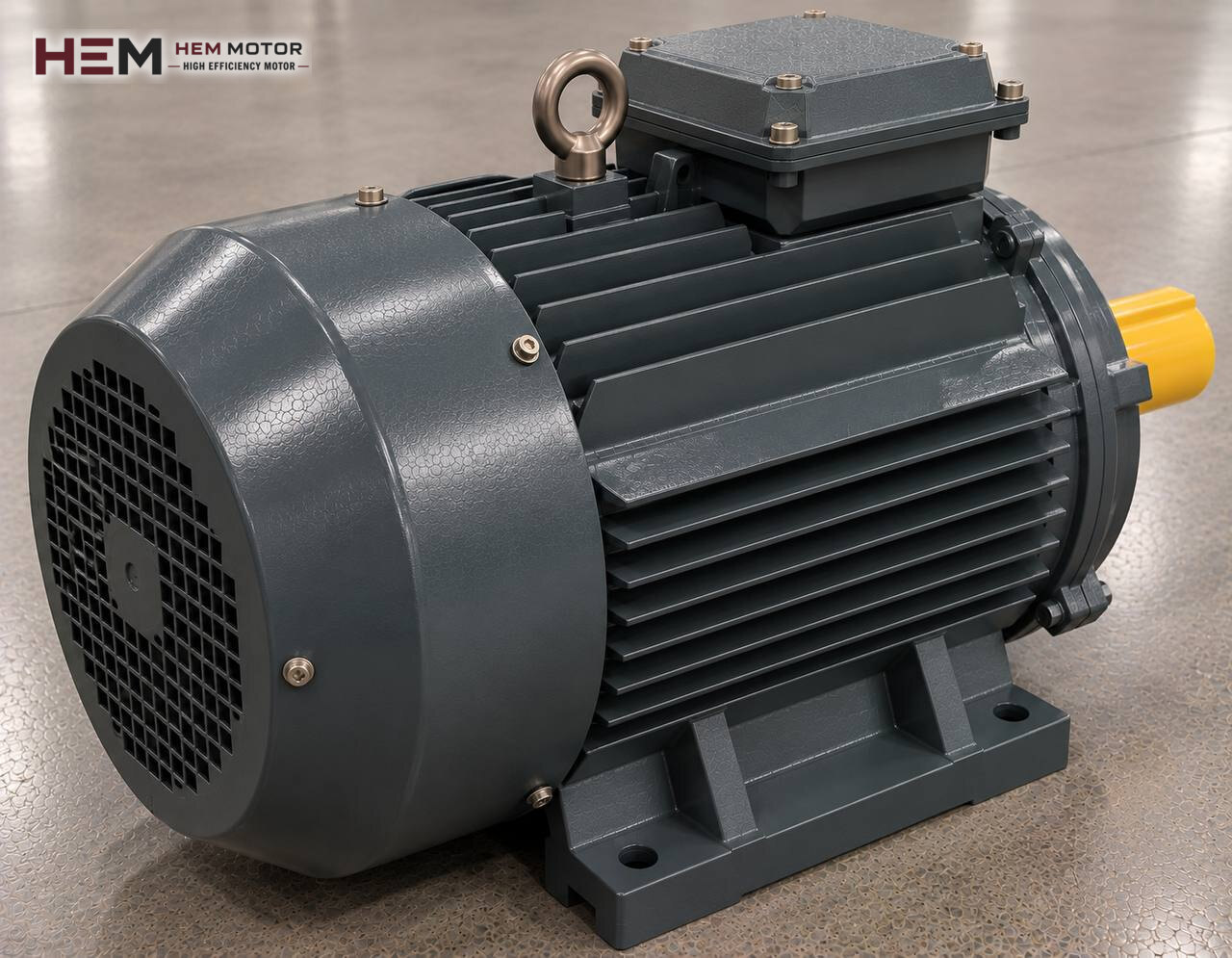

The quickest way to cut the energy cost of electric motors in metalworking shops is to find the motors that turn without doing any work and switch them off: a press brake hydraulic unit holding pressure while idle, a compressor feeding a leaky network and machine tool motors that keep running while a part is clamped are the silent items on the bill. The next steps are to match oversized motors to their load, renew worn belts and bearings, and raise the efficiency class on drives that run long hours. Below we go through these points machine by machine across the shop, measuring as we go and in order.
Which machines draw the electricity in a machining shop?
A typical shop has lathes and milling machines, CNC machining centres, a band saw, a pillar drill, grinding machines, a press brake, a guillotine shear and welding machines. Behind them run the auxiliaries that are often overlooked: a screw or piston compressor, coolant pumps, extraction fans for welding fume and grinding dust, shop ventilation and an overhead crane. The largest share of the bill usually goes not to the machine tools but to these auxiliary motors that run without a break all day.
| Machine | Operating pattern | Typical source of energy loss | First thing to do |
|---|---|---|---|
| Compressor | On throughout the shift | Air leaks, long idle running, high pressure setting | Leak survey, lowering pressure to what is needed |
| Press brake and hydraulic press | Waiting between bends | Pump holding pressure while idle | Stopping the pump during waits or speed control |
| Lathe, milling machine | Short cuts, long clamping | Main motor turning while the part is clamped | Operator habits, automatic stop |
| Extraction fans | Continuous | Throttling with a damper, clogged filter | Filter maintenance, speed control |
| Band saw, drill | Intermittent | Belt slip, blunt saw blade | Belt and cutting tool maintenance |
A situation peculiar to workshops is this: one panel supplies many small machine tools, and most of them run at low load.
This makes the motors run in their inefficient range and also increases reactive energy.
How do you catch the energy wasted in the compressor room?
In the shop, compressed air is used for pneumatic wrenches, blow guns, press brake clamps and spray guns. Small leaks at hose fittings, quick couplings and air treatment units put the compressor back on load even when nobody is using air. If the compressor cuts in by itself at the weekend or during breaks, there is a leak in the network.
The second item is the pressure setting. A working pressure set higher than the machines really need makes the motor draw more power every hour. Rather than setting the compressor for the single tool that needs the highest pressure, it is often more sensible to give that tool its own regulator. In a shop without a night shift, switching the compressor off at the end of work is a measure that costs nothing.
For driving a medium-sized screw compressor, the 15 kW cast-iron-frame 160L-4 can be considered; its rated speed is 1465 rpm and its voltage is 400/690 V.
Options for compressor drives are on the compressor electric motors page.
Why does a press brake's hydraulic unit burn electricity between bends?
At a press brake, the operator positions the sheet, checks the dimension and presses the pedal; the actual bend takes a few seconds. On older units the pump motor keeps turning during this wait, pushing oil back to the tank through the relief valve. The oil heats up, the cooler switches on and the motor consumes electricity without doing any work.
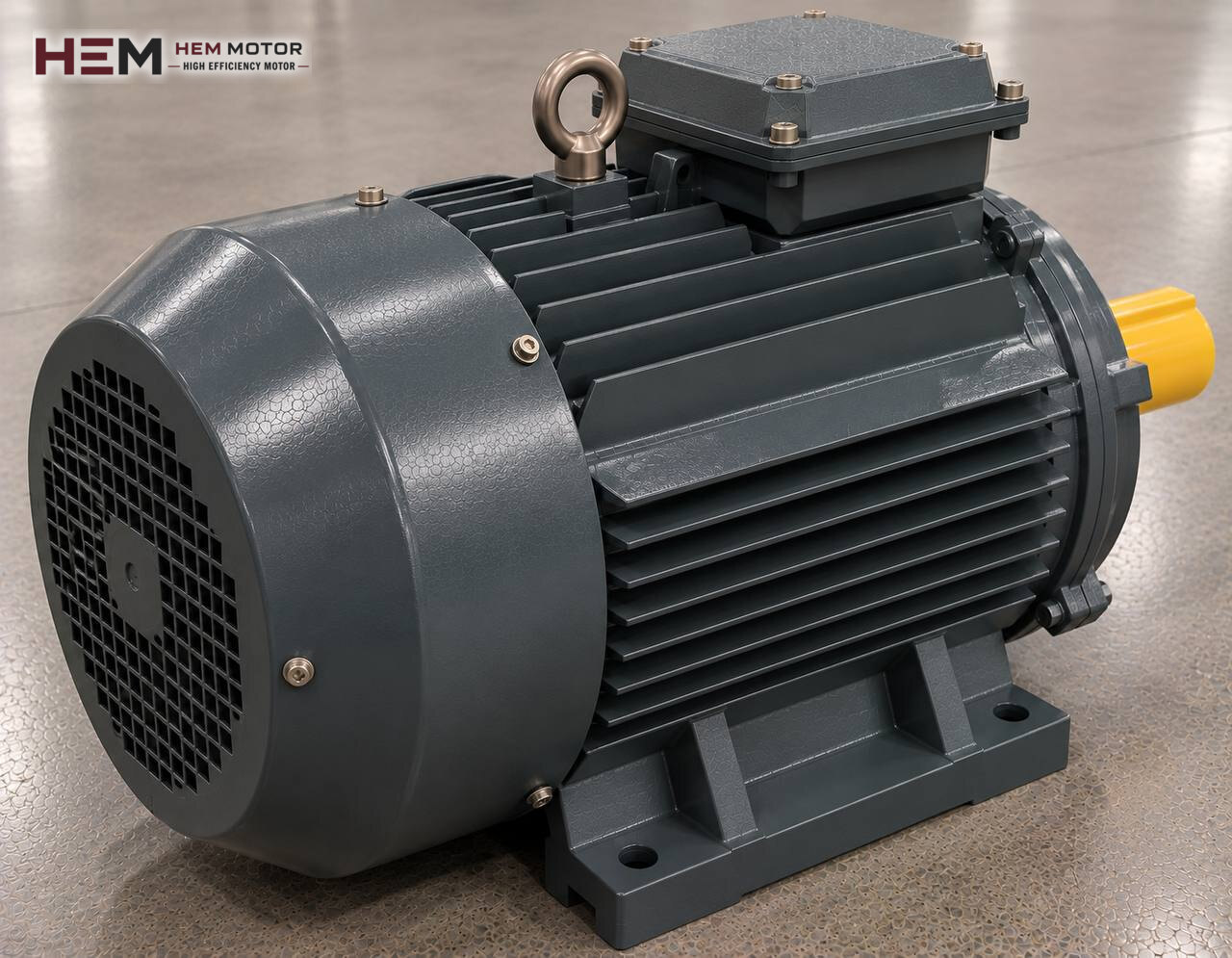
A hypothetical example: if a 7.5 kW unit idles for six hours per shift and draws roughly one third of its rated power meanwhile, around 15 kWh a day goes into waiting alone (example calculation; the real value is found by measurement). A timer that stops the pump automatically during waits, or reducing speed with a frequency converter, shrinks this loss. For such a unit the 7.5 kW cast-iron-frame 132M-4 can be considered; it runs at a rated 1460 rpm and is connected for 400/690 V.
Other models for pump drives are on the hydraulic pump electric motors page.
HEM Motor's three-phase ranges are suitable for speed adjustment with a frequency converter. If the motor will run at low speed with full torque for long periods, the impeller on the shaft may be insufficient and a separately supplied fan may be needed; if the drive is in the panel, the motor is at the foot of the machine and the cable is long, a dv/dt or sine filter is considered. Please tell us about these conditions in your order.
Why does the large motor on a machine tool cost more at low load?
In workshops, motors are often chosen one size larger "just in case". The efficiency and power factor of an induction motor fall when it runs well below rated load (general information; confirm with the motor data). A large motor running at half load costs extra in both active and reactive energy; if the reactive energy limit is exceeded, a penalty charge arises as well.
The way to find out is to measure. With a clamp meter, the current the machine draws on a typical job is measured and compared with the rated current on the motor nameplate. If the measured value is consistently far below the nameplate current, a size smaller can be considered when replacement comes up; but starting torque and the heaviest job must always be taken into account. Whether the steps of the power factor correction panel are working is also tracked from the reactive line on the monthly bill.
For small machine tools, band saws and pillar drills, the 2.2 kW aluminium-frame 100L1-4 is a frequently used size; its rated speed is 1450 rpm and its connection 230/400 V. Multi-purpose models suited to various machine tools are on the general-purpose industrial electric motors page, and the full range of power and speed options is listed in our electric motor shop.