Coffee grinders choose their electric motor by the shaft power that the hourly grinding output requires, by the speed of the burr or roller and by the duty pattern; heating comes from two separate sources, friction in the grinding zone and the motor's own losses. A selection made without separating the two either spoils the aroma or trips the relay often.
How is grinding capacity converted into motor power?
The required shaft power is the hourly output multiplied by the specific energy spent per unit of product. The formula looks simple:
Pshaft ≈ Q × esp / ηdrive
Here Q is coffee ground per hour (tonnes/hour), esp the energy specific to that bean and fineness (kWh/tonne), ηdrive the efficiency of the belt or coupling. The hard part is finding esp. Going down to Turkish coffee fineness eats far more kWh than leaving it at filter coffee coarseness; dark roasted beans break more easily than light roasted ones.
Do not guess this value.
The most reliable source is a measurement on the existing motor of the same grinder. Active power is read with a power analyser with the grinder empty and then fully fed; the difference gives the power going into grinding. If the quantity ground over the same period is weighed, specific energy is calculated directly.
Hypothetical example: if a grinder drawing 0.6 kW empty and 2.4 kW at full feed grinds 0.05 tonnes of coffee per hour, the grinding power is about 1.8 kW and specific energy 36 kWh/tonne. If twice the capacity is wanted from the same grinder, grinding power also roughly doubles as long as fineness is unchanged, and the motor moves up one step. Current and torque values of the steps can be seen side by side on the electric motor sales page.
Why does speed depend on the grinder type and not only on the motor?
In a burr grinder the disc speed directly affects particle size and heating; in a roller mill the speed difference between the two rollers sets the cutting effect. The motor's synchronous speed is matched to this need by a pulley, gearbox or direct coupling.
In commercial and industrial burr grinders a high disc speed raises capacity but also increases frictional heat. For this reason some manufacturers prefer to reach the same capacity with a lower disc speed and a larger disc diameter (general information; confirm with the machine manufacturer).
On site, speed changes are usually made with the pulley. The roughly 1450 rpm of a 4-pole motor is brought down or up to the disc speed the machine maker asks for by the pulley diameter ratio. When the pulley ratio changes, the torque seen by the motor changes in inverse proportion; lowering speed raises torque.
Where does heat in the grinder come from and how is it told apart?
Heating of ground coffee mostly comes from friction in the grinding zone; motor heat is passed to the grinder through the frame and along the shaft. To separate the two sources, temperature is read at three points. No more is needed.
The middle of the motor frame with an infrared thermometer, on the side opposite the fan cover.
The outer surface of the grinding chamber, level with the disc or roller.
The temperature of ground coffee taken from the outlet, with a contact probe thermometer.
If the chamber and coffee are hot and the motor frame is lukewarm, the heat comes from grinding: the disc may be worn, the setting too fine or the speed too high. If the motor frame is clearly hot and the chamber relatively cool, the motor is either overloaded or its cooling is blocked. On machines where the motor is flanged directly to the chamber the two heats mix; there, an insulating spacer between motor frame and flange or a switch to belt drive is considered as an option.
On a grinder placed right next to the roasting unit, ambient temperature must also be taken into account; the motor's plate power is usually for a 40 °C ambient.
Prices and technical data are on the product pages; choose a model and order online.
How do duty pattern and starting stress the motor?
Coffee grinders work in two different patterns: continuous grinding feeding a packing line, or batch work with frequent stop-start in a shop or roasting workshop. The second is harder on the winding: at every start current jumps to several times the plate value and that heat does not dissipate before the next stop.
A grinder stopped with a full hopper meets beans jammed between the discs at the next start. If starting torque is insufficient, the motor hums, the thermal relay trips or the belt slips. The practical fix is to cut the feed before stopping and let the grinder empty for a few seconds; on automatic lines this sequence is written into the control program.
A stone or metal piece arriving with the beans creates a sudden jam. If no magnet and stone separator is fitted at the start of the line, motor protection must open the circuit at this shock; a thermal relay alone may not react that fast, so the setting of the motor protection switch is also checked from this angle.
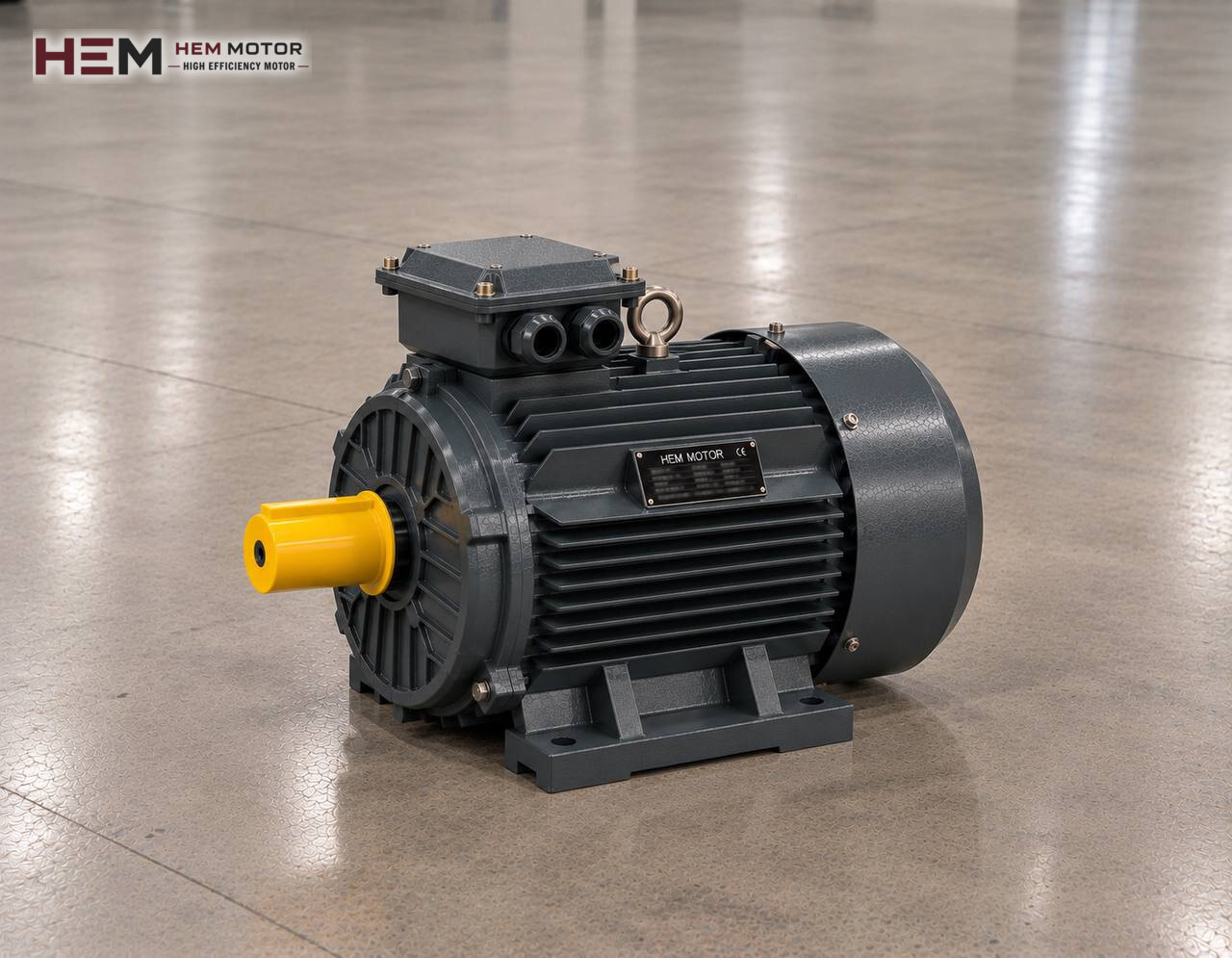
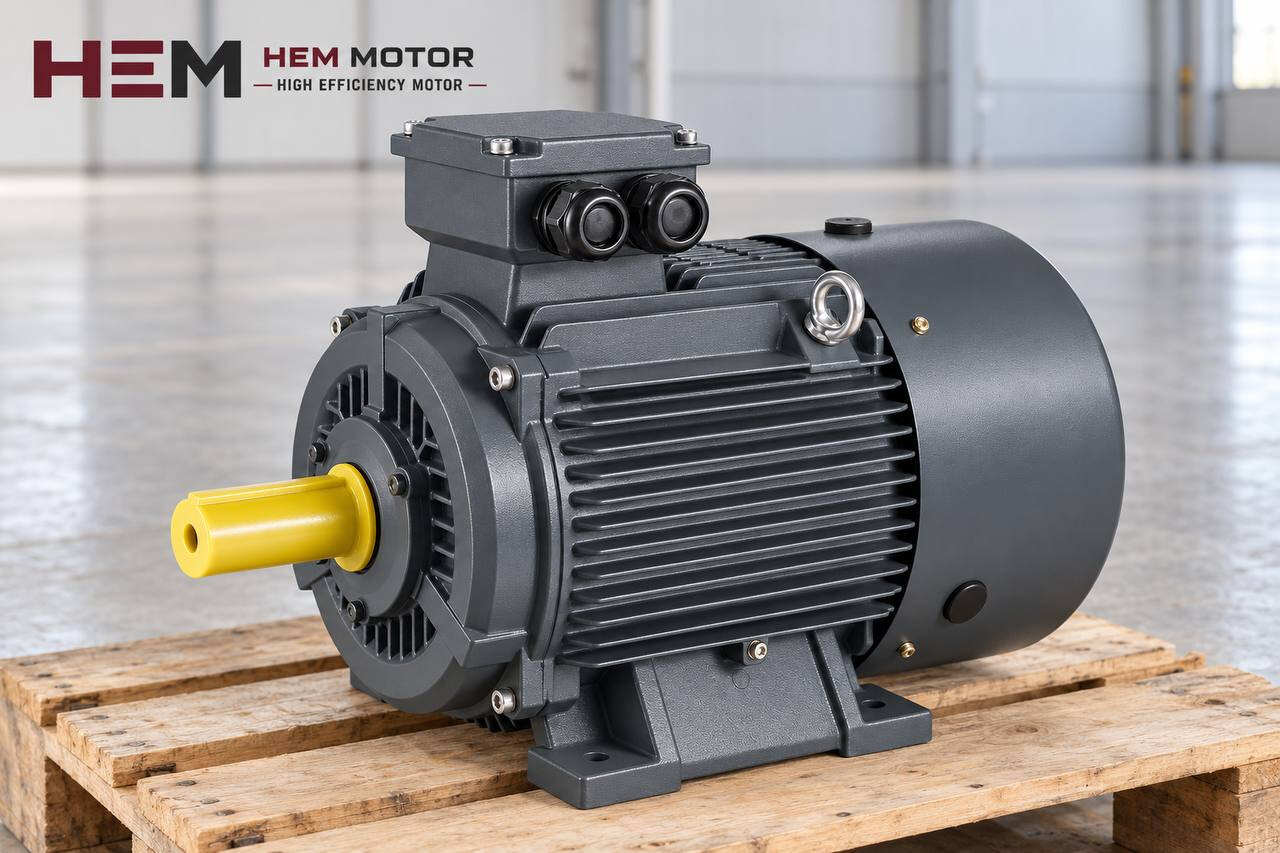
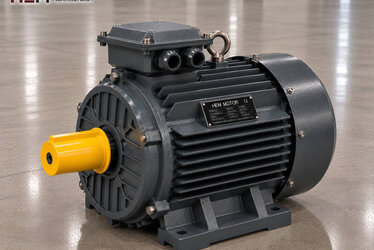
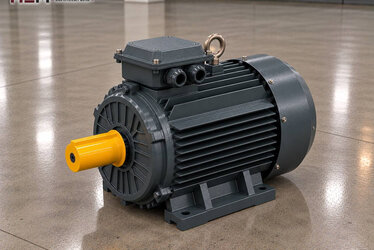
On small and medium capacity grinders, aluminium frame motors are used with belt or flange drives (representative image).
What information should be gathered when choosing a grinder motor?
The choice combines the machine manufacturer's values with site measurement. The table below summarises the information to gather before asking for a quote and why each item is needed.
Information
Where it comes from
Why it is needed
Hourly capacity and grinding fineness
Production plan
Specific energy and shaft power calculation
Disc or roller speed
Machine manufacturer's documents
Speed step and pulley diameters
Drive type: belt, coupling, flange
Inspection on the machine
Mounting type and heat transfer
Daily running time and number of starts
Shift pattern
Thermal load and protection setting
Ambient temperature and coffee dust
Measurement where the grinder stands
Cooling and fan cover cleaning
Plate of the existing motor
Plate photo
Frame and connection compatibility
Coffee dust is fine and oily; it sticks to the fan grille and between the fins and blocks the airflow. An IP55 frame protects the inside; cleaning the outside is still the maintenance team's job, and weekly compressed-air cleaning should be written into the maintenance plan.
If the drive is in direct contact with food or sits in a washdown zone, a special motor is needed for this duty; it may fall outside the standard series in HEM Motor's 2026 catalogue, so ask us with the plate and application details.
Which models fit this calculation?
The current capacity of the grinder in the hypothetical example corresponded to a draw of about 2.4 kW; if capacity is doubled, grinding power rises and approaches the 4 kW band. Four-pole aluminium frame steps that can be used with belt drive in this range:
100L2-4: 3 kW, 1450 rpm, 230/400 V (Δ/Y), 6.02 A at 400 V, 19.8 Nm.
112M-4: 4 kW, 1450 rpm, 400/690 V (Δ/Y), 7.95 A at 400 V, 26.3 Nm.
132S-4: 5.5 kW, 1460 rpm, 400/690 V (Δ/Y), 10.7 A at 400 V, 36 Nm. The step that leaves a margin on lines with frequent stop-start and starts with a full hopper.
All three have IP55 protection and class F insulation; IE3, IE4 and IE5 efficiency classes are offered, and which class is available for a given model is confirmed with the order. B3, B5, B14, B34, B35 and vertical V1/V3/V5/V6/V15 are offered depending on frame; flange size is confirmed with the order. Shaft and flange dimensions are on the technical drawings page. The full list of ratings and frames is in the electric motor store, and the industrial family's features are described on the industrial motors page.
Send the grinder type, disc or roller speed, the power values you measured empty and fully loaded and a photo of the motor plate on the grinder through the find an equivalent from the nameplate page; we will calculate together which step the capacity increase corresponds to. Prices can be seen in the HEM Motor sales list.
Frequently Asked Questions
Can a 3000 rpm motor be preferred for a coffee grinder?
It can if a high disc speed is wanted and the machine manufacturer approves. But high speed increases frictional heat; on most industrial grinders a 1500 rpm motor with a pulley arrangement is used.
If ground coffee comes out hot, should the motor be replaced?
First the source of the heat must be separated. If the chamber is hot and the motor lukewarm, the problem is disc wear, setting or speed; replacing the motor will not solve it.
Which protection is preferred on a grinder with frequent stop-start?
A motor protection switch that tolerates starting current and, if needed, a PTC sensor embedded in the winding. The PTC is an order option and monitors heat build-up directly in the winding.
Is belt drive or direct coupling more suitable?
A belt allows speed adjustment and keeps motor heat away from the grinder. A coupling needs less maintenance but brings motor and grinder thermally closer together.
HEM Motor Models Related to This Article
The cards show example models related to the topic. A suitable motor is not chosen by power alone: compare speed, voltage, mounting, shaft and connection dimensions on the product page; if unsure, send a photo of the existing motor’s nameplate on WhatsApp.
When choosing an electric motor for a feed dosing screw, the real goal is for every turn of the screw to carry the same amount at low flow; to achieve this, before moving on to mot... More Details
When choosing electric motors for a corrugated board line, two groups are thought about separately: the main drives that carry line speed and the many auxiliary drives around them.... More Details
In a rubber compound mixer the electric motor carries two loads at once: the continuous torque from the high viscosity of the compound and the impact peaks that occur every batch a... More Details
On a scrap metal separation belt the electric motor is chosen by the shaft power the belt load requires and by the type of magnet unit; a magnetic head pulley adds load to the belt... More Details
An electric motor for a PET bottle crusher works, in wet crushing, against a steadier load that the water cools and lubricates, and in dry crushing against a harsher, impact-heavy ... More Details
On a cable granulator the motor carries two separate loads: the continuous cutting load as the knives on the cutting rotor chop the cable, and the sudden impacts caused by cable bu... More Details
We use necessary and optional cookies to improve your experience, enhance content and analyse traffic. Under the GDPR, optional (analytics/marketing) cookies are only used with your explicit consent. Please choose your preference below.
Cookie Policy
 English
 Français
 Türkçe
 Español
 Русский
 العربية
 Deutsch
 Italiano