English
 Français
 Türkçe
 Español
 Русский

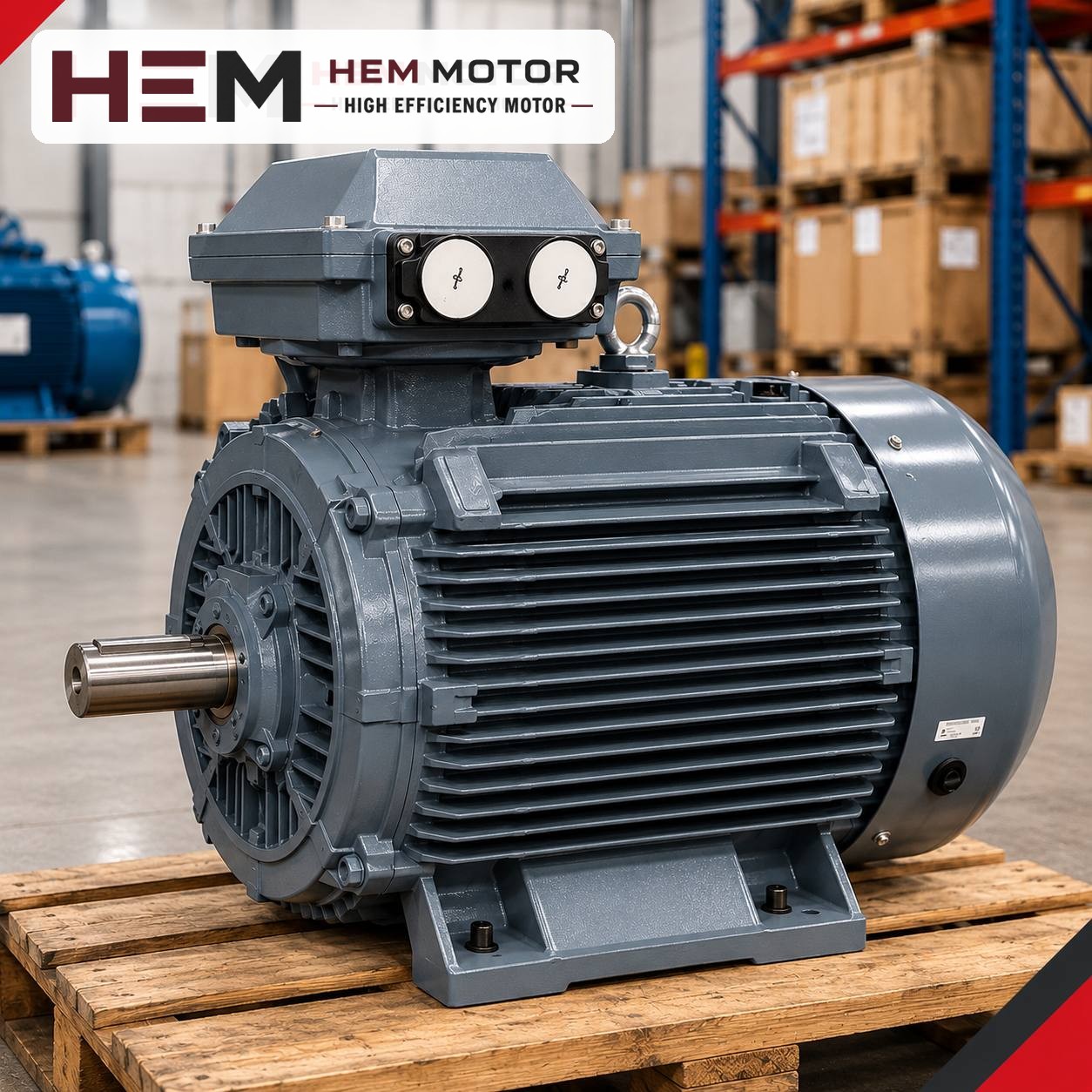

Before choosing the motor for a crate conveyor, two things need to be clear: how many crates must pass per hour, and whether stopping of the line is to be handled by the motor or by the accumulation arrangement. Line speed is calculated from capacity using crate length and the gap between crates. Frequent stop-start, on the other hand, is usually solved not by enlarging the motor but by dividing the line into zones, or by keeping the motor running and accumulating crates by friction.

From capacity to line speed
On a crate line the target is the number of crates passing per unit of time. Line speed is derived from this number: required speed ≈ crates per hour × (crate length + gap between crates) ÷ 60. The result is in m/min. The gap depends on the line design; if crates travel nose to tail the gap approaches zero, and if they are separated by sensors a certain distance is added.
The values below are hypothetical. On a line that must pass 1,200 crates per hour, let the crate length be 0.6 m and the gap 0.15 m. The required speed is 1,200 × 0.75 ÷ 60 = 15 m/min. This is the lower limit of the design speed; since the line will not run without ever stopping, a margin above this is usually left. However, raising the speed more than necessary increases crate tipping, impacts at transfer points and slipping at start-up.
| Section of the crate line | Speed relationship |
|---|---|
| Infeed and transport section | Basic speed calculated from capacity |
| Separation (gapping) section | Slightly faster than the previous section; the speed difference opens gaps between crates |
| Merge and transfer point | The speeds of the two lines are kept close to each other to prevent crate collisions |
| Accumulation section | Holds crates when the downstream machine stops; motor speed may not change |
Who handles stop-start: the motor or accumulation?
On crate lines, most stops come from the machine at the end of the line (washing, filling, stacking, palletising). When that machine stops, crates accumulate. There are three basic ways to handle this, and each puts a different load on the motor.
1. Stopping and restarting the whole line with one motor
This is the simplest arrangement. But the whole line starts loaded every time; the motor accelerates the inertia of all the crates and the chain together. As the number of stops increases, the heat of the starts accumulates and the thermal protection begins to trip. On a long line this arrangement stresses both the motor and the chain.
2. Dividing the line into zones
The line is divided into short sections, each with its own motor. Sensors stop only a section whose front is full. Each motor accelerates a smaller mass and stops only when needed. Heat per start falls; and in the event of a fault, only one section is affected rather than the whole line.
3. Keeping the motor running and accumulating by slip
On plastic slat chain or roller lines, when the front of the crate is blocked the chain keeps sliding underneath and the crates wait by friction. The motor does not stop and no start-up heat is generated. However, the sliding friction is reflected on the motor as load; as the number of accumulated crates increases, so does the current drawn by the motor. In this arrangement the power calculation must be based on the maximum number of crates in the accumulation section.
Which arrangement is chosen is the line designer's decision. Stating this arrangement and the number of stops per hour in the motor order ensures that the right power and starting method are selected.
Practical checklist for the motor under frequent starts
- Count the starts per hour: Count them at the line's actual operating speed, during a busy shift. Estimated values usually come out too low.
- Determine the load at start-up: Does the section start full or half full? Wet crates and full bottle crates are heavy.
- Look at the starting method: Direct-on-line starting with a contactor draws full current at every start. A frequency inverter gives a soft start with a ramp and also reduces crate tipping.
- Check the motor frame: If the frame gets hotter than normal at the end of the shift or the thermal relay trips, the problem may be related to the number of starts; mechanical resistance (a jammed roller, an overtight chain) is eliminated first.
Operation with a frequency inverter is common on crate lines. Our three-phase series are suitable for speed control with a frequency inverter; for long periods of full-torque operation at low speed an external fan may be required, and if the cable between drive and motor is long a dv/dt or sine filter is considered; these conditions are stated with the order. Details are in the question on inverter use. If the crate must stop at a precise point, a special braked or positioning solution is needed; this is not the same as a standard motor.