Reducer and Speed Matching When Replacing a Belt Conveyor Electric Motor

Reducer and Speed Matching When Replacing a Belt Conveyor Electric Motor

On a belt conveyor the motor does not drive the belt directly but through a gear reducer. So when a conveyor motor is replaced, the real question is not "how many kW" but "will the new motor, together with the reducer, turn the belt at the same speed and with the same pull?" The motor's rated speed, the reducer ratio and the drum diameter together determine the belt speed; the way the motor is connected to the reducer determines how many hours the replacement will take. In this article we explain how to check these three links in turn and where a standard three-phase motor is sufficient on a conveyor and where it falls short.
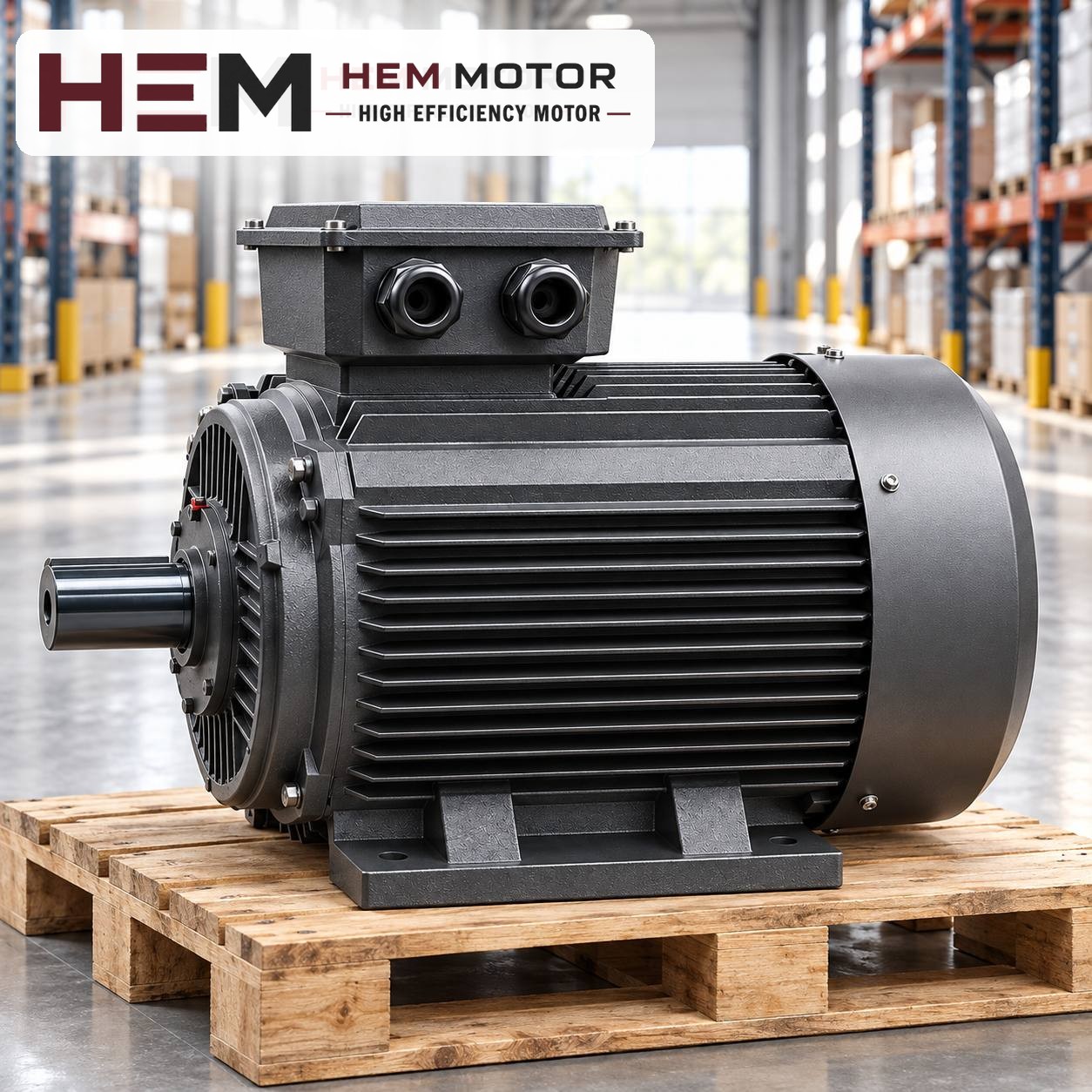
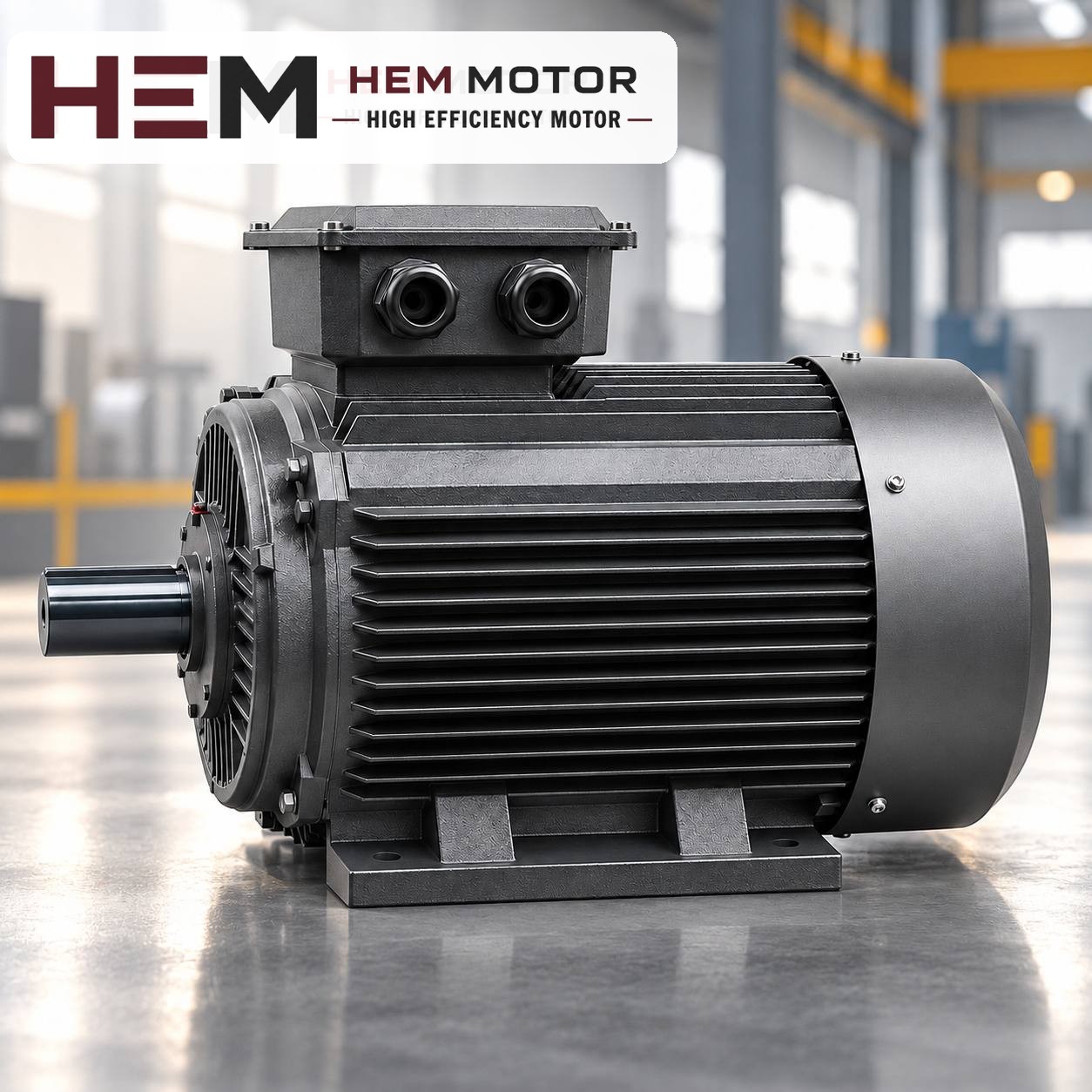
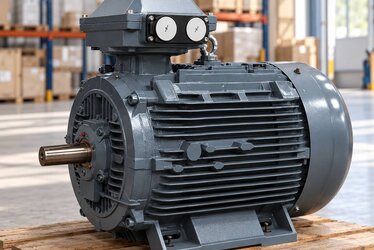
Three-phase electric motor on a pallet
When choosing a conveyor motor, the reducer ratio and motor speed are assessed together (representative image).

Where does belt speed come from?

Belt speed is the result of three values: the motor's rated speed, the reducer's gear ratio and the diameter of the drive drum. The drum speed is found by dividing the motor speed by the reducer ratio; multiplying the drum speed by the drum circumference gives the distance the belt travels per minute. In this chain, the motor is the first link that sets the speed.

The calculation below uses hypothetical values and is only meant to show the method:

  • Let the motor's rated speed be 1,450 rpm and the reducer ratio 30:1. The drum speed is then about 48.3 rpm.
  • If the drum diameter is 0.4 m, its circumference is about 1.26 m. The belt speed is 48.3 × 1.26 ≈ 61 m/min, i.e. a little over one metre per second.
  • If a 4-pole motor with a rated speed of 1,460 rpm is fitted to the same reducer, the drum speed becomes 48.7 rpm; the difference is practically unnoticeable.
  • If a 6-pole motor with a rated speed of 955 rpm is fitted to the same reducer, the drum speed drops to about 31.8 rpm and the belt slows down by a third.

The conclusion is simple: if the number of poles stays the same, the small differences between the rated speeds of different manufacturers do not change belt speed noticeably. If the number of poles changes, the reducer ratio must also be recalculated.

Torque at the reducer output and motor power

While a reducer lowers speed, it increases torque by roughly its ratio; gear losses take away part of this increase. So even if the motor's rated torque looks small, the torque pulling the belt at the reducer output is much larger. You can see the motor's rated torque in the torque table or on the product page.

The power a conveyor needs depends on the quantity of material carried, belt length, incline, idler friction and belt speed. That is why there is no rule of thumb such as "this many kW for a conveyor of this length". When replacing a motor, the most reliable starting point is the power and speed on the old motor's nameplate. If the old motor ran without problems, it makes sense to continue with the same power and the same number of poles. If the old motor was constantly overheating, tripping its thermal relay or unable to start with a loaded belt, the cause of the extra load should be investigated before moving to a larger motor: seized idlers, a belt that has lost its tension, added capacity or a change of incline.

Starting with a loaded belt

A conveyor often stays loaded with material when the line stops and starts again full. At start-up the motor must accelerate the inertia of the belt, the material and the drums, and also overcome friction. On long, inclined or heavily loaded belts this starting load can be noticeably higher than the continuous running load.

  • Direct-on-line starting: The motor delivers its full starting torque, but the belt and reducer see a sudden shock; belts and connecting elements are strained.
  • Star-delta: Reduces the starting current, but also lowers the starting torque to about a third. On a loaded, inclined belt the motor may not reach sufficient speed in star.
  • Frequency inverter: Provides a smooth, controlled start and also allows the belt speed to be adjusted. Our three-phase series are suitable for speed control with a frequency inverter; for long periods at low speed with full torque an external fan may be needed, and if the cable between drive and motor is long a dv/dt or sine filter is considered; these conditions are stated with the order.

If the old motor started with a particular method without problems, keeping the same method is the least risky route. If you want to change the starting method, state this with the order.

Prices and technical data are on the product pages; choose a model and order online.

How is the motor connected to the reducer?

Whether a replacement is easy or laborious depends largely on the type of connection. Three arrangements are common on conveyors:

  • Motor flange seated directly on the reducer input: The motor shaft enters the reducer's input bore, and the motor is bolted to the reducer by its B5 or B14 flange. Here the IEC frame size, flange size, shaft diameter and shaft length must match exactly.
  • Coupled connection: The motor is fixed by its feet (B3) to a base frame and joined to the reducer input shaft through a coupling. Shaft height and foot hole spacing are decisive; alignment is set on site.
  • Belt and pulley connection: The motor is mounted on a tensioning rail and drives the reducer input by belt. The pulley ratio has a direct effect on belt speed; the pulley diameters must be kept when replacing the motor.

With a flange connection, do not rely only on the words "B5" or "B14"; even on the same frame, the flange size can differ. At HEM Motor, B3, B5, B14, B34, B35 and vertical arrangements are offered according to the frame; the flange size is confirmed with the order. Compare the reducer's input flange dimensions with the 2D technical drawings. General information on geared drives is on the electric motors for reducers page.

Example models

The models below were chosen from the power range common in conveyor drives. All have IP55 protection, class F insulation and a 50 Hz supply. The 6-pole model in the table has been added to illustrate arrangements where a low speed is wanted and the reducer ratio has been chosen accordingly.

ModelPower / polesRated speedIEC frameVoltageRated torque
100L1-4 aluminium2.2 kW / 4-pole1,450 rpm100L230/400 V (Δ/Y)14.5 Nm
112M-6 cast iron2.2 kW / 6-pole955 rpm112M230/400 V (Δ/Y)22 Nm
112M-4 cast iron4 kW / 4-pole1,450 rpm112M400/690 V (Δ/Y)26.3 Nm
160M-4 cast iron11 kW / 4-pole1,465 rpm160M400/690 V (Δ/Y)71.7 Nm

The table also shows the effect of the number of poles at the same 2.2 kW power: the 6-pole model turns at a lower speed and delivers a higher rated torque, but its frame is 112M; fitted in place of the 4-pole 100L1-4, both the belt speed and the connection dimensions change. Other options for conveyor applications are on the conveyor belt electric motors page.

Limits of the standard motor

A standard three-phase asynchronous motor is sufficient for most conveyor drives. Some situations, however, fall outside the scope of the standard motor and require a special motor:

  • If an integrated brake is needed to prevent an inclined belt from running back when it stops, a brake motor is a special product; it is not equivalent to a standard motor. In this case, ask us with the nameplate and technical details.
  • If a single-speed standard motor is fitted in place of a two-speed motor on a conveyor, one speed step is lost.
  • Motors integrated with the reducer, or with special shafts or special flanges, may not be directly interchangeable with a standard IEC motor.
  • If the belt stops and starts frequently or runs at very low speed for long periods, the motor's cooling must be assessed separately.

Information to send with your order

  • A photo of the old motor's nameplate (power, speed, voltage, frame size)
  • Reducer type and ratio, and if possible a photo of the reducer nameplate
  • Type of connection: direct flange, coupling or belt; mounting arrangement (B3, B5, B14, B35)
  • Starting method and whether the belt starts loaded
  • Ambient conditions: dust, humidity, outdoor installation

You can review suitable models and current prices on our store page. To ask about the right model using your motor's nameplate details, send us a photo of the nameplate; for questions about the reducer connection, reach us through our contact page.

HEM Motor Models Related to This Article

The cards show example models related to the topic. A suitable motor is not chosen by power alone: compare speed, voltage, mounting, shaft and connection dimensions on the product page; if unsure, send a photo of the existing motor’s nameplate on WhatsApp.

2.2 kW 1500 rpm Aluminium Frame Electric Motor 100L1-4

100L1-4

2.2 kW · 1500 rpm

  • Aluminium frame · IEC 100L
  • 1450 rpm · IP55
  • Mounting: B3 foot; flange (B5/B14/B35) depending on frame — confirmed with the order

US$178.61 (€159.40)

View product
2.2 kW 1000 rpm Cast Iron Frame Electric Motor 112M-6

112M-6

2.2 kW · 1000 rpm

  • Cast iron frame · IEC 112M
  • 955 rpm · IP55
  • Mounting: B3 foot; flange (B5/B14/B35) depending on frame — confirmed with the order

US$235.79 (€210.43)

View product
4 kW 1500 rpm Cast Iron Frame Electric Motor 112M-4

112M-4

4 kW · 1500 rpm

  • Cast iron frame · IEC 112M
  • 1450 rpm · IP55
  • Mounting: B3 foot; flange (B5/B14/B35) depending on frame — confirmed with the order

US$252.76 (€225.57)

View product

Similar Articles