In the automotive supplier industry, the switch to IE3 and IE4 electric motors should start with hydraulic press power units running on two- or three-shift patterns, screw compressors, paint booth fans and the pumps of parts washing tunnels. Because these drives keep running even when no parts are being produced, their annual hours are high and the efficiency class difference shows most clearly on them. Machine-tool spindle drives and the servo axes of robot cells stay outside this list and are handled by their own manufacturers' decisions.
Press line, machining and paint shop: how is a supplier's motor inventory compiled?
The inventory is compiled by reading the nameplate of the motor in each machine and entering it in a table. At a sheet metal forming or plastic injection supplier, motors are usually buried inside the machines. Nobody sees them as separate assets.
The first job before the changeover decision is to read the motor nameplate on every press, injection machine, compressor, booth and washer and transfer it to a table. Power, speed, IEC frame, mounting arrangement and approximate annual running hours go into the table.
In most plants the result is surprising. The motors that most affect energy per part are not the production machines themselves but the auxiliary systems feeding them. The compressor room, the supply and exhaust fans of the paint booth, cooling water circulation and the washing tunnel keep running for a while even when the line stops.
How do OEM audits and energy targets accelerate the changeover?
The changeover speeds up because motors are the largest item in the energy data requested at audits. In the automotive supply chain, parts makers receive more and more questions about energy use and carbon footprint during their customers' supplier audits. These questions are usually answered with a plant energy report. An up-to-date inventory showing which motors are in which efficiency class provides concrete data at the audit.
In Turkey and in export markets, the minimum efficiency class new motors must meet is set by regulation; the applicable rule and dates must be confirmed from current legislation. The practical consequence for a supplier is this: instead of replacing a failed motor with a low-class motor, doing the renewal with IE3 or IE4 meets both regulation and customer expectations.
How much does an efficiency upgrade on a hydraulic press power unit save a year?
In a hypothetical example the gain comes to about 630 kWh a year, because a press motor turns for long hours at part load. On hydraulic presses the motor turns the pump continuously. The load rises while the press closes the die, and the pressure drops while the part is removed and a new one inserted. The motor keeps turning. That is why a press motor runs long hours at an average load well below its nameplate power. Part-load efficiency differs from the full-load value. The comparison is made for this range.
A hypothetical example: the motor of a press power unit running two shifts, 4500 hours a year, delivers an average of 8 kW shaft power. Assume the old motor's efficiency at this load is 0.92 and the new one's 0.935 (figures for the calculation only). The old motor draws about 8.70 kW, the new one 8.56 kW.
On the same press, unloading the pump or stopping the motor during die changes or operator breaks yields an additional gain independent of the efficiency class change. Die changes are an opportunity too.
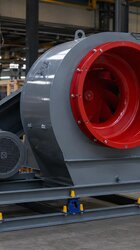
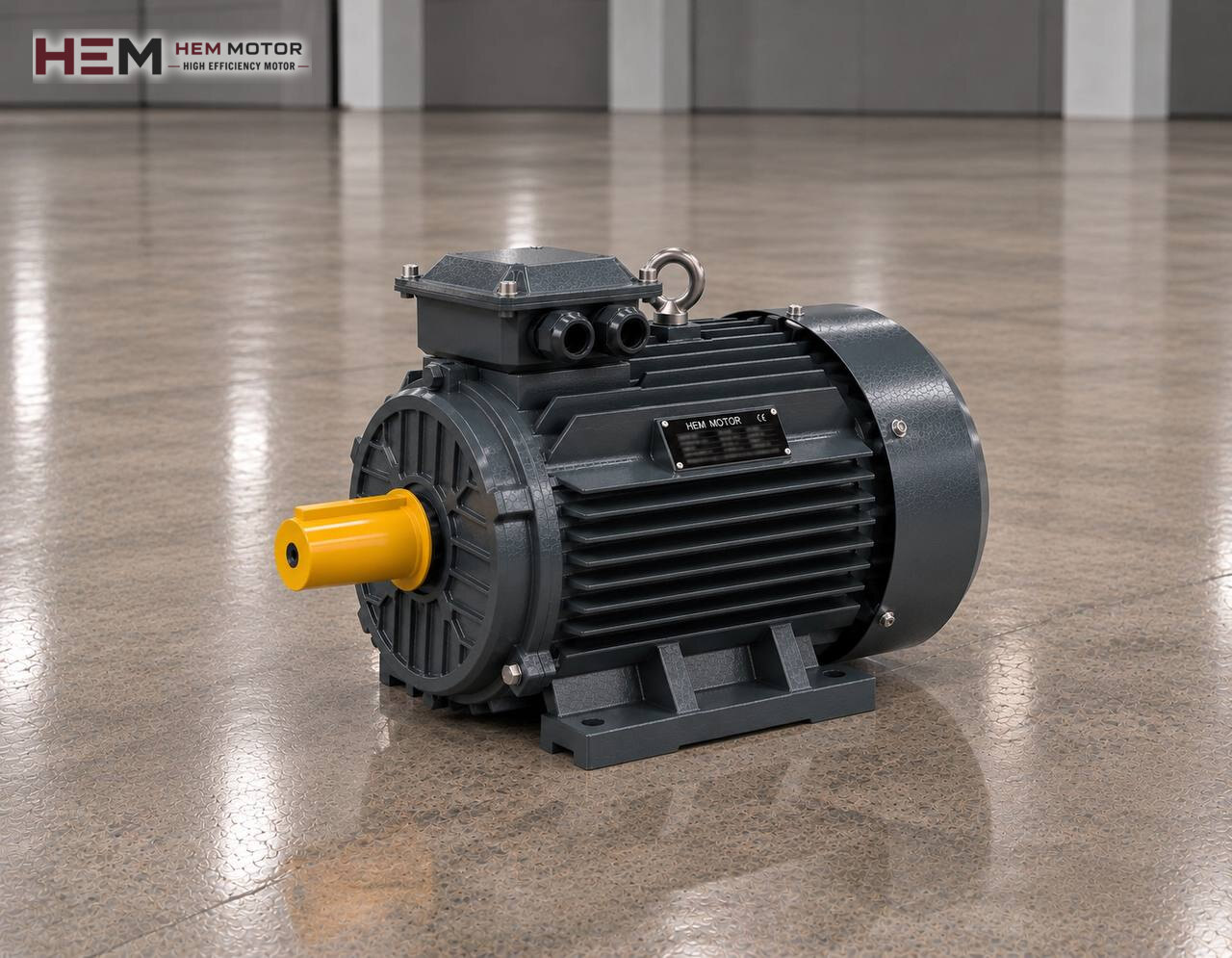
Pump and electric motor on a hydraulic power unit (representative image).
Compressed air room: why does the compressor motor go to the top of the list?
Because the screw compressor motor ranks near the top of the plant in both hours and kilowatts. Pneumatic fixtures, clamps in welding cells, spray guns and assembly tools run on compressed air. The compressor room often keeps running through the night after production ends, just to feed leaks. This is usually where an efficiency class upgrade pays back fastest.
Leaks are sealed first. Lowering the pressure setting to what is actually needed also often saves more than the motor itself.
For motors built into compressors, the pulley or coupling connection and frame dimensions must be compared with the compressor manufacturer's data; in some packaged compressors the motor is the manufacturer's own design.
Prices and technical data are on the product pages; choose a model and order online.
How is the changeover planned for paint booth fans and washing tunnel pumps?
Motor renewal is planned together with speed control. In e-coat or powder coating lines, the booth supply and exhaust fans, the oven circulation fans and the spray pumps of the pretreatment tunnel run full hours as long as the line is open. Where fan flow is set with throttling dampers, speed control by frequency inverter yields a bigger gain than the efficiency class.
In washing tunnels the environment is hot and humid. Spray pump motors take chemical vapour and splashing. The standard IP55 frame works in this environment; where it is washed directly with pressurised water, IP56 can be considered as a special order. If the motor of a fan circulating hot gas inside the oven sits in the gas stream, this duty requires a special motor; it may fall outside the scope of the standard series in HEM Motor's 2026 catalogue, so ask us with the nameplate and application details.
Machine tools, robot cells and conveyors: where should the line be drawn?
The line is drawn at auxiliary drives served by standard induction motors. CNC spindle motors and robot axis motors are servo or special motors matched to the machine maker's drive; they are not the subject of an efficiency class changeover.
However, the coolant pumps, chip conveyors and hydraulic units of the same machines run on standard induction motors and can be added to the list.
Roller and chain conveyors on assembly lines and handling systems in parts storage areas are usually low-power and geared. They are small individually but numerous. Taking a common renewal decision for motors of the same frame also simplifies inventory management. The handling systems electric motors page can be used for such lines.
Drive
Why it matters
Watch during changeover
Screw compressor
Longest running hours, high power
Leaks and pressure setting first
Hydraulic press power unit
Runs at part load throughout production
Idle time, pump connection
Paint booth and oven fans
Full hours while the line is open
Speed control instead of damper
Washing tunnel pumps
Continuous circulation, humid environment
Frame protection, glands
Machine-tool auxiliary pumps
Numerous, continuous duty
Flange and shaft fit
Spindle and robot axes
Manufacturer-specific drive system
Not included in the changeover list
Which electric motors can serve as examples for presses, compressors and booth fans?
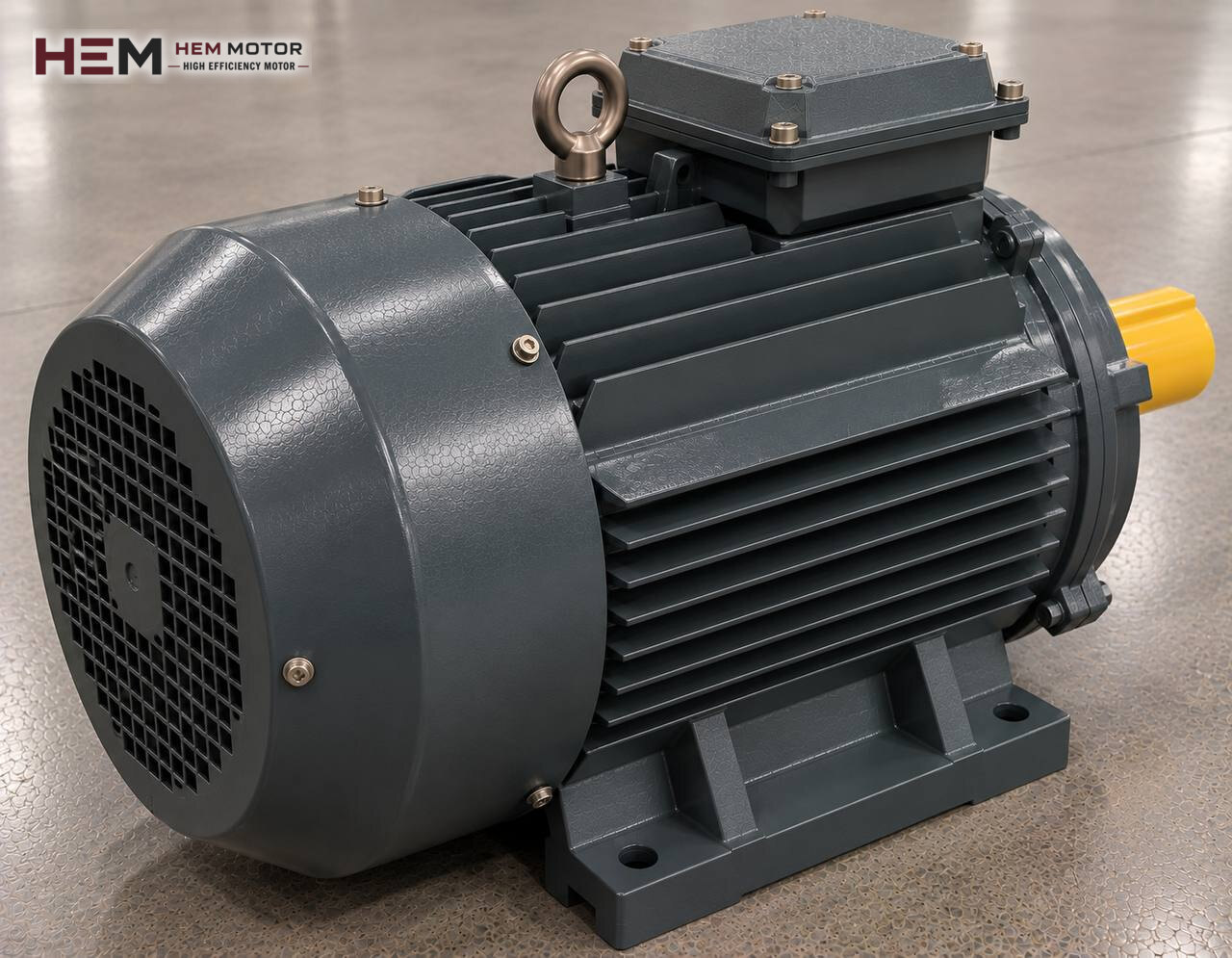
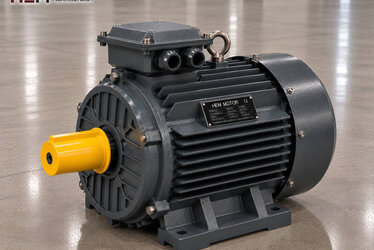
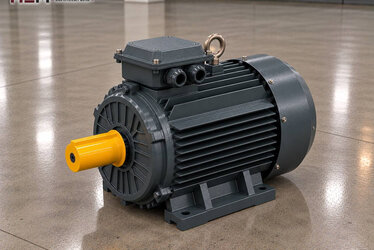
The 160L-4 for a hydraulic press, the 180L-4 for a booth exhaust fan and the 112M-2 for a washing pump can serve as examples. The models below are starting examples for auxiliary duties served by standard induction motors; power and speed must be confirmed with the machine manufacturer's data. The efficiency class is chosen among the IE3, IE4 and IE5 options at the quotation stage; efficiency values are given in the 2026 product catalogue. You can compare similar ratings in the electric motor store.
For the power unit of a medium-tonnage hydraulic press, the 15 kW cast iron frame 160L-4; rated speed 1465 rpm, voltage 400/690 V.
For a paint booth exhaust fan or a large drive in the compressor room, the 22 kW 180L-4; it turns at 1470 rpm.
For the spray pump of a parts washing tunnel, the 4 kW 112M-2; rated speed 2905 rpm, voltage 400/690 V.
How is the renewal schedule tied to model-year changes and line revisions?
Auxiliary drive motors are renewed while the line is revised for a new vehicle model. Dies, fixtures and cell layouts are changing anyway. Planning a separate shutdown creates more loss. If the line each motor belongs to and the next revision date are marked in the inventory table, the changeover becomes an orderly plan spread over several years.
For the new motor to fit, the IEC frame number is the starting point; the fit is confirmed by comparing mounting type, shaft, foot holes and flange dimensions. Depending on the frame, B3, B5, B14, B34, B35 and vertical V1, V3, V5, V6, V15 mountings are offered, and the flange size is confirmed with the order.
Our three-phase series can be driven by a frequency inverter; for fans that will run at full torque at low speed for long periods an external fan, and for a long drive cable a dv/dt or sine filter, are considered, and these conditions are stated with the order.
If you send the nameplates of the motors on the revision list via the find an equivalent from the nameplate page, we will prepare an efficiency class and frame proposal for each before the line goes live. For bulk renewals you can view the options in order of power and speed in the HEM Motor store.
Frequently Asked Questions
Can I replace a CNC machine's spindle motor with an IE4 motor?
Spindle motors are usually special motors matched to the machine maker's drive and are not the subject of a standard efficiency class changeover. The machine's coolant pump and chip conveyor, however, can be added to the list.
Where should a supplier start the efficiency class changeover?
The compressor room, hydraulic press power units and paint booth fans have the highest annual hours. The investment in these drives usually pays for itself in the shortest time.
On a paint booth fan, does motor replacement or speed control come first?
If the flow is throttled with a damper, speed control gives the bigger gain. To capture the full gain, motor renewal and the frequency inverter are planned together.
Is it possible to replace a packaged compressor's motor with a standard motor?
Many compressors use standard-frame motors, but in some models the motor is specific to the manufacturer. Nameplate and connection dimensions must be compared with the compressor manufacturer's data.
HEM Motor Models Related to This Article
The cards show example models related to the topic. A suitable motor is not chosen by power alone: compare speed, voltage, mounting, shaft and connection dimensions on the product page; if unsure, send a photo of the existing motor’s nameplate on WhatsApp.
When choosing an electric motor for a feed dosing screw, the real goal is for every turn of the screw to carry the same amount at low flow; to achieve this, before moving on to mot... More Details
When choosing electric motors for a corrugated board line, two groups are thought about separately: the main drives that carry line speed and the many auxiliary drives around them.... More Details
In a rubber compound mixer the electric motor carries two loads at once: the continuous torque from the high viscosity of the compound and the impact peaks that occur every batch a... More Details
On a scrap metal separation belt the electric motor is chosen by the shaft power the belt load requires and by the type of magnet unit; a magnetic head pulley adds load to the belt... More Details
An electric motor for a PET bottle crusher works, in wet crushing, against a steadier load that the water cools and lubricates, and in dry crushing against a harsher, impact-heavy ... More Details
On a cable granulator the motor carries two separate loads: the continuous cutting load as the knives on the cutting rotor chop the cable, and the sudden impacts caused by cable bu... More Details
We use necessary and optional cookies to improve your experience, enhance content and analyse traffic. Under the GDPR, optional (analytics/marketing) cookies are only used with your explicit consent. Please choose your preference below.
Cookie Policy
 English
 Français
 Türkçe
 Español
 Русский
 العربية
 Deutsch
 Italiano