English
 Français
 Türkçe
 Español
 Русский
 العربية

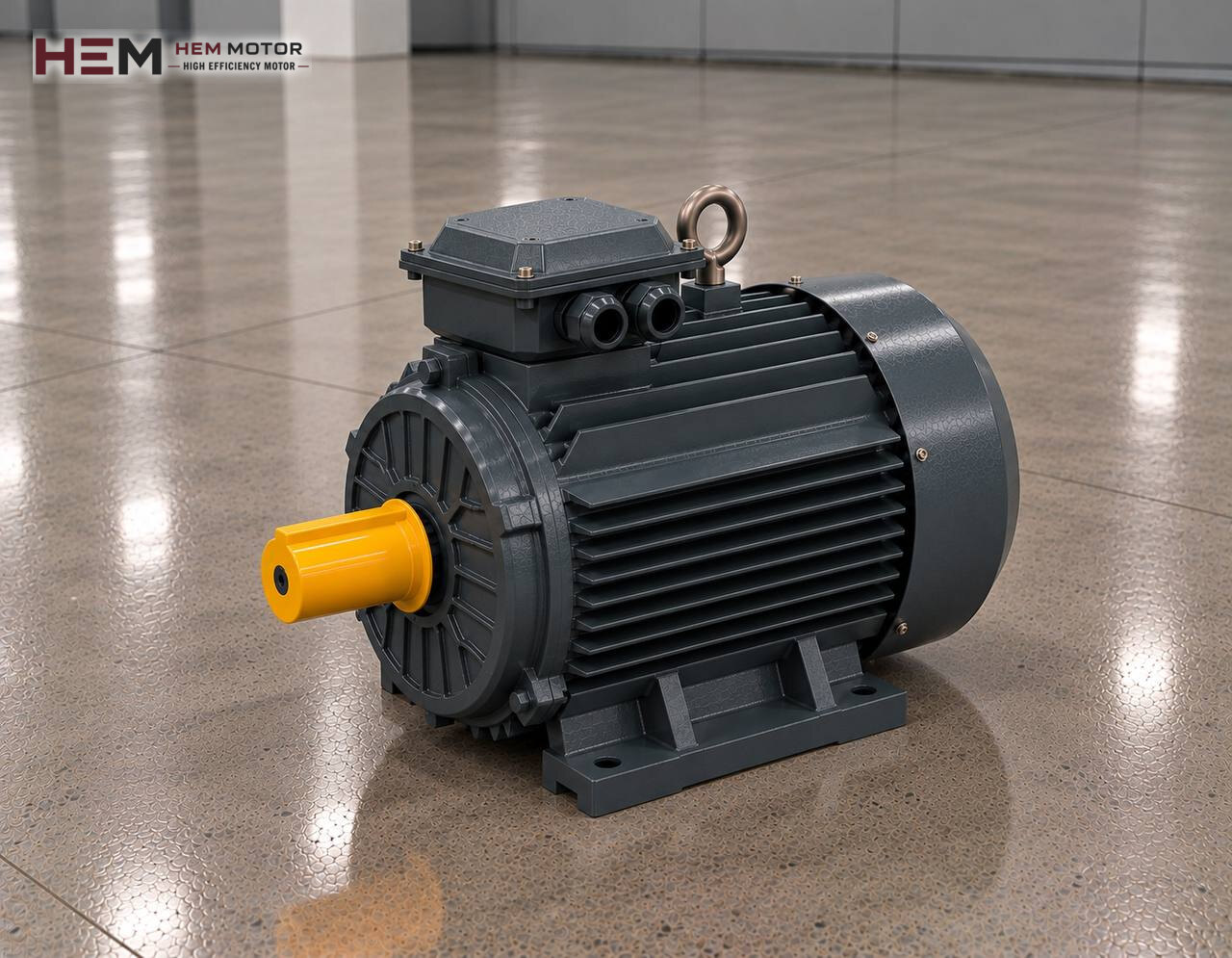
In broiler, layer and turkey houses, air quality depends largely on the exhaust fans in the walls: the ammonia-laden, dusty and humid air inside the house is taken out by these fans, and fresh air is drawn in through side-wall inlets or the pad at the tunnel entrance. Here we look at the three-phase motor that turns the impeller of those fans; the ventilation electric motors page is the starting point for the general picture.

The Motor's Share of the Work in a Poultry House Exhaust Fan
On most of the large box-type exhaust fans used in poultry houses, the motor is fixed on top of or beside the fan housing and transfers its motion to the impeller shaft through a belt. In this layout the impeller turns noticeably slower than the motor. On smaller side-wall fans, the impeller usually sits directly on the motor shaft. In both cases, all the motor produces is shaft rotation.
How many fans ventilate the house, in what order and at what temperature is decided by the house control panel. The curtain and inlet actuators that open the air inlets, heaters, the fogging pump and the feeding line are outside the scope of this page; each of them has its own drive selection. The fan's shutter usually opens by itself with the airflow.
First Questions Asked About a Poultry Fan Motor
The farm owner or poultry equipment service requesting a motor is usually asked for the following:
The fan brand and model, blade diameter, whether it is belt-driven or direct-drive, the hole pattern by which the motor is fixed to the fan housing, and the nameplate values of the old motor. The electrical infrastructure of the house also matters; because mains voltage can fluctuate in remote villages, it helps to have an electrician measure the actual voltage at the house against the nameplate voltage of the new motor.
A poultry house has many fans of the same type, and they all run hard in the same season. So not only the failed motor but a few spare motors can be added to the same order; that way a fan that stops in the summer heat is turning again within hours.
Sources That Set Power and Speed for a Poultry Fan
The motor power an exhaust fan needs comes from the airflow and back-pressure point tested by the fan manufacturer. In long tunnel-ventilated houses, air is pulled at high velocity from one end of the building to the other, so the fans run against a certain back pressure. This operating point is written in the fan data sheet; if there is no data sheet, the power and speed on the existing motor's nameplate are used.
On belt-driven poultry fans, the impeller speed comes from the pulley ratio, not from the motor speed. When the motor is changed, choosing a motor of the same speed and using the old pulley keeps the fan's operating point. Changing the pulley or the speed changes both the fan's airflow and the motor's load; this decision should be left to the fan manufacturer.
Belt tension also affects motor load. An over-tight belt strains the motor bearings, while a loose belt slips and reduces the fan's airflow. When changing the motor, it is advisable to check the belt and pulleys for wear as well.
| Fan position and duty in the house | Operating pattern | Key point in motor selection | Example HEM model |
|---|---|---|---|
| Tunnel ventilation, large box fan | Continuous for long hours in summer | Belt and pulley layout, continuous load, dust build-up | 1.5 kW 1500 rpm cast iron (90L) |
| Minimum ventilation fan | Intermittent by timer in winter | Frequent starts, condensation in cold surroundings | 0.75 kW 1500 rpm aluminium (80M) |
| Side-wall exhaust fan, low-speed impeller | Staged in transition seasons | Impeller speed and shaft connection | 1.1 kW 1000 rpm cast iron (90L) |
| Additional fan in turkey or breeder house | Varies with the season | Control method, use of an inverter | Selected according to the power in the fan data sheet |
The example models are not a final selection; they should be checked separately against the fan data sheet, the old motor's nameplate and the connection dimensions.
Connecting to the Fan Housing: Frame Number, Shaft and Holes
On poultry fans the motor is usually fixed by its feet to the fan housing via a plate or slide rail; belt tension is set by sliding the rail. For the new motor to sit on the same rail, the IEC frame number must first match the old motor. Which dimensions the frame number fixes is shown in the frame size table.
Next, the distance between foot holes, shaft centre height, shaft diameter and length, key size and the position of the pulley on the shaft are compared. On direct-drive side-wall fans the motor is sometimes flange-mounted (B5 or B14); in that case the flange diameter and bolt circle matter. The mounting arrangements offered by HEM are listed in the mounting arrangements question. The orientation of the terminal box should also be checked against the cable entry in the house wall.
Ammonia, Dust and Moisture: How Poultry House Air Affects the Motor
The motor of a poultry house exhaust fan sits right in, or right next to, the air leaving the house. This air carries ammonia rising from the litter, fine feather and manure dust and heavy moisture. Dust packs between the motor's cooling fins and inside the fan cover; if it is not cleaned, the housing cannot shed its heat and the motor runs hot.
HEM's standard motors have IP55 protection and class F insulation; the conditions the catalogue is based on are an ambient between minus 15 and plus 40 degrees and altitudes up to 1000 metres. If the temperature behind the fan on a sun-exposed house wall can exceed this value in summer, it should be stated in the order. During house washing, pressurised water should not be aimed directly at the motors; IP55 is not designed for that kind of washing, and it is safer to cover or remove the motor before cleaning.
In tunnel fans that are idle in winter, moisture can condense inside the housing; an anti-condensation heater is an order option. Operations that want to monitor the winding for overheating can request a PTC or PT100 sensor. For the differences between cast iron and aluminium frames, see the frame material question.
Long Hours, Staged Switching and Speed Control
In summer a poultry fan may spend most of the day turning, and on hot nights run until morning. The S1 continuous duty definition on the motor nameplate corresponds to this pattern of use. In winter the picture changes: in minimum ventilation, fans run for a few minutes on a timer and then stop. Because this cycle repeats all day, the number of starts per hour can be high; reading it from the control panel settings and stating it in the request is necessary for the right selection.
Some poultry panels adjust fan speed with a frequency inverter. Our three-phase ranges are suitable for use with an inverter. Since fan load drops quickly at low speed, motor heating is usually not an issue; however, if long periods at very low speed are planned, an external cooling fan should be considered, and if the cable between panel and fan is long, a dv/dt or sine filter. These details should be stated in the order.
After a sudden power cut, all fans starting at the same moment puts a high starting current on the supply. A control panel that switches fans on one after another is healthier for both the motors and the farm generator.
Information to Send for a Burnt-Out Poultry Fan Motor
In summer, a stopped tunnel fan can directly affect the health of the flock, so it matters that the equivalent motor is right the first time. It is enough to send the following via WhatsApp; how to photograph the nameplate is explained on the send nameplate page.
- Photo of the motor nameplate (power, speed, voltage, current and frame marking must be readable)
- Fan brand, model and blade diameter; a photo of the machine plate if there is one
- Belt-driven or direct-drive; if belt-driven, a photo of the pulley on the motor shaft
- Mounting type and a view of the rail or flange on which the motor sits
- Mains voltage and phase situation at the house
- Fan control: by contactor, inverter or timer
- Required quantity and any request for spare motors
If the nameplate is completely unreadable, the housing dimensions and an overall photo of the fan also help. The WhatsApp line on the contact page can be used for this information.
Motors in the Shop Worth Examining for Poultry Fans
Motors that may suit a poultry fan are in the general list of the shop. In the dusty, humid environment of a poultry house many users prefer cast iron frame motors; for light fan housings, aluminium frame motors are also considered. As examples, the 1.5 kW 1500 rpm cast iron motor, the 1.1 kW 1000 rpm cast iron motor and the 0.75 kW 1500 rpm aluminium motor can be examined. These are examples; their suitability for your fan is confirmed separately by comparing power, speed and connection dimensions.
Frequently Asked Questions
What are the likely reasons a poultry fan motor keeps burning out?
Dust built up on the cooling fins, an over-tight belt, low mains voltage and many starts at short intervals are the main suspects. It is advisable to check these points before fitting the new motor.
What should be done to protect the fan motor while the house is being washed?
Pressurised water should not be aimed directly at the motor; if possible the motor should be covered, or its power cut during washing and the spray angle kept away from the motor.
My tunnel fan motor is 1500 rpm; can I fit a 1000 rpm motor instead?
If this is done on a belt-driven fan without changing the pulley ratio, the impeller slows down and airflow drops. A speed change should only be considered together with the pulley arrangement recommended by the fan manufacturer.
What should be considered in motor selection when running on a farm generator?
The generator must be able to cover the starting current of the fans at the same moment. Having the panel switch the fans on one after another reduces this load; generator capacity should be assessed together with an electrician.
Can curtain and air inlet motors also be selected from this page?
No. They are usually low-speed, geared and positioning special drives; they are selected using data from the poultry equipment manufacturer.