English
 Français
 Türkçe
 Español
 Русский
 العربية

A paint booth provides continuous air movement in a closed or semi-open volume to remove the paint particles and solvent vapour released into the air during spray-gun painting. In car body repair shops and in furniture and metal part paint shops this air movement is usually handled by two fans: a supply fan pushing filtered clean air into the booth and an exhaust fan drawing the dirty air through the filters and discharging it outside. For other fan types in building and plant ventilation you can return to the ventilation electric motors page; here the motor turning paint booth fans, and especially the explosive atmosphere limit, is discussed.

The Limit First: Solvent Vapour, Explosive Atmosphere and the Standard Motor
Solvent-based paints release volatile and flammable vapour. The inside of the paint booth, the exhaust duct and the exhaust fan housing are the places where this vapour concentrates. In the zone classification carried out by the operator or the booth manufacturer, these areas may be defined as an explosive atmosphere (an Ex zone under ATEX). A motor operating in such a zone must be an Ex motor certified for that zone.
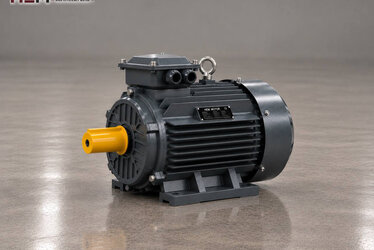
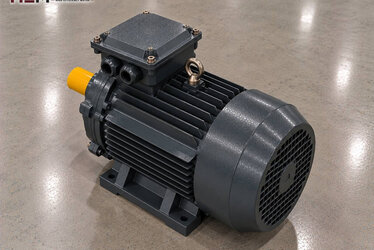
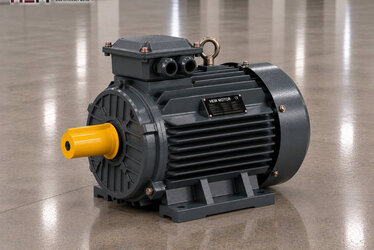
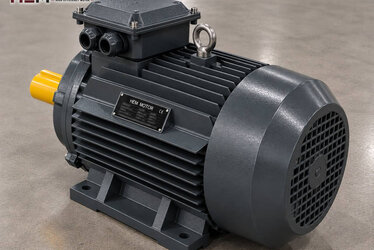
The motors sold by HEM Motor are standard three-phase asynchronous motors with IP55 protection; they cannot be used in an explosive atmosphere zone. Ex-certified motors are not included in HEM Motor's 2026 catalogue. So when a motor is requested for a paint booth fan, the first question is where the motor will stand and what the zone classification of that location is.
In some booth designs the motor is placed outside the airflow and the classified zone, for example in a separate motor compartment on the booth roof, and turns the fan by belt and pulley. Whether such a solution is safe is decided not by the motor seller but by the booth manufacturer and the operator's zone classification. A standard motor can only be discussed for a location documented by this assessment as lying outside the Ex zone.
The Parts the Motor Turns in Booth Fans
In a paint booth the motor's job is to turn the fan impeller. On the supply side the impeller pushes outside air through pre-filters and, if needed, a heater to the ceiling filter; even top-to-bottom airflow directly affects paint quality. On the exhaust side the impeller draws the air behind the floor or back-wall filters that capture paint particles and pushes it into the stack. Most booths use centrifugal fans for these two tasks; small wall-type booths may also use an axial exhaust fan.
The motor does not control the booth lighting, burner, heat exchanger, filter pressure gauge or the damper changes in baking mode. These belong to the booth manufacturer's control system. The rising air temperature in baking mode, however, matters for the motor's position and is described separately below.
Information to Prepare for a Paint Booth Fan Motor
When preparing a request for a motor replacement or a new booth, following this order makes things easier: booth brand and model, whether the fan in question is supply or exhaust, the motor position (inside the airflow or in a separate compartment) and the zone classification of that position. Then comes the nameplate of the existing motor: power, speed, voltage, current, IEC frame size and whether the plate carries an Ex mark are read. If the plate carries an Ex mark, a standard motor is not offered as a replacement.
The way the booth is used should also be asked: one shift or two; are painting and baking done in the same booth; are the fans speed-controlled? This information determines the thermal load of the motor and the control arrangement.
Air Velocity, Filter Resistance and Motor Power
The required air volume in a paint booth comes from the booth cross-section and the target air velocity inside it; the resistance the fan faces consists of filters, heater and ducts. These values are in the booth manufacturer's design and the fan power was selected accordingly. When selecting the motor, the starting point is the nameplate of the fan or the existing motor; a generalisation such as "a paint booth fan runs with this many kW" is not correct.
As filters load up, resistance rises and the fan's operating point changes. In centrifugal fans this usually reduces flow; air velocity in the booth drops and the painter is usually the first to notice. Delaying filter replacement does not protect the motor; it spoils the booth's operating condition. In belt-driven fans the impeller speed is set by the pulley ratio; changing pulleys alters fan power roughly with the cube of speed and should not be done without the booth manufacturer's approval. In belt-driven booth fans four-pole models are generally preferred on the motor side.
| Booth fan | Possible motor position | Question to ask first | Example HEM model (only outside Ex zones) |
|---|---|---|---|
| Supply fan, small repair booth | On the clean-air side, on the booth roof | Baking temperature and motor compartment | 2.2 kW, 1,450 rpm, 100L1-4 |
| Exhaust fan, belt-driven, motor in separate compartment | Outside the dirty airflow | Zone classification document | 4 kW, 1,450 rpm, 112M-4 |
| Large industrial paint shop fan | In the fan room, on a separate base | Running hours and belt arrangement | 5.5 kW, 1,460 rpm, 132S-4 |
| Direct-drive exhaust fan, motor in the flow | Inside the solvent vapour | An Ex-certified motor is required | Standard motor not offered |
The examples are not a final selection; they apply only to motor positions documented by the zone classification as outside the Ex zone, and the final choice is made according to the power and speed given by the booth manufacturer.
Comparing the Motor Compartment, Pulley and Frame Size
In booths with a separate motor compartment, the motor is usually a foot-mounted (B3) frame sitting on a tensioning slide; the belt reaches the fan shaft through an opening in the partition wall. In a replacement the first value compared is the IEC frame size. Then the foot dimensions matching the bolt holes on the slide, the height of the shaft axis above the base surface, shaft diameter and length and the keyway are measured side by side with the old motor. If the old pulley is reused, the shaft diameter must be exactly the same. The operating voltage, star/delta connection and rated current on the plates must also match.
If a foot-and-flange (B34, B35) or flange (B5, B14) motor is needed, the frames it is offered for can be seen on the mounting arrangements page. Basic dimensions by frame are given in the frame size table; exact flange and shaft values for the booth are verified together at the order stage.
Baking Mode, Paint Dust and the Motor's Operating Environment
Many automotive booths heat the booth interior after painting to cure the paint. During this time the supply fan circulates heated air; if the motor stays on the hot-air side of the heater, the ambient temperature may exceed the catalogue limit. The ratings in our catalogue apply at altitudes up to 1000 m and in ambient air between −15 and +40 degrees; if the motor compartment gets hotter during baking, this should be stated in writing before the quotation. Frame protection is IP55 and winding insulation is class F.
Fine paint dust passing the filter sticks to the motor surface and cooling fins, hardens over time and weakens cooling. Keeping the compartment where the motor stands clean and checking the fan cover regularly are therefore important. If the booth stays cold over the weekend and is heated on Monday, condensation may form in the motor; an anti-condensation heater against this, and a PTC thermistor to monitor the winding against overheating, can be added to the order.
Speed Control Between Painting and Standby
In modern booths the fans run at full speed during painting and at low speed during preparation and standby; the balance between supply and exhaust is set to keep a slight pressure difference inside the booth. This balance is often achieved with a separate frequency inverter for each fan. Our three-phase motors are suitable for being fed by a drive; the subject is detailed on the inverter-compatible motors page. As the fan slows its load falls quickly, so a separate cooling fan is rarely needed; if the drive is in a distant panel, a dv/dt or sine filter should be considered for the motor cable.
The frequency inverter and control panel are also electrical equipment and must be outside the explosive atmosphere zone; this is part of the booth manufacturer's electrical design. Booth fans are switched on and off a few times a day; this number of starts is normal for a standard fan motor, but in fans with large impellers the starting time should be taken into account in the protection setting.
Information to Send When Renewing a Booth Fan Motor
A motor request for a booth fan can be written via WhatsApp. The basis of the quotation is a photo of the nameplate of the old motor plus power (kW), speed (rpm), supply voltage, mounting type and the quantity required. You can find our numbers on the contact page.
- Booth or machine brand, model and the fan concerned (supply or exhaust)
- A clear photo of the motor nameplate; whether the plate carries an Ex mark
- Motor position and the zone classification of that position (Ex zone or outside)
- Belt and pulley or direct drive; shaft diameter and pulley details
- Temperature at the motor location in baking mode
- Speed control device, supply voltage and required quantity
Store Groups for Booth Fans Outside Ex Zones
All three-phase models on sale are together on our store page. For repair-shop booth fans the aluminium frame group, and for the large fan rooms of industrial paint shops the cast iron frame group can be browsed. Some of the models worth looking at are the 2.2 kW 100L1-4, 4 kW 112M-4 and 5.5 kW 132S-4. These models are examples; their suitability for the booth, and especially that the motor position is outside the Ex zone, is verified separately.
Frequently Asked Questions
Can I use an IP55 motor on the exhaust fan of a paint booth?
Not if the motor is in an area containing solvent vapour and classified as an explosive atmosphere; that zone requires an Ex-certified motor. IP55 defines protection against dust and water and provides no explosion protection.
Can you supply an Ex-certified motor?
Ex-certified motors are not included in HEM Motor's 2026 catalogue. For such a need, the certified motor specified by the booth manufacturer should be used.
Is it enough to move the motor outside the booth and connect it by belt?
This decision belongs to the booth manufacturer and the operator's zone classification. A standard motor should not be used until it is documented that the motor location is outside the Ex zone.
We use water-based paint; is zone classification still needed?
Paint content, cleaning solvents and the way the booth is used can change the assessment. The classification is made by the operator and the booth manufacturer according to the relevant regulations; motor selection follows that result.
Why does the motor draw less current when the filters are loaded?
In centrifugal fans rising resistance reduces flow, and the fan usually draws less power. This is not a problem for the motor, but it shows that air velocity in the booth has dropped; the filters need to be replaced on time.