English
 Français
 Türkçe
 Español
 Русский
 العربية

Exhaust fans mounted in the side or gable walls of a greenhouse push the hot, humid air outside; cooler air then enters through wet evaporative pads or open vents to fill the space. This page explains how to choose the three-phase motor that turns that impeller; for other motor applications in air handling, see the ventilation electric motors page.

What Does the Motor Turn in a Greenhouse Exhaust Fan, and What Doesn't It Do?
Most greenhouse fans are bladed axial units. In small and medium diameters the impeller hub sits directly on the motor shaft. In large box fans the motor turns a small pulley; a belt carries that motion to a large pulley on the impeller hub, so the impeller runs slower. In both layouts the motor has a single job: to keep the impeller turning at a steady speed for hours on end.
How much the greenhouse cools down is the result of the whole system, not of the motor. The water pump of the pad cooling, the pad area, the shutters, the internal circulation fans and the climate controller are separate pieces of equipment. On many fans the shutters open by air pressure or by a separate mechanism. Motor selection does not cover these parts, and the pump motor is handled separately.
Information to Collect When Looking for a Greenhouse Fan Motor
The quickest route to the right motor starts with the fan itself. If the fan manufacturer's plate or data sheet is still available, it answers most of the questions.
The first items requested are: impeller diameter and number of blades, whether the fan is direct-drive or belt-driven, the target impeller speed, the face by which the motor is fixed to the fan frame, and the power, speed, voltage and current on the nameplate of the removed motor. The electrical supply of the greenhouse should be known from the start. In small operations fed with single-phase power, the single-phase motor range is considered separately.
The number of fans also matters. If eight or ten fans on the same wall run with the same motor type, keeping them all on the same frame and speed makes spare parts easier; that is why it helps to check the nameplates of the motors on the other fans when placing a new order.
Where Do the Impeller Power and Speed Come From?
Motor power comes from the load the impeller places on the shaft while pushing the required air volume against the resistance of the greenhouse. The fan manufacturer determines this value from its own measurements; the correct source is the fan's plate or data sheet. On fans with an unreadable plate, the nameplate of the removed motor is the most reliable starting point.
There is a trap with speed: when fan speed rises, the power it absorbs grows roughly with the cube of the speed. Driving an impeller designed for 1000 rpm with a 1500 rpm motor therefore overloads the motor and stresses the blades. On a direct-drive fan the motor speed equals the impeller speed; on a belt-driven fan the impeller speed is set by the ratio of the two pulley diameters.
As the wet pad scales up and the bird mesh and insect screen fill with dust, the resistance the fan faces changes. The current drawn by the motor can shift accordingly. Measuring the current with a clamp meter at first start-up and after pad maintenance shows how close the motor runs to its nameplate value.
| Greenhouse fan layout | Link between motor and impeller | Detail to ask about | Example HEM model |
|---|---|---|---|
| Direct-drive, medium-diameter wall fan | Impeller hub on the motor shaft | Impeller speed, shaft diameter, bracket or flange connection | 1.1 kW 1500 rpm aluminium frame (90S) |
| Direct-drive, low-speed wide impeller | Motor in the centre of the fan frame, impeller on the shaft end | Impeller weight, need for low speed | 0.75 kW 1000 rpm aluminium frame (90S) |
| Belt-driven box fan | Motor pulley, belt, impeller pulley | Pulley diameters, belt tension, motor slide rail | 0.75 kW 1500 rpm cast iron frame (80M) |
| Internal circulation fan | Usually small, direct-drive | Single-phase or three-phase, suspended mounting | Single-phase range or smallest three-phase model (0.25 kW) |
The models in the table are examples only; the final choice is confirmed against the fan manufacturer's data, the existing motor nameplate and the connection dimensions.
Dimensions to Compare When Fixing the Motor to the Fan Frame
The first step in finding out whether a new motor will fit the greenhouse fan is the IEC frame number (e.g. 80M, 90S, 90L). This number ties basic dimensions such as shaft centre height and foot holes to a standard framework; details can be found in the frame size table.
Even when the frame matches, the following are compared one by one: mounting arrangement (foot-mounted B3, flange-mounted B5 or B14, B34/B35 with feet and flange together), shaft diameter and length, key size, flange bolt circle and the hole spacing on the bracket that carries the motor. On greenhouse fans the shaft is mostly horizontal; some fans fitted in the ceiling or a roof opening need vertical mounting. The available arrangements are explained on the mounting options page.
On the electrical side, the nameplate voltage, star or delta connection and rated current should be compared with the new motor. A proper fit of the impeller hub on the shaft end, with the key in place, is a precondition for vibration-free running.
Humidity, Condensation and Outdoor Air: How the Greenhouse Affects the Motor
A greenhouse is not an easy place for a motor. On summer middays the inside air heats up and becomes saturated with moisture; when the temperature drops at night, water droplets may form inside the motor housing. Motors sitting close to the outer face of the fan are also exposed to rain, wind-blown dust and direct sun.
HEM Motor's standard ranges come with IP55 protection and class F insulation. According to the catalogue, the motors are defined for operation in air between minus 15 and plus 40 degrees and at altitudes up to 1000 metres above sea level. If this upper value is exceeded behind the fan under a glass roof, or if the greenhouse is at a higher altitude, state it in the order. For fan motors that cool down at night and stand idle for days, an anti-condensation heater, and a PTC or PT100 sensor to monitor winding temperature, can be requested as order options.
The frame material is also a decision. An aluminium frame is light and makes suspended mounting on the fan frame easier; a cast iron frame is heavier and stiffer. For the differences, see the aluminium or cast iron question. In greenhouses where spraying is done, the motor should not be directly exposed to the spray; IP55 protection is not designed for pressure washing.
Staged Thermostat Operation and Speed Control by Inverter
In greenhouses, fans are usually switched on in stages by the climate controller: as the temperature rises, first one group runs, then the others. That means many starts and stops during the day. At each start the motor draws a high current for a short time; find out from the controller settings how many times per hour the same motor is started and state it in your request.
Those who want to adjust fan speed continuously instead of in stages use a frequency inverter. Our three-phase ranges are suitable for speed control by inverter. Because fan load falls quickly at low speed, the motor's own cooling fan is often enough; even so, for long periods at very low frequency an external fan is considered, and if the cable between inverter and motor is long, a dv/dt or sine filter. If several motors are fed from one inverter, each motor should have its own thermal protection.
What to Send to Replace a Failed Greenhouse Fan Motor
A fan that stops in midsummer quickly lets heat build up in that section of the greenhouse. For a fast and correct equivalent, it is enough to send the following information via WhatsApp; how to photograph the nameplate is explained on the send the motor nameplate page.
- A clear photo of the motor nameplate, with power, speed, voltage, current and frame marking readable
- Fan layout: direct-drive or belt-driven box fan; impeller diameter if known
- Mounting type (foot, flange, foot-and-flange) and a photo of where the motor attaches to the fan
- Shaft diameter and key details, and the shaft end dimension if possible
- Greenhouse supply: three-phase 400 V or single-phase
- How the fan is controlled: staged by thermostat or by inverter
- Quantity of motors to be replaced or kept as spares
If the nameplate is worn off, the fan manufacturer's name, the fan model code and the motor's frame dimensions also help. You can send the details via the WhatsApp line on the contact page.
Motor Groups in the Shop Worth Checking for Greenhouse Fans
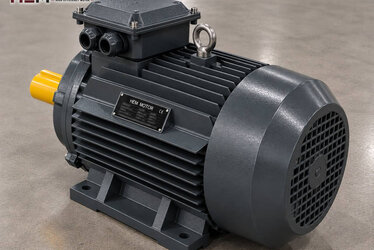
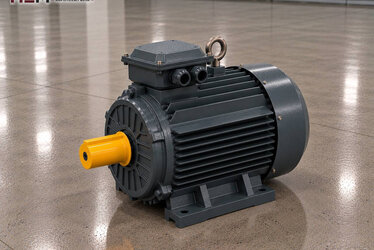
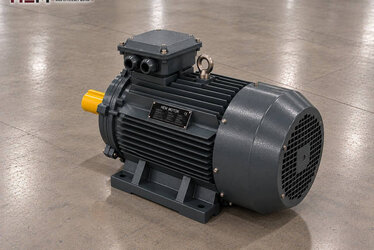
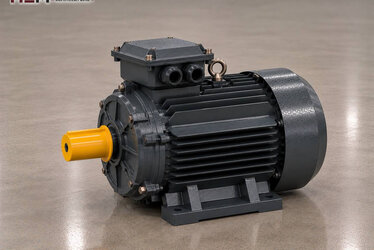
All models are listed in the electric motor shop. For light fan frames, aluminium frame motors are usually examined; for heavier impellers and belt-driven layouts, cast iron frame motors. As examples, see the 1.1 kW 1500 rpm aluminium frame motor, the 0.75 kW 1000 rpm aluminium frame motor and the 0.75 kW 1500 rpm cast iron frame motor. These are examples only; their suitability for your fan is confirmed separately by power, speed and connection dimensions.
Frequently Asked Questions
If I replace the greenhouse fan motor with a higher-speed motor, will the fan move more air?
It will, but because the power absorbed by the impeller rises with the cube of the speed, the motor is overloaded and the blades may go beyond their design limit. A speed change should only be made with the fan manufacturer's approval.
Why is the motor speed different from the impeller speed on a belt-driven greenhouse fan?
The motor pulley is small and the impeller pulley is large; the ratio between them slows the impeller down. If the new motor is chosen with the same speed and used with the same pulley, the impeller speed does not change.
What is recommended for a fan motor that does not run all winter?
During long stoppages condensation can form inside the housing. An anti-condensation heater can be requested in the order; having an electrician measure the winding insulation at the start of the season is also useful.
Can a three-phase motor be used in a greenhouse that only has single-phase power?
It cannot be connected directly. Either a suitable motor is selected from the single-phase range, or the supply situation is assessed with an electrician. Add the supply information when you send the motor nameplate.
Is the pad cooling pump motor also chosen by the selection on this page?
No. The pump is a separate piece of equipment with its own motor; it is selected from the pump's flow and pressure data. If that one also needs replacing, send the pump motor's nameplate separately.