English
 Français
 Türkçe
 Español
 Русский
 العربية

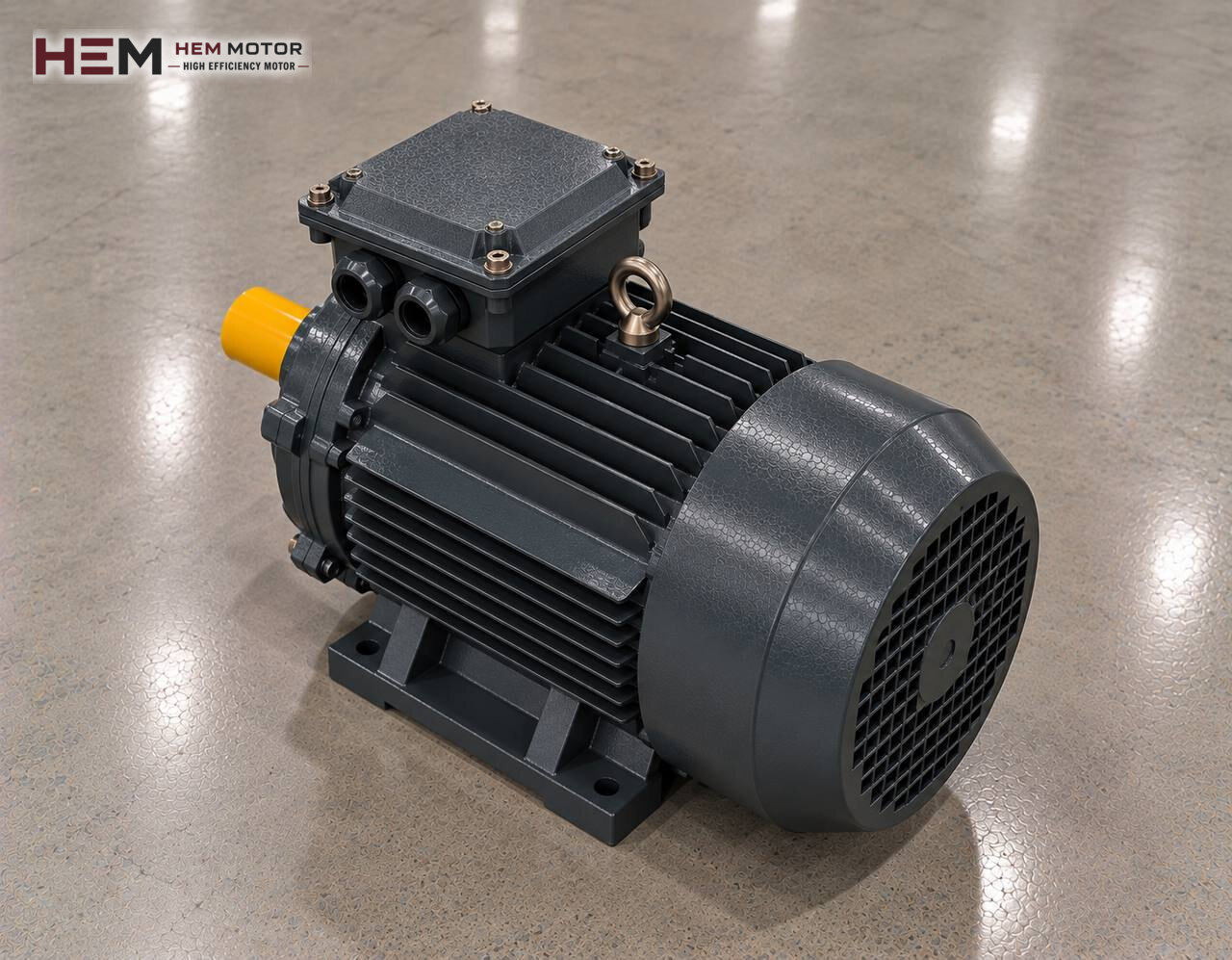
A roof exhaust fan sits on a curb or a duct collar on the roof of a building and discharges dirty, warm or humid indoor air upwards to the outside. Warehouses, production halls, sports halls and workshops use it to remove the air that collects under the ceiling by the shortest route. The general framework of ventilation applications is explained on the ventilation electric motors page; this page deals only with the motor that turns the impeller of a roof-mounted exhaust fan.

The Part the Motor Turns in a Roof Exhaust Fan, and What It Is Not Responsible For
The motor has a single job: to turn the fan impeller. In mushroom-hood roof fans this impeller is usually radial: air enters through the collar below, the blades throw it sideways and it leaves all around under the hood. In vertical-discharge models an axial propeller throws the air straight up. In both designs the motor load is the amount of air the impeller moves and the resistance it has to overcome to push this air through the ducts, grilles and damper.
The hood, the curb, the backdraft damper preventing reverse flow, snow and rain protection, anti-vibration mounts and the control panel are the fan manufacturer's design; the motor replaces none of them. Roof fans certified for smoke extraction in case of fire (rated in classes such as F300 or F400) are a separate subject: these fans need a special motor documented to run for a defined time at high temperature, and a standard motor is not suitable for this duty.
Information to Collect Before Asking for a Roof Fan Motor
The first step in finding the right motor is knowing the fan itself. The fan brand and model plate, the impeller diameter, whether the motor drives the impeller directly or through a belt, and the shaft direction of the motor (pointing down or up) are the first points to check. Then the power, speed, voltage, current and IEC frame size are read from the nameplate of the existing motor. Even if the roof cannot be reached, most of this information can be found in the fan manufacturer's catalogue using the model code.
The supply of the building must also be asked: is there a three-phase network, or only single phase in a small building? How long the fan stays on, whether it is managed by a time switch or a temperature thermostat, and whether its speed is adjusted also affect motor selection.
Where Are the Power and Speed of the Fan Read From?
The power of a roof exhaust fan comes from the flow-pressure curve given by the fan manufacturer and the point where this curve meets the duct system of the building. Rather than redoing this calculation on the motor side, the safest way is to start with the value on the fan plate or on the nameplate of the existing motor. Generalising a single kW value as "suitable for a roof fan" is not correct; two hoods that look the same may require very different power because their impeller diameter and blade angle differ.
In a direct-drive fan the impeller speed is the motor speed. Because noise and impeller tip speed are kept limited in large-diameter hoods, 6-pole motors of the 1000 rpm class or 4-pole motors of the 1500 rpm class are usually seen. In a belt-driven fan the impeller speed is set by the pulley ratio; instead of changing the motor speed, the pulleys specified by the fan manufacturer should be kept. Since fan power changes roughly with the cube of speed, fitting a faster motor quickly increases the load on the impeller and the motor.
| Fan design | Motor position and shaft direction | Point to stress in the order | Example HEM model |
|---|---|---|---|
| Radial-discharge mushroom hood, direct drive | Above the impeller, shaft pointing down | Vertical flange mounting and shaft length | 0.75 kW, 935 rpm, 90S-6 |
| Vertical-discharge axial roof fan | Inside the airflow, usually vertical | Warm and humid exhaust air | 1.1 kW, 1,445 rpm, 90S-4 |
| Large belt-driven roof fan | Outside the airflow, on a horizontal base | Pulley, belt tension and foot dimensions | 2.2 kW, 955 rpm, 112M-6 |
The models in the table are examples; the final selection is made according to the power and speed given by the fan manufacturer, the way the motor is connected and the operating conditions on the roof.
Comparing Vertical Shaft Mounting, Flange and Base Dimensions
In most roof exhaust fans the motor stands vertically. A flange motor with the shaft pointing down is described by vertical mounting arrangements such as V1, and one with the shaft pointing up as V3; which frames these arrangements are offered for is confirmed with the order. In belt-driven hoods the motor sits on a horizontal base and a foot-mounted B3 frame is used. A summary of the mounting options is on the mounting arrangements page.
The comparison starts with the IEC frame size; then flange type and diameter (large B5 flange or small B14 flange), shaft diameter and length, key size, foot hole spacing on a foot-mounted motor and the electrical values are checked one by one. Because the impeller hub sits directly on the shaft, even a small difference in shaft length can make the impeller rub against the collar. The frame size table can be used for dimensions; measuring side by side with the old motor is recommended.
Weather on the Roof: Sun, Rain and Winter Cold
Although the motor on the roof is protected under the hood, the inside of the hood heats up in summer sun and is exposed to frost and wind in winter. The catalogue values of HEM motors apply to an ambient temperature of −15 to +40 degrees and an altitude of up to 1000 metres; a roof or hot ceiling void outside these limits must be stated in the order. The motors have IP55 protection and class F insulation; this protection is against splashing water and dust and does not replace the hood design that keeps rain water away from the motor.
In vertical motors condensation water collects at the lower end of the frame. On roofs that cool down at night and heat up during the day, an anti-condensation heater and a PTC sensor monitoring winding temperature can be requested as order options. If the motor sits inside the airflow of an exhaust carrying kitchen, paint shop or chemical vapour, this must also be stated separately.
Speed Control, Day-Night Stages and Frequent Switching
In many facilities the roof fan runs at high speed during the day and low speed at night, or switches on and off according to indoor temperature. A frequency inverter can be used to adjust the speed; our three-phase ranges are suitable for this use and details are on the inverter-compatible motors page. Since the fan draws little power at low speed, external cooling is usually not needed; however, if the motor is on the roof and the drive is in a panel downstairs, a dv/dt or sine filter should be considered for the long cable run.
In fans that a thermostat switches on and off frequently, each start heats the motor with a short high current. The inertia of a large-diameter impeller lengthens this start. On roofs where wind turns the stopped impeller backwards, the start may last even longer; the thermal protection setting should take this into account, and the backdraft damper should be maintained on the fan side.
What to Send When Replacing a Faulty Roof Fan Motor
You can send your replacement request via WhatsApp. A nameplate photo of the existing motor together with power (kW), speed (rpm), voltage, mounting type and quantity is a good start. Phone and WhatsApp details are on the contact page.
- Fan brand, model code and impeller diameter
- A readable photo of the motor nameplate and the IEC frame size
- Shaft direction (down or up) and flange type; pulley details if belt-driven
- Shaft diameter and shaft length measured from the impeller hub
- Supply: three phase or single phase, network voltage
- Whether a drive is used for speed control, and the cable length
- Content of the exhaust air (humidity, temperature, vapour) and number of units
Store Groups and Example Models to Review for a Roof Exhaust Fan
All models are listed in our electric motor store. For small and medium hoods the lighter aluminium frame motors, and for large belt-driven fans the cast iron frame motors can be reviewed. As examples, the 0.75 kW 90S-6, 1.1 kW 90S-4 and 2.2 kW 112M-6 models can be considered. These models are examples; their suitability for the fan is verified separately. For small buildings with a single-phase supply, single-phase motors in the 0.18–5.5 kW range can be considered.
Frequently Asked Questions
Can I replace a roof fan motor with a horizontal motor?
If the motor in a direct-drive hood is installed to run vertically, the order should state vertical mounting. Bearings and condensate drainage are arranged according to the mounting direction; the mounting arrangement is confirmed with the order.
If I replace the motor with a faster one, will the fan move more air?
It will, but the power demand of the fan rises roughly with the cube of speed. The motor may be overloaded and the impeller may exceed its design limit; any speed change should be made after consulting the fan manufacturer.
How is condensation prevented in a motor standing on the roof?
On roofs where the fan stands idle for long periods and temperature differences are large, an anti-condensation heater can be requested as an order option. The hood parts protecting the motor from rain must also be in good condition.
Is a standard motor used in a roof fan for smoke extraction?
No. Smoke extraction fans documented in classes such as F300 or F400 need a certified special motor; a standard motor is not suitable for this use.
Does slowing the roof fan with an inverter harm the motor?
With a fan load, power also falls at low speed, so this usually causes no problem. If the cable between the drive and the motor is long, the need for a filter and the starting settings of the drive should be checked separately.