English
 Français
 Türkçe
 Español
 Русский
 العربية

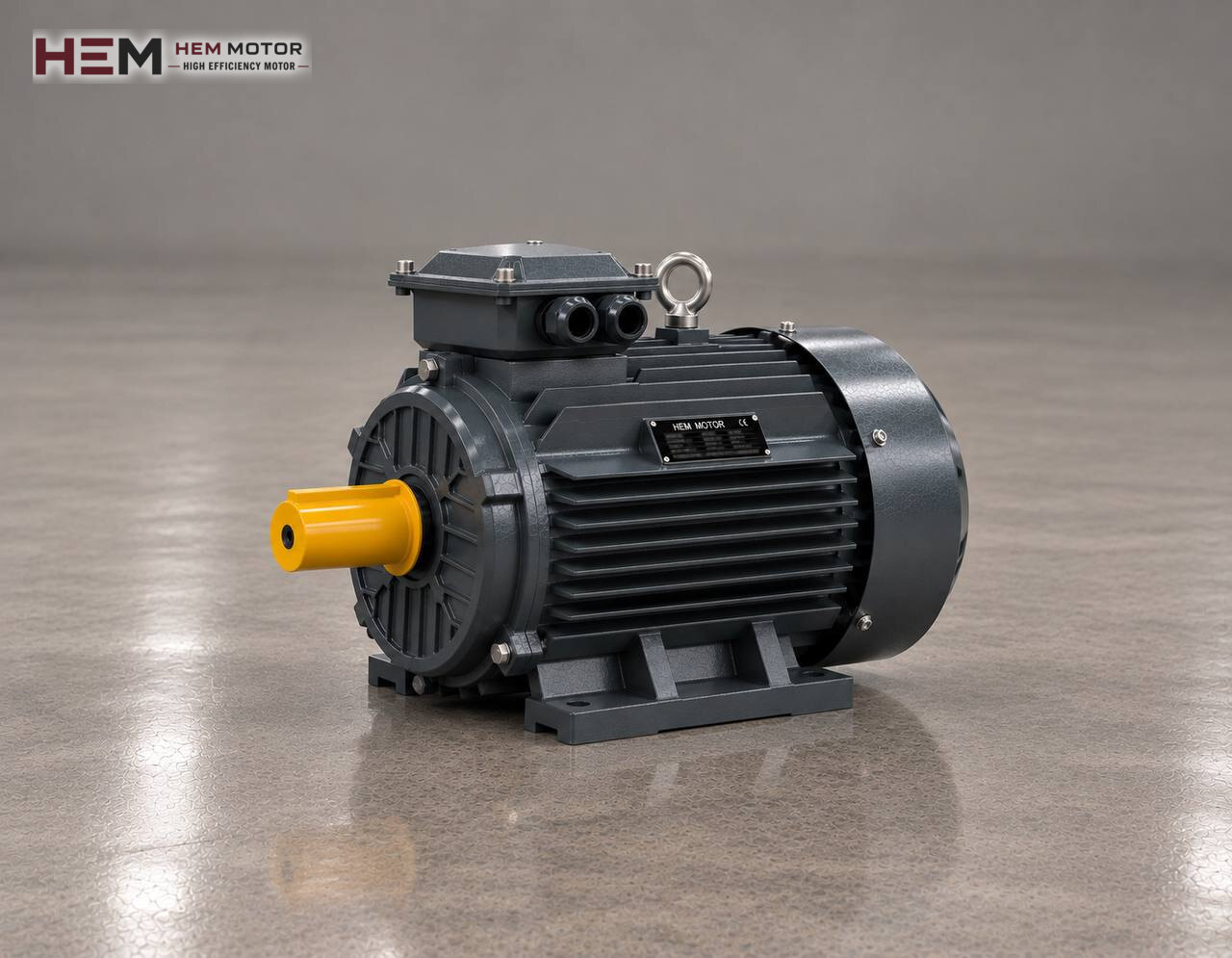
A blower is a machine that delivers air continuously at a pressure a fan cannot reach but far below that of a compressor; it sends air to the diffusers of a treatment basin, to a pneumatic conveying pipe or to a drying line. This page covers the three-phase asynchronous motor that turns the blower rotor; for an overview of all ventilation machines, go back to our Ventilation Electric Motors page.

How Does a Roots Blower Move Air, and What Does the Motor Feel?
In a rotary lobe (roots) blower, two rotors inside the casing turn in opposite directions without touching, thanks to external timing gears. With each turn, a pocket of air trapped between the lobes is carried from the inlet to the discharge port. The air is not compressed inside; pressure builds when the pocket meets the line on the discharge side.
For the motor the consequence is this: the air volume delivered is almost directly proportional to speed, while shaft torque depends on back-pressure rather than speed. As the basin water gets deeper, diffusers clog or a valve is added to the pipework, pressure — and with it motor current — rises. This machine is therefore treated as a constant-torque load; unlike a fan, its load does not drop sharply as speed falls.
Protection against overpressure is the blower side's job: the relief valve on the discharge line vents air when the design pressure is exceeded. If this valve sticks or its setting is raised, the motor runs permanently overloaded; an overload trip is then usually a valve or line problem, not a motor fault.
The Motor in Side Channel and Multistage Blowers
In a side channel (regenerative) blower, a single impeller with bucket-shaped edges accelerates the air again and again along a circular groove machined into the casing. The impeller usually sits on the motor's own shaft and the motor is bolted to the blower casing by its flange; typical speed is the 2-pole class. Unlike the roots type, load rises with a closed valve; if inlet or outlet is fully throttled, the impeller heats up and the motor is strained. It is common in vacuum and low-flow pressure duties, aquariums and fish ponds, and packaging machines.
In multistage centrifugal blowers, several impellers lined up on a common shaft compress the air step by step. The motor is connected by a coupling, and speed is again mostly in the 2-pole class. In this machine power falls as airflow decreases; keeping the inlet valve throttled at start-up eases acceleration. The special motors of high-speed turbo blowers with integrated motors are not in HEM Motor's 2026 catalogue; this page covers arrangements driven by a standard IEC motor.
Belt-and-Pulley Arrangement and Base-Frame Mounting
In most roots blower packages the motor sits beside or below the blower on a base with a tensioning device, and power is transmitted by belts. The pulley ratio sets the blower speed and hence the airflow; users wanting a different airflow often just change the pulley. Since torque stays roughly constant as long as pressure is unchanged, raising the speed increases power in the same proportion; check the power on the motor nameplate before making the change.
Belt tension places a side load on the motor's drive-end bearing. Fitting the pulley close to the shaft shoulder, keeping tension at the manufacturer's value and not over-tightening the belt extends bearing life. Where high side loads are expected, state this in your order.
Depending on the frame, blower motors can be supplied with feet, flange or both (B3, B5, B14, B34, B35) or in vertical position (V1, V3, V5, V6, V15); we settle the flange type and shaft size in the quotation. A foot-mounted frame is common on belt-driven packages, and a flange or foot-and-flange B34/B35 design on side channel blowers carried by the casing.
Starting: Start With the Blow-Off Valve Open
If a roots blower starts while the discharge line is under pressure, the motor must accelerate against full load from the first moment. That is why well-built packages have a blow-off valve on the discharge side: it is held open at start-up and closes once the motor reaches speed, directing air into the line. With this arrangement both star-delta and a soft starter work without trouble.
Watch the winding voltage: our models from 4 kW upwards are rated 400/690 V, connect in delta on a 400 V supply and suit star-delta starting. Smaller ones are rated 230/400 V; since they already run in star on a 400 V supply, this method is not used with them. In a package without a blow-off valve, or with a faulty one, the low torque in star may not suffice; the changeover drags out and the overload trips.
In treatment plants the blower usually runs twenty-four hours a day; this is continuous operation rather than frequent stop-start. Even so, the number of starts per hour matters for standby blowers switched in and out by dissolved oxygen control; in that case a PTC/PT100 winding sensor can be added as an order option.
Airflow Control With an Inverter, and Cooling
Because airflow in a roots blower is proportional to speed, a frequency inverter is the natural way to match air to the basin's oxygen demand. But since torque stays constant, at low speed the motor still draws high current while its own shaft fan slows down and cooling falls off. If hours of loaded operation at low frequency are expected, a separately powered cooling fan may be needed; if a long cable will run between drive and motor, a dv/dt or sine filter comes into play. Noting these in your quotation request is all we need. The three-phase motors in our ranges can be driven by an inverter; details on the inverter-compatible electric motors page.
Also check the blower's minimum permitted speed in the machine manufacturer's data; at very low speed the delivered air heats up and the blower may hit its own limit.
Blower Room, Acoustic Enclosure and Maintenance
Roots blowers are noisy and are often placed in an acoustic enclosure. The enclosure cuts noise but also traps hot air: the heat of the compressed air, the heat radiated by the blower casing and the motor's own losses build up in the same small volume. Check regularly that the enclosure ventilation fan is running and that the air inlet filter is not clogged; tell us the temperature inside the enclosure at the quotation stage.
Enclosure protection is IP55 and winding insulation is class F. For the humid, mildly corrosive air of a treatment plant, an anti-condensation heater is an order option; an aggressive gas atmosphere, however, is not a design condition of the standard motor and must be stated separately in the order. In maintenance, belt tension, pulley alignment and the noise of the pulley-end bearing are the first things to check. For pump and mixer drives in a treatment plant, the treatment plant pump and mixer motors page is a useful complement.
Motor Selection Table by Blower Type
| Blower type | Motor connection | Value to check | Example HEM model |
|---|---|---|---|
| Side channel blower | Flange-mounted, impeller on motor shaft | Current with closed valve, flange size | 3 kW 100L-2 (2,895 rpm) |
| Small roots package | Belt and pulley, tensioning base | Working pressure, pulley ratio | 5.5 kW 132S-4 (1,460 rpm) |
| Treatment basin roots blower | Belt and pulley, continuous duty | Basin depth, minimum speed on inverter | 18.5 kW 180M-4 (1,470 rpm) |
| Large roots or multistage blower | Belt or coupling | Starting method, blow-off valve | 45 kW 225M-4 (1,485 rpm) |
These models are for guidance; the actual choice is determined by the blower's back-pressure, required speed, connection type and site conditions. In replacement jobs, the kW and rpm values on the old motor's nameplate are the most solid starting point.
Send Us the Following for a Blower Motor
For a quotation, please send: the machine type (roots, side channel or multistage blower), required power and speed, supply voltage, mounting arrangement, connection type (belt, flange or coupling), whether it will run on an inverter, and the quantity. A photo of the existing motor's nameplate speeds things up; our send your motor nameplate article explains how to take it.
Prices are on the buy electric motors page, and WhatsApp and phone details are on the contact page. For all motor locations in treatment and biogas plants, read our treatment and biogas plant article.
Frequently Asked Questions
Is fitting a larger pulley enough to increase a roots blower's airflow?
Airflow rises, but because torque depends on pressure, power rises in the same proportion as speed. Before the change, check that the motor power and the blower's maximum permitted speed are sufficient.
Why does the blower motor trip its overload at start-up?
The most common cause is starting while the discharge line is under pressure. Check that the blow-off valve is open at start-up, that the relief valve is not stuck and that the relay is set to the nameplate current.
Can I halve the blower speed with an inverter?
Yes, if the blower's minimum permitted speed allows it; but since torque stays constant, the motor may heat up at low speed. State this mode of operation in your order; whether an external fan is needed will be assessed.
Can I replace a side channel blower's motor with a standard motor?
Because the impeller sits on the motor shaft, the new motor's shaft and flange must match the old one exactly. Send the old motor's nameplate and flange dimensions, and we will identify a compatible model together.