Replacing a Screw Compressor Electric Motor: Power and Coupling Compatibility

Replacing a Screw Compressor Electric Motor: Power and Coupling Compatibility

When the motor of a screw compressor fails, production often stops because it depends on compressed air, and the quickest solution seems to be finding a motor of the same power and fitting it. Yet in a screw compressor the motor is usually connected to the air end through a coupling and with precise shaft alignment; even if the power is right, the motor will not fit in place if the shaft, flange or coupling hub does not match. In this article we look at motor replacement in coupled screw compressors under two headings, power matching and coupling matching, and make it concrete with the relevant HEM Motor models.
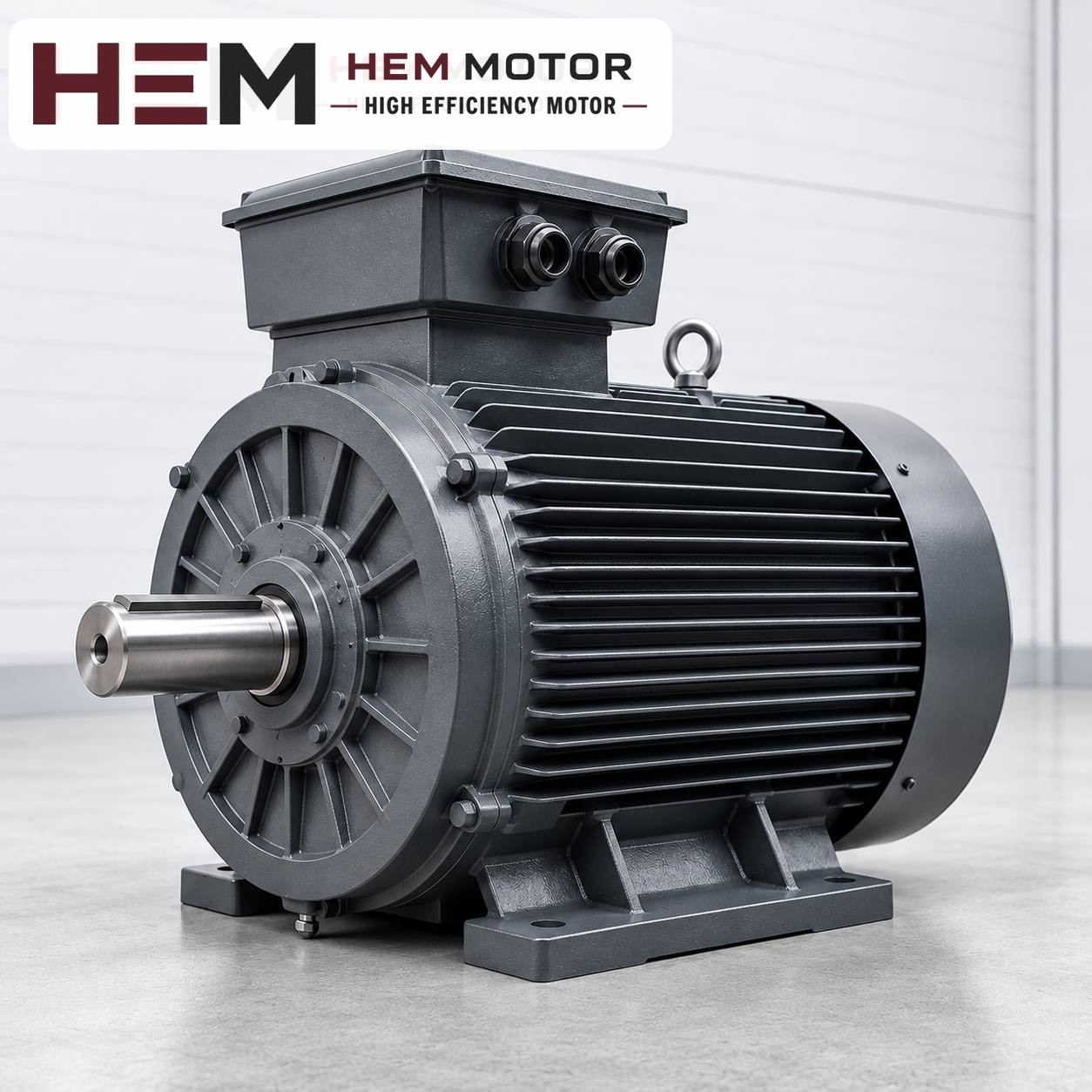
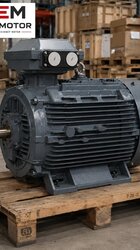
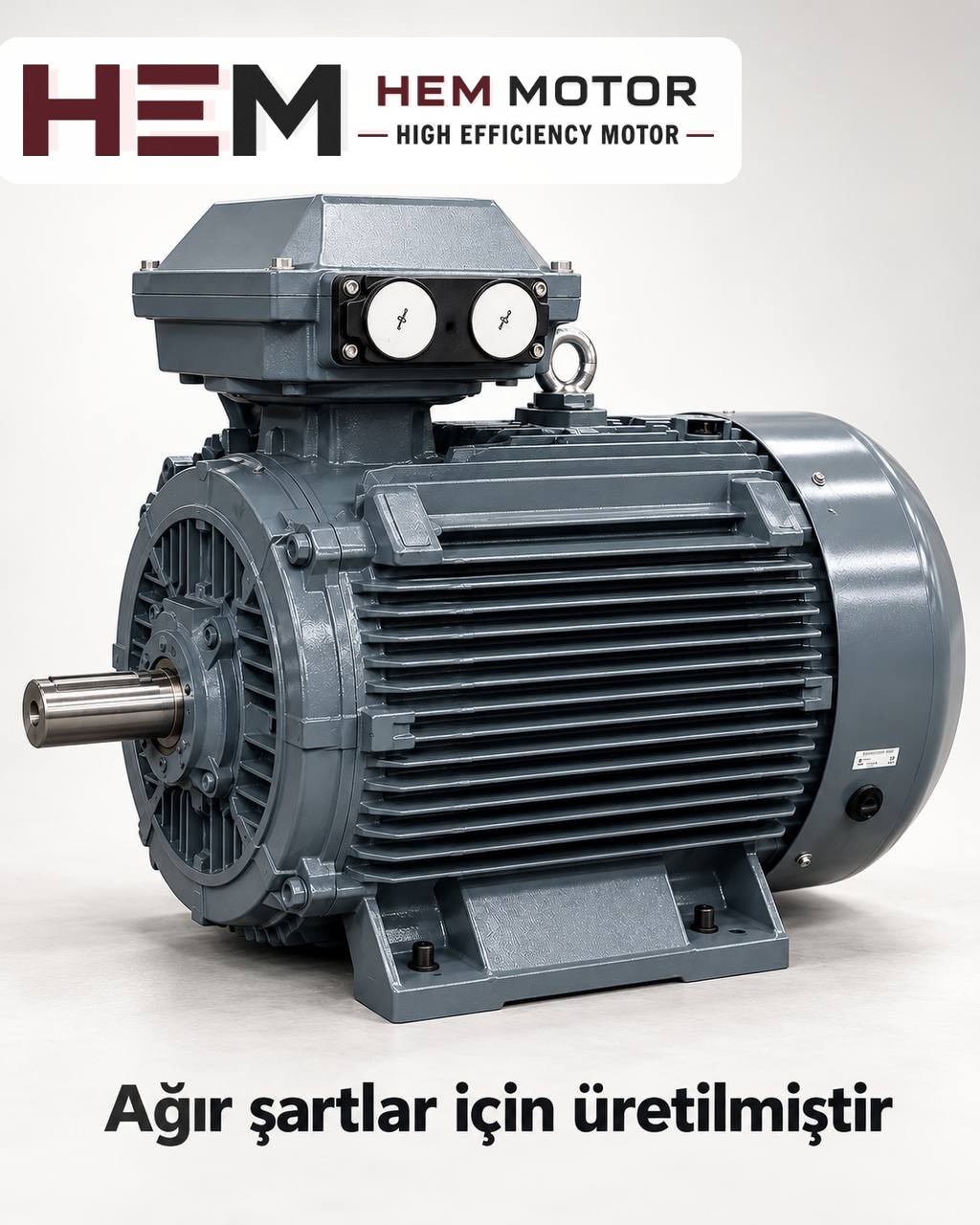
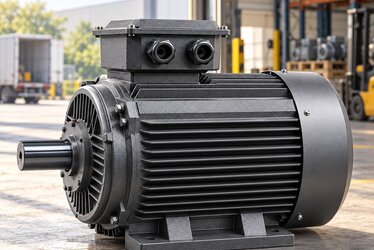
Three-phase electric motor with the shaft end visible
In a coupled drive, shaft end diameter, key and shaft length are checked together with the coupling hub (representative image).

Operating conditions of the motor in a screw compressor

From the motor's point of view, a screw compressor is not an ordinary constant load. Before a replacement you need to know the following operating characteristics:

  • Load/unload cycle: In conventional compressors, the motor switches to unloaded running when the pressure set point is reached and loads again when pressure falls. This cycle repeats many times a day.
  • Starting frequency: If air consumption is low, the motor stays unloaded for a long time and stops; it starts again when needed. The compressor controller limits the number of starts allowed per hour; when replacing, this setting and the new motor's suitability for the starting frequency should be discussed.
  • Hot enclosure: The motor is usually inside a sound-insulated enclosure. The temperature inside can be noticeably higher than that of the plant room; where the motor draws its cooling air from matters.
  • Direction of rotation: A screw air end is designed to turn in one direction only. Running it in reverse can cause damage within a short time, so the direction of rotation must be checked at the first start.

Power matching: is the kW on the nameplate enough?

The new motor's power must not be lower than the power on the old motor's nameplate. But looking only at kW misses some situations.

  • The old motor's service factor: Some compressor manufacturers use motors with a service factor above 1 and set up the compressor to use part of that margin. If the old nameplate shows an SF, be sure to tell us. In HEM Motor models the service factor is 1.15 at 75 kW and above; for smaller ratings no SF value is given in the product record, so equivalence at the same kW can only be assessed by knowing the old motor's real load.
  • Change in operating pressure: If the compressor's working pressure was raised later, the air end draws more power. If that was the cause of the motor failure, a motor of the same power may soon end up the same way.
  • Current and protection: If the new motor's nameplate current differs from the old one's, the protection settings on the compressor controller and in the panel are updated to the new nameplate.
  • Speed: In a coupled compressor the air end speed equals the motor speed (in models with a gearbox the gear ratio also comes into play). Fitting a motor with a different number of poles changes the air flow and the absorbed power; therefore the speed is kept the same as the old motor's.

Coupling matching: the connection between motor and air end

In coupled screw compressors, the motor and air end are usually joined in one of two ways: the motor is bolted by its feet to a common base frame and drives the air end through a coupling, or the motor sits by its flange on a bell housing (adapter housing), with the coupling inside that bell.

Shaft and coupling hub

  • Shaft end diameter and key: The bore and keyway of the coupling hub must fit the new motor's shaft exactly. If the hub has to be re-machined, the cost and time are added to the replacement plan.
  • Shaft length and shoulder distance: The hub must seat fully on the shaft, and the gap between the two coupling halves must stay at the value specified by the coupling manufacturer. If the shaft is shorter or longer, the gap will not match.
  • Special shaft: In some compressors the motor was built with a non-standard shaft end or a special connection. In that case a standard motor can only be used if the connection matches exactly; otherwise a special motor is needed. Send us the old motor's nameplate and shaft dimensions and we will assess it together.

Flange, feet and shaft alignment

  • Flange connection: If the motor is connected to the bell by its flange, the flange type and size are decisive; at HEM Motor the flange size is confirmed with the order. Mounting arrangements are offered according to the frame; the options are summarised in the question on mounting arrangements.
  • Foot connection: If the motor is fixed to the base frame by its feet, the shaft height and foot hole spacing must be the same as the old motor's. These dimensions are given by frame in the 2D technical drawings and the 2026 catalogue.
  • Alignment: With a foot connection, the coupling alignment is measured and redone after the replacement. A misaligned coupling wears the motor bearings and the air end bearings.

Prices and technical data are on the product pages; choose a model and order online.

Same power, different frame: the 37 kW example

The 37 kW models show well why frame compatibility matters. At HEM Motor, 37 kW is offered with a cast iron frame, and the frame size changes with speed:

Model codePowerSynchronous / rated speedIEC frameRated current (400 V)Rated torque
200L2-237 kW3,000 / 2,960 rpm200L64.0 A119.4 Nm
225S-437 kW1,500 / 1,485 rpm225S66.1 A237.9 Nm
225M-445 kW1,500 / 1,485 rpm225M80.2 A289.4 Nm

At the same 37 kW, the 3,000 rpm model is in a 200L frame and the 1,500 rpm model in a 225S frame; the shaft height, foot spacing and very probably the shaft end differ. In other words, you need to know not only the old motor's power but also its speed and frame size. All three models in the table are IP55, insulation class F and supplied at 400/690 V (Δ/Y), 50 Hz; on a 400 V network they are connected in delta and are suitable for star-delta starting.

Starting and inverter-driven compressors

Most conventional fixed-speed screw compressors start with star-delta; since the air end is held unloaded during the start, the starting load is low. For this arrangement the new motor must be rated for delta connection at 400 V; a motor rated 230/400 V cannot be used with star-delta on a 400 V network.

In variable-speed (inverter-driven) compressors the motor is fed from a frequency inverter. HEM Motor's three-phase series are suitable for speed control with a drive. If the compressor stays at its lowest speed and full torque for long periods, an external fan may be needed for the motor; if the drive is far from the enclosure and the cable is long, a dv/dt or sine filter is considered. State these conditions and the speed range the drive will operate in with your order; for details see the question on use with an inverter. In some inverter-driven compressors the motor is designed specifically for the compressor; in that case replacement with a standard motor may not be possible.

Example scenario: a foot-mounted, coupled 37 kW compressor

The scenario is for illustration and hypothetical; no customer event is described. Suppose that in a workshop the 37 kW motor of a fixed-speed screw compressor started with star-delta is to be replaced because of a winding failure. The old motor's nameplate reads 2,960 rpm and frame 200L.

  • Since speed and frame stay the same, the candidate is the 37 kW motor with model code 200L2-2.
  • If the old nameplate turns out to show SF 1.15, the compressor's real draw is checked from service records or a current measurement; if the motor runs continuously above its nameplate power, the next power up is considered. Because the frame may change at the next power, base and coupling compatibility are checked again.
  • The shaft end and key are compared with the existing coupling hub using the catalogue; it is checked whether the shaft length changes the coupling gap.
  • After mounting, the coupling is aligned, the current setting in the compressor controller is updated to the new nameplate, and the direction of rotation is checked with a brief jog at the first start.

For a compressor whose air end runs with a 1,500 rpm motor, the 225S-4 or the next power up, the 225M-4, comes into question; which is suitable is determined from the old motor's nameplate and frame dimensions.

Information to send for the replacement

  • A photo of the old motor's nameplate: power, speed, current, voltage, frame size and SF if shown
  • Compressor type: fixed-speed or inverter-driven; starting method
  • Connection: foot-mounted with a coupling or flange-mounted to a bell housing; if flanged, the flange size
  • Shaft end diameter, key width and shaft length; coupling type
  • Enclosure temperature and environment, number of starts per day

General information on compressor applications is on our compressor electric motors page. You can see suitable models and current prices on the buy electric motors page. To ask for the right model using your motor's nameplate data, send us the motor nameplate; for other questions use our contact page.

HEM Motor Models Related to This Article

The cards show example models related to the topic. A suitable motor is not chosen by power alone: compare speed, voltage, mounting, shaft and connection dimensions on the product page; if unsure, send a photo of the existing motor’s nameplate on WhatsApp.

37 kW 3000 rpm Cast Iron Frame Electric Motor 200L2-2

200L2-2

37 kW · 3000 rpm

  • Cast iron frame · IEC 200L
  • 2960 rpm · IP55
  • Mounting: B3 foot; flange (B5/B14/B35) depending on frame — confirmed with the order

US$1,474.59 (€1,315.97)

View product
37 kW 1500 rpm Cast Iron Frame Electric Motor 225S-4

225S-4

37 kW · 1500 rpm

  • Cast iron frame · IEC 225S
  • 1485 rpm · IP55
  • Mounting: B3 foot; flange (B5/B14/B35) depending on frame — confirmed with the order

US$1,517.45 (€1,354.22)

View product
45 kW 1500 rpm Cast Iron Frame Electric Motor 225M-4

225M-4

45 kW · 1500 rpm

  • Cast iron frame · IEC 225M
  • 1485 rpm · IP55
  • Mounting: B3 foot; flange (B5/B14/B35) depending on frame — confirmed with the order

US$1,677.74 (€1,497.27)

View product

Similar Articles