If a compressor motor cannot start against tank pressure, the cause is usually not the motor's power. The most common causes are a faulty unloader or check valve, low supply voltage or a lost phase, and an incorrectly set star-delta changeover; until these are corrected, a larger motor will struggle in the same way. This article explains which checks to make on site, in what order, before ordering a new motor, and which finding really calls for a motor replacement.
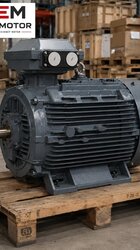
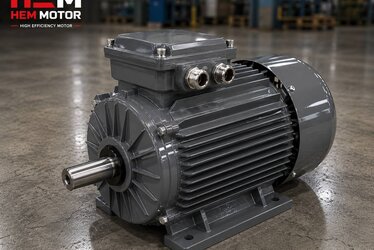
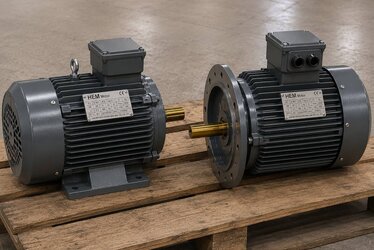
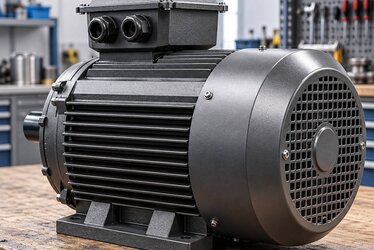
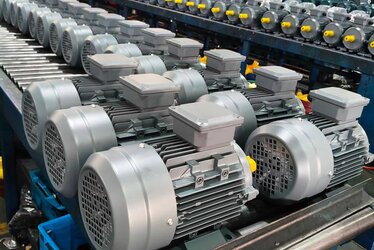
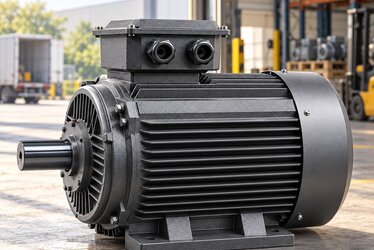
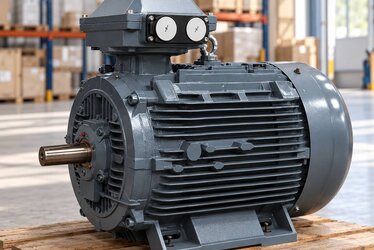
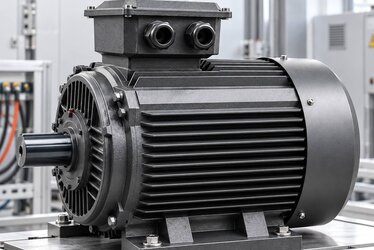
On a compressor with starting problems, the arrangement before and after the motor is checked first (representative image).
A compressor is actually designed to start unloaded
Most reciprocating and screw compressors are designed on the assumption that the compression side will be unpressurised when the motor starts. On a reciprocating compressor, when the pressure switch stops the motor, the unloader valve vents the air between the head and the check valve. On a screw compressor, the inlet valve is held closed at start and a restart is not allowed until the separator tank pressure has fallen to a certain level.
When this arrangement works, the motor only has to overcome friction and the inertia of the rotating parts at start. When it fails, the motor has to accelerate while compressing against tank pressure. An induction motor's starting and breakdown torque cannot always handle this load; the motor stalls at low speed, hums and the protection trips. In other words, the symptom of "not starting under pressure" is usually a fault in the unloading arrangement, not in the motor.
Order of checks on site
The sequence below starts with the most likely and easiest-to-check cause. Electrical measurements must be made by an authorised person.
Step
Check
Sign of a fault
1
Unloader valve (reciprocating) / inlet valve and blow-down (screw)
No hissing when the motor stops; pressure remains in the head or separator tank
2
Check valve
Tank air leaks continuously through the unloader line or flows back to the head
3
Three-phase voltage at the moment of starting
Voltage drops markedly at start, or one phase is missing
4
Contactor contacts and terminal connections
Burnt contact, loose terminal, current difference between phases
5
Star-delta changeover time and connection
Motor switches to delta before gaining speed in star, or stays stuck in star
6
Mechanical seizure and oil condition
Shaft is hard to turn by hand when de-energised; oil very thick in the cold
7
The motor itself
Low insulation resistance, resistance imbalance between windings, bearing noise
Unloader and check valve: the most common cause
On a reciprocating compressor the unloader valve is usually on the pressure switch and vents the air in the head with a short hiss when the motor stops. If there is no hiss, or it lasts very long, there are two possibilities: the unloader valve is blocked and the head stays pressurised, or the check valve leaks and tank air escapes through the unloader line. In the first case the motor works against pressure at the next start; in the second, the compressor cuts in constantly and the winding heats up.
On a screw compressor, an inlet valve that does not close at start or a blow-down valve that does not vent the separator tank gives the same result. These checks are made according to the compressor manufacturer's instructions; replacing the part is both cheaper and faster than replacing the motor.
Voltage, phase and contactor: electrical causes that reduce motor torque
The torque an induction motor produces varies roughly with the square of the applied voltage. If the voltage drops by ten percent at the moment of starting, the motor's starting torque falls by roughly a fifth. A long supply cable, an undersized cable cross-section, a weak transformer or other large loads on the same line can cause this drop. The measurement must be made at the motor terminals and at the moment of starting; the no-load voltage is misleading.
Losing a phase is more serious. Without one phase, a three-phase motor cannot start from standstill; it only hums and heats up quickly. A burnt contactor contact, a blown fuse or a loose terminal can cause this. A current difference between phases is also a warning sign. We explained in detail which fault trips which protection device in our motor protection article.
Prices and technical data are on the product pages; choose a model and order online.
Star-delta: are the changeover time and connection correct?
In star connection the motor torque is about one third of that in delta. If the compressor starts unloaded, this torque is enough; if it starts under pressure, it is not. That is why, on a compressor running with star-delta, a sound unloading arrangement is even more important.
Changeover time: If the timer relay switches too early, the motor goes to delta at low speed and a large current surge occurs; if it switches too late, the motor struggles in star for a long time.
Nameplate voltage: For star-delta, the motor must run in delta on a 400 V network. HEM Motor's three-phase models of 4 kW and above are rated 400/690 V (Δ/Y) and suit this arrangement. Models of 3 kW and below are rated 230/400 V (Δ/Y); on a 400 V network they are connected in star and cannot be started with star-delta.
Wrong connection: If the old motor was rated 230/400 V while the panel was built for star-delta, or if a motor with a different nameplate voltage was fitted during a replacement, the motor runs permanently at low torque. Always check that the nameplate and the panel arrangement match.
When is a motor replacement really needed?
If the checks above are clean and the problem persists, the motor itself is examined: winding insulation resistance, resistance balance between the three windings and bearing condition. A motor with an aged winding or a partial short circuit cannot produce its rated torque. Also, if the compressor's capacity has been increased (pulley enlarged, pressure setting raised), the motor may have become too small for the new load; in that case the power is redetermined according to the compressor manufacturer's value.
When replacing, the old motor's number of poles, frame code and nameplate voltage are kept. Example 4-pole models in power ratings common on compressors:
132S-4 cast iron: 5.5 kW (7.5 HP), 1,460 rpm, IEC 132S, 400/690 V (Δ/Y), 10.7 A, 36 Nm.
160M-4 aluminium: 11 kW (15 HP), 1,465 rpm, IEC 160M, 400/690 V (Δ/Y), 20.4 A, 71.7 Nm.
180M-4 cast iron: 18.5 kW (25 HP), 1,470 rpm, IEC 180M, 400/690 V (Δ/Y), 33.5 A, 120.2 Nm.
Review suitable HEM Motor models and current prices on the buy electric motors page. Information specific to compressor applications is on the compressor motors page.
Hypothetical example: a compressor that starts in the morning but not during the day
This example has been constructed for explanation. Suppose an 11 kW reciprocating compressor in a workshop starts without problems at the first start in the morning; but during the day, when the pressure switch brings the motor back in, the motor hums and the thermal relay trips.
In the morning the tank and head are unpressurised, so starting is easy; during the day it turns out that pressure remains in the head.
When the motor stops, there is no hiss from the unloader valve; the valve is clogged with dirt.
After the valve is cleaned and replaced, the motor reaches speed without problems at every start. The motor's insulation resistance is measured and found normal, so no motor replacement is needed.
Conclusion: information to send before ordering
On a compressor that will not start under pressure, the unloading arrangement, voltage and starting method are checked first; motor replacement is the last step. If the motor is to be replaced, send the following:
A photo of the old motor's nameplate: power, speed, nameplate voltage, frame
Compressor type (reciprocating/screw), working pressure and any capacity change
Starting method (direct-on-line, star-delta, drive) and panel arrangement
Voltage and current values measured at the moment of starting
Mounting arrangement and pulley/coupling details
You can see the models and current prices on our online sales page. Upload a photo of your current motor's nameplate, its speed and mounting details to the nameplate submission page and request a quote for a suitable model; for other questions, write to us.
Frequently Asked Questions
What should I do if the compressor motor hums but does not turn?
Stop the motor immediately. The most likely causes are a lost phase or pressure remaining in the head; check the fuses, the contactor and the unloader valve.
Will a more powerful motor solve the problem of starting under pressure?
It may hide it temporarily, but if the cause is the unloader valve or voltage drop, the problem persists and the compressor is stressed too. Remove the cause first.
If the compressor does not start in star-delta but starts direct-on-line, is the motor faulty?
Usually not. In star the torque drops to one third; if the unloading arrangement is faulty, this torque is not enough. Check the unloader valve and the changeover time first.
What could be the reason if starting becomes harder in cold weather?
Compressor oil thickening in the cold increases the starting load. Use the oil recommended by the compressor manufacturer and keep the room from getting too cold.
HEM Motor Models Related to This Article
The cards show example models related to the topic. A suitable motor is not chosen by power alone: compare speed, voltage, mounting, shaft and connection dimensions on the product page; if unsure, send a photo of the existing motor’s nameplate on WhatsApp.
There is no single "seed cleaner motor" in a seed cleaning and grading machine; the machine consists of several motors, each carrying a different load: the drive that shakes the si... More Details
On a dough kneading machine, the spiral or fork arm folds the dough with a slow but powerful movement; on most models the bowl also turns about its own axis. This need for low spee... More Details
On a circular saw, the toothed blade cuts the material at dozens of revolutions per second; on most machines the blade is attached to the motor shaft or to a shaft very close to th... More Details
On a wood band saw, the blade that does the cutting runs over two large wheels; the motor usually turns the lower wheel through a belt and pulley. Thanks to this arrangement, a ban... More Details
On a bridge-type marble cutting machine, the main motor is the part that turns the diamond blade and carries the heaviest load throughout the cut. When this motor has to be replace... More Details
Baling presses compress cardboard, paper, plastic film, PET bottles and scrap metal into transportable bales. The part that produces the press force is the hydraulic cylinder; what... More Details
We use necessary and optional cookies to improve your experience, enhance content and analyse traffic. Under the GDPR, optional (analytics/marketing) cookies are only used with your explicit consent. Please choose your preference below.
Cookie Policy
 English
 Français
 Türkçe
 Español
 Русский