Replacing the Main Electric Motor on a Marble Bridge Cutting Machine

Replacing the Main Electric Motor on a Marble Bridge Cutting Machine

On a bridge-type marble cutting machine, the main motor is the part that turns the diamond blade and carries the heaviest load throughout the cut. When this motor has to be replaced because of a fault or age, the first idea is usually to read the power on the nameplate and buy a motor with the same kW rating. On a bridge saw, however, what really decides the outcome is how the motor is connected to the cutting head. In this article we go through, in order, what to check before the replacement, when a standard three-phase motor can do the job and when a special motor is needed.

How is the main motor connected on a bridge saw?

Machine builders design the cutting head in different ways. Before the replacement, identifying which group your machine belongs to is the first step towards finding the right motor.

  • Blade mounted directly on the motor shaft: The diamond blade is clamped with flange washers onto the motor's extended shaft, which is threaded or stepped. The shaft length, the shaft end form and the front bearing are designed to carry the blade load. This design is specific to the machine.
  • Head driven by belt and pulley: The motor sits in a separate seat on the head, the blade spindle turns in its own bearings and power is transmitted by a belt. The motor shaft carries only a pulley.
  • Motor hung on the head body by its flange: The motor is bolted to the cutting head by its front flange; the shaft either drives the blade spindle through a coupling or carries the blade directly.

Of these three designs, a standard motor can be considered only in belt-and-pulley and coupling arrangements, and only if the connection dimensions follow the IEC standard. If the blade is mounted directly on the shaft, the situation is different.

When can a standard motor be fitted directly?

On marble machines, a large share of the motors are built with a special shaft, special bearings, a long or special flange, or a shaft on which the blade is mounted directly. A standard motor can be fitted directly in its place only when all of the following conditions are met:

  • The shaft diameter, length and key must have the standard values for the motor's IEC frame size.
  • The flange type and connection dimensions (spigot diameter, pitch circle, number of holes) must match a standard B5 or B14 flange.
  • For foot mounting, the foot hole spacing and the shaft height must fit the existing base.
  • The shaft end must carry a pulley or a coupling, not the blade; in other words, the motor bearings must not carry the blade forces directly.

If even one of these points is not met, going ahead with a standard motor is not right: a special motor is needed. In that case, photograph the nameplate, the shaft end and the flange face of the motor to be removed and send them to us; we will assess the need for a special motor on that basis. Site adaptations such as turning down the shaft end, welding an adapter onto the flange or changing the bearing can upset both the alignment and the balance of the blade.

To compare standard dimensions, see the 2D technical drawings and the 2026 technical and product catalogue. The general relationship between frame size and power is explained in the frame size table. Our product pages do not list the mounting arrangement for each model one by one; foot, flange, foot-and-flange and vertical options are offered according to the frame, and the size of the flange that will sit on the cutting head is confirmed with you at the order.
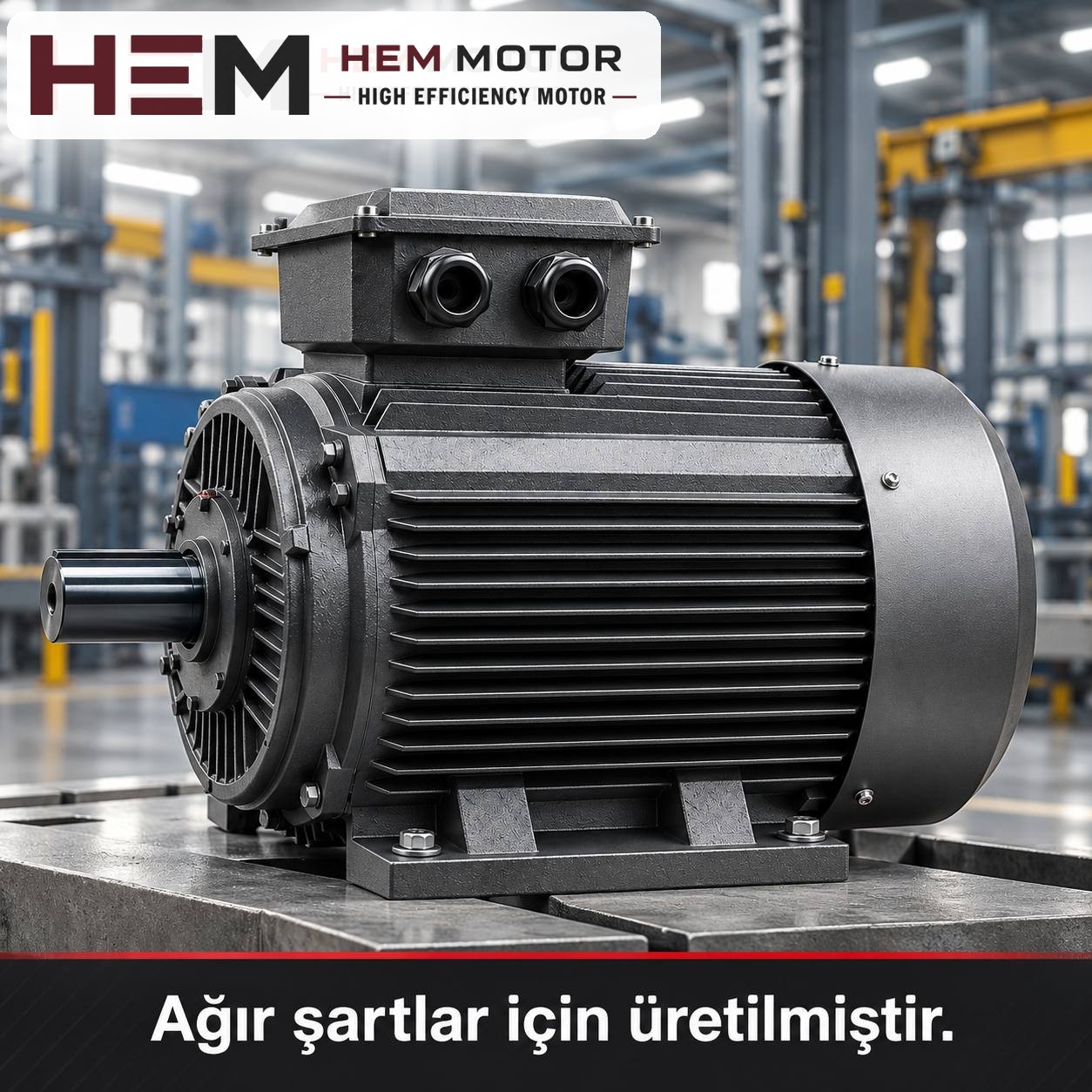
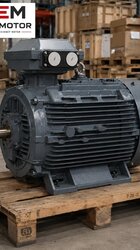
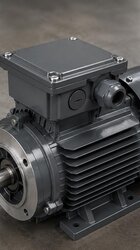
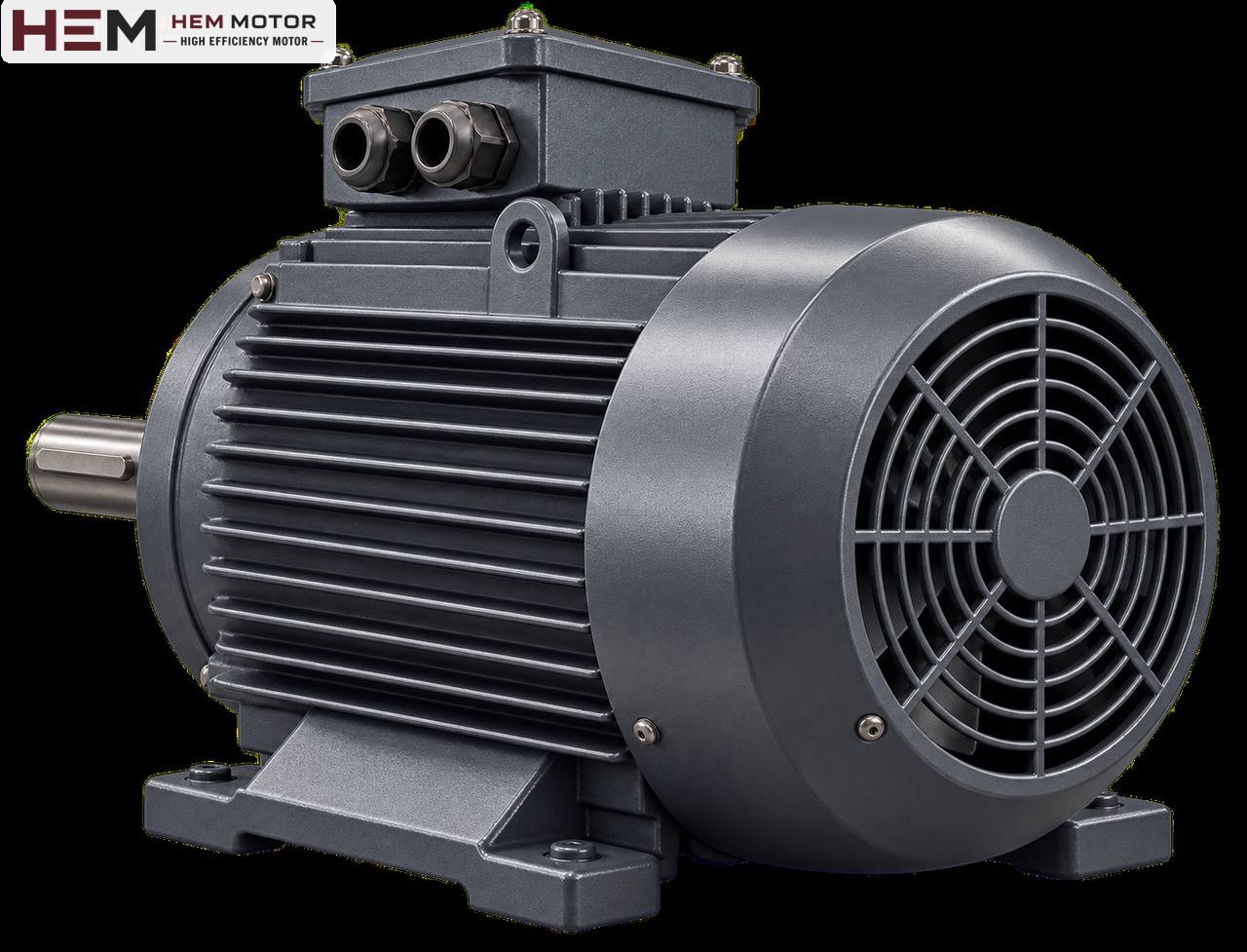
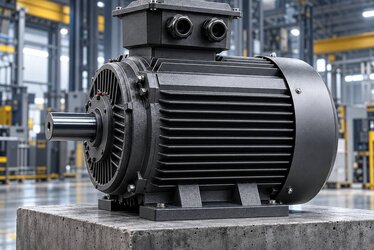
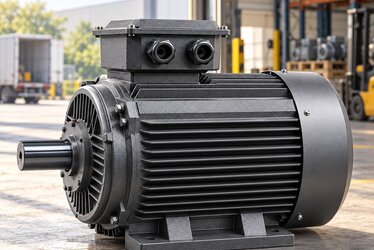
Three-phase motor in harsh conditions similar to a stone workshop
The shaft and flange of the motor on the cutting head should be photographed before the replacement (representative image).

Water, slurry and dust: the limit of IP55

On a bridge saw the blade is cooled with water all the time; stone slurry and fine dust build up around the machine. All HEM Motor models on sale have IP55 protection. This class keeps out dust that would harm the internal parts and withstands light water spray reaching the motor from various angles. However, it does not cover a motor that stays under a continuous curtain of water, is pressure-washed or runs buried in slurry.

  • Place the motor as far as possible from the zone where the blade throws water; keep the protective cover in place if there is one.
  • Keep the air inlet of the fan cover clear of slurry and dust; a clogged cover weakens cooling.
  • Check the terminal box cover gasket and the sealing of the cable entry at every replacement.
  • If the water jet is aimed straight at the motor, state this clearly in the order; conditions beyond IP55 are outside the scope of a standard motor.

In such environments, cast iron frame models are usually preferred; the stiffer frame copes better with head vibration and impacts.

Prices and technical data are on the product pages; choose a model and order online.

Power and speed: what to read on the nameplate

It is not possible to state an exact power just from the name of a bridge cutting machine. Blade diameter, hardness of the stone, cutting depth, feed rate and daily operating time are assessed together. For a replacement, the most reliable reference is the nameplate of the old motor that has worked without problems. Note the following from the nameplate:

  • Power (kW or HP) and rated speed. For example, a motor with 1,500 rpm synchronous speed shows a value such as 1,465 or 1,470 rpm on its nameplate; this difference is normal.
  • Voltage and connection (such as 400/690 V Δ/Y) and rated current.
  • Frame size (such as 160L, 180M) and mounting arrangement.
  • The machine builder's special part number, if any; such a number is a sign of a special motor.

If the blade speed differs from the motor speed, the ratio between them is set by the pulley diameters. Changing the speed changes the peripheral speed of the blade; so staying with the same number of poles is the safest route. On machines where cutting speed is set by a drive, our three-phase motors can be used with a frequency inverter. If the blade will turn at low speed and full load for long periods, the motor's own fan may not be enough and a separate fan is considered; if the drive is far from the panel, a dv/dt or sine filter comes into play depending on cable length. Write these details with your order. For a summary of the topic, see the inverter question.

Example: replacing a 15 kW motor on a belt-driven head

The following flow is a hypothetical example; it is not a real customer application. Consider a machine where the motor drives the blade spindle by belt and sits on a foot-mounted (B3) slide. The old motor's nameplate shows 15 kW, 1,465 rpm and a 160L frame.

  • Verify the connection: The shaft end carries only a pulley and the blade turns in separate bearings. The shaft diameter and keyway are compared with the standard size and they match.
  • Match the model: These values correspond to the 15 kW 1,500 rpm cast iron 160L-4 model: 4 poles, 1,465 rpm, IEC 160L, 400/690 V (Δ/Y), 27.3 A rated current.
  • Check the base: As the frame size is the same, the holes in the slide are expected to line up; still confirm the foot spacing with the technical drawing.
  • Set the belt alignment: If the pulley is taken off the old motor and fitted to the new shaft, check the hub and key fit, then adjust the belt tension.

If on the same machine the old motor turns out to be an 18.5 kW unit with a 180M frame, the match is the 180M-4 model (1,470 rpm, 33.5 A). If a 3,000 rpm motor was used on the head, the 160M2-2 (2,945 rpm, IEC 160M) can be compared for 15 kW. If the frame size changes, the slide and belt distance change too. The current price is shown on each model's own product page.

Common mistakes during replacement

  • Ordering by power alone, without comparing the shaft and the flange.
  • Trying to replace a special shaft that carries the blade directly with a standard shaft.
  • Changing the number of poles without allowing for the change in blade speed.
  • Turning the water jet towards the motor and assuming IP55 will be enough.
  • Not updating the thermal protection setting to the rated current of the new motor; for this, see the motor protection article.

What to prepare for a quotation

So that we can give the right answer for a bridge saw motor, send the following information together:

  • A photo of the nameplate of the motor on the head, sharp enough for every value to be read
  • Close-up photos of the shaft end and the flange; if possible, the shaft diameter and length
  • Connection type: is the blade directly on the shaft, belt-driven or coupled?
  • Mounting arrangement (foot, flange, foot-and-flange) and mains voltage
  • Starting method and how close water and slurry get to the motor

You can find three-phase models that may suit belt-driven or coupled heads, with their prices, in the buy electric motors section. If the shaft or flange is not standard, send the motor nameplate and the photos; let us clarify together whether a special motor is needed. For any other questions, use our contact page.

HEM Motor Models Related to This Article

The cards show example models related to the topic. A suitable motor is not chosen by power alone: compare speed, voltage, mounting, shaft and connection dimensions on the product page; if unsure, send a photo of the existing motor’s nameplate on WhatsApp.

15 kW 1500 rpm Cast Iron Frame Electric Motor 160L-4

160L-4

15 kW · 1500 rpm

  • Cast iron frame · IEC 160L
  • 1465 rpm · IP55
  • Mounting: B3 foot; flange (B5/B14/B35) depending on frame — confirmed with the order

US$673.45 (€601.85)

View product
18.5 kW 1500 rpm Cast Iron Frame Electric Motor 180M-4

180M-4

18.5 kW · 1500 rpm

  • Cast iron frame · IEC 180M
  • 1470 rpm · IP55
  • Mounting: B3 foot; flange (B5/B14/B35) depending on frame — confirmed with the order

US$867.46 (€775.24)

View product
15 kW 3000 rpm Cast Iron Frame Electric Motor 160M2-2

160M2-2

15 kW · 3000 rpm

  • Cast iron frame · IEC 160M
  • 2945 rpm · IP55
  • Mounting: B3 foot; flange (B5/B14/B35) depending on frame — confirmed with the order

US$566.29 (€506.09)

View product

Similar Articles