English
 Français
 Türkçe
 Español
 Русский

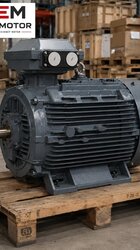
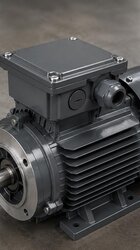

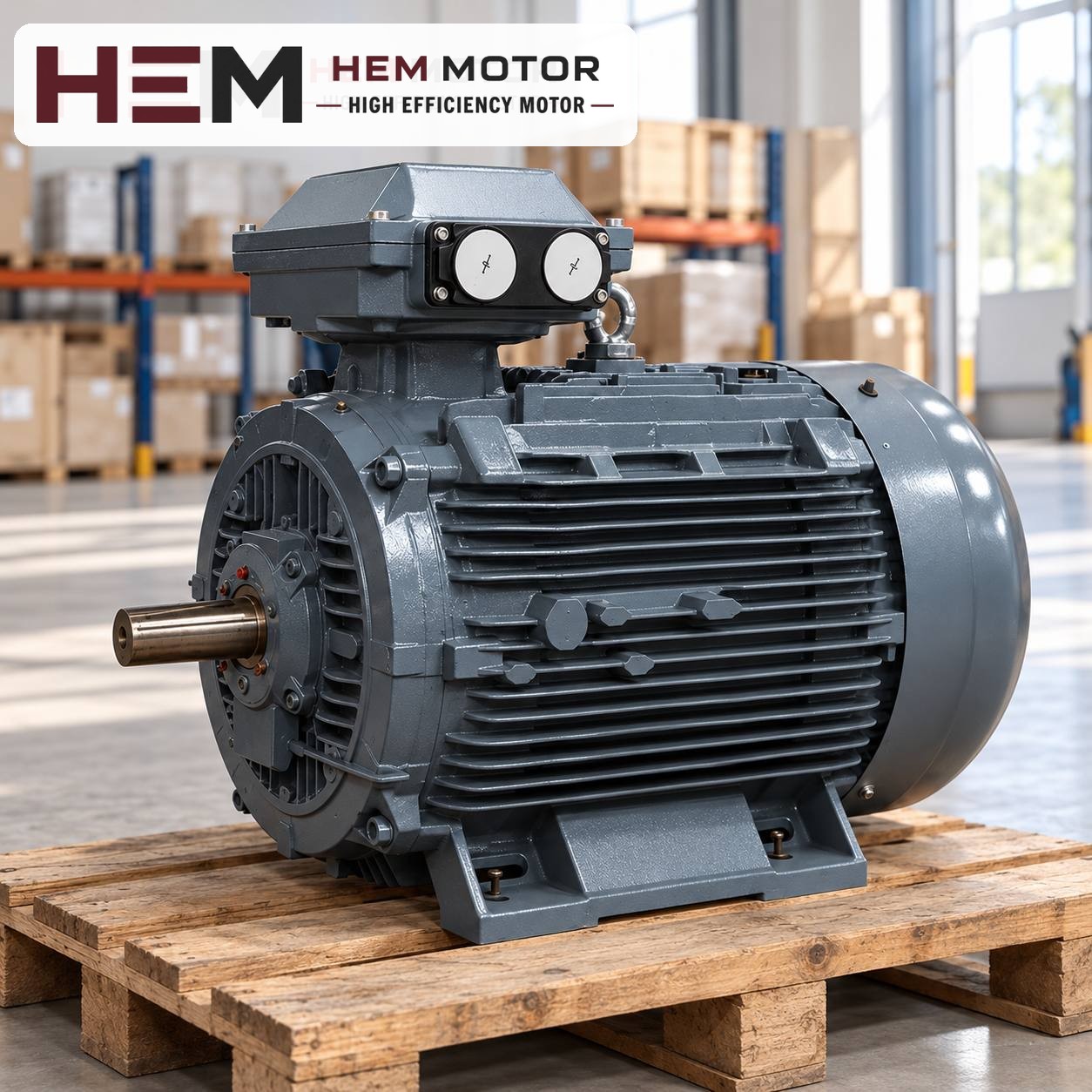

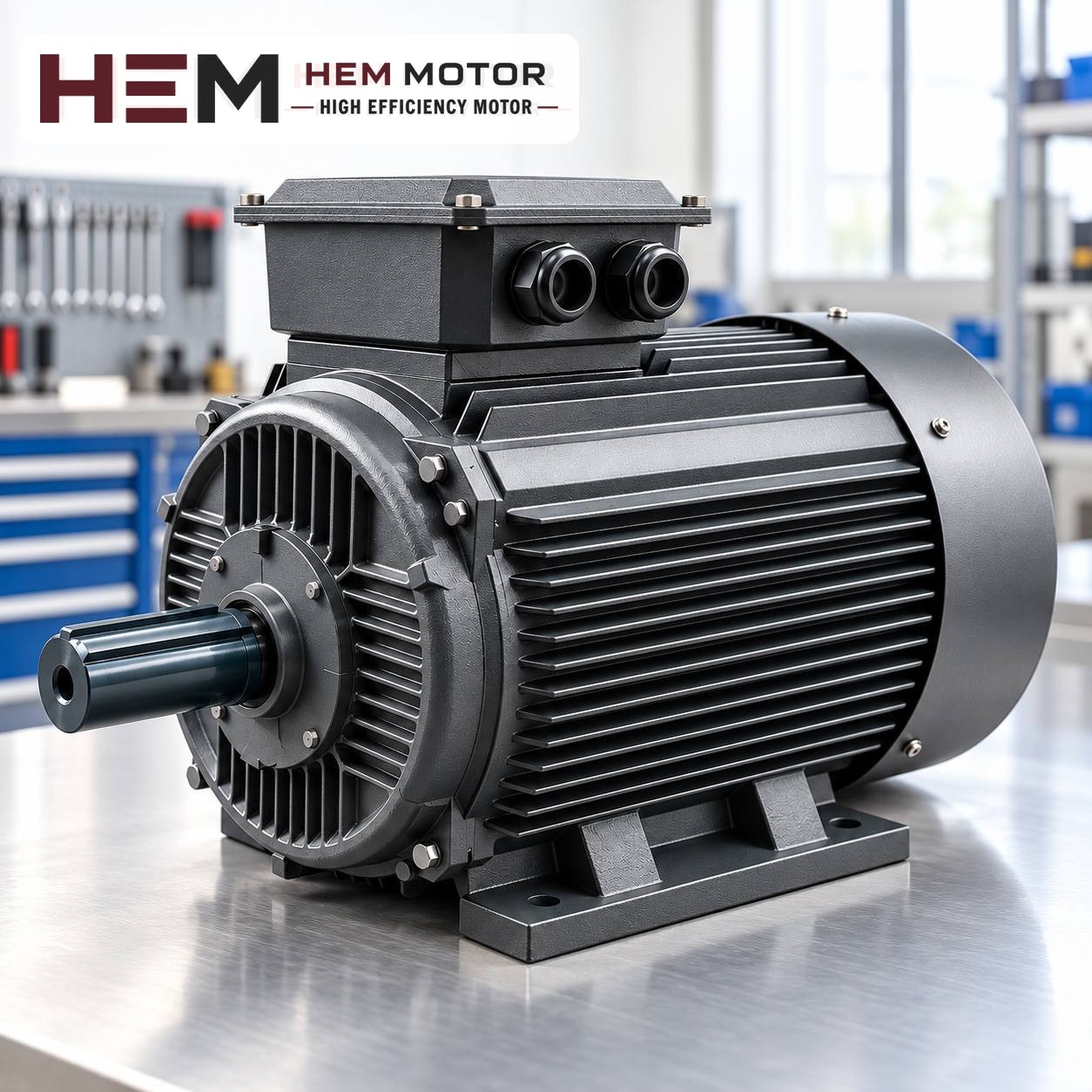
On a wood band saw, the blade that does the cutting runs over two large wheels; the motor usually turns the lower wheel through a belt and pulley. Thanks to this arrangement, a band saw motor is less a machine-specific part and more a drive motor that carries a pulley. Still, when replacing the motor, looking only at the power rating is not enough: motor speed, pulley ratio, belt load and starting conditions together determine the blade speed and the cut quality. In this article we explain how to match the motor and the pulley on a band saw.
The drive train on a band saw
On a band saw, power reaches the blade in four steps: the motor shaft, the motor pulley, the belt and the pulley of the lower wheel. As the lower wheel turns, the blade returns over the upper wheel. Each link in this chain affects the next:
- Motor speed: Determined by the number of poles; a 4-pole motor turns at around 1,450–1,465 rpm under load.
- Pulley ratio: The ratio of the motor pulley diameter to the wheel pulley diameter gives the wheel speed.
- Wheel diameter: The linear speed of the blade is the wheel circumference multiplied by the wheel speed.
- Belt: It must transmit power without slipping, but without putting more side force than necessary on the motor bearings.
When you change one part of this chain, for example by replacing the motor with a model with a different number of poles, the blade speed also changes. That is why the first rule in a replacement is to stay with the same number of poles whenever possible.
Pulley ratio and blade speed calculation
Blade speed is usually expressed in metres per second and is kept within the range recommended by the machine builder according to wood species, blade tooth and cutting thickness. The calculation is simple:
- Wheel speed = motor speed × (motor pulley diameter ÷ wheel pulley diameter)
- Blade speed (m/s) = 3.14 × wheel diameter (m) × wheel speed ÷ 60
Here is a hypothetical example: if a motor running at 1,460 rpm has a 100 mm pulley and the wheel pulley is 200 mm, the wheel turns at 730 rpm. Let the wheel diameter be 0.6 m; the blade speed is then about 3.14 × 0.6 × 730 ÷ 60 ≈ 22.9 m/s. If a 2-pole motor running at 2,930 rpm is fitted to the same machine, the blade speed doubles as long as the pulleys stay the same. This is an unacceptable change for both the blade and the wheel bearings.
If the number of motor poles must change, a new pulley ratio is calculated to keep the old blade speed. However, a higher-speed motor gives lower torque at the same power; when the speed is reduced by the pulleys, the torque rises again, but the starting behaviour and the belt load change. So treat a change of poles as a last resort.
Pulley on the motor shaft: points to watch
The shaft of a band saw motor is a standard IEC shaft, and a keyed pulley is fitted on it. This is the difference from machines such as marble cutters or circular saws, where the blade sits directly on the shaft. Even so, the following details should be checked during a replacement:
- Pulley hub: If you will reuse the old pulley on the new motor, the hub bore and keyway must match the size of the new shaft. If the frame size is the same, the shaft size is also expected to be the same; if it differs, the pulley hub is re-machined or a new pulley is bought.
- Pulley position: Fitting the pulley close to the frame rather than at the very end of the shaft reduces the bending force on the bearing.
- Belt tension: An over-tight belt quickly wears the motor's front bearing; a loose belt slips and heats up during the cut.
- Alignment: The motor pulley and the wheel pulley must be in the same plane; misalignment wears the belt and creates vibration.
We do not give dimensions such as shaft diameter and length here; the values per frame are in the 2D technical drawings and the 2026 technical catalogue. On pulley-driven machines the motor is usually attached to a slide in the foot-mounted B3 arrangement; the slide also serves to adjust the belt tension. Mounting arrangements are provided according to frame size and, if there is a flange-mounted layout, the flange size is verified with the order.