On a circular saw, the toothed blade cuts the material at dozens of revolutions per second; on most machines the blade is attached to the motor shaft or to a shaft very close to the motor. This proximity makes a motor replacement more delicate than on a pulley-driven machine. The right motor is not just one with the same power; it is one that turns at the same speed, whose shaft and connection fit the blade, and that behaves as the machine expects when starting and stopping. In this article we look at replacing the motor on a circular saw through speed and shaft connection.
Three connection types on circular saws
On woodworking, profile cutting and panel sizing machines, the connection between the blade and the motor is usually one of these three forms:
Blade directly on the motor shaft: The motor shaft is extended; the flange washers and nut that clamp the blade sit on the shaft end. The shaft end is often threaded, stepped or of a special diameter, and the front bearing is selected for the blade forces.
Belt-driven blade spindle: The blade turns on a separate spindle in its own bearings, and the motor drives this spindle by belt. The motor shaft carries only a pulley.
Flange-mounted motor and coupling: The motor is attached to the machine body by its flange and drives the blade spindle through a coupling.
This distinction is the first question that decides whether a standard motor can be used.
Special shaft or standard IEC shaft?
Circular saw motors with the blade fitted directly on the shaft are made specifically for the machine: a long or specially shaped shaft, a bearing arrangement that carries the axial and radial load of the blade, and sometimes a long flange shaped to the machine body. Fitting a standard motor in place of such a motor removes the shaft that is supposed to carry the blade. A standard three-phase motor can be fitted directly only if all of the following conditions are met:
The shaft diameter, length and key have the standard IEC dimensions for the frame size.
The flange has standard B5 or B14 dimensions, or the motor sits on a foot-mounted (B3) base.
The shaft end carries a pulley or a coupling, not the blade.
If one of the conditions is not met, a special motor is needed. In that case, ask us by sending the nameplate photo of the existing motor and clear photos of the shaft end and the flange. Attaching the blade to a standard shaft with an adapter or re-turning the shaft end can cause blade run-out and bearing damage; because the peripheral speed of the blade is high, this is an occupational safety risk.
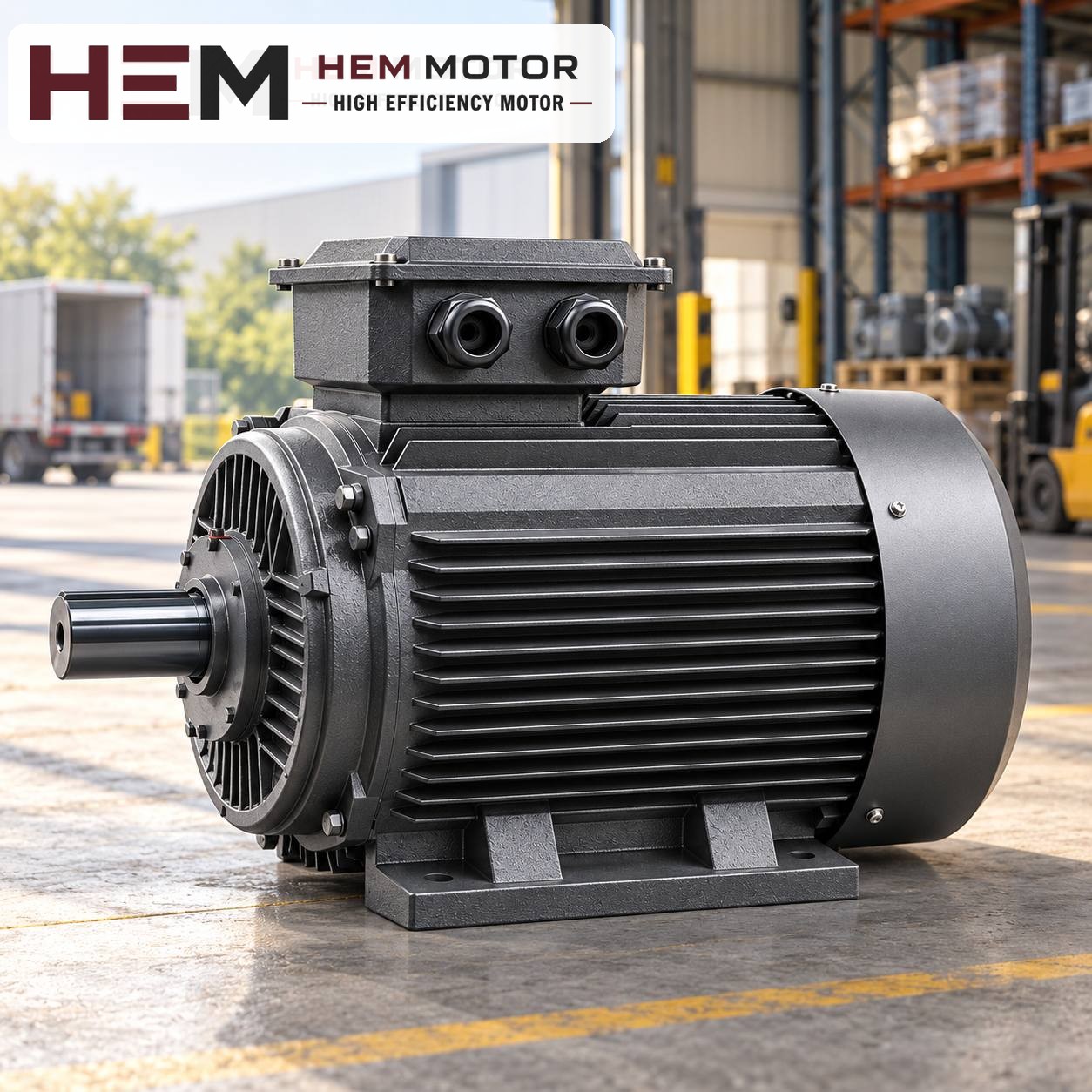
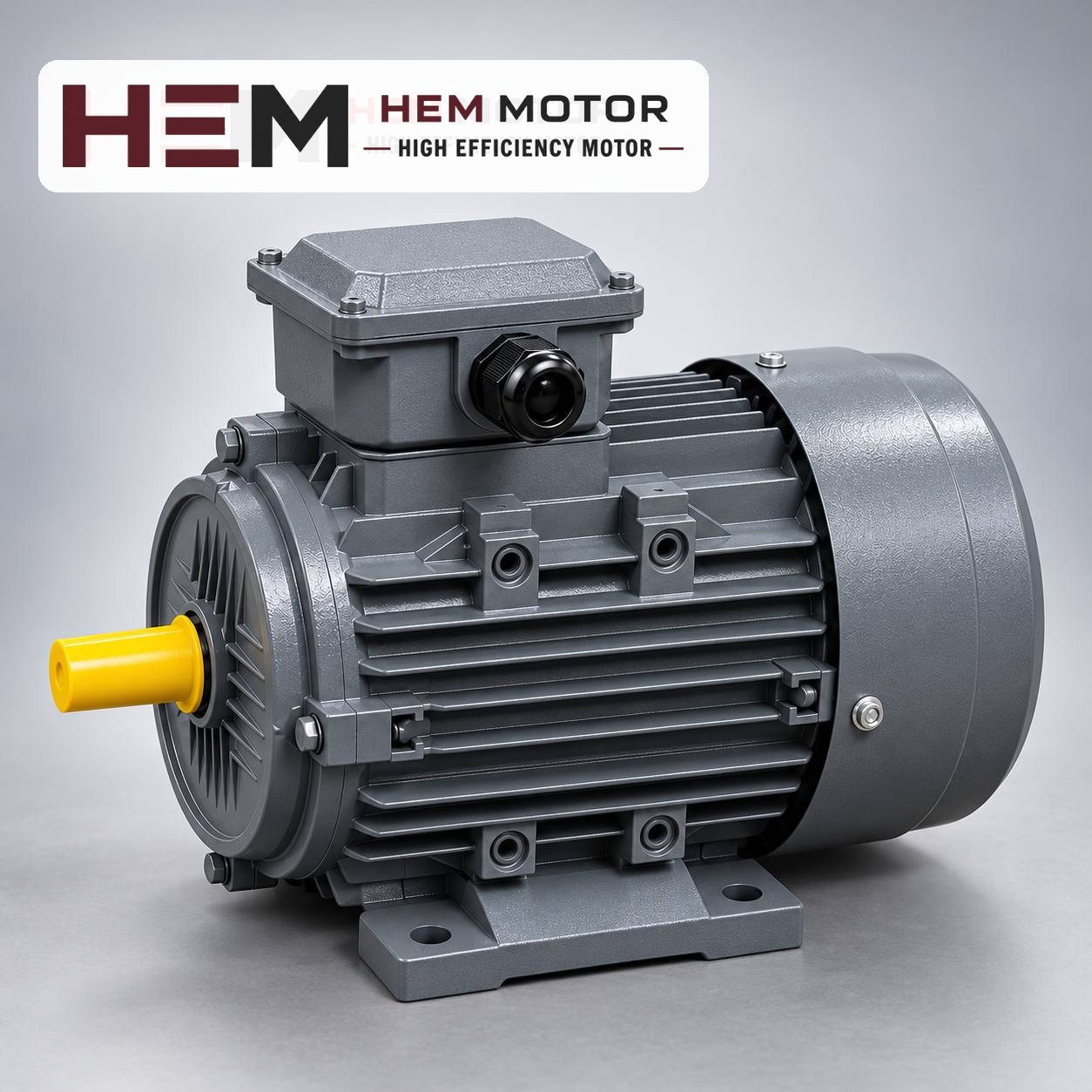
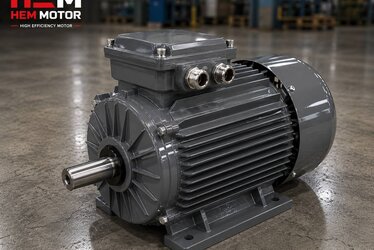
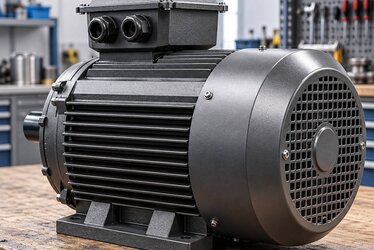
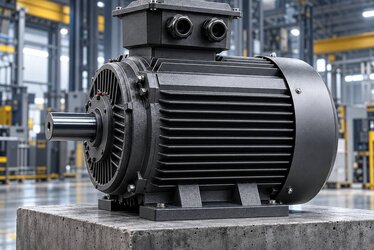
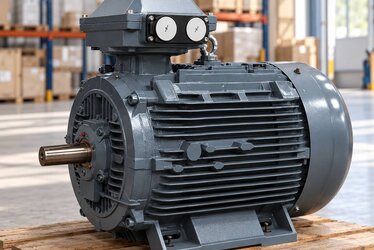
On a standard IEC shaft, a pulley or coupling is attached to the shaft end (representative image).
Speed: do not change the blade's peripheral speed
On a circular saw, cut quality depends largely on the peripheral speed of the blade. Peripheral speed is proportional to the product of blade diameter and speed. If the blade is directly on the motor shaft, the blade speed is the motor's rated speed. A 2-pole motor turns at around 2,900 rpm under load, a 4-pole motor at around 1,450 rpm. Switching between these two motors doubles or halves the blade speed.
The blade and its teeth are made for a certain maximum speed; the maximum speed marked on the blade must not be lower than the motor speed.
On belt-driven machines, the pulley ratio changes the speed; keeping the old number of poles is safer than changing the motor's poles.
On machines where speed is set by a drive, remember that our three-phase series are suitable for speed adjustment with a frequency inverter, that an external fan may be needed for long periods at low speed with full torque, and that a dv/dt or sine filter is considered if the cable between drive and motor is long. These conditions are stated with the order; details in the inverter question.
The rated speed read on the nameplate is slightly lower than the synchronous speed. For example, the 4 kW model in the 3,000 rpm class shows 2,905 rpm on its nameplate, and the 3 kW model in the 1,500 rpm class shows 1,450 rpm. In a replacement, compare the nameplate value with that of the old motor.
Prices and technical data are on the product pages; choose a model and order online.
On a circular saw, the blade teeth cut in a given direction; if the motor runs in reverse, the blade does not cut the material, it grabs it or may throw it back. After the new motor is connected, a short test is run without the blade and the direction of rotation is compared with the arrow on the machine. If the direction is wrong, two supply phases are swapped.
At start-up, the inertia of the blade and spindle loads the motor. Small motors with a 230/400 V (Δ/Y) nameplate are connected in star on a 400 V supply and usually start direct-on-line. Motors with a 400/690 V (Δ/Y) nameplate run in delta on a 400 V supply and are suitable for star-delta starting. State the method in the order according to your panel.
Stopping the blade quickly is important. If there is a brake unit at the rear of the motor, it is a brake motor and is not treated as the same as a standard motor; it must be enquired about as a special motor with the nameplate details. If stopping is done by an electronic brake in the panel, a standard motor can be considered.
Power selection and example models
An exact power cannot be stated without knowing the blade diameter, the thickness and hardness of the material being cut, the feed rate and the daily operating time. The most reliable starting point is the nameplate of the motor that has worked without problems on the same machine. The following models are examples of power and speed classes often found on belt-driven or coupled circular saws:
All these models have a standard IEC shaft; they do not have the long shaft on which a blade is mounted directly. In workshops with heavy sawdust, a cast iron frame offers a sturdier construction; all models come with IP55 protection and class F insulation. General information for woodworking machines can be found on the woodworking machine motors page. The current price is on each model's own product page.
Example: replacement on a belt-driven panel saw
This example is hypothetical and does not describe a real customer application. On a panel sizing saw where the blade spindle turns in separate bearings and the motor drives it by belt, the old motor's nameplate reads 5.5 kW, 2,930 rpm and a 132S frame.
The shaft end carries only a pulley; the motor bearings do not carry the blade. A standard motor can be considered.
The values match the cast iron 132S1-2 model; since the number of poles stays the same, the blade speed does not change.
The pulley hub is compared with the diameter and key of the new shaft; if it fits, the old pulley is reused.
The motor sits on a foot-mounted slide; the hole spacing is compared with the 2D technical drawings.
The direction of rotation is tested without the blade, then the thermal protection is set to the new rated current.
If on the same machine the blade were mounted directly on the motor shaft, this flow would not apply; because a special shaft is needed, a special motor would be enquired about with the nameplate and photos.
What to send before ordering
A photo of the existing motor's nameplate: power, speed, voltage, current and frame size must be readable
Photos of the shaft end and the flange; is the blade directly on the shaft, belt-driven or coupled
Blade diameter and the maximum speed marked on the blade
Mounting arrangement, mains voltage, starting method and whether the motor has a brake
See three-phase models that may suit circular saws and their current prices on the buy electric motors page. If the shaft or flange is special, send us the nameplate and photos; let us clarify the right solution together. For other matters, use our contact page.
HEM Motor Models Related to This Article
The cards show example models related to the topic. A suitable motor is not chosen by power alone: compare speed, voltage, mounting, shaft and connection dimensions on the product page; if unsure, send a photo of the existing motor’s nameplate on WhatsApp.
There is no single "seed cleaner motor" in a seed cleaning and grading machine; the machine consists of several motors, each carrying a different load: the drive that shakes the si... More Details
If a compressor motor cannot start against tank pressure, the cause is usually not the motor's power. The most common causes are a faulty unloader or check valve, low supply voltag... More Details
On a dough kneading machine, the spiral or fork arm folds the dough with a slow but powerful movement; on most models the bowl also turns about its own axis. This need for low spee... More Details
On a wood band saw, the blade that does the cutting runs over two large wheels; the motor usually turns the lower wheel through a belt and pulley. Thanks to this arrangement, a ban... More Details
On a bridge-type marble cutting machine, the main motor is the part that turns the diamond blade and carries the heaviest load throughout the cut. When this motor has to be replace... More Details
Baling presses compress cardboard, paper, plastic film, PET bottles and scrap metal into transportable bales. The part that produces the press force is the hydraulic cylinder; what... More Details
We use necessary and optional cookies to improve your experience, enhance content and analyse traffic. Under the GDPR, optional (analytics/marketing) cookies are only used with your explicit consent. Please choose your preference below.
Cookie Policy
 English
 Français
 Türkçe
 Español
 Русский