In fan drives, a direct-coupled motor is the right choice if the speed the fan needs matches a standard motor speed (about 3,000, 1,500 or 1,000 rpm), if the air moved is clean enough to pass by the motor and if ease of maintenance is the priority. A belt and pulley system comes to the fore if the fan speed falls between the standard speeds, if the motor must be kept out of a hot or dusty gas flow and if the speed is to be adjusted on site. This article compares the two arrangements from the fan application's point of view and shows which questions lead to the decision.
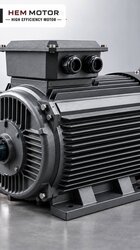
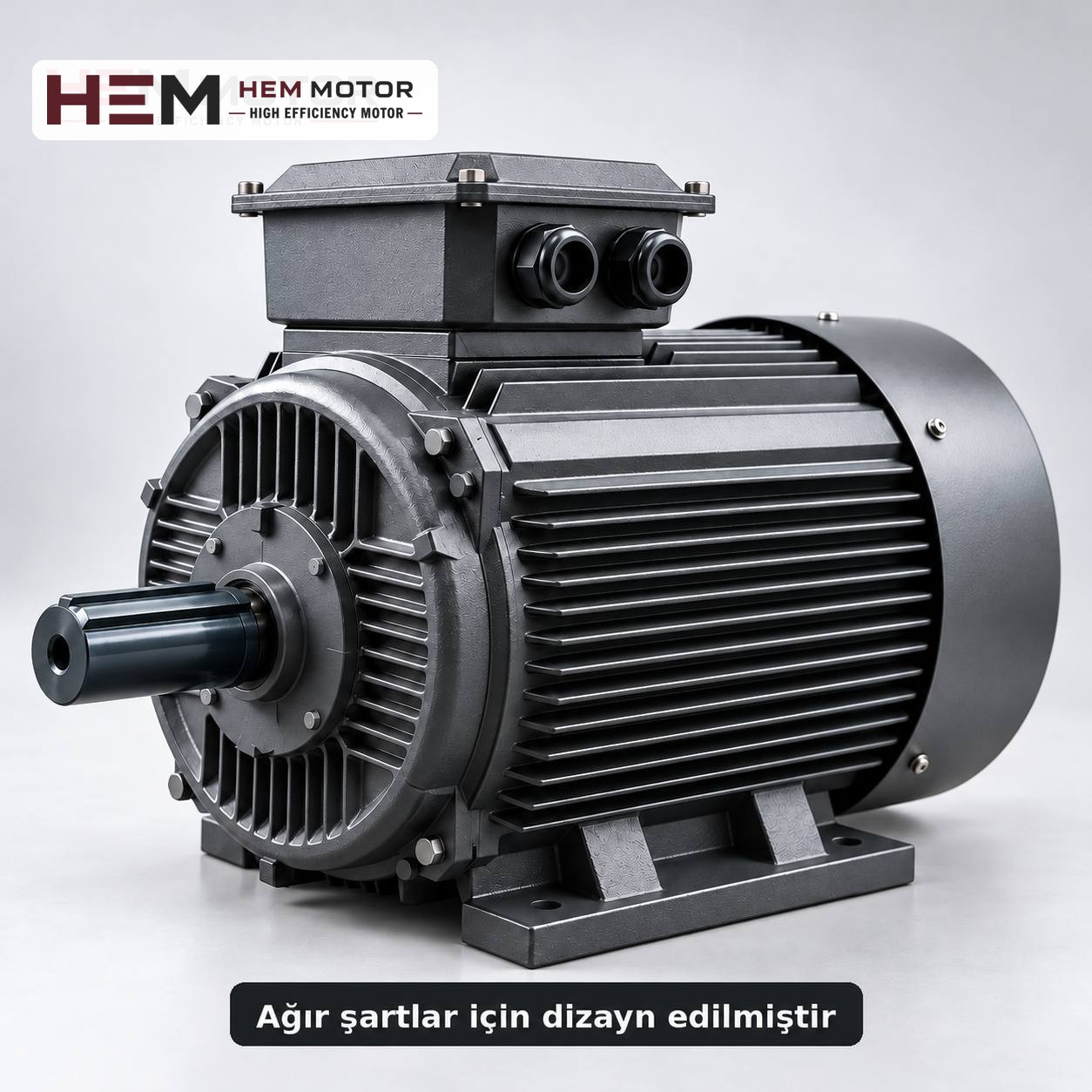
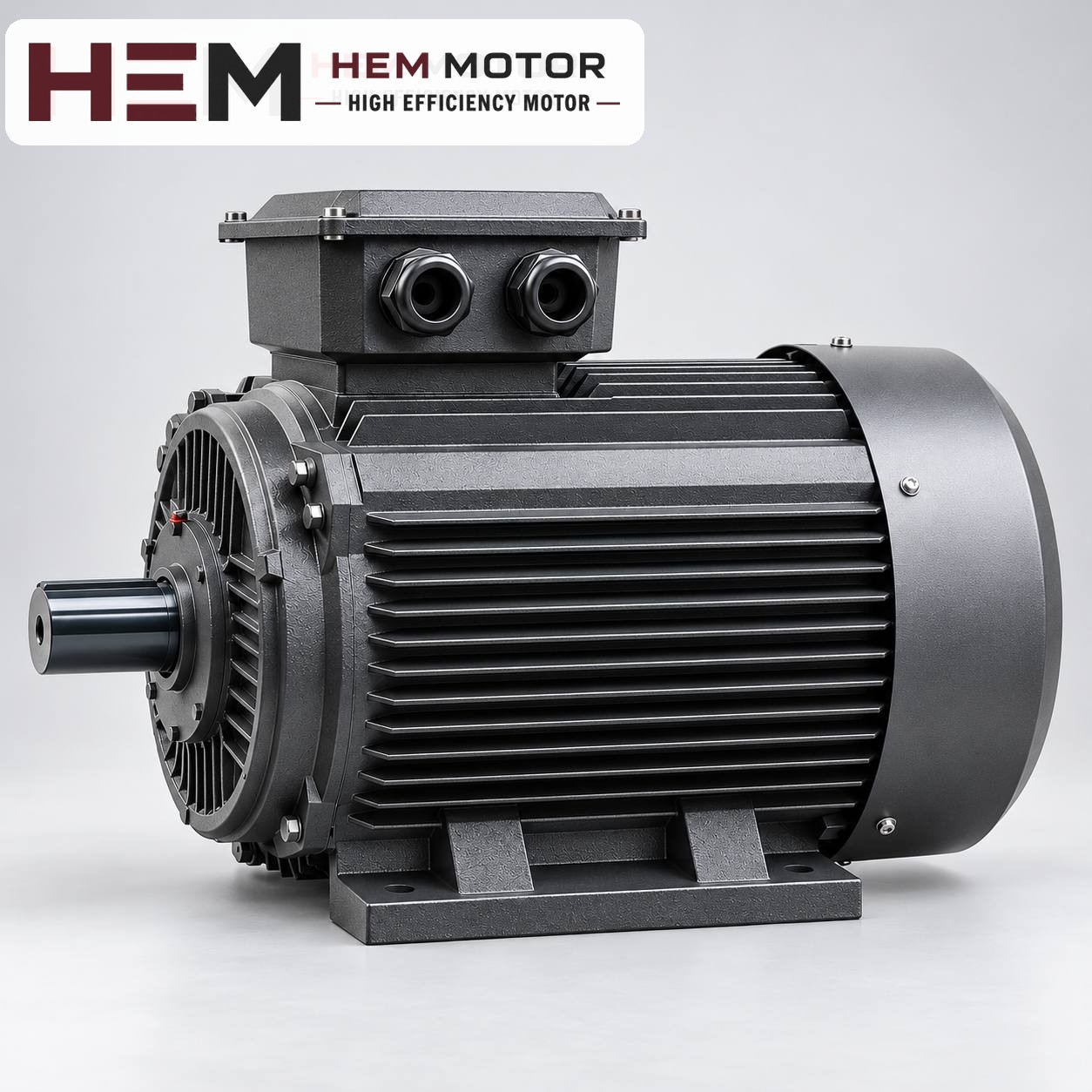
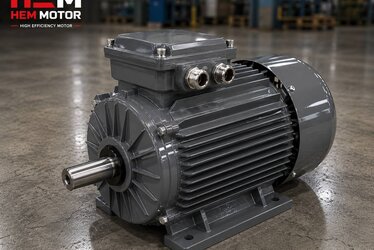
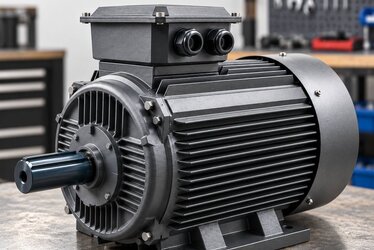
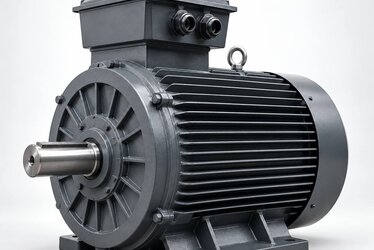
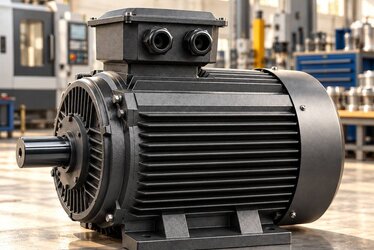
The fan drive arrangement also determines how the motor shaft end is loaded (representative image).
The two arrangements in brief: shaft, hub and pulley
In a direct-coupled drive the impeller or propeller is mounted directly on the end of the motor shaft or connected by a short coupling. The fan speed equals the motor's rated speed. The motor either sits on the fan casing by its flange or is fixed by its feet on a common base frame.
In a belt and pulley drive the impeller is mounted on a shaft carried by its own bearing unit; the motor turns this shaft via belt and pulleys. The fan speed is the motor speed multiplied by the ratio of the pulley diameters. The motor usually sits on tensioning rails or a hinged base.
This structural difference is the source of almost every row in the comparison below.
Comparison table
Criterion
Direct-coupled
Belt and pulley
Fan speed
Limited to the motor's rated speed (e.g. 2,930, 1,460, 970 rpm)
Set to the required speed by the pulley ratio
Transmission loss
Practically none
Belt loss and slip; increases as belt tension falls
Maintenance
No belt; alignment and bearing checks are enough
Periodic tensioning, belt and pulley groove replacement
Motor shaft load
The impeller's weight and thrust act on the shaft
Belt tension applies a constant radial force to the shaft end
Motor position
Close to the impeller; often in or at the edge of the airflow
Can be placed outside the gas flow, at a cool and clean point
Speed adjustment on site
Only with a frequency inverter
By changing pulleys, or with a drive
Starting
Impeller inertia is reflected directly to the motor
Inertia is referred to the motor by the square of the pulley ratio; the belt may slip at start
Space required
Compact, single axis
Wider; a belt guard is needed
The speed question: does the speed the fan needs match a standard speed?
This is the first and most decisive question. A fan impeller is designed to deliver the required flow and pressure at a speed chosen by the manufacturer. If that speed is close to the rated speed of a 2-, 4- or 6-pole motor, a direct-coupled arrangement is possible. If not, there are two routes: set the speed with belt and pulleys, or run a direct-coupled motor at the required speed with a frequency inverter.
On the inverter route, going above 50 Hz is dangerous with a fan load: because shaft power rises roughly with the cube of speed, a speed increase of a few percent quickly overloads the motor. Below 50 Hz the situation is easier, as the torque demand of the fan load also falls. Our three-phase series are suitable for speed control with a frequency inverter; during long periods of full-torque operation at low speed an external fan may be required, and if the cable between drive and motor is long a dv/dt or sine filter is considered; these conditions are stated with the order.
A point not to forget: the speed on the nameplate is the rated speed, not the synchronous speed. The actual speed of a "1,500 rpm" motor is around 1,450–1,465 rpm depending on load. On a direct-coupled fan this difference is passed straight to the impeller speed.
The environment question: will the motor stay in the gas flow?
On direct-coupled axial fans the motor is often behind the propeller, right in the airflow. With fans moving clean, cool air this is an advantage; the passing air also cools the motor. But if the air is hot, dusty, oily or humid, the motor is directly exposed to these conditions.
A belt-driven arrangement is the simplest way to separate the motor from the gas flow. This is why belt-driven or long-shaft bearing arrangements are common on oven circulation fans, flue gas fans and extraction fans carrying heavy dust. The three-phase models sold by HEM Motor are IP55 protected and have class F insulation; a standard motor is not designed to run inside a hot gas flow. Such a duty requires a special motor and may fall outside the scope of the standard series in HEM Motor's 2026 catalogue.
Prices and technical data are on the product pages; choose a model and order online.
Mechanical load: what do the motor bearings carry?
The two arrangements load the motor shaft differently. In a belt drive, belt tension applies a constant radial force to the shaft end. A small motor pulley diameter and high power increase this force. Fitting the pulley close to the shaft shoulder and tensioning the belt to the value recommended by the manufacturer protect the life of the front bearing.
In a direct-coupled arrangement the radial force largely disappears; instead, the impeller's weight and, on axial fans, the propeller's thrust act on the shaft. Heavy, large-diameter impellers are connected to a separate bearing unit via a coupling rather than carried on the shaft end. Impeller balance matters in both arrangements, but in direct coupling the imbalance passes as vibration directly to the motor bearings.
Shaft diameter, shaft length and flange dimensions by frame are given in the 2D technical drawings. Mounting arrangements (B3, B5, B14, B34, B35 and vertical V1/V3/V5/V6/V15) are offered according to the frame; the flange size is confirmed with the order.
Decision list and example models
When the following questions are answered in order, the choice often becomes obvious:
Is the fan's design speed close to a standard rated speed? If yes, direct coupling is a candidate.
Is the air hot, dusty or humid? If yes, the belt-driven arrangement that separates the motor from the flow comes to the fore.
Will the speed be adjusted on site? Is a pulley change or a drive preferred?
Is the impeller heavy? Can it be carried on the shaft end, or is a separate bearing unit needed?
Can the maintenance team regularly tension and replace belts?
As an example, three different speed options in the 5.5–7.5 kW range:
132S1-2 aluminium: 5.5 kW (7.5 HP), 2 poles, 2,930 rpm, IEC 132S, 400/690 V (Δ/Y), 10.1 A. For high-speed, clean-air direct-coupled centrifugal fans.
132S-4 aluminium: 5.5 kW (7.5 HP), 4 poles, 1,460 rpm, IEC 132S, 400/690 V (Δ/Y), 10.7 A, 36 Nm. The most common speed on both direct-coupled and belt-driven fans.
160M-6 cast iron: 7.5 kW (10 HP), 6 poles, 970 rpm, IEC 160M, 400/690 V (Δ/Y), 73.8 Nm. For low-speed fans with large impellers; to obtain low speed without a belt.
Review suitable HEM Motor models and current prices on the buy electric motors page. Further information specific to fan applications is on the fan and extractor motors page.
Hypothetical example: a centrifugal fan that needs about 1,150 rpm
This example has been constructed for explanation. Suppose the impeller of a process fan delivers the required flow at about 1,150 rpm according to the manufacturer's data sheet. This speed is close neither to 1,460 nor to 970 rpm.
Belt-driven solution: a 4-pole motor and a pair of pulleys with a ratio of about 1.27; the speed can later be fine-tuned by changing pulleys.
Direct-coupled solution: a 4-pole motor and a frequency inverter; the fan runs below 50 Hz at the required speed. Belt maintenance disappears, but the cost of the drive and cable conditions are assessed.
If the air is hot or dusty, the belt-driven solution keeps the motor away from the flow; if it is clean, both solutions can be applied.
Conclusion: information to send with the order
The choice between direct coupling and belt drive is made together with the fan speed, the condition of the air and the maintenance conditions. Send us the following:
The fan's design speed, shaft power and impeller type
The preferred drive arrangement and, if belt-driven, the pulley diameters
Temperature, dust and humidity of the air moved
Mounting arrangement and, if available, a photo of the existing motor's nameplate
Voltage, starting method and whether a drive will be used
You can see the models and current prices on our shop page. Send a photo of your current motor's nameplate, its speed and mounting details via the nameplate submission page and request a quote for a suitable model; you can send other questions through our contact page.
Frequently Asked Questions
Is a direct-coupled fan always more efficient?
On the transmission side usually yes, since there is no belt loss. But if the fan has to run at a speed different from the one required, this advantage can be lost.
Can I choose a smaller motor for a belt-driven fan?
No. Belt loss and slip are also covered by the motor; motor power is selected by considering the fan's shaft power together with transmission losses.
How do I adjust the speed of a direct-coupled fan without pulleys?
With a frequency inverter. Because going above 50 Hz quickly overloads the motor on a fan load, adjustment is usually made below 50 Hz.
Which arrangement is preferred for a fan moving hot air?
A belt-driven or long-shaft arrangement with separate bearings that keeps the motor away from the hot flow is preferred; a standard motor is not operated inside hot gas.
HEM Motor Models Related to This Article
The cards show example models related to the topic. A suitable motor is not chosen by power alone: compare speed, voltage, mounting, shaft and connection dimensions on the product page; if unsure, send a photo of the existing motor’s nameplate on WhatsApp.
When replacing the drying fan motor of a glass washing machine, three things must stay the same as on the old motor: the number of poles (and therefore the fan speed), the motor's ... More Details
On a cold storage condenser, a standard three-phase motor can be used if the fan propeller is fitted to the shaft of a separate IEC-frame motor or driven by a belt. In external-rot... More Details
The motor for the circulation pump of a fabric dyeing machine is chosen not by looking at the machine's capacity but according to the pump's own data: flow, head, pump speed and th... More Details
When a stenter fan motor is replaced, two conditions are decisive: the temperature where the motor sits must be at a level a standard IP55, class F motor can work in, and the new m... More Details
A standard three-phase motor is the right choice for the hot air fan of a shrink packaging machine only if the motor frame stays outside the hot zone of the tunnel. The fan impelle... More Details
What strains the pump motor on a bottle washing machine is often not the electrical load but the motor's surroundings: steam rising from hot caustic solution, label pulp stripped o... More Details
We use necessary and optional cookies to improve your experience, enhance content and analyse traffic. Under the GDPR, optional (analytics/marketing) cookies are only used with your explicit consent. Please choose your preference below.
Cookie Policy
 English
 Français
 Türkçe
 Español
 Русский